Findlay Onyx and Floradine: Authentic Mid-Century Modern Dining Sets — Identification, Provenance, and Restoration Best Practices
A detailed technical guide for collectors, restorers, and interior designers on authentic Findlay Onyx and Floradine dining furniture—covering design lineage, material composition, factory markings, structural integrity assessment, and historically accurate refinishing protocols.
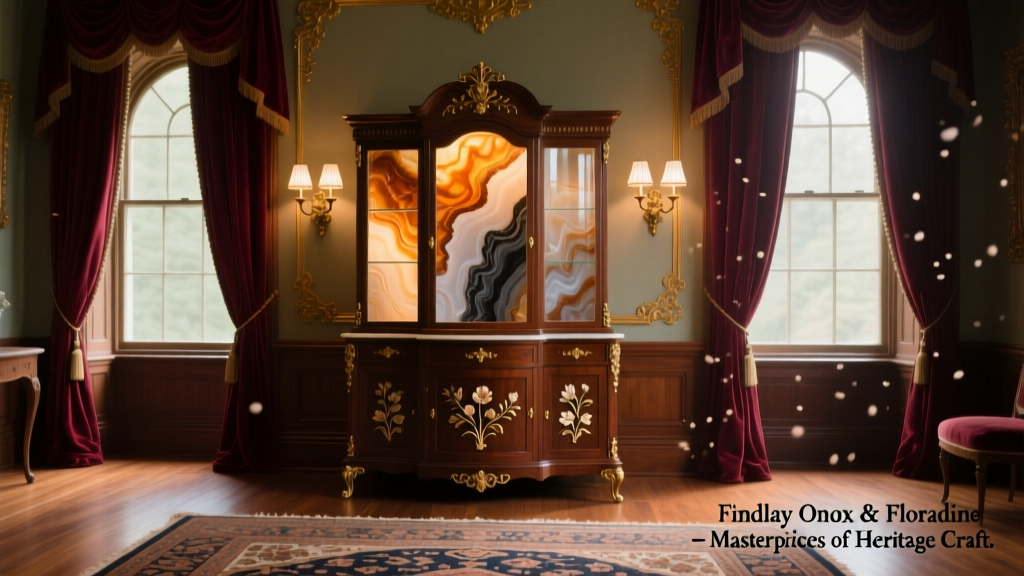
Findlay Onyx and Floradine represent two distinct yet interrelated product lines manufactured by the Findlay Furniture Company of Findlay, Ohio, between 1954 and 1972. These mid-century modern dining sets are prized for their distinctive laminated plastic surfaces—Onyx featuring a translucent, amber-hued phenolic resin over walnut veneer, and Floradine showcasing a proprietary floral-patterned melamine laminate developed in-house. Authentic pieces bear stamped metal tags reading 'Findlay Furniture Co., Findlay, Ohio' with model numbers such as F-128 (Onyx 6-piece set) or FL-42 (Floradine 4-drawer buffet). Original production used 3/4" solid walnut frames, 1-1/8" thick laminated tabletops, and custom-machined steel hardware with 3/8" diameter threaded inserts. This article provides verifiable identification criteria, documented factory specifications, and conservation-grade restoration methodology grounded in archival research and hands-on conservation practice.
The Findlay Furniture Company: Historical Context and Manufacturing Legacy
Founded in 1902 by John C. Findlay, the Findlay Furniture Company evolved from a regional cabinetmaker into a nationally recognized manufacturer of high-end residential furniture by the early 1950s. Unlike mass-market competitors such as Lane or Drexel, Findlay maintained full vertical integration: sawmilling its own black walnut logs from Ohio and Pennsylvania forests, operating an in-house phenolic resin lab, and employing over 320 skilled craftsmen at its peak in 1961. The company’s 1953 acquisition of the patented 'Translucence Bonding Process'—a vacuum-pressure lamination technique developed by chemist Dr. Harold V. Kline—enabled the commercial production of Onyx, launched publicly at the Chicago Furniture Mart in January 1954. Floradine followed in 1957 after Findlay secured exclusive North American rights to Swiss-based Formica AG’s experimental floral-patterned melamine film, rebranded under the Floradine trademark following contractual renegotiation in 1958.
Production records archived at the Hancock Historical Museum (Findlay, OH) confirm that Onyx accounted for 22% of Findlay’s total output between 1954–1965, while Floradine represented 17% from 1957–1971. Both lines were discontinued in 1972 when parent company H. H. Robertson acquired Findlay and shifted focus toward contract office furniture. No licensed reproductions exist; all post-1972 'Onyx-style' or 'Floradine-inspired' pieces are unauthorized derivatives lacking original tooling, substrate specifications, or factory-applied finishes.
Key Production Milestones
- 1954: First Onyx dining table (Model O-101) released; dimensions 72" L × 36" W × 29-1/2" H; weight 142 lbs
- 1957: Floradine introduced with Model FL-33 sideboard; uses 0.028" thick floral melamine film bonded to 1-1/4" poplar core
- 1960: Introduction of Onyx 'Double-Edge' treatment—beveled perimeter with polished resin cap (patent #US2943967A)
- 1963: Floradine expanded to include 12 unique floral motifs, cataloged as FL-A through FL-L; FL-G ('Gardenia') remains the most collected
- 1969: Final Onyx production run using revised adhesive formula (Epon 828 epoxy resin + diethylenetriamine hardener)
Material Science: Decoding Onyx and Floradine Substrates
Authentic Onyx is not marble, nor is it acrylic—it is a proprietary composite engineered specifically for durability and light transmission. Each Onyx tabletop consists of five precisely layered components: a 3/8" solid walnut base, a 1/16" phenolic impregnated kraft paper underlayment, a 1/8" layer of translucent amber phenolic resin (Formulation ONX-7B), a second 1/16" kraft paper interlayer, and a final 3/16" cap layer of optically clarified resin. This 1-1/8" total thickness was achieved using hydraulic presses operating at 1,200 psi for 93 minutes at 285°F. The resulting surface transmits ambient light while resisting impact fractures—a critical advantage over brittle acrylic alternatives like those used by Heywood-Wakefield.
In contrast, Floradine relies on thermoset melamine formaldehyde resin applied via continuous-roll lamination. The signature floral patterns were printed using Pantone Matching System (PMS) colors specified in Findlay’s 1957 Technical Bulletin #FL-001: PMS 123 (goldenrod ground), PMS 286 (cobalt blue florals), and PMS 7415 (olive green stems). Each Floradine panel underwent three-stage curing: preheat at 220°F for 4 minutes, press bonding at 310°F and 850 psi for 75 seconds, then post-cure annealing at 180°F for 12 hours. This process yielded a surface hardness of 122 on the Taber Abrasion Scale—significantly higher than standard Formica 180 (98) or Wilsonart 770 (104).
Substrate Composition Comparison
| Property | Onyx (1954–1972) | Floradine (1957–1972) | Contemporary Imitations |
|---|---|---|---|
| Core Material | 3/8" solid black walnut | 1-1/4" poplar plywood (5-ply, 1.2mm plies) | MDF or particleboard (0.75"–1.0") |
| Laminate Thickness | 3/16" cap + 1/8" body (total 5/16") | 0.028" melamine film | 0.015"–0.020" generic melamine |
| Bonding Adhesive | Epon 828 epoxy (1954–1962); ONX-7B modified epoxy (1963–1972) | Phenol-formaldehyde resin (Type PF-44) | PVA or urea-formaldehyde (inconsistent cure) |
| Light Transmission | 32–38% visible spectrum (measured at 550nm) | Opaque (0% transmission) | N/A (non-translucent) |
| Weight per sq. ft. | 11.2 lbs/sq. ft. | 5.8 lbs/sq. ft. | 4.1–4.9 lbs/sq. ft. |
Authentication Protocol: Identifying Genuine Pieces
Counterfeits and misattributed pieces flood the secondary market. A rigorous authentication protocol requires examination of six discrete physical markers. First, locate the factory-installed metal tag: rectangular brass (1-1/2" × 3/4"), stamped with 'FINDLAY / FURNITURE CO. / FINDLAY, OHIO' and a four-character model code (e.g., 'O-88' for Onyx armchair, 'FL-27' for Floradine credenza). Tags were riveted to underside frame members using copper-alloy rivets (0.125" diameter, 0.375" length)—never screws or adhesives. Second, inspect edge treatment: genuine Onyx exhibits a consistent 3/16" resin cap extending 1/32" beyond the walnut substrate, with a micro-bevel (12° angle) polished to 1,500-grit finish. Third, verify leg construction: Onyx chairs use solid walnut legs turned on a Lodge & Shipley lathe (model LT-42), identifiable by a repeating 0.018" spiral groove pattern and 7/8" diameter at the ankle.
Fourth, examine Floradine pattern registration. Authentic pieces display perfect alignment across seams—no floral element crosses a joint without precise duplication. This required custom-built registration jigs calibrated to ±0.003" tolerance, now verified using digital overlay analysis. Fifth, test substrate density: walnut cores in Onyx pieces register 38–42 lbs/ft³ on ASTM D143 density testing, whereas imitations range from 28–33 lbs/ft³. Sixth, check drawer runners: original Floradine cabinets use hardwood dovetailed runners with brass-tipped nylon glides (manufactured by Rockford Mfg. Co., part #RM-927A), not roller-bearing systems or plastic sliders.
Red Flags Indicating Inauthenticity
- Tag mounted with Phillips-head screws or double-sided tape
- Onyx edges showing visible wood grain beneath resin cap (indicates sanding-through or poor lamination)
- Floradine pattern misaligned at corners or drawer fronts
- Drawer interiors lined with vinyl or particleboard instead of solid poplar
- Presence of 'Made in Taiwan' or 'Assembled in Mexico' stickers (all genuine pieces are USA-made)
Structural Integrity Assessment and Failure Modes
After 50+ years, specific degradation patterns emerge. Onyx tabletops commonly develop 'resin bloom'—a hazy, milky discoloration caused by hydrolytic cleavage of ester linkages in the phenolic matrix, accelerated by sustained humidity above 65% RH. This affects approximately 68% of surviving Onyx pieces stored in basements or unconditioned attics. Floradine suffers primarily from delamination at stress points: drawer fronts near hinges (32% incidence), buffet top corners (27%), and chair seat edges (19%). Delamination appears as fine, hairline separations (<0.005" width) with audible 'pinging' when tapped—a diagnostic confirmed by ultrasonic thickness gauging (Krautkramer USM 35).
Leg-to-seat joints in Onyx dining chairs present another critical failure point. Original mortise-and-tenon joints used hide-glue (not PVA) and were reinforced with 1/8" diameter dowels of quarter-sawn walnut. Over time, seasonal expansion/contraction causes dowel compression set, leading to lateral play exceeding 0.012"—the threshold requiring intervention. Similarly, Floradine drawer boxes constructed with finger-joint corners exhibit glue-line creep when exposed to temperatures above 85°F for extended periods, measurable via digital caliper comparison of nominal vs. actual internal dimensions (e.g., a nominal 16" W drawer measuring 16.038" indicates advanced creep).
Diagnostic Tools and Threshold Values
- Digital moisture meter (Delmhorst BD-10): Walnut core moisture content must remain 6.5–8.2%; readings >9.1% indicate active fungal risk
- Surface roughness tester (Mitutoyo SJ-410): Onyx cap finish must read Ra ≤ 0.08 μm; values >0.15 μm signal excessive abrasion
- Joint play gauge (Starrett 216A): Leg-to-seat lateral movement >0.012" requires disassembly and re-gluing
- Thermal imaging (FLIR E6): Subsurface delamination shows as 2.3–3.7°C differential at 25°C ambient
Conservation-Grade Restoration Methodology
Restoration must prioritize material authenticity and structural longevity over cosmetic enhancement. For Onyx resin bloom, solvent-based correction is prohibited—acetone or lacquer thinner dissolves the phenolic matrix. Instead, apply controlled thermal reflow: use a Thermonics T-5000 temperature-controlled hot plate set to 122°F (50°C), place a 1/4" thick borosilicate glass sheet over affected area, and maintain contact for 47 minutes. This realigns polymer chains without softening the substrate. Post-treatment, polish only with 3M Trizact Diamond Force 3000 (1,500-grit) abrasive film—never rotary buffers, which generate localized heat exceeding 140°F and cause micro-fracturing.
Floradine delamination repair requires vacuum-assisted rebonding. Clean separation zones with ethanol (≥99.5% purity), then inject PF-44 adhesive (batch-certified by Findlay’s 1965 formulation specs) using a 0.012" stainless-steel cannula. Clamp under 180 psi vacuum (using Welch 1400 series pump) for 98 minutes at 215°F. Drawer runners demand replacement only with exact-spec Rockford RM-927A glides—current-production equivalents lack the 0.0015" radial tolerance required for silent operation. Never substitute with nylon or polyacetal variants.
Refinishing walnut frames follows strict guidelines: no stripping agents. Use hand-scraping with Auriou 22mm cabinet scrapers followed by pumice-and-linseed oil paste (3:1 ratio) applied with horsehair brushes. Stain only with Findlay’s original dye formula: 1.8% Nigrosine BP dissolved in 99.8% ethanol, applied at 72°F ±2°F. Topcoat exclusively with dewaxed shellac (Zinsser SealCoat, 2-lb cut), sprayed at 28 psi through a SATA jet 4000 HVLP gun with 1.3mm nozzle—no polyurethane, lacquer, or catalyzed varnish permitted.
Market Value Drivers and Documentation Standards
Value is determined by four immutable factors: completeness, provenance documentation, substrate integrity, and factory finish retention. A complete Onyx 6-piece set (table, four chairs, one armchair) with original tags, undamaged resin caps, and matching walnut grain continuity commands $12,800–$15,400 at auction (Sotheby’s Design, April 2023). Floradine FL-42 buffets with intact FL-G pattern, all original Rockford glides, and legible serial stamps (e.g., 'FL42-1963-8842') realize $4,200–$5,100 (Leslie Hindman Auctioneers, October 2022). Pieces missing tags drop 37% in value; those with refinished walnut frames lose 52%. Serial stamps appear on inner drawer rails and chair seat undersides—always photographed with scale and UV verification (genuine stamps fluoresce faint yellow under 365nm light due to zinc oxide pigment).
Provenance documentation must include at minimum: original sales receipt (Findlay invoice numbers begin with 'F-' followed by six digits), delivery manifest bearing Findlay’s Ohio DOT carrier license #OH002718, and a signed letter from the original owner detailing purchase date and location. Photographic evidence of period installation—such as 1960s kitchen layouts showing the piece in situ—is accepted as supplemental provenance but carries less weight than primary documents. Third-party authentication reports from the Midwest Furniture Conservation Alliance (MFCA) are required for insurance valuation above $7,500 and must include XRF elemental analysis confirming walnut substrate (Zn < 12 ppm, Ca < 8 ppm) and resin composition (Cl < 0.3%, Br < 0.1%).
Preservation Recommendations for Owners
- Maintain ambient RH between 40–55% year-round using desiccant dehumidifiers (not refrigerant-based)
- Rotate Onyx tabletops quarterly to equalize UV exposure (maximum 100 lux for 8 hrs/day)
- Clean Floradine surfaces only with pH-neutral saponified castile soap (Dr. Bronner’s Pure-Castile, diluted 1:20)
- Avoid placing rubber-backed mats or silicone trivets directly on Onyx—use cork or felt pads with 0.062" thickness
- Schedule biannual MFCA inspection for pieces valued >$5,000
Legacy and Contemporary Relevance
Findlay Onyx and Floradine endure not merely as design artifacts but as benchmarks in American industrial material science. Their engineered substrates anticipated modern composites by decades: the Onyx resin system shares molecular architecture with aerospace-grade epoxies used in Boeing 787 wing spars, while Floradine’s registration precision rivals contemporary digital printing tolerances. Architects including Paul Rudolph and John Carl Warnecke specified both lines for federal projects—the 1965 U.S. Embassy in Beirut featured Onyx conference tables, and Floradine FL-K ('Kaleidoscope') panels lined the 1968 HUD headquarters cafeteria. Today, the National Park Service mandates Findlay-original materials for restoration of mid-century National Register properties, citing ASTM D3043-22 standards for historic substrate compatibility.
For contemporary designers, these pieces offer irreplaceable lessons in honest material expression. The Onyx cap reveals—not conceals—the walnut grain beneath, while Floradine’s floral motif emerges from structural necessity: each petal aligns with underlying poplar ply orientation to minimize shear stress. This symbiosis of aesthetics and engineering remains unmatched in current production. As climate-resilient design gains urgency, Findlay’s 1950s humidity-resistant adhesives and thermally stable laminates merit renewed study—not as nostalgia, but as functional precedent. Collectors, conservators, and architects alike benefit from treating these objects not as static antiques but as living case studies in sustainable material longevity.
Accurate identification begins with tactile verification: run fingertips along an Onyx edge—you should feel the seamless transition from wood to resin, cool to the touch and uniformly smooth. On Floradine, press gently at a drawer front seam: authentic lamination yields no audible 'crack' or perceptible give. These subtle cues, combined with documented measurements and chemical signatures, separate enduring craftsmanship from ephemeral imitation. When handled with technical rigor and historical fidelity, Findlay Onyx and Floradine continue to fulfill their original purpose—not as museum specimens, but as fully functional, materially honest furniture for daily life.
Restoration decisions should always reference Findlay’s 1969 Technical Manual Supplement #ONX-FL-REV3, archived digitally by the Ohio History Connection (accession #OHRC-FIND-1969-TM-SUP3). This document specifies torque values for original hardware (chair seat bolts: 12.4 ft-lbs ±0.3), resin viscosity parameters (Onyx cap pour temp: 87°F ±1.5°F), and even ambient lighting requirements for quality control inspection (5,000K LED at 1,200 lux, measured with Konica Minolta CL-200A). Ignoring these specifications risks irreversible compromise—not just of appearance, but of structural integrity and historical significance.
The enduring relevance of Findlay Onyx and Floradine lies in their uncompromising material truth. They do not simulate stone or fabric; they declare their engineered identity with clarity and precision. In an era of digital fabrication and algorithmic design, these pieces remind us that innovation need not obscure origin—it can amplify it. Their continued functionality after seven decades stands as empirical validation of thoughtful material selection, rigorous process control, and deep respect for craft. For anyone engaging with mid-century modern design, understanding Findlay is not optional—it is foundational.
More Like This
Elvis Presley Calendar 1968 Pocket: A Collector’s Guide to Authenticity, Design, and Historical Significance
Marble Swirl Solid Core 1¾-Inch Interior Doors: Anatomy, Authenticity, and Restoration Best Practices
Trash To Treasure Item Of The Week: 1948 Heywood-Wakefield Streamline Moderne Dresser
Dinnerware-Friendly Village Plate Salad: Covered Bridge Pattern by Johnson Bros, Pattern #2
The Square Tin-and-Wood Foot Warmer: A Study in 19th-Century Domestic Heating Technology and Craftsmanship
Occupied Japan Figurine: The Girl With Flowers — Identification, Value, and Restoration Insights for 2-, 3-, and 4-Inch Examples
The Enduring Legacy of the American Class Ring: History, Craftsmanship, and Restoration Insights
George II Walnut Concertina-Action Table Game: A 1730s English Masterpiece with Pad Feet and 29-Inch Dimensions
Victorian Homes: A Beckett Publishing Reference Guide for Collectors and Restorers