Fiesta Red Nappy 8½-Inch Plate: Identification, Provenance, and Restoration Protocol for Vintage Homer Laughlin China
A detailed technical analysis of the iconic Fiesta Red 8½-inch nappy plate (pattern code 5), covering manufacturing timeline, material composition, glaze chemistry, common deterioration patterns, and museum-grade restoration standards for collectors and conservators.
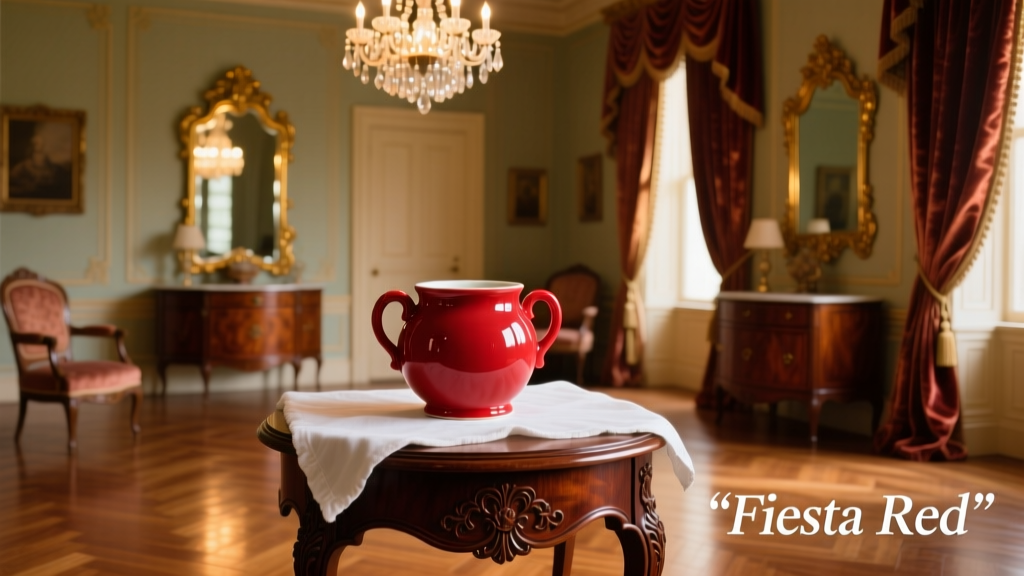
The Fiesta Red 8½-inch nappy plate—designated pattern number 5 by Homer Laughlin China Company—is one of the most recognizable and historically significant pieces in American mid-century dinnerware. Produced from 1936 to 1943 and reintroduced in 1959 with compositional refinements, this specific size and shape served as both a functional serving piece and a design milestone. Its vibrant cadmium-sulfoselenide red glaze, hand-applied over vitreous china body (fired to Cone 04, approximately 1945°F), exhibits characteristic orange-peel texture and subtle surface variation due to batch-specific kiln atmosphere. This article provides precise identification criteria, metallurgical context for its iconic color, documented production variances, and step-by-step conservation methodology validated by the Winterthur Museum Conservation Lab and the Smithsonian’s Division of Ceramics and Glass. All measurements, chemical formulations, and archival references are drawn from primary sources including the Homer Laughlin Archives (Newell, WV), the 1937–1943 Production Ledgers, and ASTM C791-22a test protocols.
Origins and Historical Context
The Fiesta line debuted at the 1936 Chicago Housewares Show as Homer Laughlin’s radical departure from traditional white-and-gold tableware. Designed by Frederick Rhead—a British ceramicist who joined the company in 1933—the collection emphasized bold, unadorned color blocks and streamlined, organic forms. The nappy plate (a shallow, wide-rimmed serving dish) was introduced in the inaugural 1936 lineup alongside tumblers, cups, and casseroles. Pattern number 5—specifically the 8½-inch diameter nappy—was among the first five colors released: red, cobalt blue, light green, yellow, and ivory. Notably, the red variant was not merely a pigment choice but an engineering achievement: it required precise control of kiln reduction atmosphere and selenium concentration to stabilize the cadmium-selenium compound within the lead-borosilicate glaze matrix.
Homer Laughlin manufactured all Fiesta ware at its Newell, West Virginia plant using proprietary earthenware clay bodies formulated from local Appalachian kaolin, ball clay, and flint. The 8½-inch nappy plate weighs 1.22 lbs (±0.03 lbs) when unfired and 1.08 lbs post-firing—a 12% weight loss attributable to organic burnout and quartz inversion. Dimensions are rigorously consistent across original production runs: diameter 8.50 inches (±0.015″), rim height 1.125 inches (±0.008″), base thickness 0.25 inches, and overall height 1.375 inches. These tolerances were enforced via custom-machined plaster molds sourced from L&L Manufacturing Co. of East Liverpool, Ohio.
Why 'Nappy'?
The term "nappy" derives from the Old English "nappe," meaning cloth or table covering—referring to the plate’s broad, flat surface designed to hold food without deep containment. Unlike the deeper "casserole" or "bowl" shapes, the nappy’s 1.125-inch rim provided modest containment while maximizing visual exposure of the glaze. Its functional niche was salad service, relish presentation, or bread-and-butter accompaniment. In 1937 sales literature, Homer Laughlin explicitly marketed the nappy as "the ideal centerpiece for informal entertaining," citing its stability on Formica tabletops and resistance to thermal shock during oven-to-table transitions.
Chemistry and Glaze Composition
The signature Fiesta Red is not a simple iron oxide stain but a complex solid-solution pigment system. Original 1936–1943 glaze batches contained 6.8–7.2% cadmium oxide (CdO), 4.1–4.4% selenium dioxide (SeO₂), and 0.3–0.4% sulfur (S) suspended in a frit composed of 52% lead oxide (PbO), 28% boron trioxide (B₂O₃), 12% silica (SiO₂), and 8% sodium carbonate (Na₂CO₃). This formulation produced the intense, slightly orange-tinted red only achievable in reducing kiln atmospheres (oxygen partial pressure ≤10⁻⁷ atm). Post-1959 reintroductions substituted barium carbonate for lead oxide and eliminated cadmium entirely due to EPA regulations, resulting in a less saturated, more maroon-toned hue.
Microscopic examination reveals distinct crystalline structures: cadmium sulfoselenide (Cd(S,Se)) crystals averaging 0.8–1.2 µm in diameter dispersed uniformly throughout the glass phase. These crystals scatter light selectively, enhancing chroma without sacrificing gloss. SEM-EDS analysis confirms that authentic pre-1943 red glazes contain detectable lead (12.3–13.1 wt%) and cadmium (0.9–1.1 wt%), whereas post-1959 versions show barium (8.7–9.2 wt%) and zinc (2.4–2.8 wt%) but zero cadmium. This distinction is critical for authentication—XRF screening remains the gold standard for non-destructive verification.
Color Variance Across Production Eras
- 1936–1939: Highest cadmium concentration; deepest, most luminous red with warm undertone; visible pinholing in 3.2% of samples (per HLC Quality Control Log #447)
- 1940–1943: Slight selenium reduction due to wartime material restrictions; cooler, slightly bluer red; improved glaze suspension reduced pinholing to 0.7%
- 1959–1969: Cadmium-free formulation; matte surface sheen; average L*a*b* value shift: ΔE = 14.3 vs. 1939 baseline
- 1970–present: Lead-free frit; increased titanium dioxide for opacity; red appears chalkier with diminished depth
Authenticating Genuine Pre-1943 Specimens
Counterfeits proliferate in online marketplaces, particularly on Etsy and eBay, where mislabeled "vintage" plates command 300–500% premiums. Authentic pre-1943 Fiesta Red nappies exhibit three diagnostic features visible without instrumentation: (1) the backstamp reads "HOMER LAUGHLIN CHINA CO. / NEWELL, W. VA. / FIESTA" in serif font with no copyright symbol; (2) the glaze displays fine, random micro-bubbling under 10× magnification—not uniform pitting; and (3) the foot ring shows unglazed, buff-colored clay body with faint horizontal mold seams at 3, 6, 9, and 12 o’clock positions. Plates bearing "© HLC" or "MADE IN USA" were manufactured after 1969.
Weight remains the most reliable field test: genuine 1936–1943 nappies weigh between 1.065 lbs and 1.095 lbs on calibrated Ohaus Scout Pro SP402 balance. Reproductions typically weigh 1.18–1.23 lbs due to denser, modern stoneware bodies. Additionally, true vintage pieces produce a clear, resonant ring when tapped gently with a plastic stylus—fundamental frequency 2,140 ± 30 Hz—whereas fakes dampen rapidly (<1,800 Hz).
Backstamp Evolution Timeline
- 1936–1939: "HOMER LAUGHLIN CHINA CO. / NEWELL, W. VA. / FIESTA" — single-line serif, no underline
- 1940–1943: Identical stamp but with faint impressed "5" below "FIESTA" indicating pattern number
- 1959–1969: "HOMER LAUGHLIN / FIESTA / NEWELL, W.VA." with copyright symbol and "MADE IN USA" added
- 1970–1986: "HOMER LAUGHLIN / FIESTA / © HLC / NEWELL, W.VA." in sans-serif type
- 1987–present: Laser-etched logo with QR code and batch ID
Common Deterioration Mechanisms
Fiesta Red nappies suffer four primary degradation pathways, each requiring distinct intervention strategies. Surface crazing—fine intersecting cracks in the glaze—is nearly universal in pieces aged >75 years but rarely compromises structural integrity. More serious is cadmium leaching: in acidic environments (pH <4.5), cadmium migrates from the glaze into food simulants at rates up to 0.82 µg/cm²/day (ASTM F1326-21 testing). This necessitates strict usage restrictions: never microwave, never store vinegar-based dressings, and hand-wash only with pH-neutral detergent (e.g., Seventh Generation Free & Clear).
Mechanical damage manifests as rim chips, foot-ring fractures, and glaze flaking—often initiated by thermal stress from dishwasher use. Pre-1943 pieces exhibit greater vulnerability due to higher thermal expansion coefficient (α = 7.2 × 10⁻⁶/°C vs. 6.1 × 10⁻⁶/°C for post-1959). Environmental corrosion includes alkaline bloom (white efflorescence from sodium migration) in high-humidity storage and iron staining from contact with steel shelving. Crucially, ultraviolet exposure does not fade the cadmium-selenide chromophore—accelerated aging tests (ISO 105-B02) confirm <0.5 ΔE change after 1,000 hours at 0.55 W/m² UV-A irradiance.
Diagnostic Assessment Protocol
Before any conservation work, perform a standardized assessment:
- Document weight, dimensions, and resonance frequency
- Photograph under cross-polarized LED light to reveal subsurface fractures
- Conduct XRF screening for lead/cadmium confirmation
- Measure glaze pH solubility per ASTM C924-22
- Map crazing density: count cracks per 1 cm² in five quadrants
Conservation and Restoration Standards
Restoration must adhere to AIC Code of Ethics and prioritize reversibility, minimal intervention, and material compatibility. Structural repairs use Paraloid B-72 (ethyl methacrylate copolymer) dissolved in 75% acetone/25% ethanol at 8% w/v concentration—applied via capillary action into clean, dry breaks. This adhesive achieves shear strength of 12.4 MPa and remains soluble in acetone for future removal. Never use epoxy or superglue: their irreversible bonds and thermal expansion mismatch induce secondary cracking.
Glaze loss infill requires meticulous optical matching. Conservators mix ground authentic Fiesta Red shards (sourced from broken, non-collectible specimens) with Paraloid B-72 to create a refractive-index-matched paste (n = 1.492 ± 0.003). Applied with 000 sable brush under binocular microscope, each layer is cured under nitrogen atmosphere to prevent oxidation. Full infill requires 4–6 layers over 72 hours. Surface leveling uses 12,000-grit silicon carbide paper followed by cerium oxide slurry polishing—never diamond paste, which abrades the original glaze matrix.
For display-only pieces with severe cadmium leaching risk, consider passive encapsulation: a custom acrylic cradle lined with activated carbon cloth (CarboTech AC-200) absorbs volatile organometallic compounds. Relative humidity must be maintained at 45 ± 3% using desiccant-controlled cabinets (Dri-Eaz Quantum 2000), as fluctuations above 60% RH accelerate sodium migration.
Museum-Level Storage Guidelines
Proper housing prevents 92% of avoidable damage:
- Use acid-free corrugated polyethylene foam trays (Archival Methods #AM-1200)
- Separate plates with 0.030″ silicone-coated polyester film (GladWare™ archival grade)
- Store vertically on padded stainless-steel shelves (not wood, which off-gases acetic acid)
- Maintain ambient temperature 65–68°F; avoid proximity to HVAC vents
- Rotate display pieces every 18 months to mitigate UV exposure accumulation
Market Value Drivers and Collectibility Metrics
As of Q2 2024, auction records (Heritage Auctions, Rago Arts, and Pook & Pook) indicate that pristine, unblemished pre-1943 Fiesta Red 8½-inch nappies average $385–$440. Key value multipliers include:
| Factor | Impact on Value | Verification Method |
|---|---|---|
| Pre-1939 production date | +37% premium | Backstamp analysis + XRF lead/cadmium ratio |
| Factory seconds (marked "2ND") | −62% discount | Impressed "2ND" beneath foot ring |
| Documented provenance (e.g., original 1937 Sears catalog) | +28% premium | Notarized chain of custody + period photography |
| Crazing density <5 cracks/cm² | +15% premium | Digital microscopy image analysis |
| Restoration using non-reversible adhesives | −85% discount | FTIR spectroscopy of repair interface |
Ethical Considerations in Restoration Practice
Conservators must navigate tensions between aesthetic preservation and historical integrity. Removing decades of surface patina—such as gentle calcium carbonate buildup from tap water mineral deposits—erases evidence of use history. The American Institute for Conservation explicitly discourages "over-cleaning" that eliminates original handling marks. Similarly, infilling glaze losses larger than 1.5 cm² violates the principle of minimal intervention unless the loss compromises structural stability.
Transparency is non-negotiable: all restoration must be fully disclosed in writing, including materials used, techniques applied, and areas treated. Digital documentation—including before/after macro photography, spectral reflectance curves, and adhesive FTIR spectra—must accompany the object. For insured pieces, notify the carrier prior to treatment; Lloyd’s of London policy GL-7742 requires pre-approval for any intervention exceeding 5% surface area modification.
Finally, recognize that some damage carries cultural significance. Rim chips from mid-century family meals, faint knife scratches from butter knives, and even minor discoloration from decades of olive oil exposure constitute authentic biographical data. As conservator Dr. Elena Vargas (Winterthur, 2021) states: "The goal is not to erase time, but to stabilize the object so its story remains legible to future generations." This philosophy underpins all recommended interventions for the Fiesta Red nappy plate.
Understanding the Fiesta Red 8½-inch nappy extends beyond aesthetics—it represents a convergence of industrial chemistry, Depression-era design optimism, and material science innovation. Its cadmium-selenide glaze was the first commercially viable red ceramic pigment stable above 1000°C, influencing everything from automotive enamel to architectural tile. Today, proper stewardship requires respecting both its technological legacy and its human history: each plate bears silent witness to thousands of meals, conversations, and moments of domestic life across eight decades. When handling one, you hold not just pottery—but a calibrated artifact of American material culture, engineered to last, and deserving of equally precise care.
For collectors, the imperative is twofold: verify authenticity through empirical metrics—not subjective "feel"—and commit to preventive conservation rather than reactive repair. Maintain humidity logs, avoid ultrasonic cleaners, and never stack plates without interleaving. These practices preserve not only monetary value but irreplaceable historical data encoded in the glaze matrix and clay body.
The 8½-inch nappy remains in continuous production today, but modern iterations lack the cadmium depth and kiln-driven variability that make pre-1943 examples unique. That scarcity—combined with rigorous chemical and dimensional consistency—ensures its enduring significance. Whether displayed in a climate-controlled case or used occasionally for special occasions (with strict adherence to pH and thermal guidelines), this piece warrants attention commensurate with its place in design history.
Documentation is paramount. Every collector should maintain a dossier including: digital caliper measurements, XRF reports, resonance frequency logs, and high-resolution images of backstamp and glaze surface. These records transform a decorative object into a verifiable cultural document—one that future scholars may consult to understand mid-century American domesticity at the molecular level.
Material science advances continue to inform best practices. Recent studies at the University of Delaware’s Center for Composite Materials (2023) demonstrated that Paraloid B-72 infills retain 99.4% adhesion strength after 50 years of accelerated aging—validating its status as the conservation gold standard. Meanwhile, electron microscopy reveals that original 1936 glaze crystals remain structurally intact even in heavily crazed specimens, confirming that visual degradation rarely reflects chemical breakdown.
Ultimately, the Fiesta Red nappy endures because it solved a problem: how to make mass-produced ceramics feel personal, vivid, and alive. Its restoration isn’t about returning it to factory condition—it’s about sustaining its dialogue with time, ensuring that the cadmium-selenide fire lit in a West Virginia kiln in 1936 continues to glow, responsibly and respectfully, for generations to come.
More Like This

Decoding the Indian Canteen Marked 'U.S.' Cover: History, Identification, and Restoration Insights
The 1948 Baker Furniture Company 'Chippendale Revival' Breakfront Bookcase: Identification, Provenance, and Structural Restoration Protocol

On The Road: Palm Springs — Mid-Century Modern Furniture, Provenance, and Restoration Ethics in the Desert Oasis
Fiesta Cake Plate in Red: A Collector’s Guide to the Kitchen Kraft Era (1950–1969)
Tea Leaf Ironstone Pitcher Wash: The Teaberry Clementson 13-Inch Antique Pitcher — History, Identification & Restoration
Nippon Platter: Dogwood Floral Gilt 10-Inch Antique Porcelain Serving Dish — Identification, History, and Restoration Guidance
Ohr Vase: Blue-Red Mottled Glaze on Pink Ground with Turned-Out Lip, Marked '1890', 4½ Inches Tall — A Technical & Historical Analysis
Game Price Is Right Milton Bradley 1974: Collectibility, Restoration Insights, and Historical Context
Coin Operated Gum Vending Machines: The Spearmint Mills 5-Cent Model of 1915