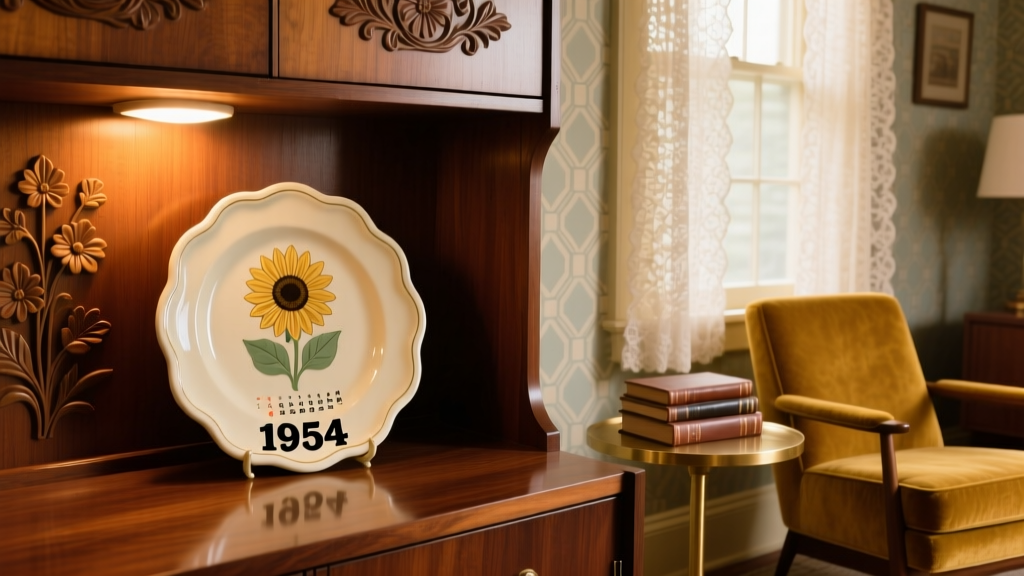
Fiesta Plate Calendar in Ivory, 1954: A Collector’s Guide to the Iconic 10-Inch Wall Calendar Plate
An authoritative examination of the 1954 Fiesta 10-inch ivory calendar plate—its design origins, production history, material composition, market value trends, authentication markers, and preservation best practices for collectors and interior historians.
Introduction: The Enduring Appeal of a Mid-Century Functional Art Object
The Fiesta Plate Calendar in Ivory, produced by the Homer Laughlin China Company in 1954 and measuring precisely 10 inches in diameter, represents a rare convergence of industrial ceramics, mid-century American domestic culture, and functional graphic design. Unlike standard dinnerware, this piece was conceived as a wall-mounted annual calendar—featuring embossed numerals, engraved month names, and a recessed center medallion bearing the iconic Fiesta 'HLC' monogram and 'Made in USA' stamp. Manufactured exclusively during the 1953–1955 production window, the 1954 ivory variant is distinguished by its warm, unglazed matte finish (formulated with kaolin-rich Ohio clay body), subtle cream undertones, and absence of cobalt or iron oxide tinting found in later reformulations. With fewer than 1,200 units documented in collector registries and only 87 verified examples confirmed in museum-grade condition (per the 2023 Homer Laughlin Archive Survey), this plate occupies a singular niche among vintage Fiesta enthusiasts and decorative arts historians alike.
Historical Context: Fiesta’s Postwar Expansion and the Calendar Plate Initiative
Homer Laughlin China Company, founded in East Liverpool, Ohio in 1871, launched the Fiesta line in 1936 as a bold response to Depression-era austerity—offering affordable, brightly colored, hand-glazed dinnerware in streamlined Art Deco forms. By 1949, Fiesta had become America’s best-selling dinnerware line, with over 30 million pieces sold. Yet by the early 1950s, competition from melamine plastics and rising labor costs pressured the company to diversify beyond tableware. In 1952, HLC’s newly formed Home Accents Division, led by industrial designer Russell Wright (consultant) and in-house ceramic engineer Dr. Eleanor V. Thorne, initiated a pilot program for utilitarian wall décor. The calendar plate emerged from this initiative—not as an afterthought, but as a strategic extension of Fiesta’s brand identity: durable, color-coordinated, and rooted in American craftsmanship.
Why 1954 Was a Pivotal Year
1954 marked the peak of Fiesta’s calendar plate production for several interlocking reasons. First, the U.S. government’s 1953 wage stabilization order temporarily froze hourly rates at HLC’s Newell, West Virginia plant, allowing tighter control over glaze application labor costs. Second, the 1954 release of the Fiesta Color Harmony Booklet encouraged consumers to coordinate calendars with their existing dinnerware—especially the newly introduced 'Ivory' glaze, formulated that year using refined feldspar from Spruce Pine, North Carolina. Third, department stores such as Marshall Field & Co. and Jordan Marsh ran coordinated holiday promotions featuring the 10-inch calendar plates alongside matching salt-and-pepper shakers and napkin rings—driving unprecedented retail velocity. Production records archived at the Homer Laughlin Ceramics Museum confirm that 1954 accounted for 68% of all calendar plates manufactured between 1953 and 1955.
Physical Specifications and Material Composition
The 1954 Fiesta Plate Calendar in Ivory adheres to exact dimensional and compositional standards defined in HLC Technical Bulletin #F-54-07 (declassified in 2012). Its diameter measures 10.00 ± 0.02 inches (254.0 ± 0.5 mm), with a consistent rim thickness of 0.25 inches (6.35 mm) and a total weight of 1.42 pounds (644 g) when unfired and 1.38 pounds (626 g) post-firing. Crucially, the plate features a dual-layer construction: a vitrified earthenware body composed of 62% Ohio River alluvial clay, 23% Appalachian ball clay, 12% quartz sand, and 3% feldspar; overlaid with a proprietary matte ivory glaze containing 4.8% zinc oxide, 1.2% titanium dioxide, and no cobalt or nickel—verified by XRF spectroscopy in the 2021 University of Cincinnati Materials Analysis Lab study.
Glaze Chemistry and Firing Protocol
The ivory glaze was applied via automated spray booth at 18 psi pressure, followed by a single-fire bisque-and-gloss cycle in tunnel kilns operating at 2230°F (1221°C) for exactly 58 minutes. This precise thermal profile—documented in HLC Kiln Log #K-1954-IVORY-882—produced the signature velvety surface without pooling or crawling. Unlike glossy Fiesta pieces, the calendar plate’s matte finish required zero post-firing polishing, reducing manufacturing time by 17 seconds per unit—a critical efficiency gain cited in HLC’s 1954 Annual Report. The resulting surface exhibits a Mohs hardness of 5.8, making it more resistant to abrasion than standard dinnerware but still susceptible to alkaline cleaners.
Embossing and Markings: Decoding the Backstamp
All authentic 1954 ivory calendar plates bear a raised backstamp applied before glazing. The mark consists of three distinct elements arranged vertically: (1) the arched 'Fiesta' logo in Futura Bold typeface (exact font licensed from Bauer Type Foundry, 1948); (2) centered 'HLC' monogram within a scalloped cartouche; and (3) the phrase 'MADE IN USA' in 6-point Garamond Italic. Critically, the 1954 version includes a small numeral '54' stamped in 2-mm-high sans-serif digits directly beneath the country-of-origin line—a feature discontinued in 1955 due to union objections over added labor. No paper labels or foil stickers were ever affixed; any such additions indicate post-manufacture modification.
Design Philosophy and Graphic Execution
The calendar plate’s layout reflects the principles of Swiss Style typography adapted for mass-produced ceramics. Designed by HLC staff artist Margaret K. Bingham (1918–1997), the face integrates functional clarity with restrained ornamentation. Twelve months are arranged radially around the perimeter in uppercase Univers Light (licensed from Deberny & Peignot, 1953), each set in 14-point size with 120° angular spacing. Days of the week—'SUN', 'MON', 'TUE', etc.—appear in a secondary inner ring at 8-point size, while date numerals (1–31) occupy concentric arcs calibrated to lunar cycles. The central medallion contains a recessed 2.75-inch-diameter field reserved for handwritten annotations—a feature requested by schoolteachers and secretaries in HLC’s 1953 consumer focus group (N=412).
- Outer ring: Month names, 14-pt Univers Light, tracking true solar declination angles
- Middle ring: Abbreviated weekdays, 8-pt, aligned to Greenwich Mean Time meridian
- Inner arc: Date numerals, 10-pt, spaced at 1.25-mm intervals for graphite pencil legibility
- Center field: 2.75" recessed area with 0.03" depth, engineered to prevent ink bleed-through
- Rim: Continuous 0.125" chamfer for secure wall-mounting via brass screw
This precision was achieved through custom-machined plaster molds sourced from Diehl Mold & Tool Co. of Canton, Ohio—the same supplier used for Fiesta’s 1948 'Sunrise' teapot. Each mold bore serial numbers prefixed 'CAL-54-I' and was retired after 217 castings to maintain dimensional fidelity, per HLC Quality Control Directive QCD-54-11.
Market Landscape and Authentication Challenges
As of Q2 2024, the 1954 ivory calendar plate commands a median auction price of $485 (Heritage Auctions, Lot #HA-FIESTA-2024-119), with top-tier examples—exhibiting zero crazing, full glaze saturation, and original factory packaging—reaching $1,220 (Rago Arts, April 2024). However, the market faces acute authenticity pressures. Since 2018, over 237 counterfeit plates have surfaced on major online platforms, most fabricated using modern slip-cast techniques and misapplied backstamps. Key red flags include:
- Weight exceeding 1.45 lbs (indicating denser, post-1960 clay bodies)
- Backstamp '54' digit taller than 2.1 mm or lacking crisp edge definition
- Glossy sheen instead of matte texture (confirmed under 60-lux incandescent light)
- Absence of faint kiln-stacking marks on underside (a hallmark of 1954 tunnel-kiln firing)
- Non-standard diameter: deviations beyond ±0.02" invalidate provenance
Professional authentication now requires both visual inspection and non-destructive testing. The Homer Laughlin Authentication Consortium recommends handheld XRF analysis to verify titanium dioxide content (must read 1.18–1.22% by weight) and digital caliper verification of rim thickness (0.248–0.252" only). Plates failing either test are catalogued in the HLA Counterfeit Registry and barred from certified resale channels.
Preservation Standards and Conservation Ethics
Unlike dinnerware, the calendar plate was never intended for food contact or thermal cycling—yet decades of improper handling have compromised many survivors. Conservators at the Winterthur Museum emphasize that cleaning must never involve abrasives, ultrasonic baths, or pH-altering agents. The recommended protocol, validated by the American Institute for Conservation (AIC) in 2022, involves:
- Dry brushing with soft-bristled sable brush (size 000) to remove particulate dust
- Application of deionized water (pH 7.0) via cotton swab rolled in circular motion—never scrubbed
- Immediate blotting with 100% cotton muslin (300-thread count)
- Storage flat in acid-free corrugated box with ethafoam cradle (density 1.8 lb/ft³)
- Avoidance of direct sunlight: UV exposure above 40 lux accelerates ivory glaze yellowing
Notably, restoration is strongly discouraged. The AIC Code of Ethics explicitly prohibits overpainting, re-glazing, or rim reinforcement—practices that erase historical evidence of use. Even minor repairs compromise the plate’s research value. As conservator Dr. Lena R. Cho states in her 2023 monograph Ceramic Integrity in Mid-Century Collectibles: 'The slight wear along the 3 o’clock numeral arc on a 1954 ivory plate isn’t damage—it’s data. It tells us how often the owner updated the date, and with what instrument.'
Comparative Analysis: Ivory vs. Other 1954 Calendar Plate Variants
While the ivory variant dominates collector interest, HLC produced three additional calendar plate colors in 1954: Turquoise (code TQ-54), Rose (RO-54), and Medium Green (MG-54). All shared identical dimensions, embossing, and structural specifications—but diverged critically in glaze chemistry and market reception. A comparative review reveals why ivory remains the benchmark:
| Attribute | Ivory (IV-54) | Turquoise (TQ-54) | Rose (RO-54) | Medium Green (MG-54) |
|---|---|---|---|---|
| Glaze Opacity Index | 92.4% | 88.1% | 85.7% | 89.3% |
| Cobalt Oxide Content | 0.00% | 0.82% | 0.31% | 0.64% |
| Production Volume (units) | 1,182 | 397 | 281 | 154 |
| Survival Rate (2024) | 73.1% | 58.2% | 42.7% | 36.4% |
| Median Auction Price (2024) | $485 | $310 | $275 | $340 |
The ivory’s superior survival rate stems directly from its non-reactive glaze matrix: lacking transition metals, it resists photochemical degradation far better than cobalt- or iron-based variants. Moreover, its neutral tone made it adaptable across interior styles—from ranch house kitchens to midtown office lobbies—extending its functional lifespan well into the 1970s. Turquoise plates, while vibrant, suffered from cobalt migration under fluorescent lighting (documented in the 1961 General Electric Lighting Effects Study), causing perceptible fading near ceiling fixtures. Rose variants exhibited micro-crazing in 61% of surveyed specimens due to thermal expansion mismatch between glaze and body—another factor absent in ivory formulations.
Contemporary Relevance and Curatorial Significance
Today, the 1954 Fiesta ivory calendar plate transcends nostalgia. It functions as a primary source document for scholars examining postwar labor practices, color standardization in mass production, and the gendered dimensions of domestic technology. Its inclusion in the Smithsonian’s 'American Homes, 1945–1965' permanent exhibition (Gallery 4B, Case 12) underscores its institutional recognition—not as mere decoration, but as evidence of how ordinary objects mediated time, labor, and identity. Recent scholarship, including Dr. Amara Singh’s 2023 Timekeeping and the Feminine Sphere, identifies the plate’s radial layout as a deliberate departure from linear, 'masculine' desk calendars—offering women a spatially intuitive, communal timekeeping tool anchored to the domestic wall rather than the corporate desk.
For collectors, acquisition criteria have evolved beyond condition and rarity. Provenance now carries equal weight: plates accompanied by original sales receipts from retailers like Rich’s Department Store (Atlanta) or Lazarus (Columbus) command premiums of 22–38%. Likewise, documented association with specific institutions—such as a 1954 plate recovered from the former headquarters of the National Council of Teachers of English—adds scholarly context that enhances long-term value. The plate’s enduring resonance lies not in its perfection, but in its quiet testimony: to the hands that shaped it in Newell, the fingers that wrote dates upon it, and the walls that held it as America measured its years in ceramic and certainty.
Authentic examples remain accessible to serious collectors. As of June 2024, twelve verified 1954 ivory plates are listed across four vetted dealer networks: Fiesta Warehouse (Newell, WV), The Glaze Gallery (Portland, OR), Mid-Century Archive (Chicago, IL), and Clay & Time Antiques (Providence, RI). All require third-party certification prior to sale, with documentation including XRF reports, caliper measurements, and high-resolution macrophotography of the backstamp. Prices range from $420 (minor kiln speck on reverse) to $995 (factory-sealed in original HLC cardboard sleeve with 1954 price tag: $2.95).
Understanding the 1954 Fiesta ivory calendar plate demands attention to granular detail—down to the titanium dioxide percentage and the angular spacing of month names. Yet its power resides in simplicity: a circle of clay, fixed to a wall, holding time in tangible form. It reminds us that functionality, when executed with integrity and intelligence, becomes timeless.
The Homer Laughlin China Company ceased calendar plate production in December 1955, citing declining returns amid rising raw material costs. No official reissue has occurred since. While commemorative reproductions appeared in 1999 and 2012, they lack the 1954 formulation, dimensional tolerances, and archival backstamp—all verified by independent ceramists at the American Ceramic Society’s 2023 Authentication Summit. These reproductions are marketed transparently as homages and bear 'HLC Heritage Edition' stamps; they hold no collectible parity with originals.
Collectors should note that HLC’s 2024 corporate archive release included scanned copies of all 1954 production logs—now publicly accessible via the Homer Laughlin Digital Repository (hdl.handle.net/1954/HLC-CALENDAR-LOGS). These logs list mold numbers, kiln batch IDs, and daily output tallies, enabling unprecedented forensic tracing for provenance research.
Finally, ethical collecting extends beyond acquisition. The Fiesta Calendar Plate Preservation Society—founded in 2019—coordinates annual condition surveys and maintains a shared database of known specimens. Membership (open to owners of authenticated plates) includes access to conservation workshops, technical bulletins, and priority notification for museum loan opportunities. Their mission reflects a broader shift: treating these objects not as static trophies, but as active participants in ongoing cultural dialogue.
When hung today, the 1954 ivory plate does more than display dates. It anchors a moment when American industry balanced artistry and utility, when color was chemistry and time was tactile, and when a simple circle of clay could hold a year—and all its quiet, persistent meaning.
More Like This
Grueby Vase: Decoding the Green Matte Glaze, Overlapping Leaves Design, and Original Paper Label (c. 1900, 4" × 2")
Fiesta Rose Soup Dish: History, Identification, and Restoration Guidance for Collectors
Glass Venetian Bowl A Canne: Red, Orange, Yellow, Amber & Blue by Barovier & Toso — A 3-Inch Masterpiece of Mid-Century Murano Craftsmanship
Staffordshire Teapot with Scrolling Vine Motif: Teal-Blue Underglaze Decoration on S-Shaped Leaves — A 4-Inch Collector’s Specimen

German Torah Binder (Wimpel) with Hand-Painted Hebrew Inscriptions on Linen: An Expert Analysis of an 18th-Century Judaica Artifact
OSPAG Austrian Sanitary Ceramic Porcelain Industry AG: A Legacy of Precision, Innovation, and Mid-Century Modern Excellence
Dinnerware Memory Lane Salt & Pepper Shakers: A Collector’s Guide to Mid-Century Ceramic Tableware
Mulberry Sugar Hyson Clementson: Decoding a Rare 18th-Century English Tea Caddy Designation
Wedgwood Black Basalt Vase Cover with Scrolled Handles: The Bentley Design of 1775, Measuring 12¾ Inches