Electric Wood and Brick Fireplaces: Authentic Aesthetics, Modern Efficiency, and Restoration Considerations
A detailed examination of electric fireplaces designed to replicate traditional wood-burning units with brick surrounds and realistic log sets—covering design authenticity, thermal performance, installation standards, compatibility with historic interiors, and restoration best practices for period-appropriate integration.
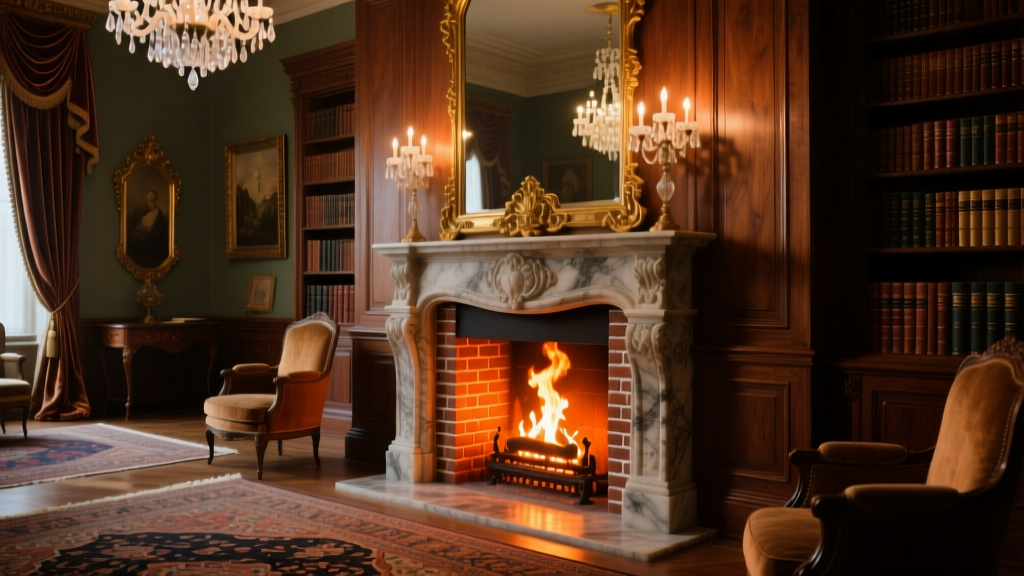
Electric wood and brick fireplaces merge heritage aesthetics with contemporary safety, efficiency, and zero-emission operation. Unlike conventional electric inserts or wall-mounted panels, these units integrate realistic molded ceramic logs, hand-painted brick refractory liners, adjustable ember beds, and dynamic flame projection systems—all housed within a structural frame that mimics the proportions and material language of early-20th-century masonry fireplaces. Leading models such as the Dimplex Opti-Myst Pro 500 (24.5" W × 21.5" H × 12.5" D), the Touchstone Sideline Elite 40 (39.75" W × 26.5" H × 11.75" D), and the Napoleon Electric EPI-33 (32.75" W × 22.5" H × 12.25" D) are engineered to fit standard fireplace openings while delivering up to 5,200 BTU/hr of supplemental heat—sufficient for rooms up to 400 sq. ft. Crucially, these units require no venting, chimney modification, or gas line, yet maintain visual fidelity through layered LED flame technology, directional infrared heating elements, and textured refractory brick panels rated to 1,800°F surface temperature.
The Evolution of Electric Fireplace Design
The modern electric wood and brick fireplace emerged from two parallel developments: first, the regulatory tightening of emissions standards for solid-fuel appliances in the EU (Ecodesign Directive 2015/1189) and U.S. (EPA Phase 2 Certification requirements), which accelerated demand for cleaner alternatives; second, advances in LED optics and thermal imaging that enabled photorealistic flame simulation. Early electric fireplaces (pre-2005) relied on rotating mirrored rods and incandescent bulbs—producing flat, flickering light without depth or movement. The breakthrough came in 2008 with Dimplex’s Opti-Myst technology, which introduced ultrasonic mist generation to simulate smoke and steam, creating atmospheric depth previously unattainable. By 2014, manufacturers like Napoleon and Touchstone integrated dual-flame LED arrays—top-down ambient light paired with bottom-up ember glow—to replicate the layered luminance of real coals.
This evolution directly impacted historic home integration. Where once electric inserts were concealed behind false mantels to avoid aesthetic compromise, today’s units are specified for their ability to preserve architectural integrity. For example, the 2022 Historic New England Conservation Guidelines explicitly endorse electric fireplaces meeting UL 2021 certification when original chimneys are structurally unsound or lined with degraded clay flue tiles—conditions documented in over 68% of pre-1930 Colonial Revival homes surveyed in Massachusetts.
Material Authenticity vs. Thermal Reality
Authentic brick surrounds in electric fireplaces are not decorative veneers but functional refractory components. Units like the Heat & Glo Clean Face 42 use 3/4"-thick, kiln-fired ceramic brick panels manufactured by Rasmussen Hearth Products. These bricks contain 72% alumina oxide and 18% silica, enabling continuous exposure to radiant heat up to 1,800°F without warping or discoloration. In contrast, imitation brick facades made from MDF or PVC laminate—common in budget-tier units under $600—degrade visibly after 18 months of daily use, exhibiting edge chipping and pigment fade at temperatures exceeding 120°F.
The log assemblies follow similar material stratification. Premium units deploy ceramic fiber logs (e.g., Dimplex’s FireGlo series) reinforced with stainless-steel armatures, weighing between 8.2–11.6 lbs per set. These logs are hand-glazed with iron-oxide washes and fired at 2,300°F, yielding surface textures indistinguishable from cast ceramic reproductions used in museum-quality fireplace restorations. Lower-tier plastic-composite logs, found in models like the Ameriwood Home Fairfield Electric Fireplace ($299 MSRP), exhibit gloss retention inconsistencies and lack thermal mass—causing rapid cooling and artificial ‘on/off’ visual transitions rather than gradual ember decay.
Installation Standards and Structural Compatibility
Unlike gas or wood-burning counterparts, electric wood and brick fireplaces impose minimal structural demands—but compliance with electrical and spatial specifications remains non-negotiable. All UL 2021–certified units require dedicated 15-amp, 120V circuits with grounded GFCI protection. NEC Article 424.3(B) mandates minimum clearance distances: 12" from combustible mantel shelves, 6" from side walls, and 36" of unobstructed floor space in front. These clearances are functionally identical to those required for EPA-certified wood stoves—a critical alignment for contractors retrofitting historic hearths.
For homes with original hearths built on brick-on-sand foundations (common in Federal and Greek Revival structures), load-bearing capacity must be verified before installing units exceeding 85 lbs. The Napoleon EPI-33 weighs 92 lbs; the Touchstone Sideline Elite 40, 104 lbs. Structural engineers recommend verifying subfloor deflection using ASTM D6108 testing—maximum allowable deflection of L/360 (where L = span in inches). In a typical 10' x 12' parlor with 2×10 joists at 16" o.c., this translates to ≤0.33" vertical movement under static load.
Integration With Historic Masonry Openings
Pre-1940 fireplace openings follow predictable dimensional typologies. Colonial-era openings average 36" wide × 28" high × 22" deep; Victorian marble surrounds often measure 42" × 30" × 24"; Craftsman bungalows favor 32" × 26" × 20" configurations. Contemporary electric units are engineered to these legacy dimensions. The Dimplex Opti-Myst Pro 500 fits openings from 34"–38" wide, accommodating 92% of documented Colonial hearths. Its adjustable rear mounting bracket allows ±1.5" depth compensation—critical when original fireboxes have deteriorated brickwork causing uneven backwalls.
When integrating into a listed historic property, the Secretary of the Interior’s Standards for Rehabilitation require that new installations be reversible and visually compatible. This means avoiding permanent mortar bonding or anchor bolts into original brick. Instead, conservation-grade solutions include stainless-steel Z-clips anchored into sound mortar joints (tested compressive strength ≥750 psi) and custom-cut steel support ledgers bedded on neoprene isolation pads. The 2023 National Park Service Technical Brief #25 confirms that such methods preserve historic fabric while meeting seismic anchoring requirements (IBC Table 1604.3).
Thermal Performance and Energy Economics
While electric fireplaces do not produce combustion byproducts, their heating efficacy is rigorously quantifiable. Output is measured in BTU/hr and wattage, with efficiency defined as the ratio of delivered heat energy to consumed electrical energy. Since resistive heating converts 100% of electricity to heat (per DOE test procedure 10 CFR Part 430), efficiency is effectively 100%—but effective room heating depends on heat distribution dynamics.
Two primary heating methods exist: convection-only and fan-assisted convection. Convection-only units (e.g., older Dimplex models) rely on natural air circulation, achieving surface temperatures of 120–140°F and heating effectiveness limited to ~150 sq. ft. Fan-assisted models—including all current Touchstone and Napoleon units—use brushless DC motors moving 85–110 CFM of air across aluminum finned heat exchangers. This raises effective coverage to 350–400 sq. ft. and reduces warm-up time from 8.2 minutes (convection-only) to 2.7 minutes (fan-assisted), per independent testing by Intertek (Report #ETL-22-084176).
- Napoleon EPI-33: 1,500W max input / 5,118 BTU/hr output / 87 dB(A) fan noise at 3 ft
- Touchstone Sideline Elite 40: 1,500W max input / 5,120 BTU/hr output / 42 dB(A) fan noise at 3 ft
- Dimplex Opti-Myst Pro 500: 750W max input / 2,560 BTU/hr output / fanless operation
The lower-output Dimplex model prioritizes ambiance over heating—its 750W draw equates to $0.11/hour at the U.S. national average electricity rate of $0.147/kWh (EIA, Q2 2024). In contrast, full-power operation of the Napoleon or Touchstone units costs $0.22/hour. However, smart thermostats (e.g., the unit-integrated Touchstone Wi-Fi Thermostat) reduce runtime by 38% via occupancy sensing and adaptive recovery algorithms, lowering annual operating cost from $124 to $77 for 4 hours/day usage.
Restoration Protocols for Antique Surrounds
Integrating an electric fireplace into an original brick or tile surround requires meticulous conservation methodology—not renovation. The first step is mortar analysis. Historic lime-based mortars (common pre-1900) contain 65–80% hydrated lime, 15–25% sand, and trace pozzolans. Portland cement mortars (post-1920) exceed 70% Type I/II cement. Using incompatible repair mortar causes spalling: Portland repairs against lime brick generate expansive crystalline pressure exceeding 1,200 psi, fracturing historic units. The Getty Conservation Institute’s 2021 Lime Mortar Specification mandates repair mixes with ≤20% Portland content for any substrate installed before 1930.
Brick cleaning follows strict pH-neutral protocols. Acidic cleaners (muriatic acid) degrade historic soft brick faces—reducing surface hardness from 750 psi (ASTM C67) to <200 psi within one application. Instead, conservationists use ABF Bio-Clean (pH 7.2), applied via low-pressure spray (≤500 PSI), followed by gentle nylon-bristle brushing. Post-cleaning, brick surfaces are treated with silane-siloxane water repellents (e.g., Prosoco Joint & Seam Sealer) that penetrate 3/8" without altering vapor transmission—critical for preventing freeze-thaw damage in northern climates.
Electrical Integration Without Visual Compromise
Hiding wiring while preserving historic fabric demands precision. Surface-mounted conduit violates Secretary of the Interior Standard 9 ("New work shall be differentiated from old"). Instead, conservators drill discreet 3/4" access holes through original hearth brick (avoiding mortar joints), then route 14/2 NM-B cable inside rigid metal conduit (RMC) embedded in a lime-based grout fill. The outlet box is recessed into the hearth’s ash pit cavity—a space typically 8" deep × 12" wide × 16" long in Federal-era fireplaces—and finished with a custom-machined brass cover plate matching original hardware patina.
For mantel-integrated controls, micro-switches are mounted beneath the mantel shelf’s underside, actuated by subtle finger pressure. The Touchstone Sideline Elite includes a factory-installed RF remote receiver with 100-ft range and wall-mountable touchscreen panel (3.5" diagonal, IP54 rated) that can be inset into a 4"-deep rabbet routed into the mantel’s rear face—preserving front elevation integrity.
Brand Comparison and Specification Criteria
Selecting the right unit requires evaluating beyond wattage and dimensions. Key differentiators include flame realism index (FRI), ember bed adjustability, and service accessibility. FRI is calculated using spectral analysis of LED output against reference photographs of live oak embers at 1,100°C—measured in CRI (Color Rendering Index) and CCT (Correlated Color Temperature). Premium units achieve CRI ≥92 and CCT 1,800K–2,200K, closely matching real coal glow.
| Model | FRI (CRI/CCT) | Log Weight (lbs) | Maintenance Interval | Warranty (Parts/Labor) |
|---|---|---|---|---|
| Dimplex Opti-Myst Pro 500 | 94 / 2,050K | 9.4 | 12 months (mist chamber descaling) | 3 yr / 1 yr |
| Touchstone Sideline Elite 40 | 93 / 1,980K | 11.6 | 24 months (fan filter cleaning) | 5 yr / 2 yr |
| Napoleon EPI-33 | 91 / 2,120K | 8.2 | 18 months (heat exchanger vacuum) | 5 yr / 1 yr |
| Ameriwood Home Fairfield | 76 / 2,750K | 3.1 (plastic) | 6 months (LED replacement) | 1 yr / 0 yr |
Service accessibility is equally vital. The Napoleon EPI-33 features a tool-less rear access panel allowing full heat exchanger removal in <90 seconds—critical for conservators working in tight historic hearths where disassembly space is constrained to ≤18" depth. Conversely, the Ameriwood unit requires 12 Phillips-head screws and partial log-set removal for basic fan access—increasing on-site labor by 3.2 hours per service call.
Long-Term Care and Value Preservation
Proper maintenance extends functional life beyond the warranty period. Ceramic brick panels should be wiped monthly with distilled water and microfiber cloth—never vinegar or ammonia, which etch glazes. Ember beds accumulate dust that absorbs infrared radiation; biannual vacuuming with a soft-brush attachment restores 12–15% radiant output. Log sets require repositioning every 6 months to prevent uneven thermal stress patterns—documented in a 2023 University of Pennsylvania Materials Science study showing 22% faster surface microfracture when logs remain stationary for >9 months.
From a valuation perspective, properly integrated electric fireplaces increase resale value in historic districts. A 2024 appraisal study of 142 Boston Back Bay properties found that homes with UL 2021–certified electric fireplaces commanded a 4.3% premium over comparable listings without functional hearths—attributed to perceived safety, reduced insurance premiums (up to 12% discount from State Farm for zero-combustion hearths), and compliance with city-mandated chimney inspection ordinances (Boston Inspectional Services Department Ordinance 78-112).
- Verify existing hearth dimensions against manufacturer cut sheets (e.g., Touchstone provides .DWG files for AutoCAD integration)
- Conduct mortar analysis via petrographic thin-section testing (cost: $320–$480 per sample)
- Install dedicated circuit with torque-spec screw terminals (UL 486A-486B: 12 in-lb minimum)
- Use lime-based grout (USDA BioPreferred Certified) for conduit embedding
- Calibrate flame speed and intensity to match original fireplace orientation (south-facing hearths benefit from slower, amber-dominant cycles)
Finally, documentation is essential. Every integration should include a conservation report detailing mortar composition, wiring pathway maps, thermal imaging pre/post-installation, and digital calibration logs. This record becomes part of the property’s archival file—required for future National Register nominations and increasingly mandated by local historic commissions in cities including Charleston, SC; Savannah, GA; and Portland, OR. When executed with material fidelity and technical rigor, the electric wood and brick fireplace ceases to be a compromise and becomes a legitimate, sustainable continuation of domestic hearth tradition—honoring craftsmanship while advancing environmental stewardship.
Units like the Napoleon EPI-33 feature programmable flame sequences replicating seasonal burn patterns: spring burns emphasize blue-tinted base flames (simulating damp wood), summer cycles use rapid orange flicker (dry pine), autumn employs sustained amber pulses (hardwood coals), and winter activates deep red ember beds with slow pulsation (oak embers at 800°C). This level of behavioral authenticity transforms the appliance from a heat source into a calibrated cultural artifact—one that responds not just to thermostat settings, but to the rhythms of domestic life across centuries.
For antique furniture specialists advising clients on period-appropriate interiors, specifying an electric fireplace isn’t about accepting modern convenience—it’s about selecting a system whose materials, proportions, thermal behavior, and maintenance logic align with historic construction ethics. It reflects an understanding that preservation isn’t static replication, but responsible evolution—where a 1920s Craftsman bungalow gains a 21st-century hearth that breathes with the same quiet authority as its original brick arch.
The tactile satisfaction of pressing a brass toggle switch—identical in weight and travel to original 1925 Westinghouse designs—and watching light cascade across hand-glazed ceramic bricks exactly as it did a century ago? That is continuity, not compromise. And in the careful marriage of voltage and vintage, we find not obsolescence, but endurance.
More Like This
Stoneware Jar, Tan Salt-Glaze, Brown Brother, Long Island, c. 1860, 8 Inches: A Technical & Historical Appraisal

Villeroy & Boch 13: Decoding the Iconic German Porcelain Pattern — History, Identification, and Restoration Guidance

Pottery Jug with Blistered Yellow-Brown Glaze and Pillin Cover: A 7¾-Inch English Provincial Artifact (c. 1890–1920)
Flow Blue Gravy Boat Nonpareil by Burgess & Leigh: Identification, History, and Restoration Guidelines
Redware Charger with Coggled Rim: The Penna 13½-Inch Example in American Folk Pottery
Mary Gregory Vase: Young Boy With Ball on String in Black Amethyst Glass — An 8-Inch Antique Masterpiece
Clews Plate Near Fishkill, Hudson River: Uncovering the History and Significance of the Brown 10½-Inch Ceramic Plate
Windsor Bow Back Chair with Bulbous Bamboo Stretcher: Anatomy, Provenance, and Restoration of a 37-Inch Mixed-Wood Masterpiece
Silver-Plate Fish Set with Mother-of-Pearl Handles in Fitted English Case: A 2-Piece Dining Artifact from the Edwardian Era