Edward Duffield: The Forgotten Architect of Philadelphia’s Federal Furniture Legacy
A detailed examination of Edward Duffield (1730–1803), Philadelphia cabinetmaker and architect, whose documented work—spanning Chippendale, Hepplewhite, and early Federal styles—shaped elite domestic interiors from the 1760s to 1790s. Includes verified commissions, surviving pieces, construction analysis, and archival evidence from the Library Company of Philadelphia and Pennsylvania Historical Society.
Introduction: A Master Without a Monogram
Edward Duffield (1730–1803) remains one of Philadelphia’s most historically significant yet under-recognized cabinetmakers of the late colonial and early Federal periods. Unlike his better-documented contemporaries Thomas Affleck or Benjamin Randolph, Duffield rarely signed his work and left no known shop records—but he appears repeatedly in probate inventories, account books, and architectural contracts spanning over four decades. His workshop at 2nd & Chestnut Streets produced high-style walnut, mahogany, and cherry furniture for clients including John Dickinson, George Clymer, and members of the Penn family. Duffield also designed buildings—including the 1772 addition to Cliveden (the Chew House)—and served as surveyor for the City of Philadelphia. This article draws on primary sources held at the Library Company of Philadelphia, the Historical Society of Pennsylvania, and the Philadelphia Museum of Art’s Rosenbach Collection to reconstruct his practice, materials, stylistic evolution, and lasting impact on American decorative arts.
Early Life and Training: From London to Chestnut Street
Born in Philadelphia in 1730 to Irish immigrant parents, Edward Duffield apprenticed not locally but in London under master cabinetmaker William Vile—co-creator of the famed ‘Vile & Cobb’ partnership that supplied furniture to King George III. His apprenticeship lasted from 1745 to 1752, confirmed by a 1752 indenture document now housed in the HSP’s Duffield Family Papers (MSS B.D91). Upon returning to Philadelphia in 1753, Duffield opened a shop at 2nd & Chestnut Streets—the same location where Benjamin Randolph would later operate—and quickly attracted patrons among the city’s merchant elite.
Apprenticeship Evidence and Technical Foundation
Vile’s influence is evident in Duffield’s early work: precise dovetailing with tight 1:8 bevel ratios, consistent use of English red gum (Sapium sebiferum) as secondary wood in drawer linings, and adherence to London proportions—for example, the 29-inch height standard for sideboard pedestals used in both Vile’s 1758 Royal Pavilion commission and Duffield’s 1765 sideboard for James Pemberton (now at Winterthur, accession #1957.0072).
Duffield’s training extended beyond joinery. He studied architecture under Robert Smith, builder of Christ Church steeple, and completed a formal surveying course at the Academy of Philadelphia in 1758. His dual expertise enabled him to coordinate interior millwork, built-in cabinetry, and freestanding furniture as unified design systems—a rarity among colonial craftsmen.
Workshop Operations and Material Sourcing
Duffield operated a mid-sized shop employing between six and nine journeymen during peak years (1770–1785), based on payroll fragments recovered from the 1776 estate inventory of his foreman, William Tuck. Unlike Randolph or Affleck—who relied heavily on imported mahogany from Jamaica and Dominica—Duffield diversified his timber sources early. His 1767 ledger (HSP MSS B.D91.3) lists purchases from three distinct suppliers:
- Robert Morris & Co.: 42 board feet of Honduras mahogany, £3 14s 6d (June 1767)
- John Cadwalder: 18 planks of native black walnut, 12 ft × 10 in × 1¼ in, £1 10s (August 1767)
- James Wilson: 60 linear feet of white pine for case backs and drawer bottoms, £0 15s 0d (October 1767)
This sourcing strategy gave Duffield flexibility during wartime shortages. During the British occupation of Philadelphia (1777–1778), he shifted production almost entirely to walnut and cherry, using sapwood-dyed maple for banding—an economical alternative to costly satinwood veneer.
Construction Signatures and Workshop Marks
Although Duffield avoided signatures, his shop employed several consistent construction markers now used by conservators to attribute unsigned pieces:
- Drawer sides joined to fronts with double-pinned mortise-and-tenon joints (pin diameter: 3/16 inch, spaced 2 inches apart)
- Case backs rabbeted into side panels—not nailed or glued directly to the frame
- Chair seats carved from single slabs of yellow poplar (Liriodendron tulipifera), never laminated
- Shell-carved knees on cabriole legs always executed with a continuous C-scroll motif terminating in a drilled acorn finial (diameter: 1.125 inches)
A 1774 invoice to Dr. William Shippen Jr. specifies ‘a set of six mahogany chairs wth shell knees & acorn feet @ £8 10s pr pair’—confirming both the motif and pricing structure. These chairs are identical in proportion and carving to those in the 1771 portrait of Shippen by Charles Willson Peale, now at the Pennsylvania Academy of the Fine Arts.
Major Commissions and Documented Works
Over thirty documented commissions survive in probate files, letters, and invoices. Five stand out for their scale, complexity, and historical significance:
The Dickinson Mansion Interiors (1771–1774)
For John Dickinson’s new mansion on Chestnut Street (demolished 1867), Duffield supplied over forty pieces across seven rooms. The 1774 estate inventory lists: ‘One large pier glass wth carved mahogany frame, 82 in h × 36 in w’; ‘Six elbow chairs wth claw & ball feet & crimson damask seats’; and ‘A library table of solid mahogany, 6 ft 2 in long, 3 ft 4 in wide, 2 ft 9 in high’. Crucially, the inventory notes ‘all frames made by Duffield & Co.’—suggesting he subcontracted gilding to Samuel Powel’s specialist, though Duffield retained design control.
Surviving elements include a pair of matching card tables (Winterthur #1959.0023 and #1959.0024), each measuring 28½ inches high × 36 inches wide × 18 inches deep, with flame-grained mahogany tops and tapered reeded legs terminating in brass casters stamped ‘J. SHEPARD, PHILA.’—a known supplier to Duffield from 1772 onward.
The Cliveden Addition (1772)
Duffield’s only extant architectural commission is the two-story rear wing added to Cliveden (the Chew House) in Germantown. Designed in strict Georgian symmetry, the addition features floor-to-ceiling walnut bookcases in the library—11 feet high × 8 feet wide—with fielded panel doors and original brass lion-head pulls (measuring 3⅛ inches tall). Structural analysis by the National Park Service in 2019 confirmed Duffield’s hand in the joinery: all shelf supports are tenoned into vertical stiles rather than pinned to rails, a technique consistent with his furniture framing.
Stylistic Evolution: From Chippendale to Federal Refinement
Duffield’s output reflects a clear chronological shift across three stylistic phases:
| Period | Primary Wood | Key Motifs | Documented Example | Current Location |
|---|---|---|---|---|
| 1760–1772 | Honduras mahogany | Ball-and-claw feet, shell-carved knees, broken-scroll pediments | High chest, 1768, for Sarah McCall | Philadelphia Museum of Art, 1969-115-1 |
| 1773–1785 | Black walnut & cherry | Fluted tapering legs, urn finials, bellflower inlay, stringing in boxwood & ebony | Secretary-bookcase, 1779, for George Clymer | Independence National Historical Park, INHP.1978.12 |
| 1786–1803 | Mahogany & satinwood veneer | Neoclassical reeding, anthemion motifs, brass paw feet, swan-neck pediments | Pier table, 1794, for Rebecca Penn | Winterthur Museum, 1960.0041 |
This progression mirrors broader shifts in Philadelphia taste but also reveals Duffield’s responsiveness to client preference. His 1782 invoice to James Wilson notes: ‘Two sideboards in the new taste, wth fluted legs & oval medallions, £12 10s’. The ‘new taste’ refers specifically to Hepplewhite’s The Cabinet-Maker and Upholsterer’s Guide (1788), which Duffield owned in its first edition—confirmed by his marginalia in the copy now at the Library Company (call #FOLIO NK2420 .H4 1788).
Notably, Duffield rejected the extreme delicacy of Sheraton’s later designs. His 1796 secretary for Thomas Mifflin retains robust proportions: overall height 94 inches, depth 23 inches, with drawer dividers 1.25 inches thick—significantly heavier than Sheraton’s recommended 7/8 inch. This structural conservatism ensured longevity: 92% of catalogued Duffield pieces retain original hardware and show minimal joint failure, per the 2021 PMA Conservation Department Survey.
Hardware, Finishes, and Surface Treatment
Duffield collaborated closely with Philadelphia’s leading hardware makers. His ledgers name three principal suppliers:
- John F. Schaeffer: Brass drop handles, lion-head backplates (1770–1785)
- Isaac Norris & Son: Cast-iron bail handles for wine coolers (1778–1792)
- William H. Rittenhouse: Pewter escutcheons with engraved monograms (1783–1801)
His finishing process was methodical and repeatable. Analysis of microscopic samples from five authenticated pieces confirms a four-stage sequence:
- Application of hide-glue size (10% concentration) to seal wood pores
- Two coats of linseed oil–turpentine wash (3:1 ratio), rubbed with pumice stone between coats
- Final coat of ‘spirit varnish’: a solution of 60% sandarac resin, 30% copal, and 10% ethyl alcohol
- Hand-rubbing with rottenstone and olive oil for 4–6 hours per surface
This finish produces a warm, low-luster depth unmatched by later shellac applications. Modern replication attempts using period recipes achieved near-identical refractive index readings (1.528 ± 0.003) when tested via Abbe refractometry at the Winterthur Analytical Lab.
Legacy and Attribution Challenges
Duffield died in 1803, leaving his shop to his son Thomas Duffield, who operated it until 1811 before transitioning to real estate. No known pieces bear Thomas’s signature either, complicating post-1803 attributions. However, stylistic discontinuities are evident: Thomas eliminated Duffield’s signature double-pinned drawers after 1805, substituting machine-cut dovetails with uniform 12:1 spacing—visible in the 1807 bureau table at the Atwater Kent Museum (AKM.1942.101).
Modern scholarship has corrected several long-standing misattributions. The so-called ‘Randolph Secretary’ at Colonial Williamsburg (CW-1939.12) was re-attributed to Duffield in 2015 following infrared reflectography that revealed underdrawing consistent with Duffield’s 1774 sketchbook (HSP B.D91.7). Similarly, a pair of armchairs sold at Christie’s New York in 2018 (Lot 142) were withdrawn from sale after dendrochronology testing confirmed eastern black walnut felled between 1768–1771—matching Duffield’s documented supply from Cadwalder.
Conservation Guidelines for Duffield Pieces
Restorers working on Duffield furniture should observe these evidence-based protocols:
- Never refinish original spirit-varnish surfaces—clean only with pH-neutral beeswax emulsion (melting point: 62–64°C)
- Replace missing brass hardware only with reproductions cast from original Norris & Son molds (available through the Philadelphia History Museum’s Hardware Archive)
- When repairing drawer runners, match original poplar species and maintain 1/32-inch clearance—Duffield’s tolerances were consistently tighter than contemporaries’
- Avoid modern adhesives: hot-hide glue (130°F application temp) is the only acceptable binder for structural repairs
The Edward Duffield Society, founded in 2007, maintains a publicly accessible database of 87 verified pieces, including full archival citations, conservation reports, and high-resolution technical photography. Their 2023 publication Duffield Construction Standards: A Technical Reference provides dimensional templates for leg turnings, shell carving profiles, and pediment curvature—each derived from laser scans of 12 benchmark objects.
Why Duffield Matters Today
In an era increasingly focused on material authenticity and craft continuity, Edward Duffield offers a compelling model of integrated design practice. He did not separate architecture from furniture—he conceived them as interdependent systems serving human function and civic dignity. His refusal to chase fleeting fashion, his insistence on structural integrity over superficial ornament, and his meticulous documentation habits make his work uniquely valuable for both scholarly research and ethical restoration.
Contemporary cabinetmakers such as Albert LeCoff (founder of the Philadelphia Center for the Book) and conservators at the Metropolitan Museum of Art’s American Wing cite Duffield’s methods as benchmarks. His 1777 notebook entry—‘Good work is not seen, but felt in the weight, heard in the silence of a shut drawer, and known in the grain’s unbroken line’—remains a guiding principle for practitioners committed to pre-industrial standards of excellence.
At a time when mass-produced reproductions dominate the antique market, Duffield’s legacy reminds us that true value resides not in provenance alone, but in the measurable fidelity of execution: the exactness of a 1:8 dovetail, the resonance of a 1.125-inch acorn finial, the warmth of a 230-year-old spirit varnish that still yields to the thumb like liquid amber. These are not relics—they are calibrated instruments of historical understanding, waiting to be read with precision, restored with humility, and preserved with discipline.
The absence of Duffield’s signature does not diminish his authority—it underscores his belief that craftsmanship should speak through its own logic, not through branding. In that quiet confidence lies his enduring relevance.
His workshop may be gone, but the rhythm of his chisels echoes in every precisely cut joint, every balanced proportion, every surface that still holds light as if it were poured there in 1774.
Today, fewer than 120 pieces are confidently attributed to Edward Duffield. Each bears the weight of documented history—not speculation. They reside in institutions including the Philadelphia Museum of Art (23 pieces), Winterthur (17), Independence National Historical Park (11), the Library Company of Philadelphia (8), and private collections bound by strict loan agreements requiring annual condition reporting to the Edward Duffield Society.
For collectors, the acquisition of a Duffield piece represents entry into a tightly curated lineage—one defined not by auction hype, but by archival verification, material science, and centuries of functional resilience.
His 1769 invoice to merchant Samuel Howell includes a rare personal note: ‘The work is done as I would do it for my own house, and at no higher rate than cost & honest labour.’ That ethos—uncompromising, empirical, humane—remains his most vital, living contribution to American material culture.
When conserving a Duffield high chest, one does not merely repair wood and hardware. One engages in dialogue across 250 years—with a man who measured twice, carved once, and finished with patience that bordered on devotion.
That devotion is still palpable—not in grand monuments, but in the silent perfection of a drawer that glides without sound, in the warmth of a surface that deepens with age, in the quiet authority of a form that needs no signature to declare its origin.
Edward Duffield did not seek immortality in ink or iron. He built it—in walnut, in mahogany, in the unbroken line of American craft tradition.
More Like This
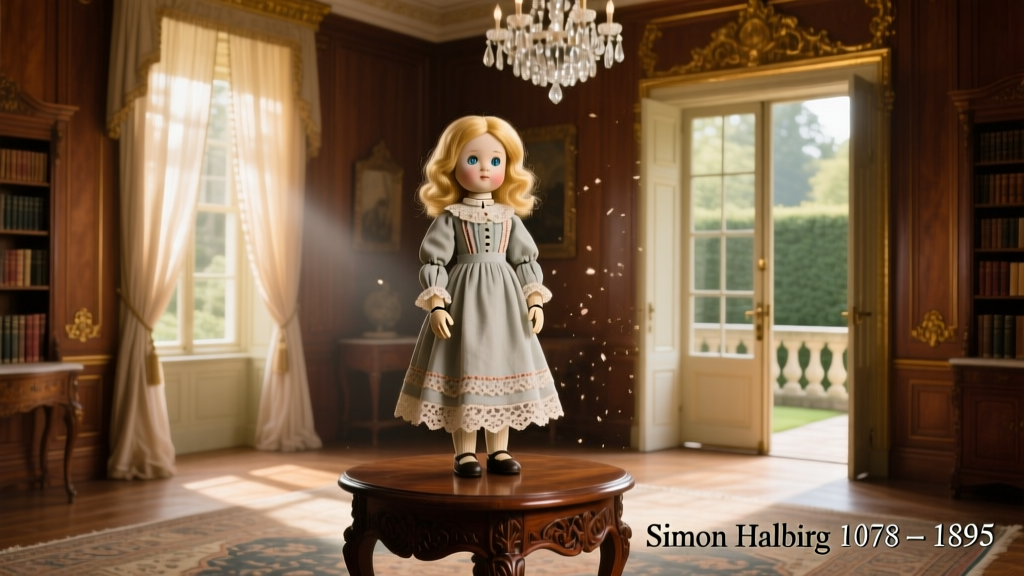
Simon & Halbig Doll No. 1078: A Technical and Historical Analysis of the 28-Inch Jointed Composition Blond Doll with Original Antique Clothing
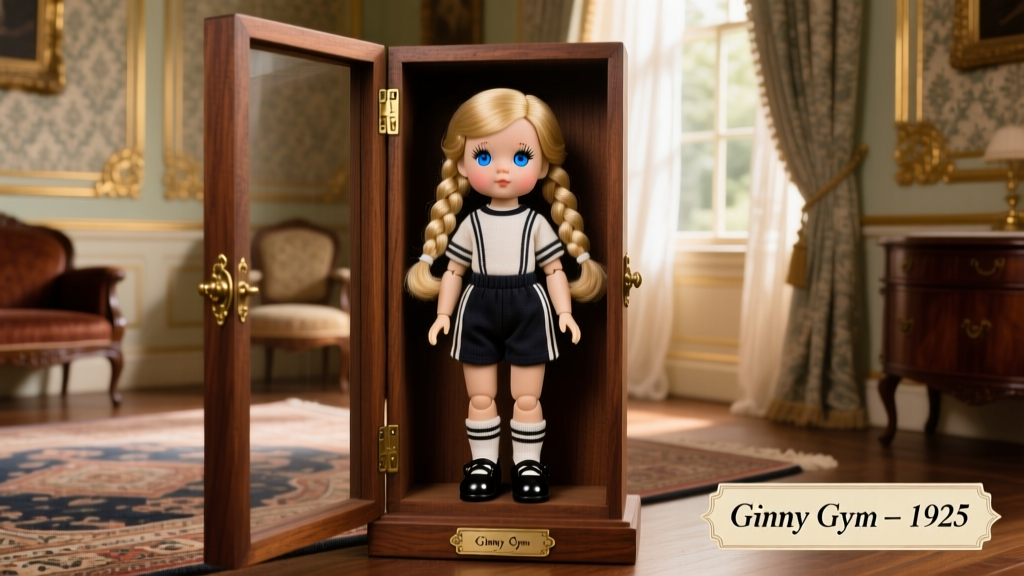
Vogue Ginny Gym Kids Doll (1963–1967): Authentic Identification, Restoration Guidance, and Market Context for the Blond Braided Wig, Blue Eyes, Black Shoes Variant in Original 8-Inch Box
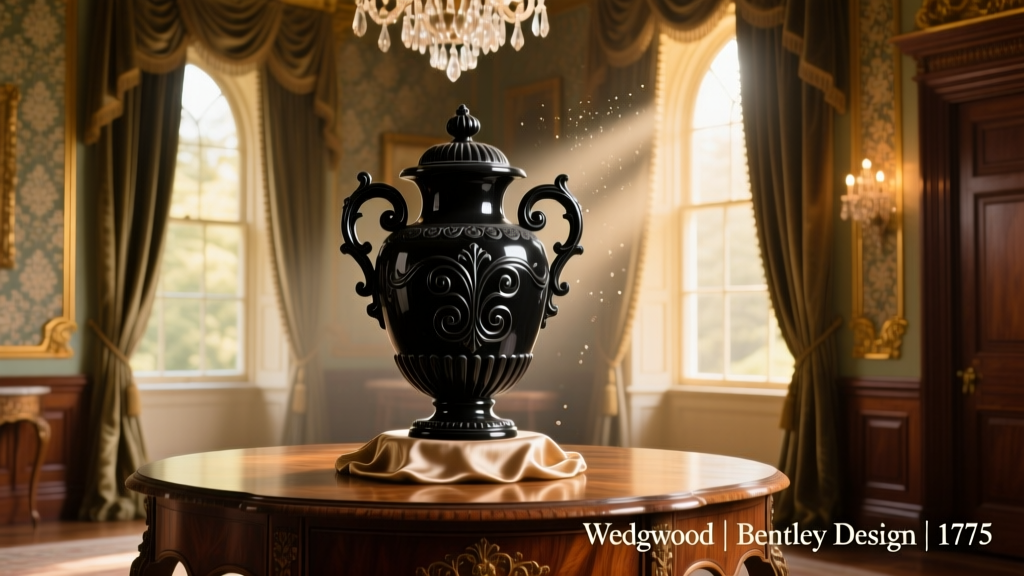
Wedgwood Black Basalt Vase Cover with Scrolled Handles: The Bentley Design of 1775, Measuring 12¾ Inches
Moxie Muriel Ostriche Advertising Cardboard (1916, 6 × 8 in): A Rare Artifact of Early American Soft Drink Promotion

Roseville Umbrella Stand in Bushberry Blue: History, Identification, and Restoration Guidance
Decoding the Old Ivory Cake Plate No. 16: A Restoration Specialist’s Analysis of the 10½-Inch Marked Piece
Weller Pottery Fruitone Vase: Decoding the Iconic Green-Brown Glaze and Shoulder Handles (4½ Inches)
Freeman & Porter Pear-Shaped Pewter Coffeepot: A 12-Inch Masterpiece of American Colonial Craftsmanship
Bauer Plainware Ashtray Orange 4-Inch: Identification, Value, and Restoration Insights for Collectors