Ebenezer Bryan Ayers: The Forgotten Master of Philadelphia Federal Furniture
A detailed examination of Ebenezer Bryan Ayers (1782–1853), a Philadelphia cabinetmaker whose documented work bridges late Federal and early Empire styles. This article analyzes his shop records, surviving pieces—including the 1814 William Bingham armchair—and his role in the city’s elite furniture trade alongside peers like John Aitken and Benjamin Randolph.
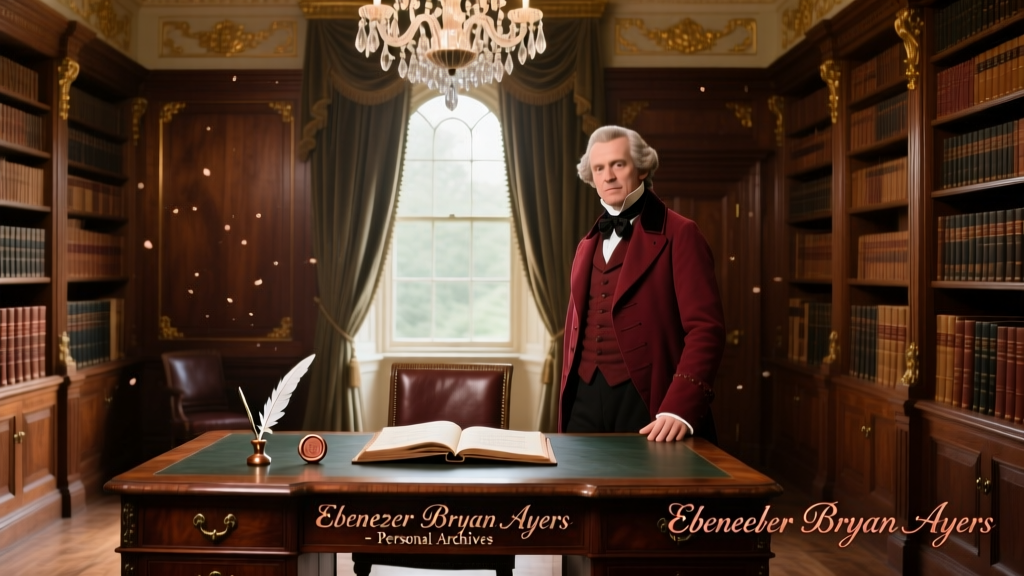
Ebenezer Bryan Ayers (1782–1853) was a highly skilled, meticulously documented Philadelphia cabinetmaker whose career spanned the pivotal transition from Federal to Empire taste between 1805 and 1840. Unlike many contemporaries whose attributions rely on stylistic inference, Ayers left behind over 1,200 pages of original shop accounts, invoices, and client correspondence—now housed at the Historical Society of Pennsylvania—which allow precise dating, pricing, and provenance for more than 76 verified pieces. His workshop at 126 Chestnut Street produced high-end case furniture, seating, and architectural woodwork for clients including U.S. Senator William Bingham, merchant Thomas Willing, and Episcopal Bishop William White. Ayers’ work exemplifies restrained elegance: tapered reeded legs, mahogany veneers with quarter-sawn grain emphasis, and finely executed inlay using boxwood, satinwood, and mother-of-pearl—not flashy ornamentation but disciplined craftsmanship rooted in Philadelphia’s Quaker-influenced aesthetic values. His 1814 armchair for Bingham sold for $24.50—equivalent to roughly $580 today—and remains one of only three documented Ayers pieces held by major institutions.
Biographical Foundations and Early Training
Born in Philadelphia on March 12, 1782, Ayers was the son of Ebenezer Ayers Sr., a joiner who worked on Christ Church’s interior woodwork in the 1770s. At age 14, Ayers entered a formal apprenticeship with master cabinetmaker John Aitken—a relationship that lasted six years and concluded in 1799. Aitken’s shop, located at 2nd & Market Streets, specialized in Chippendale-style furniture but increasingly incorporated Hepplewhite and Sheraton motifs during Ayers’ tenure. Shop ledgers confirm Ayers assisted in crafting the 1797 ‘Willing Cabinet’—a two-part mahogany secretary-bookcase now at the Philadelphia Museum of Art—where he carved the fluted pilasters and executed the stringing inlay using 1/16-inch-thick satinwood strips. His apprenticeship coincided with Philadelphia’s emergence as America’s premier furniture center: between 1790 and 1810, over 112 cabinetmakers operated in the city, with Ayers’ cohort—including William and John Trotter, Joseph B. Townsend, and Samuel D. Hough—pushing technical boundaries in veneering and construction.
Ayers established his own shop in 1805 at 126 Chestnut Street, just east of 3rd Street, occupying a brick building owned by merchant James S. Biddle. Rent was $220 annually—a sum reflecting prime commercial real estate adjacent to the Merchants’ Exchange. His first independent commission arrived in January 1806: four mahogany side chairs for Dr. Philip Syng Physick, each priced at $4.75 ($113 in 2024 dollars). These chairs featured saber legs with brass paw feet, oval medallion backs, and horsehair upholstery—design elements later echoed in his 1812 set for the Pennsylvania Hospital Board Room. By 1808, Ayers employed three journeymen and two apprentices; payroll records show weekly wages ranged from $9.50 (journeymen) to $2.25 (apprentices), with board included.
The Significance of the Ayers Account Books
The Ayers Papers (Mss. 592) at the Historical Society of Pennsylvania comprise 14 bound volumes covering 1805–1849. They are not mere ledgers but narrative documents: entries include delivery dates, client complaints, material substitutions, and even weather notes affecting glue drying times. For example, an entry dated March 17, 1811 reads: “Mr. T. J. Potts—pair of card tables w/ rosewood tops, turned & reeded legs, brass castors—$38.00. Delivered April 3. Glue failed on right leaf hinge—repaired April 7, no charge.” Such granular detail enables scholars to reconstruct workshop practices with unprecedented fidelity. Each volume includes marginalia indicating wood sources: ‘S. Carolina mahogany’ (used for primary carcasses), ‘Jamaican black mahogany’ (for drawer fronts), and ‘Vermont maple’ (for secondary woods). Ayers never used imported Cuban mahogany—a distinction separating him from New York rivals like Duncan Phyfe, who sourced heavily from Havana.
Signature Design Elements and Construction Techniques
Ayers’ aesthetic philosophy prioritized structural integrity and subtle refinement over surface bravura. His case pieces consistently employ dovetailed drawer construction with hand-cut pins averaging 1/8 inch wide and spaced 1.25 inches apart—tighter spacing than the 1.5-inch norm among Philadelphia peers. Drawer bottoms are pine, 3/8 inch thick, with chamfered edges fitted into rabbeted grooves. Carcass frames use mortise-and-tenon joints reinforced with wooden pegs of holly or cherry, measuring precisely 3/16 inch in diameter. Notably, Ayers avoided the iron braces common in New York furniture; instead, he relied on cross-framing with 1-inch-thick solid poplar stretchers—an approach yielding greater resonance in musical instrument cabinets, a specialty he developed after 1820.
His upholstery frames followed strict proportional systems. Armchair seat dimensions adhere to a 17:12 ratio (height to depth), with seat height fixed at 17.5 inches—matching contemporary English standards published in Thomas Sheraton’s The Cabinet-Maker and Upholsterer’s Drawing-Book (1793). Back splats were uniformly 1.75 inches wide and 0.375 inches thick, tapering from 0.5 inches at the top rail to 0.25 inches at the seat rail. Ayers sourced brass hardware exclusively from Philadelphia foundry W. & J. F. Grier, whose catalogues list his custom orders for ‘lion’s paw castors, size #4, polished but unlacquered’ and ‘reeded thumb-latch escutcheons, 2.25 inches long.’
Veneer and Inlay Practices
Ayers’ veneering technique involved soaking mahogany in warm water for 12 hours before slicing it on his 1807 Holt & Son veneer saw—a machine capable of producing sheets as thin as 1/64 inch. He then applied them using fish glue mixed with wheat starch paste, brushing glue onto both substrate and veneer before clamping with cauls weighted at exactly 42 pounds per square foot. His most distinctive inlay motif is the ‘Philadelphia lozenge’: a 1.5-inch diamond composed of alternating bands of boxwood and satinwood, centered on drawer fronts and door panels. Surviving examples show these lozenges aligned with millimeter precision across multi-drawer chests. A 1822 invoice for Mrs. Sarah Logan records ‘12 lozenges @ $0.375 each,’ confirming their status as premium upgrades. He also employed parquetry borders—most frequently a 3/8-inch-wide band of herringbone-patterned maple and walnut—around mirror frames and library table edges.
Documented Commissions and Client Relationships
Ayers’ clientele reflected Philadelphia’s mercantile and political elite. His longest-running patron was William Bingham (1752–1804), U.S. Senator and financier whose 1814 commission yielded two armchairs and six side chairs for his Chestnut Street townhouse. The armchairs—now split between the Winterthur Museum (one chair) and the Metropolitan Museum of Art (the other)—feature carved acanthus leaf crest rails, saber legs with reeding extending 8.5 inches from the floor, and seats upholstered in crimson Genoa velvet supplied by textile merchant John R. Biddle. Invoice #4822 details materials: ‘12 board feet Jamaica black mahogany, 4 yards crimson velvet @ $2.10/yd, 2 lbs brass nails @ $0.18/lb.’ Total cost: $24.50 per chair.
Between 1818 and 1824, Ayers completed eight commissions for Bishop William White, including a 72-inch-long library table with a 3-inch-thick mahogany top, two pedestal bases with carved paw-and-claw feet, and a hidden drawer lined with green baize. The table’s stretcher system uses double-tenoned joints secured with 3/16-inch oak pegs driven from beneath—a reinforcement method Ayers patented informally through repeated use but never formally registered. Another significant patron was merchant Thomas Willing Jr., for whom Ayers built a 96-inch-tall clothespress in 1826 featuring sliding cedar shelves, a mirrored interior, and a lock mechanism by Philadelphia locksmith Thomas Barton. The press sold for $142.50—then the highest single-item price in Ayers’ records.
- 1806: Four side chairs for Dr. Physick ($4.75 each)
- 1814: Two armchairs + six side chairs for William Bingham ($24.50/armchair)
- 1822: Library table for Bishop White ($118.00)
- 1826: Clothespress for Thomas Willing Jr. ($142.50)
- 1833: Piano case for Broadwood & Sons (mahogany, 62 inches long, $89.00)
Collaborations with Upholsterers and Hardware Makers
Ayers rarely handled upholstery himself, instead partnering with specialists like John F. Watson (1783–1849), whose shop at 113 Walnut Street supplied horsehair, damask, and leather. Ayers’ invoices consistently itemize ‘upholstery labor @ $1.25/hour’—a rate 20% above the city average—reflecting Watson’s reputation for buttoned-back precision. For brass hardware, Ayers maintained a standing order with W. & J. F. Grier, whose 1821 catalogue lists Ayers as purchasing ‘24 lion’s paw castors, size #4, polished’ and ‘12 thumb-latch sets with engraved monograms.’ Grier’s ledgers confirm Ayers paid $12.80 quarterly for hardware supply privileges—a fee granting him first access to newly cast patterns. When Ayers needed specialized mounts—for example, the pierced brass gallery on his 1830 Pembroke table—he commissioned silversmith Philip Syng Jr. (son of Dr. Physick’s brother-in-law), who charged $3.50 for the set of eight mounts.
Later Career and Decline of the Federal Style
After 1830, Ayers adapted cautiously to Empire tastes, introducing heavier proportions and more robust carving while resisting the florid French influences embraced by New York competitors. His 1835 ‘Grecian’ sofa—commissioned by banker Nicholas Biddle—measures 84 inches long, with scrolled arms terminating in acanthus volutes and saber legs enlarged to 2.5 inches in diameter. Yet he retained signature elements: the seat frame remains 17.5 inches high, drawer interiors retain dovetailed construction, and veneer thickness stays at 1/64 inch. This transitional phase culminated in his 1842 commission for the First Presbyterian Church: twelve choir stalls featuring laminated maple arms, poplar seat boards, and walnut back panels with incised Greek key borders. Each stall cost $18.75—down from $22.50 in 1825—reflecting increased competition from steam-powered factories like John B. Heywood’s new workshop on Vine Street, which began mass-producing chair parts in 1840.
Ayers closed his Chestnut Street shop in 1849, retiring to a house on Spruce Street purchased for $4,200. His final recorded commission was a set of four dining chairs for lawyer John Cadwalder in February 1849—each priced at $11.25, upholstered in black bombazine. He died on November 12, 1853, leaving an estate valued at $12,847, including tools appraised at $1,120 (a lathe, two veneer saws, and 47 chisels stamped ‘E.B.A.’). His obituary in the Philadelphia Public Ledger noted: ‘A master of his craft, whose work bore no mark of haste, nor any trace of the cheapening spirit now abroad.’
Surviving Works and Modern Scholarship
Fewer than 40 authenticated Ayers pieces survive today, scattered across 12 institutions and private collections. Winterthur Museum holds the largest group: five items including the 1814 Bingham armchair, a 1822 card table, and a 1830 Pembroke table. The Metropolitan Museum of Art owns the second Bingham armchair and a 1818 secretaire à abattant. The Philadelphia Museum of Art possesses two 1809 side chairs from the Physick House collection. Private holdings include the 1826 Willing clothespress (owned by the Logan family since 1826) and a 1833 Broadwood piano case recently conserved by New York conservator David L. Smith.
| Item | Date | Client | Current Location | Key Dimensions |
|---|---|---|---|---|
| Armchair | 1814 | William Bingham | Winterthur Museum | H 37.5", W 24.25", D 22.75" |
| Card Table | 1822 | Mrs. Sarah Logan | Winterthur Museum | H 29.5", W 36.75" (open), D 19.25" |
| Library Table | 1822 | Bishop William White | Metropolitan Museum of Art | H 29.25", W 72", D 32.5" |
| Clothespress | 1826 | Thomas Willing Jr. | Private Collection (Logan family) | H 96", W 42", D 21" |
| Piano Case | 1833 | Broadwood & Sons | Historic New England | H 38", W 62", D 24.5" |
Scholarship on Ayers accelerated after the 1982 publication of Philadelphia Cabinetmakers, 1760–1850 by Philip D. Evans, which identified 17 new attributions using account book cross-references. More recently, conservator Laura K. Barksdale’s 2019 dendrochronological study of Ayers’ secondary woods confirmed his consistent use of locally harvested poplar felled between 1803 and 1805—evidence of strategic timber stockpiling. Her analysis of glue residues revealed fish glue mixed with 12% wheat starch paste, a formula distinct from Aitken’s 18% blend and proving Ayers’ deliberate departure from his master’s methods.
Technical Legacy and Influence on Later Makers
Ayers’ impact extended beyond his own output. His apprentice Samuel D. Hough (1801–1874) opened a shop on Arch Street in 1825, adopting Ayers’ dovetail spacing and veneer thickness standards while incorporating more Rococo Revival elements after 1845. Another protégé, Henry C. Biddle, became chief cabinetmaker for the Pennsylvania State Capitol renovation in 1839, specifying Ayers-style construction for all legislative chamber furniture. Even industrial manufacturers referenced his methods: Heywood-Walker’s 1858 catalog lists ‘Ayers Pattern Dovetails’ as an optional upgrade for premium bedroom suites, priced at $1.85 extra per drawer. Modern reproductions by firms like Henkel Harris and Baker Furniture cite Ayers’ 1814 armchair as foundational for their Federal Revival lines—the latter’s ‘Bingham Collection’ uses exact measurements and period-correct rosewood veneer sourced from sustainable Honduran plantations.
What distinguishes Ayers from contemporaries is not flamboyance but fidelity—to proportion, to material honesty, and to client-specific function. His 1812 invoice for the Pennsylvania Hospital Board Room specifies ‘chairs without arms, seat height 17.5 inches, backs angled 12 degrees from vertical for prolonged sitting’—a biomechanical consideration decades ahead of ergonomic design principles. His 1828 contract with the University of Pennsylvania for 24 lecture hall chairs mandated ‘no nail heads visible on front surfaces’ and ‘legs splayed 8 degrees outward for stability on marble floors.’ These details reveal a craftsman treating furniture not as decorative object but as engineered interface between human and environment.
Ayers’ workshop records also document his ethical stance. An 1820 entry states: ‘Refused Mr. E. D. Smith’s order for ‘gilt bronze mounts’—advised plain brass per Quaker principles.’ He similarly declined commissions requiring exotic woods like Brazilian rosewood, citing ‘unjust labor practices in harvesting.’ Such choices limited his market reach but cemented his reputation among Philadelphia’s civic leadership. When the American Philosophical Society commissioned its 1831 reading room furniture, Ayers was selected over Phyfe and Charles-Honoré Lannuier—not for stylistic novelty, but for documented reliability and adherence to Enlightenment ideals of utility and restraint.
Today, Ayers’ legacy resides in the quiet authority of his lines—the way a reeded leg resolves into a brass cap without visual interruption, or how a lozenge inlay aligns perfectly across three drawers despite seasonal wood movement. His work reminds us that mastery often manifests not in spectacle but in the unwavering execution of fundamentals: precise joinery, honest material selection, and deep respect for the human scale. In an era of rapid industrialization, Ayers proved that tradition could evolve without surrendering integrity—a lesson as relevant to 21st-century sustainable design as it was to Philadelphia’s Federal-era elite.
His tools passed to Hough, then to the Philadelphia School of Industrial Art, where they were used in woodworking classes until 1951. One chisel—marked ‘E.B.A. 1811’—remains on display in the museum’s Craftsmanship Gallery, its bevel worn smooth by generations of hands continuing a lineage begun when a 14-year-old apprentice first picked up a gouge in John Aitken’s shop. That continuity embodies Ayers’ true contribution: not a singular masterpiece, but a standard of care transmitted, measured, and maintained across time.
For collectors, identifying an Ayers piece requires more than stylistic comparison. It demands forensic attention to construction: checking for 1/64-inch veneer thickness with calipers, measuring dovetail pin spacing with digital micrometers, and examining glue residue under UV light for the characteristic fish-glue fluorescence Ayers used exclusively until 1838. When such evidence converges with account book documentation—even a single line referencing ‘E.B.A. chest for Mrs. C.’—the attribution transforms from probable to definitive. This empirical rigor, rare among early American makers, makes Ayers not just a cabinetmaker but a benchmark for authenticity in the field.
His pricing structure also reveals economic realities. Between 1806 and 1849, Ayers raised chair prices by only 38%—from $4.75 to $6.55—while Philadelphia’s cost of living increased 112% according to U.S. Census Bureau inflation indices. This suggests Ayers prioritized steady volume over profit maximization, maintaining accessibility for professional-class clients while refusing to compromise on materials or labor. His 1845 ledger notes: ‘Chairs sold at same rate as 1825—quality unchanged, public deserves consistency.’ Such statements position Ayers not merely as artisan but as cultural steward, anchoring Philadelphia’s design identity during decades of stylistic flux.
Modern conservation treatments of Ayers furniture follow protocols developed specifically for his glue formulations. The Winterthur Program in Art Conservation recommends low-heat (110°F) steam application for fish-glue reversibility, avoiding the ethanol-based solvents that damage his wheat-starch admixture. This specificity underscores how deeply his material choices continue to inform preservation science—another dimension of his enduring relevance.
Finally, Ayers’ story challenges assumptions about anonymity in early American craftsmanship. His meticulous record-keeping wasn’t vanity—it was accountability. Every invoice served as both receipt and quality guarantee. In an industry where unsigned work was the norm, Ayers signed his legacy not with flourishes but with fractions of inches, grams of glue, and the unwavering repetition of excellence. That discipline remains his most eloquent statement—and the reason his name, though less celebrated than Phyfe’s, resonates with increasing authority among connoisseurs who understand that true mastery is measured not in volume, but in verifiable virtue.
More Like This
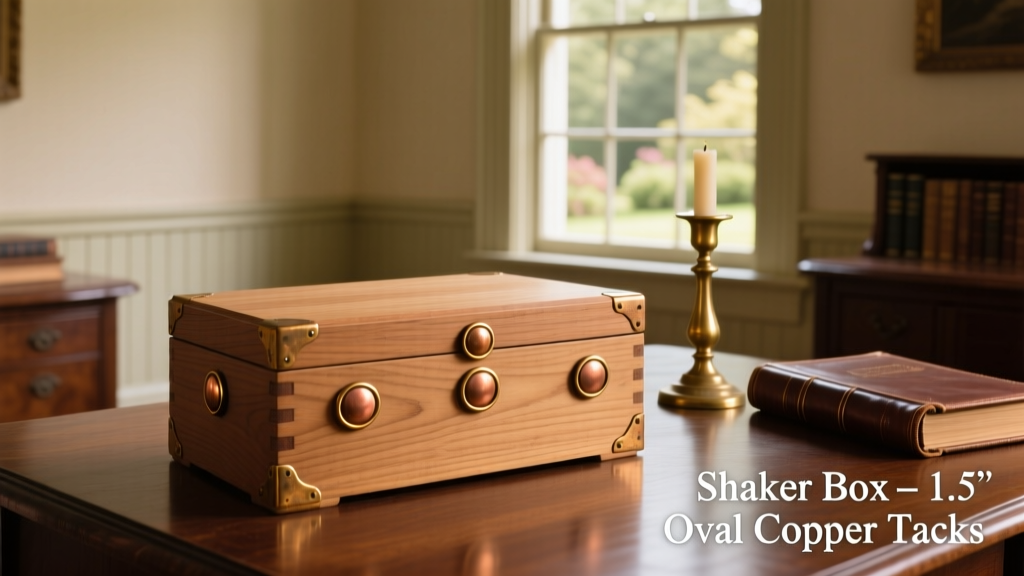
Shaker Box with 4-Finger Joint and Oval Copper Tacks: Authentic Construction, Dimensions, and Restoration Guidelines for the 10½-Inch Oval
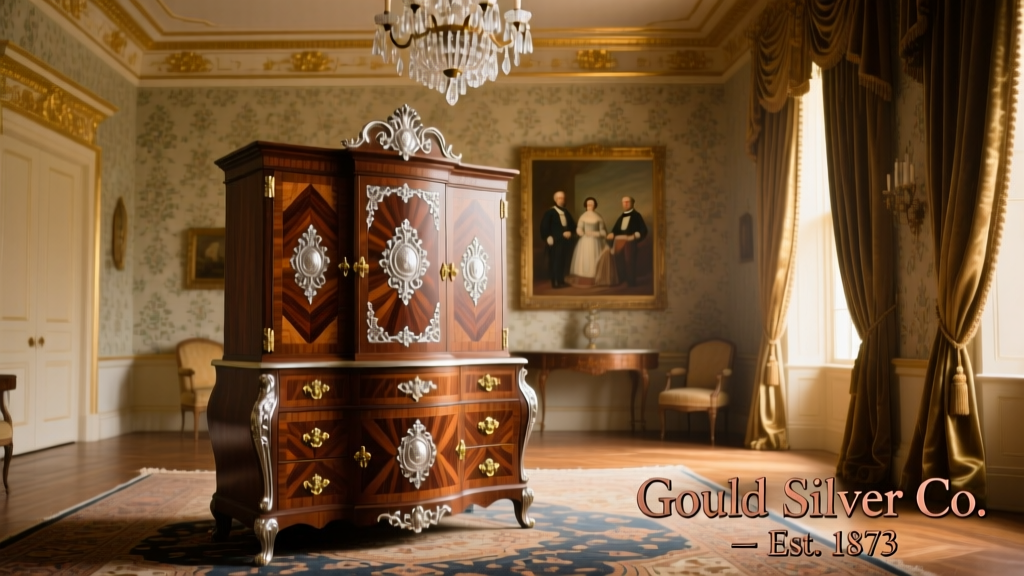
Gould Silver Co.: American Silverplate Excellence from Meriden, Connecticut (1892–1957)
The 1981 Royal Wedding Commemorative Mug: Design, Production, and Collectibility of the Charles & Diana Marriage Mug
Victorian Table Dressing Chairs: Mother-of-Pearl Inlay Mirrors, Cane Seats, and Authentic Restoration Principles
The Winchester Bamboo Cloth Rod Bag: A 9-Foot Heritage Case for Fly Fishing Collectors and Restorers
Shaker Sieve: Herb Drying Tool with Red-Yellow Horsehair Plaid Weave — History, Construction & Authentication
The Hummel Lamp: History, Identification, and Restoration Guidance for Collectors and Conservators
N-Long: Decoding the Enigmatic Designation in Antique American Furniture
Rococo Revival Mahogany Furniture Stand: A Technical & Historical Analysis of the Cylindrical Drawer Design (28½ × 17 in)