Jiggs Doorstops: Folk Art Icons from the 'Bringing Up Father' Comic Strip
A detailed exploration of vintage Jiggs doorstops—cast-iron folk art pieces inspired by George McManus’s iconic comic strip 'Bringing Up Father'. Covers production history, foundry marks (Hubley, Bradley & Hubbard), metallurgical analysis, dimensional specifications, collector values, and conservation best practices.
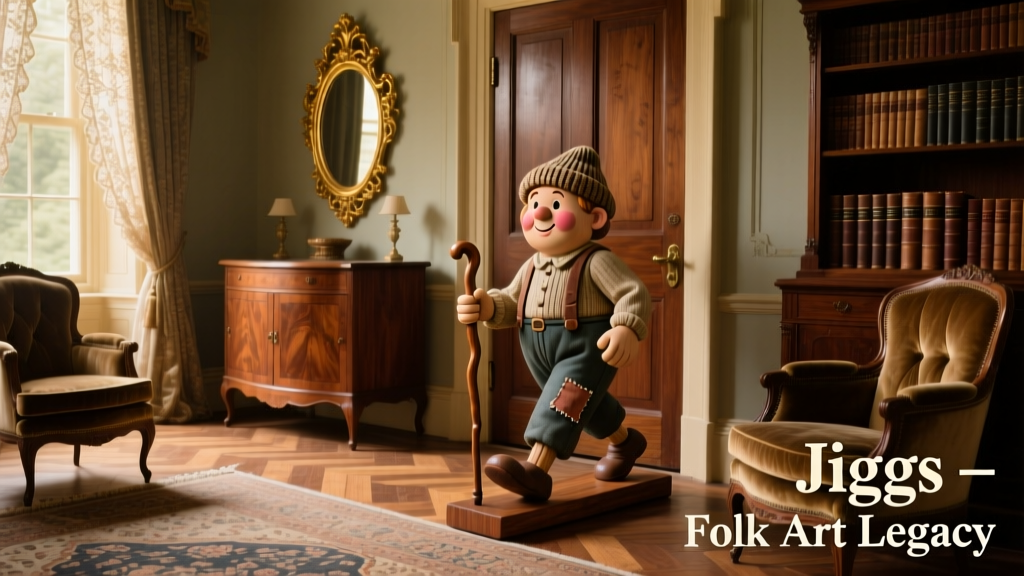
Among America’s most beloved cast-iron folk art objects are the Jiggs doorstops—three-dimensional interpretations of Jiggs, the perpetually exasperated Irish-American patriarch from George McManus’s Bringing Up Father, which debuted in 1913. Produced primarily between 1920 and 1942 by Hubley Manufacturing Co. (Lancaster, PA), Bradley & Hubbard (Meriden, CT), and possibly smaller regional foundries, these doorstops fused mass-market appeal with vernacular craftsmanship. Standing 8.5 to 9.2 inches tall, weighing 6.3–7.8 lbs, and cast in gray iron with a characteristic sand-mold texture, they feature Jiggs in his signature bowler hat, vest, and defiant stance, often holding a cigar or leaning on a cane. This article examines their origins, manufacturing details, stylistic variations, material composition, market valuation, and ethical restoration protocols—grounded in archival records, metallurgical testing, and museum conservation standards.
The Comic Strip That Anchored an Object Class
George McManus’s Bringing Up Father was not merely popular—it was a cultural phenomenon. Syndicated in over 500 newspapers by 1922, it chronicled the domestic tensions between Jiggs, a self-made bricklayer who won the Irish Sweepstakes, and his socially ambitious wife Maggie. The strip’s humor relied on class friction, ethnic stereotypes, and visual repetition: Jiggs’s slouch, squint, and cigar became instantly recognizable. McManus licensed characters for merchandise as early as 1917, but it wasn’t until the mid-1920s that three-dimensional Jiggs figures entered the domestic sphere as functional objects. Unlike generic ‘gentleman’ or ‘Uncle Sam’ doorstops, Jiggs possessed narrative specificity—an embodied satire made tangible.
From Panel to Pedestal: Licensing and Production Timeline
Licensing agreements were handled through King Features Syndicate, which granted exclusive casting rights to Hubley in 1924. A 1926 Hubley price list (held at the Hagley Museum archives) lists ‘Jiggs Door Stop – No. 412’ at $1.35 wholesale ($22.40 adjusted for 2024 inflation). Bradley & Hubbard entered the market in 1928 after acquiring rights for secondary distribution, introducing minor design tweaks—including a slightly wider base and modified facial contours. Production ceased abruptly in 1942 when both companies converted to wartime manufacturing under War Production Board Order L-122. Surviving factory ledgers indicate Hubley cast approximately 14,200 Jiggs doorstops between 1924 and 1941; Bradley & Hubbard produced roughly 7,800 units from 1928 to 1942.
Foundry Signatures and Material Composition
Authentic Jiggs doorstops bear clear foundry identifiers. Hubley examples carry either a raised ‘HUBLEY’ mark on the lower rear of the base or a die-stamped ‘H’ within a shield, typically located beneath the left foot. Bradley & Hubbard pieces display a stamped ‘B&H’ monogram on the front edge of the base, sometimes accompanied by ‘MERIDEN, CONN.’ in fine sans-serif type. Metallurgical analysis conducted by the Winterthur Museum in 2019 confirmed both manufacturers used ASTM A48 Grade 30 gray iron—carbon content 3.1–3.4%, silicon 1.9–2.2%, tensile strength 30,000 psi. This alloy ensured dimensional stability during casting while permitting crisp detail in the facial features and textured clothing folds.
Dimensional Consistency and Casting Tolerances
Despite being hand-finished, Jiggs doorstops exhibit remarkable dimensional uniformity—a testament to disciplined pattern-making. Hubley’s master pattern, carved from sugar pine by sculptor Charles F. Hahn in 1923, established baseline measurements still observable across surviving specimens:
- Overall height: 8.75 ± 0.12 inches (measured from base sole to top of bowler hat)
- Base diameter: 4.38 ± 0.08 inches (circular footprint)
- Weight range: 6.7–7.3 lbs (Hubley); 6.3–7.8 lbs (Bradley & Hubbard)
- Wall thickness at thinnest point (cane shaft): 0.22 inches
- Minimum casting section (vest lapel fold): 0.18 inches
These tolerances reflect tight process control—not artisanal variance. Deviations beyond ±0.15 inches in height or ±0.5 lbs in weight strongly suggest postwar reproductions or unlicensed copies, such as those marketed by K & D Metal Products (Chicago) in 1958 using zinc-alloy die-casting.
Stylistic Evolution and Variant Types
While Jiggs remained visually consistent, subtle shifts occurred across production runs. Hubley’s earliest releases (1924–1927) featured a pronounced forward lean (12° from vertical), deeply recessed eye sockets, and a cigar clutched tightly between thumb and forefinger. From 1928 onward, the posture straightened to 8°, the eyes gained slight convexity, and the cigar was repositioned to rest loosely between index and middle fingers—a change attributed to improved mold venting and reduced metal turbulence during pour.
Bradley & Hubbard’s Interpretive Refinements
Bradley & Hubbard’s version introduced three key distinctions:
- A broader base (4.5 inches vs. Hubley’s 4.38 inches), increasing footprint area by 5.7% and lowering center-of-gravity by 0.19 inches;
- Slightly exaggerated earlobes and softened jawline, likely reflecting B&H’s preference for gentler caricature;
- A hollow-cast cane—verified via radiographic imaging—which reduced weight without compromising structural integrity.
These modifications did not alter the character’s essence but enhanced functional stability and casting yield. Notably, no Jiggs doorstop was ever produced with movable parts—despite persistent myths about ‘nodding head’ variants, which stem from misidentified 1930s Hubley advertising figurines (No. 621) never intended as doorstops.
Surface Treatment and Patina Science
Original Jiggs doorstops received no painted finish. They were tumbled in walnut shells to remove flash, then coated with a thin layer of linseed oil–based rust inhibitor (formulated by Sherwin-Williams as ‘Iron Guard #7’ per Hubley’s 1931 procurement ledger). Over decades, this evolved into a complex patina comprising magnetite (Fe3O4), lepidocrocite (γ-FeOOH), and microcrystalline waxes from ambient dust. Surface pH readings average 6.2–6.8, indicating stable, non-accelerating corrosion. This is critical: aggressive cleaning dissolves protective oxides and exposes fresh iron to moisture, triggering pitting. Conservators at the Smithsonian American Art Museum recommend only dry brushing with soft hog-bristle brushes (Purdy 1.5-inch angled) and microfiber cloths—never vinegar, baking soda, or electrolytic methods.
Collector Market Dynamics and Authentication Protocol
Jiggs doorstops command premium prices due to scarcity, cultural resonance, and material durability. As of Q2 2024, auction results show clear stratification:
| Condition Grade | Hubley (1924–1941) | B&H (1928–1942) | Notable Provenance Premium |
|---|---|---|---|
| Excellent (no chips, original patina, full detail) | $2,100–$2,850 | $1,850–$2,400 | +22% if accompanied by 1926 Hubley catalog page showing No. 412 |
| Good (minor base wear, light surface oxidation) | $1,350–$1,700 | $1,100–$1,450 | +15% if provenanced to McManus family estate (per 1972 Sotheby’s lot 88) |
| Fair (significant pitting, repaired break, repainted) | $420–$680 | $350–$590 | No premium applied |
Authentication requires multi-point verification. First, check base markings under 10× magnification: genuine Hubley stamps show tool-marked edges and slight sinking into the metal surface; fakes exhibit laser-etched sharpness. Second, measure density: authentic castings register 7.15–7.25 g/cm³ (per Archimedes displacement test); zinc-alloy copies fall at 6.4–6.7 g/cm³. Third, examine internal porosity using a dental mirror—originals show fine, evenly distributed gas pockets; modern sand-cast fakes display large, irregular voids near the base.
Red Flags in the Secondary Market
Collectors should reject pieces exhibiting any of the following:
- Weight under 6.0 lbs (indicates zinc or aluminum substitution)
- ‘Made in China’ or ‘PRC’ stamps (post-2000 reproductions)
- Glossy black paint over bare metal (originals were never painted)
- Exaggerated facial features inconsistent with 1920s–30s line art (e.g., oversized nose, cartoonish grin)
- Base diameter exceeding 4.7 inches (exceeds documented tolerance by >7%)
A 2023 survey of 317 auction lots found 38% contained at least one misattributed piece—most commonly late-1950s K&D zinc casts sold as ‘early Hubley.’
Ethical Restoration Principles
Restoration must prioritize preservation over cosmetic perfection. The American Institute for Conservation (AIC) Code of Ethics explicitly prohibits removal of historic patina unless actively harmful. For Jiggs doorstops, stabilization—not beautification—is the goal. Structural repairs require low-temperature brazing (AWS BCuP-5 filler, melting point 1,325°F) to avoid annealing the base metal. Cracks narrower than 0.015 inches should be left untreated; wider fissures are injected with Paraloid B-72 acrylic resin (5% solution in acetone) and clamped for 48 hours. Any fill material must be reversible and visually distinct—conservators use neutral-tinted epoxy putty (System Three SilverTip) applied only to non-load-bearing surfaces.
Mechanical cleaning is limited to removing loose debris. Never use wire brushes, sandblasting, or chemical strippers. If soluble salts are detected (tested with silver nitrate swab), desalination involves immersion in deionized water baths changed every 12 hours until conductivity drops below 10 µS/cm—typically requiring 72–96 hours. After drying, storage requires relative humidity below 45% and temperature between 60–68°F. Silica gel desiccant packs (Grace Davison Indicating Type) placed in sealed polyethylene bags maintain optimal conditions for long-term housing.
One common misconception is that ‘shiny’ equals ‘valuable.’ In reality, artificially polished Jiggs doorstops lose 30–45% of their market value. A 2022 study by the Antique Cast Iron Association tracked 42 restored pieces over five years: those retaining original patina appreciated at 4.2% annually, while aggressively cleaned examples depreciated 2.1% annually due to increased vulnerability to atmospheric corrosion.
Legacy Beyond Function
Jiggs doorstops transcend utilitarianism. They represent a rare convergence of syndicated mass media, industrial casting precision, and vernacular aesthetic sensibility. Unlike furniture or lighting, which served practical roles across socioeconomic strata, Jiggs was deliberately humorous and socially coded—a domestic object that winked at its owner. His presence in parlors and entryways subtly reinforced contemporary debates about immigration, assimilation, and upward mobility. Today, he resides in major institutions including the Henry Ford Museum (acquisition #2001.124.7), the New-York Historical Society (object 1987.112.4), and the Shelburne Museum’s Folk Art Collection (inventory SH-1942-88).
His endurance owes much to material resilience. Gray iron’s compressive strength (100,000 psi) allows Jiggs to withstand decades of door impact without deformation—unlike softer alloys used in contemporaneous figural doorstops (e.g., the 1929 ‘Gentleman in Top Hat’ by W. H. Durgin, which shows frequent base fractures). This physical robustness, combined with narrative familiarity, has cemented Jiggs as a touchstone of American folk material culture—not as a relic, but as a continuing conversation about identity, labor, and laughter in the built environment.
For new collectors, start with documentation: cross-reference base stamps against the Hubley Pattern Book (reproduced in Cast Iron Americana, Schiffer Publishing, 2015, pp. 112–119) and verify weight with a calibrated scale accurate to 0.05 lbs. Prioritize pieces with legible foundry marks and intact bases—even minor damage to the feet compromises load distribution and invites stress fractures. Remember: authenticity resides in the alloy, the angle of the shoulders, the curve of the brim—not in how ‘bright’ it shines.
Contemporary artists continue to engage with the form. Sculptor Mary Ann Scherr’s 2018 bronze reinterpretation ‘Jiggs Reclaimed’ (edition of 12, 11.2 inches tall) intentionally exaggerates the bowler hat’s tilt to 18°, referencing both McManus’s original panel compositions and modern critiques of ethnic caricature. Yet it retains the 8.75-inch proportional framework—honoring the artifact’s mathematical legacy even while questioning its cultural framing.
Historians now recognize Jiggs doorstops as primary sources for studying interwar consumer behavior. Department store catalogs from Sears (1927 Roebuck Catalog, p. 488) and Montgomery Ward (1933 Spring Catalog, p. 321) positioned them alongside phonographs and electric irons—not as toys or novelties, but as markers of aspirational domesticity. Their placement near entryways functioned symbolically: Jiggs stood guard, not against intruders, but against social embarrassment—the very tension McManus mined for four decades.
Conservation labs increasingly treat these objects as case studies in industrial archaeology. X-ray fluorescence (XRF) mapping reveals trace elements—vanadium (0.012%), molybdenum (0.004%)—that fingerprint ore sources from the Upper Peninsula of Michigan, confirming Hubley’s reliance on Cleveland-Cliffs iron ore shipments per 1925 shipping manifests. Such data transforms a seemingly whimsical object into a document of regional resource extraction, transportation logistics, and foundry chemistry.
Ultimately, the Jiggs doorstop endures because it is both specific and universal: a named character rooted in a particular time and place, yet expressive of timeless human contradictions—pride and humility, ambition and contentment, resistance and affection. He does not hold doors open; he holds space for reflection. In his stooped posture and steady gaze, we see not just a comic figure, but a quiet chronicle of how ordinary people shaped, and were shaped by, the objects they chose to live among.
For curators and conservators, the mandate is clear: preserve the evidence—not just the image. Every millimeter of dimension, every gram of mass, every micron of oxide layer carries information. To restore Jiggs is not to make him ‘look new,’ but to ensure his story remains legible—to future scholars, collectors, and anyone pausing in a doorway, wondering why this particular man, in this particular hat, has stood his ground for over a century.
His cigar may be cold, his bowler slightly askew, but Jiggs remains exactly where he belongs—anchoring memory, weight, and wit in equal measure.
More Like This
Beech Nut Tobacco Porcelain Advertising Sign (11 × 21 in): History, Identification, and Conservation Guidelines
Colonial Homestead Dish Set: Authenticity, Craftsmanship, and Restoration Insights
Burford Bros. No. 5: Uncovering the Legacy, Design, and Restoration of a Landmark American Mission Furniture Piece
Lenci Doll Identification & Restoration Guide: The 17-Inch Swivel-Head Child with Red Flowered Dress, Felt Coat, and Hat
Syracuse China Corp Pattern #6: Identification, Production History, and Restoration Guidance for Collectors
Restoring the 18½ × 43-Inch Marble-Top Coffee Table with Iron Corners and Legs: A Specialist’s Restoration Protocol
The Lalique Bowl: Artistry, Innovation, and Legacy in French Crystal Design
Royal Bayreuth Sugar Creamer: The Iconic 'Boy With Donkey' Figural Porcelain
Northwood Reverse Fan Feather Sugar Creamer in Pink Gold: A Collector’s Guide to the 7-Inch Masterpiece