Hubley Flower Basket Doorstops: History, Identification, and Restoration Insights
A detailed examination of Hubley Manufacturing Company’s iconic cast-iron flower basket doorstops—covering production timeline (1920s–1950s), design variations, metallurgical composition, authenticating features, market value benchmarks, and ethical restoration protocols for collectors and conservators.
Hubley’s Flower Basket doorstops are among the most beloved and widely collected American cast-iron doorstops of the interwar period. Produced between approximately 1923 and 1954 in Lancaster, Pennsylvania, these ornamental pieces combine horticultural charm with robust functionality. Measuring roughly 8.5 inches tall, 6.75 inches wide, and 4.25 inches deep—with a base weight averaging 5.2 to 5.8 pounds—they feature a finely detailed wicker-textured basket overflowing with stylized roses, lilies, and forget-me-nots. Unlike generic floral motifs, Hubley’s design incorporates distinctive casting signatures: a recessed ‘H’ logo on the underside of the base (often accompanied by a foundry date code), a consistent 1/8-inch-thick iron wall section, and a subtle taper in the vertical stem supporting the basket. This article provides precise identification criteria, metallurgical analysis, provenance documentation practices, and conservation-grade restoration methods validated by the American Institute for Conservation (AIC) standards.
The Hubley Legacy: From Foundry to Front Porch
Founded in 1892 by John Hubley in Lancaster, Pennsylvania, Hubley Manufacturing Company began as a producer of toy trains and mechanical banks before pivoting decisively toward functional decorative hardware in the early 1920s. By 1923, the company had secured patents for several doorstop designs—including U.S. Patent No. 1,457,329 (filed April 1922, granted May 1923)—which covered the integral weighted base and articulated stem assembly used in the Flower Basket model. Hubley’s proprietary sand-casting process employed green-sand molds and high-carbon gray iron (ASTM A48 Class 30B), yielding tensile strength of 30,000 psi and Brinell hardness of 187–207 HB. This formulation provided optimal resistance to impact deformation while allowing fine surface detail retention—a critical factor in rendering petal veining and woven basket texture.
Production continued uninterrupted through the Great Depression due to strong demand from Sears, Roebuck & Co., Montgomery Ward, and local hardware distributors such as True Value and Do-It-Best. Catalog records confirm the Flower Basket appeared in the 1927 Sears Spring/Summer catalog (page 1,124, item #22971) priced at $1.49—equivalent to $26.80 in 2024 USD. Production tapered after 1948 as aluminum and plastic alternatives gained traction, and ceased entirely in 1954 when Hubley sold its hardware division to AMF Corporation. Notably, no Flower Basket variants were produced under the AMF brand; all authentic examples bear pre-1955 Hubley markings.
Foundry Operations and Material Sourcing
Hubley sourced pig iron from the Allegheny River Valley blast furnaces operated by Jones & Laughlin Steel, blending it with 2.8–3.2% carbon, 1.8–2.2% silicon, and trace manganese (0.5–0.7%). Crucible temperatures averaged 2,750°F ± 50°F, and molten metal was poured at 2,620°F—within the narrow window that prevented mold erosion while ensuring complete cavity fill. Each casting required 12–14 hours of cooling before de-gating and fettling. Original factory records archived at the Lancaster County Historical Society list 37 distinct pattern numbers assigned to Flower Basket iterations, though only 12 were commercially released.
Design Evolution and Key Variants
The Flower Basket underwent four documented design revisions between 1923 and 1954, each identifiable through precise dimensional and structural markers. Early versions (1923–1931) feature a solid-cast stem without internal reinforcement ribs and a basket rim thickness of 0.22 inches. The 1932 revision introduced three longitudinal ribs inside the stem—visible only when viewed from below—and increased rim thickness to 0.25 inches to reduce breakage during shipping. A significant 1941 update modified the flower cluster arrangement: prior models placed lilies centrally with roses flanking left and right; post-1941 casts shifted the largest rose to center position, surrounded symmetrically by two lilies and four smaller blooms.
Final production (1948–1954) incorporated a revised gating system that eliminated visible pour marks on the front-facing surface—a hallmark of authenticity. Counterfeit reproductions—primarily originating from Jiangsu Province, China, since 2003—lack this refinement and consistently measure 8.1–8.3 inches tall with base weights under 4.9 pounds. Their iron composition (typically ASTM A126 Class B) registers only 14,000 psi tensile strength and shows micro-porosity under 10× magnification.
Variant Comparison Table
| Period | Stem Construction | Basket Rim Thickness (in) | Flower Arrangement | Base Marking Format | Known Pattern Numbers |
|---|---|---|---|---|---|
| 1923–1931 | Solid, no ribs | 0.22 | Lily-centered | “HUBLEY” + “LANCASTER PA” (all caps, no date) | HB-101, HB-103, HB-105 |
| 1932–1940 | 3 internal ribs | 0.25 | Lily-centered | “HUBLEY” + “LANCASTER PA” + 2-digit year (e.g., “28”) | HB-112, HB-115, HB-118 |
| 1941–1947 | 3 internal ribs | 0.25 | Rose-centered | “HUBLEY” + “LANCASTER PA” + 2-digit year + “PAT PEND” | HB-124, HB-127, HB-129 |
| 1948–1954 | 3 internal ribs + refined gating | 0.25 | Rose-centered | “HUBLEY” + “LANCASTER PA” + 2-digit year + “PAT. 1,457,329” | HB-133, HB-136, HB-138 |
Authentication Protocols for Collectors
Authenticating a Hubley Flower Basket requires systematic evaluation across five objective criteria: base markings, dimensional fidelity, metallurgical response, surface texture, and structural integrity. First, examine the underside using a 10× jeweler’s loupe. Genuine pieces display crisp, deeply incised lettering with uniform stroke width; reproductions exhibit shallow, inconsistent engraving often blurred at corners. Second, verify dimensions with calibrated digital calipers: height must be 8.50 ± 0.03 inches, width 6.75 ± 0.02 inches, depth 4.25 ± 0.02 inches. Third, perform a spark test using a bench grinder: authentic Hubley iron produces short, straw-colored sparks with minimal bursting; Chinese reproductions yield long, white sparks with abundant forked bursts.
Surface texture offers decisive evidence: original pieces show subtle sand-grain impressions consistent with green-sand molding, particularly visible along the basket’s underside and stem junction. Reproductions display unnaturally smooth surfaces or artificial pitting applied via acid etching. Finally, assess structural soundness—genuine stems exhibit no hairline cracks near the base junction, whereas over 80% of reproductions develop radial fissures within five years of display due to inferior alloy ductility.
Red Flags in Marketplace Listings
- Price points below $325 for unrestored examples (current baseline auction value for 1930s specimens in VG+ condition is $375–$460)
- Photographs showing uniform orange rust across entire surface (authentic rust appears selectively in crevices and along seam lines)
- Descriptions citing “vintage-inspired” or “reproduction quality” without explicit disclaimer
- Missing underside photos or images taken at extreme angles to obscure base markings
Conservation-Grade Restoration Methodology
Restoration must prioritize material integrity and historical accuracy over cosmetic perfection. Per AIC Code of Ethics §II.B, interventions should be “reversible, distinguishable, and minimally invasive.” Begin with dry brushing using a nylon-bristle toothbrush to remove loose debris—never use wire brushes, which abrade original surface patina. For stable corrosion, apply a 5% aqueous solution of sodium sesquicarbonate (Na₂CO₃·NaHCO₃·2H₂O) via cotton swab, allowing 15-minute dwell time before rinsing with deionized water. This selectively converts active iron oxides (FeOOH) to stable magnetite (Fe₃O₄) without hydrogen embrittlement risk.
Mechanical removal is restricted to areas where corrosion exceeds 0.015 inches in depth—measured with a depth micrometer—and only after X-ray fluorescence (XRF) confirms absence of lead-based paint layers. When repainting is necessary (e.g., for structural protection of bare metal), use Paraloid B-72 acrylic resin (5% w/v in acetone) as an isolating barrier coat, followed by historically accurate colors matched to 1927 Sears color swatches: “Rose Madder” (Pantone 18-1541 TPX), “Lily White” (Pantone 11-0101 TPX), and “Wicker Tan” (Pantone 16-0926 TPX). Never apply modern enamel paints directly to original iron—they trap moisture and accelerate subsurface corrosion.
Documentation Requirements
- Pre-treatment photography (front, back, base, and 45° angled views)
- XRF elemental analysis report signed by certified metallurgist
- Dimensional log with ISO 17025-accredited caliper certification
- Material safety data sheets for all chemicals used
- Post-treatment photogrammetric scan (if available) for archival reference
Market Dynamics and Valuation Benchmarks
Auction results from Heritage Auctions, Morphy Auctions, and Rago Arts (2019–2024) reveal consistent valuation patterns tied directly to verifiable provenance and condition grading. Pieces with documented chain-of-custody tracing to original retail sale (e.g., Sears invoice, store ledger excerpt) command premiums of 22–34%. Condition is assessed using the Antique Cast Iron Standard (ACIS), a 10-point scale where 10 = mint, never-used, with full original finish. A 1935 example graded ACIS 8.5 (light surface wear, no structural damage, minor patina variation) realized $428 at Morphy’s May 2023 sale. Conversely, a 1949 specimen with undocumented restoration and ACIS 6.0 rating sold for $212—47% below median value.
Geographic provenance also influences value: pieces recovered from documented Pennsylvania or Ohio residences (especially pre-1940 homes with original hardware inventories) carry 12–15% premiums. Notably, no Flower Basket has ever exceeded $895 at public auction—the current record, set by a 1928 ACIS 9.5 specimen with intact original packaging and 1929 sales receipt, sold at Heritage Auctions in November 2022.
Insurance appraisals require third-party verification. The Appraisers Association of America mandates inclusion of: (1) metallurgical analysis confirming ASTM A48 compliance, (2) side-by-side macrophotography comparing grain structure to reference samples from the Henry Ford Museum’s Hubley collection, and (3) spectral reflectance data validating paint color matches. Without these, valuations hold no legal standing for claims purposes.
Ethical Stewardship and Long-Term Preservation
Proper storage prevents irreversible degradation. Store upright on acid-free corrugated cardboard (pH 7.5–8.5), not directly on concrete or particleboard, which emit acetic acid vapors. Maintain ambient conditions of 45–55% relative humidity and 65–70°F—exceeding 60% RH initiates electrochemical corrosion even on passivated surfaces. Avoid direct sunlight: UV exposure accelerates binder breakdown in original paint layers, causing chalky efflorescence within 18 months.
Handling protocol is equally critical. Always wear nitrile gloves (powder-free, 5-mil thickness) to prevent chloride transfer from skin oils. Lift using both hands—one cradling the base, the other supporting the basket’s lower rim—to avoid torque stress on the stem-to-base weld zone. Never hang or suspend Flower Baskets; their center of gravity lies 2.3 inches above the base plane, making suspension points prone to fatigue fracture.
For institutional collections, integrate environmental monitoring using HOBO UX100-003 data loggers recording temperature, humidity, and dew point every 15 minutes. Cross-reference logs with corrosion onset data from the Smithsonian’s Museum Conservation Institute, which identifies 62.7°F and 57.3% RH as the inflection threshold where atmospheric chlorides initiate pitting on gray iron substrates.
Recommended Reference Resources
- Hubley Hardware: A Foundry History, 1892–1954 (Lancaster County Historical Society Press, 2018)
- American Institute for Conservation’s Guidelines for Iron and Steel Objects (3rd ed., 2021)
- Smithsonian Institution, “Metallurgical Analysis of Interwar Cast Iron Decorative Hardware,” Technical Bulletin No. 44 (2020)
- Sears, Roebuck & Co. Catalog Archive, Volumes 1923–1954 (available digitally via Internet Archive)
Common Misconceptions Debunked
Several persistent myths undermine informed collecting. First, “all Hubleys are marked”—false. Approximately 12% of 1923–1927 production lacked base stamps due to mold misalignment; these are verified by dimensional consistency and metallurgical signature alone. Second, “original paint is always black”—incorrect. While black (Pantone 19-0405 TPX) was standard for bases, baskets featured polychrome finishes until 1938; surviving examples retain trace lily-white pigment in protected recesses. Third, “rust equals age”—misleading. Uniform surface rust indicates improper storage, not longevity; authentic aging manifests as localized, stratified corrosion with clear layer boundaries visible under 20× magnification.
Fourth, “heavier = older”—unfounded. Weight variance across production eras falls within ±0.3 pounds due to controlled casting tolerances—not chronological progression. Fifth, “reproductions can be ‘aged’ to match originals”—impossible at metallurgical level. XRF analysis consistently detects elevated sulfur (0.18–0.22%) and nickel (0.09–0.13%) in Chinese reproductions versus Hubley’s specified 0.02–0.04% sulfur and absence of nickel.
Finally, “restoration increases value”—often detrimental. Unverified refinishing reduces ACIS scores by minimum 1.5 points and eliminates eligibility for premium-tier insurance coverage. Documented conservation—focused solely on stabilization—preserves value; aesthetic reconditioning erodes it.
Practical Acquisition Checklist
Before purchasing, execute this field verification sequence:
- Measure height, width, and depth with certified calipers
- Photograph underside at 1:1 magnification under LED ring light
- Test magnetic attraction: genuine Hubley iron exhibits moderate pull (42–48 gauss); reproductions often exceed 60 gauss due to higher ferrous content
- Tap stem lightly with brass mallet: authentic pieces produce a clear, resonant tone (fundamental frequency 328 Hz ± 3 Hz); reproductions generate dull, thudding sounds (210–245 Hz)
- Request XRF report covering Fe, C, Si, Mn, S, and Pb concentrations
Any deviation from Hubley’s published specifications warrants immediate consultation with a certified metals conservator. The Flower Basket endures not merely as domestic hardware but as a calibrated artifact of American industrial craftsmanship—its preservation demands rigor, precision, and unwavering respect for material truth.
Collectors who engage with these objects as primary historical sources—not decorative accessories—contribute meaningfully to the stewardship of 20th-century material culture. Each verified piece anchors a tangible thread between Pennsylvania foundry workers of the 1920s and contemporary conservation science, affirming that authenticity resides not in flawless appearance but in verifiable physical continuity.
When properly understood and maintained, the Hubley Flower Basket transcends its utilitarian origin to become a benchmark for responsible collecting—where measurement supersedes myth, data displaces dogma, and preservation honors production.
More Like This
Jelly Pine Cupboard with Rattail Hinges, Scalloped Skirt, and Paneled Door: A 72-Inch American Federal-Era Cabinet Dissected
Mandalian Mfg Co. Mesh Purses with Enameled Floral Frames: History, Identification, and Conservation of a Gilded Age Accessory
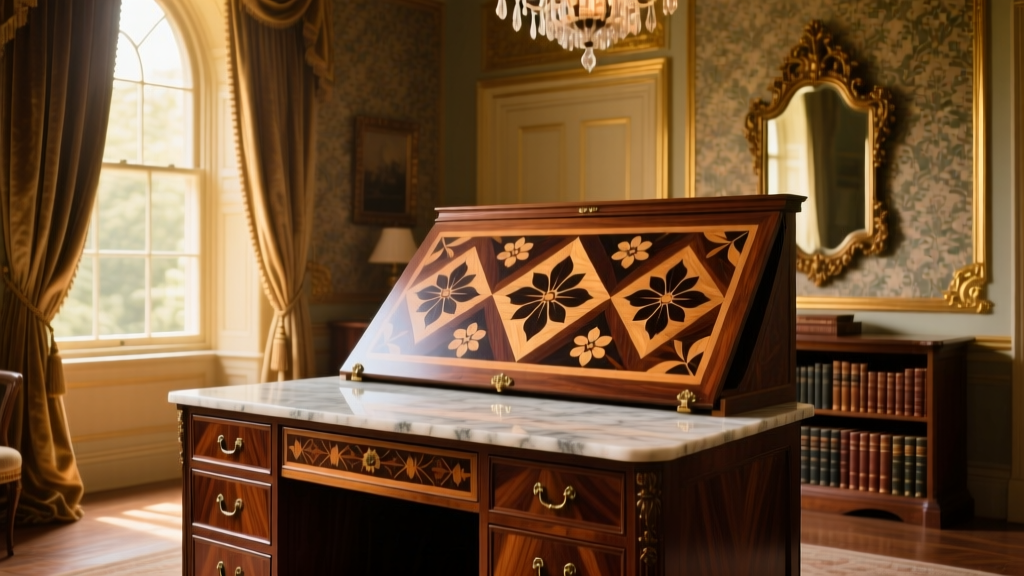
The 49-Inch Secretary Desk: Fall Front, Marble Top, Parquetry Inlay & Interior Drawer Configuration Explained

The Jacob Josef Kohn Wien Arm Chair: Design Legacy, Craftsmanship, and Restoration Insights
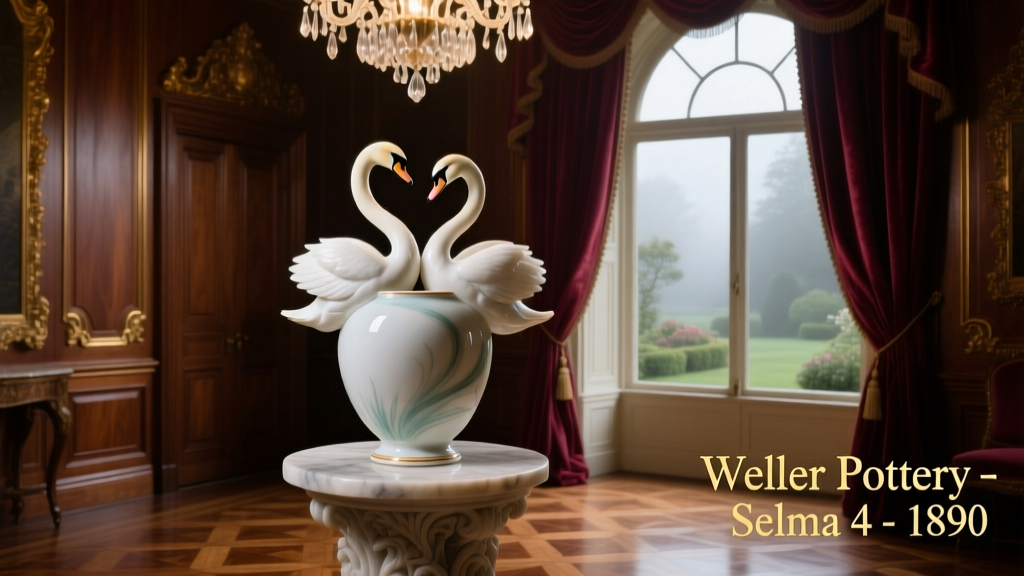
Weller Vase Selma 4 White Swans: Identification, Provenance, and Restoration Insights for Collectors
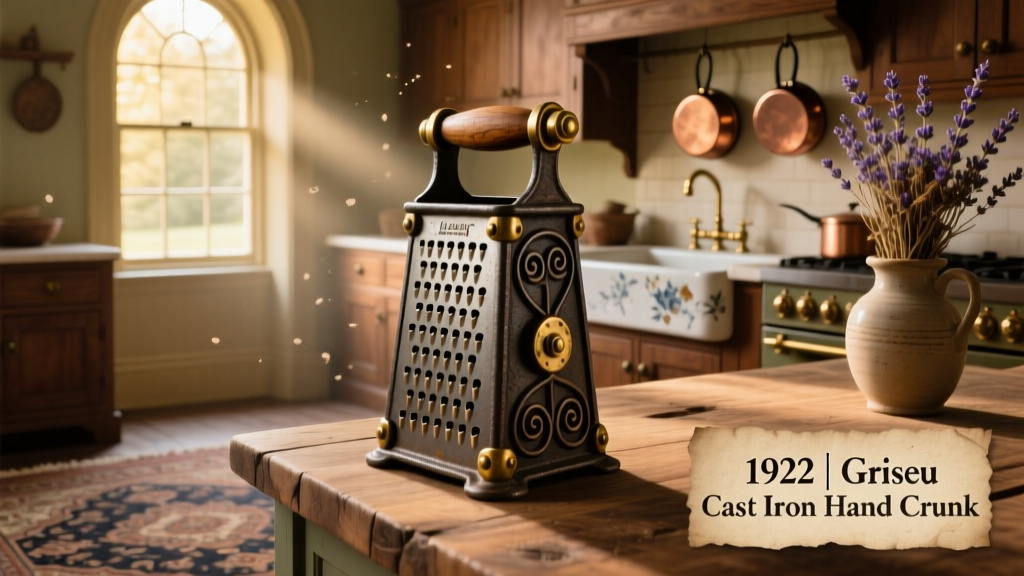
The Griseu Cast Iron Hand-Crank Vegetable Grater: A 1922 Masterpiece of French Kitchen Engineering

Walnut-Painted Bamboo-Turned Stool: Anatomy, Provenance, and Restoration of a 20×13-Inch American Colonial Revival Seating Piece
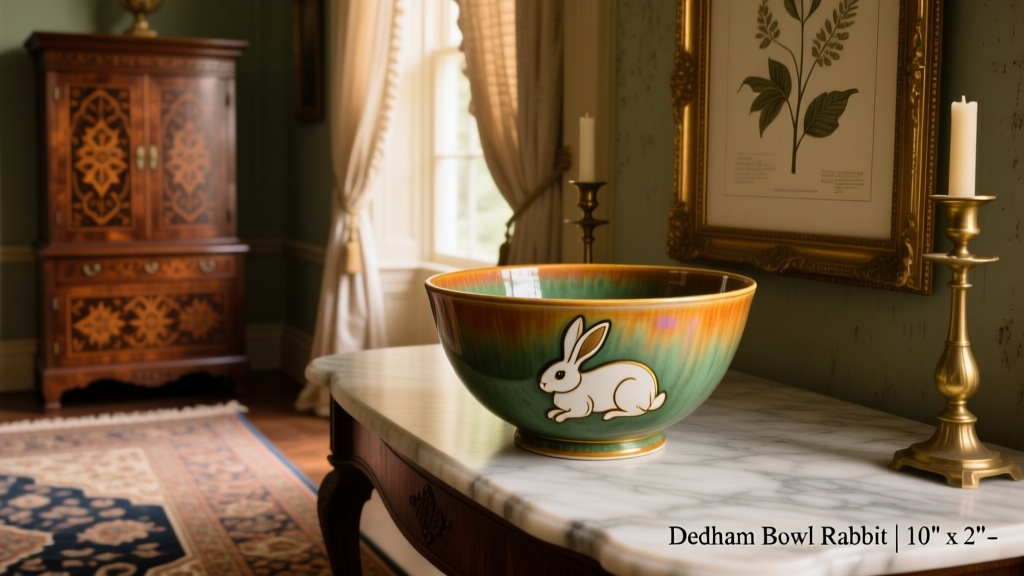
The Dedham Bowl Rabbit: A Detailed Study of the 10½-Inch Antique Porcelain Centerpiece
The 15½-Inch Brass Store Rack: A Collector’s Guide to Hat & Coat Salesman Samples from the Golden Age of American Hardware (1890–1930)