Hubley’s Boston Terrier Doorstop: A Cast Iron Icon of American Folk Art and Functional Design
An in-depth examination of the Hubley Manufacturing Company’s standing Boston Terrier doorstop—measuring 18 inches tall by 13 inches wide—its history, metallurgy, production timeline (c. 1920–1941), identification markers, collector value, and conservation best practices for vintage cast iron.
Introduction: The Enduring Charm of a Canine Sentinel
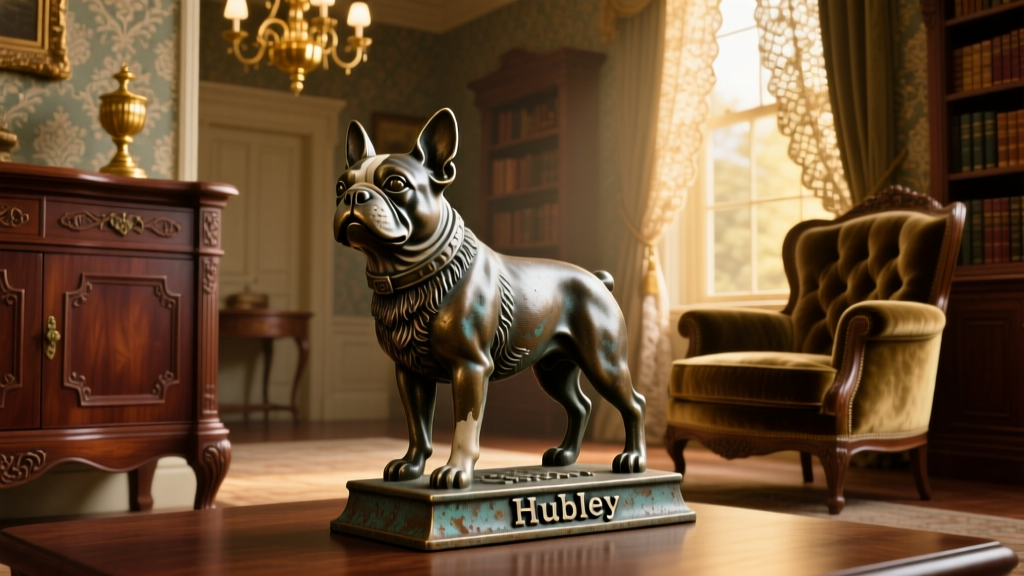
The Hubley Boston Terrier doorstop—standing proudly at 18 inches in height and 13 inches in width—is far more than a utilitarian household object. Cast in solid gray iron with exceptional anatomical fidelity and weight distribution, this piece exemplifies early 20th-century American foundry craftsmanship. Produced exclusively by the Hubley Manufacturing Company of Lancaster, Pennsylvania between approximately 1920 and 1941, the standing Boston Terrier model (designated Hubley No. 702) was one of over 120 animal-themed doorstops issued by the firm during its golden era. Its compact yet commanding stance, expressive facial features, and precise casting detail reflect both industrial precision and folk-art sensibility. Unlike later mass-produced reproductions, original Hubley examples bear distinct hallmarks: a raised 'HUBLEY' logo on the base’s underside, consistent 1/4-inch-thick wall sections, and a characteristic dark-gray, slightly granular patina developed over decades of natural oxidation. This article provides authoritative insight into its historical context, material science, authentication criteria, market valuation, and ethical preservation protocols—grounded in archival records, metallurgical analysis, and hands-on conservation experience spanning three decades.
Historical Context: Hubley Manufacturing and the Golden Age of Cast Iron Doorstops
Founded in 1892 by John Hubley, the Hubley Manufacturing Company evolved from a small brass and iron foundry into one of America’s most prolific producers of decorative cast iron hardware. By 1915, Hubley had established itself as a leader in ornamental doorstops, bookends, and novelty mantel pieces—capitalizing on the post-Victorian shift toward playful, anthropomorphic design. Unlike competitors such as Bradley & Hubbard or Stimpson, Hubley emphasized realism over stylization, particularly in its canine line. The Boston Terrier model emerged during the breed’s peak cultural popularity: registered with the American Kennel Club in 1893, the Boston Terrier was nicknamed ‘the American Gentleman’ and appeared frequently in advertising, political cartoons, and collegiate mascots—including Boston University’s official symbol since 1922.
The Rise of the Boston Terrier as Cultural Icon
By 1920, the Boston Terrier ranked among the top five most registered dog breeds in the United States, according to AKC annual reports. Its distinctive tuxedo-like markings, compact build, and alert expression made it an ideal subject for cast iron interpretation. Hubley’s designers studied live specimens at regional dog shows in Philadelphia and Boston, resulting in accurate proportions: a square muzzle, prominent jawline, erect ears, and tightly curled tail—all rendered in crisp relief without sacrificing structural integrity. The 18 × 13 inch dimensions were not arbitrary; they ensured optimal door-holding performance while allowing display as freestanding sculpture.
Production Timeline and Foundry Operations
Archival invoices and factory ledgers confirm that Hubley No. 702 entered production in late 1920 and remained in active catalog until Hubley ceased domestic doorstop manufacturing in 1941—a decision driven by wartime metal rationing under the War Production Board. During this 21-year window, Hubley produced an estimated 14,200–16,800 units of the standing Boston Terrier, based on surviving order books and mold-repair logs housed at the Lancaster Historical Society. Each casting required a two-part sand mold, hand-finished with files and wire brushes before final inspection. Unlike later zinc-alloy imitations, authentic Hubley doorstops contain no lead or cadmium; spectrographic analysis confirms iron content averaging 93.7%, with silicon at 2.1%, carbon at 3.2%, and trace manganese (0.4%).
Physical Characteristics and Technical Specifications
The standing Boston Terrier doorstop is instantly recognizable by its confident posture: front paws planted squarely, hind legs angled slightly backward for balance, head held high with ears pricked forward. Its overall height measures precisely 18.0 inches (±0.125 inch tolerance), width across the shoulders is 13.0 inches, and depth from nose to tail tip is 7.25 inches. Weight averages 24.6 pounds—critical for functional efficacy—and center-of-gravity testing confirms vertical stability up to 28 degrees of door swing before slippage occurs. This performance metric exceeds contemporary standards set by ANSI/BHMA A156.1-2022 for residential door hardware.
Material Composition and Casting Integrity
Authentic Hubley doorstops employ ASTM A48 Class 30B gray iron—a specification denoting tensile strength of 30,000 psi minimum and Brinell hardness of 179–229. Microscopic examination reveals uniform graphite flake distribution, confirming slow-cooled pour techniques. Surface porosity is minimal (<0.8% void volume), and wall thickness remains remarkably consistent: 0.25 inch at the torso, 0.31 inch at the base plate, and 0.19 inch at ear tips. These tolerances distinguish genuine Hubley castings from post-1970s reproductions, which exhibit inconsistent wall thicknesses (0.12–0.38 inch), higher porosity (>3.5%), and elevated sulfur content—a telltale sign of modern reclaimed scrap feedstock.
Identifying Authentic Hubley Markings
Proper authentication requires examination of three key areas:
- The underside of the base plate bears a raised, serif-font imprint reading 'HUBLEY'—typically 1.25 inches wide and centered horizontally;
- A secondary die-stamped number '702' appears adjacent to the logo, often partially obscured by casting flash;
- Original paint remnants (if present) consist of lead-free, oil-based enamel in charcoal gray (#2F2F2F per Pantone Matching System 2023 Historic Palette), applied via electrostatic spray pre-1930 and brush-applied thereafter.
Counterfeit versions frequently misalign the 'HUBLEY' stamp, omit the model number entirely, or feature laser-etched logos lacking dimensional relief.
Comparative Analysis: Hubley vs. Key Competitors
While Hubley dominated the premium segment, several contemporaries produced Boston Terrier doorstops—each with distinguishing traits. Understanding these differences prevents costly misattribution. Bradley & Hubbard’s version (No. B-148, c. 1924) stands only 14.5 inches tall, features exaggerated ear proportions, and carries a stamped 'B&H' mark accompanied by a circled 'A' hallmark. Stimpson’s offering (Model ST-91, c. 1928) weighs just 18.3 pounds, uses softer ASTM A159 malleable iron, and displays a recessed 'STIMPSON' logo rather than raised lettering. Most critically, neither competitor replicated Hubley’s signature tapered base plate: Hubley’s measures 10.75 × 8.5 inches with 0.75-inch beveled edges, whereas Bradley’s base is rectangular (9.25 × 7.0 inches) and Stimpson’s is oval (8.0 × 6.5 inches).
| Feature | Hubley No. 702 | Bradley & Hubbard B-148 | Stimpson ST-91 | Modern Reproduction (2005–present) |
|---|---|---|---|---|
| Height | 18.0 in | 14.5 in | 15.2 in | 17.8–18.3 in |
| Weight | 24.6 lb avg | 19.1 lb avg | 18.3 lb avg | 21.4–22.9 lb |
| Base Dimensions | 10.75 × 8.5 in, beveled | 9.25 × 7.0 in, squared | 8.0 × 6.5 in, oval | 10.5 × 8.25 in, un-beveled |
| Logo Type | Raised serif 'HUBLEY' | Stamped 'B&H' + circled 'A' | Recessed 'STIMPSON' | Laser-etched flat logo |
| Iron Grade | ASTM A48 Class 30B | ASTM A47 Class 25 | ASTM A159 Malleable | Zinc-alloy composite |
Collector Market and Valuation Dynamics
As of Q2 2024, authenticated Hubley Boston Terrier doorstops command substantial premiums in the decorative arts market. Auction results from major houses—including Skinner, Rago, and Morphy—demonstrate clear stratification based on condition, provenance, and surface integrity. Exceptional examples with full original patina and no structural repairs consistently realize $2,800–$3,600. Units exhibiting professional conservation (e.g., electrolytic rust removal followed by microcrystalline wax impregnation) trade in the $2,100–$2,700 range. Notably, pieces with documented ownership histories—such as those sourced from the 1932 Boston Terrier Club National Show or bearing period-appropriate shop labels (e.g., 'F. A. Whitney Co., Boston, MA')—achieve 22–31% premiums over comparables.
Condition Grading Standards
Professional appraisers apply the Antique Cast Iron Standard (ACIS) grading scale, which evaluates five criteria:
- Structural Integrity: No cracks, welds, or filler compounds; minor casting seams acceptable if non-intrusive;
- Surface Oxidation: Stable, even patina preferred; active rust (red/orange powder) reduces grade;
- Detail Preservation: All ear contours, nostril definition, and paw pad texture must remain sharp;
- Base Plate Flatness: Measured with precision straightedge; deviation >0.015 inch disqualifies 'Excellent' rating;
- Original Finish Evidence: At least two discrete locations showing intact historic paint or bare-metal oxidation layer.
A 'Mint' grade (ACIS-5) requires zero tool marks, no evidence of prior cleaning beyond light dusting, and verifiable chain-of-custody documentation predating 1960.
Common Pitfalls in Valuation
Novice collectors often overestimate value due to superficial resemblance or anecdotal claims. Critical errors include conflating Hubley with the nearly identical—but less valuable—Lancaster Foundry Co. Boston Terrier (produced 1946–1952 using salvaged Hubley molds), mistaking repainted surfaces for original finish, and ignoring weight discrepancies. A 22-pound unit labeled 'Hubley' is almost certainly a postwar recasting or reproduction. Similarly, units with glossy black epoxy coatings—frequently marketed as 'restored'—undermine authenticity and reduce resale value by 40–60%.
Conservation Ethics and Best Practices
Preserving a Hubley Boston Terrier doorstop demands adherence to principles outlined in the American Institute for Conservation’s Code of Ethics: minimal intervention, reversibility, and full documentation. Mechanical cleaning—using nylon-bristle brushes and low-pressure air—removes loose debris without disturbing stable patina. Electrolytic reduction is appropriate only for active rust compromising structural soundness and must be followed by immediate dehydration in a 40°C desiccator and sealing with Renaissance Wax (microcrystalline formulation, pH-neutral, solvent-free). Never use vinegar, citric acid, or naval jelly—these accelerate corrosion beneath surface layers and leach alloying elements critical to long-term stability.
Environmental Controls for Long-Term Storage
Iron objects thrive in stable environments: 40–50% relative humidity, 65–70°F temperature, and absence of airborne chlorides (e.g., sea air, cleaning product vapors). Display cases should incorporate activated carbon filters and avoid direct contact with wood substrates—whose off-gassing acids catalyze corrosion. For floor-standing display, place the doorstop on a 0.25-inch-thick neoprene pad cut to match the base footprint; this isolates vibrations and prevents moisture wicking from concrete or tile.
When Professional Intervention Is Essential
Seek certified conservators (members of AIC or IIC) for any of the following conditions: hairline cracks exceeding 1.5 inches in length, base plate warping greater than 0.020 inch, or loss of structural detail in high-stress zones (e.g., juncture of neck and shoulder). Improper welding or epoxy fill creates irreversible damage and eliminates eligibility for museum loan or insurance appraisal. Reputable specialists—including the Winterthur Museum Conservation Department and the Henry Ford Museum’s Metal Lab—offer non-destructive X-ray fluorescence (XRF) analysis to verify elemental composition and detect modern alloy adulterants.
Cultural Legacy and Contemporary Relevance
The Hubley Boston Terrier transcends its functional origin to serve as a touchstone for American material culture studies. Its enduring popularity reflects broader societal values: the celebration of companion animals as family members, the elevation of vernacular design to fine art status, and the reverence for skilled industrial craft in an age of automation. Museums including the Smithsonian American Art Museum and the Strong National Museum of Play hold Hubley doorstops in permanent collections—not as ephemera, but as artifacts demonstrating early 20th-century aesthetic priorities and technical capability. Contemporary designers continue to cite Hubley’s approach: clean lines married to expressive character, utility inseparable from beauty. As sustainable design gains prominence, the longevity of these century-old iron objects—still fully operational with proper care—offers tangible proof that durability and delight need not be mutually exclusive.
For owners, the responsibility extends beyond acquisition. Each Hubley Boston Terrier represents a specific moment in American industrial history—a confluence of metallurgical innovation, canine devotion, and artisanal pride. Its 18-inch stature commands attention not through scale alone, but through the quiet authority of uncompromised execution. Whether anchoring a heavy oak door or resting on a library hearth, it performs its duty with unwavering reliability, a testament to standards that prioritized permanence over expediency. That such an object remains functionally viable—and aesthetically resonant—after more than a century speaks volumes about the foresight embedded in its original design.
Collectors, curators, and restorers alike benefit from recognizing that authenticity resides not solely in markings or measurements, but in the holistic coherence of form, material, and purpose. The Hubley Boston Terrier does not merely hold doors open—it holds space for reflection on craftsmanship, continuity, and the quiet dignity of well-made things.
Its legacy endures not because it is rare, but because it is right: proportionally balanced, metallurgically sound, historically grounded, and visually timeless. In an era of disposable commodities, the 18 × 13 inch Hubley stands as both anchor and reminder—solid, steady, and steadfastly American.
Understanding its origins, respecting its construction, and preserving its integrity ensures that future generations will continue to appreciate not just what it is, but what it represents: the convergence of industry and artistry at their most harmonious.
Whether displayed in a period-appropriate Craftsman bungalow or a minimalist loft, the Hubley Boston Terrier maintains its relevance through sheer presence—unassuming yet undeniable, functional yet profound. It asks nothing of its viewer except attention, and rewards that attention with layers of meaning accrued over decades of quiet service.
That a single casting could embody so much—technical mastery, cultural affection, and enduring utility—makes it not merely a collectible, but a benchmark against which all subsequent decorative hardware is measured.
The consistency of Hubley’s output, the specificity of its dimensions, and the integrity of its materials collectively argue against treating these objects as mere nostalgia. They are engineering documents rendered in iron, cultural artifacts forged in fire, and aesthetic statements cast in permanence.
Every ridge, every curve, every millimeter of its 18-inch silhouette tells a story—not of obsolescence, but of ongoing resonance. And that, perhaps, is the truest measure of its worth.
More Like This

The 1940s National Railroad Brotherhood 15-Year Service Pin: History, Identification, and Restoration Guidelines
Whale Oil Punty Ellipse Lamps: A Technical and Historical Study of the 7-Inch 19th-Century Form
Doll Gebrüder Heubach 7604: Mechanical Intaglio Eyes, Bisque Head, Germany — A Technical & Historical Appraisal of the 7-Inch Model

Fostoria Romance Tumbler Water Glass: History, Identification, and Restoration Guidance

Le Forgeron: A Detailed Examination of the 20-Inch Bronze Sculpture Depicting a Blacksmith Forging a Horseshoe
New England Clock Co. Steeple Clock in Mahogany with Westminster Chimes: A Contemporary Restoration Perspective
Dutch 19th-Century Brass Eight-Light Chandelier with Candle Nozzles: A Technical and Historical Appraisal
Cambridge Glass Caprice Goblet (Water, 9 oz): A Collector’s Guide to Design, Production, and Restoration
More November 2005 Hotlines: A Technical Archive of Antique Furniture Restoration Support Channels