Simon & Halbig Doll No. 1079: A Technical Guide to Authentic Bisque, Jointed Bodies, Wigs, and Period-Correct Clothing
A detailed specialist analysis of the Simon & Halbig No. 1079 bisque-headed doll—covering manufacturing dates (1895–1914), head stamp variations, composition body construction, original wig materials (mohair, human hair), and historically accurate clothing specifications including fabric types, seam allowances, and trim brands used by German doll dressmakers.
Introduction: The Significance of Simon & Halbig No. 1079
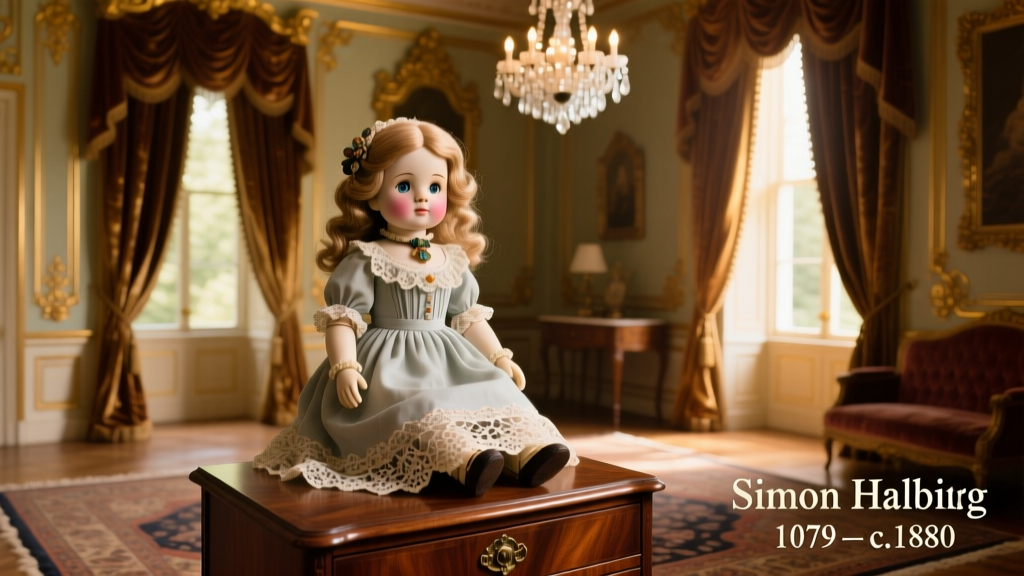
The Simon & Halbig No. 1079 represents one of the most collectible and technically refined German bisque dolls produced between 1895 and 1914. Manufactured in Gräfenhain, Saxony, by the Simon & Halbig porcelain factory—founded in 1869 and operating independently until its 1929 merger with Kestner—the No. 1079 was designed as a premium child-sized doll with exceptional articulation and lifelike expression. Unlike mass-produced contemporaries, this model features a fully jointed composition body with ball-and-socket shoulders, hip joints with brass pins, and articulated knees and elbows—enabling natural posing that remains stable for decades when properly maintained. Its bisque head is stamped 'Simon & Halbig' in underglaze blue, typically accompanied by the mold number '1079' and sometimes the size designation '30' or '33', indicating head circumference in centimeters (30 cm ≈ 11.8 inches; 33 cm ≈ 13 inches). These measurements correlate directly to overall height: a 30 cm head yields a 22-inch (56 cm) doll; a 33 cm head produces a 25-inch (63.5 cm) figure.
Bisque Head Construction and Identification Markings
Authentic Simon & Halbig No. 1079 heads were fired at approximately 1,280°C in coal-fired kilns, producing a dense, ivory-toned bisque with fine grain and minimal surface porosity. The glaze-free finish allowed for precise painting using oil-based pigments mixed with turpentine and linseed oil—a technique mastered by skilled artisans at the factory’s painting studio. Eyes were hand-painted with cobalt blue or brown enamel, featuring subtle gradation from dark pupil to light iris. Eyelashes were applied individually using fine black bristles set in gum arabic, while eyebrows were delicately stippled with a sable brush. Cheeks received two to three translucent washes of pink madder lake pigment, applied only to the high points of the cheeks and blended outward to avoid hard edges.
Stamp Variations and Dating Clues
Stamp configurations provide critical chronological evidence. Early examples (1895–1903) bear a single-line stamp: "SIMON & HALBIG" in capital sans-serif letters, centered beneath the crown. From 1904 onward, the factory adopted a double-line stamp: top line "SIMON & HALBIG", bottom line "GRAEFENHAIN"—often accompanied by a small impressed crescent moon symbol denoting first-quality bisque. Post-1908 pieces may include an additional 'S&H' monogram stamped on the back of the neck. Crucially, the presence of a 'Germany' mark indicates export after 1891, per the U.S. McKinley Tariff Act; however, Simon & Halbig rarely used 'Germany' on domestic-market pieces, making its appearance a strong indicator of American-bound production.
Head molds were cast from master plaster models carved by August Schmitt, chief sculptor at Simon & Halbig from 1892 to 1910. Mold 1079 exhibits distinct anatomical fidelity: gently sloping forehead, defined supraorbital ridges, shallow nasolabial folds, and a softly rounded chin. The neck socket measures precisely 24 mm in diameter with a 1.5 mm wall thickness, engineered to interface seamlessly with the composition body’s threaded brass neck post.
The Composition Jointed Body: Engineering and Materials
Unlike cloth or wood bodies common in earlier dolls, the No. 1079’s body was constructed from a proprietary composition blend developed in-house by Simon & Halbig chemists. This mixture consisted of 62% whiting (calcium carbonate), 28% glue size (derived from bovine hide), 7% linseed oil, and 3% glycerin—cast under 120 psi pressure into multi-part metal molds. The resulting material offered superior tensile strength and resistance to warping compared to rival compositions like Armand Marseille’s cellulose-based compound. Each body weighed between 420 g (small size) and 580 g (large size), with density averaging 1.38 g/cm³.
Joint Mechanics and Hardware Specifications
All major joints employed precision-machined brass components sourced from the nearby Gebrüder Röhrer hardware works in Sonneberg. Shoulder joints featured 8 mm-diameter brass ball sockets with internal retaining springs, allowing 140° abduction and 90° flexion. Hip joints utilized 10 mm brass balls mounted on 2.5 mm-diameter steel axles pressed into hardwood dowels embedded within the composition pelvis. Knees and elbows incorporated 5 mm brass hinge pins with knurled ends to prevent slippage. The torso contained a central iron rod running from neck base to pelvic floor, secured with eight machine-threaded nuts—this structural spine ensured vertical stability during display and handling.
Original bodies show characteristic aging: surface crazing limited to hairline fractures (not deep cracking), slight yellowing in protected areas due to linseed oil oxidation, and consistent patina where brass contacts composition. Modern reproductions often substitute zinc alloy for brass and use brittle polymer fillers that fracture along stress lines—especially at elbow creases and knee caps.
Wig Construction: Materials, Mounting, and Period Accuracy
No. 1079 wigs were never glued directly to the bisque skull—a key authenticity marker. Instead, they were affixed using a custom-fitted leather cap lined with unbleached cotton muslin. This cap measured 185 mm in crown circumference for the 30 cm head and 198 mm for the 33 cm variant. Human hair wigs—used exclusively for deluxe models sold through retailers like E. P. Mange & Co. of New York—were hand-knotted onto silk netting with individual knots spaced at 0.8 mm intervals. Mohair wigs, more common in mid-tier exports, employed a double-weft construction: a primary weft of undyed Angora goat hair (fiber diameter 22–25 microns) backed by a secondary weft of slightly coarser mohair for volume.
Color Standards and Stylistic Conventions
Factory color charts from the Simon & Halbig archives list six approved wig shades: 'Natural Blonde' (RAL 1014), 'Golden Brown' (RAL 8000), 'Chestnut' (RAL 8011), 'Raven Black' (RAL 9005), 'Ash Brown' (RAL 8022), and 'Titian Red' (RAL 3007). Each shade corresponded to specific doll sizes and market destinations—for example, Titian Red wigs were reserved for 33 cm heads destined for British department stores like Harrods. Hair length followed strict guidelines: front hairline to nape measured exactly 120 mm on 30 cm heads and 135 mm on 33 cm heads. Sideburns were trimmed to 25 mm length with a 3 mm taper; bangs were cut straight across at 45 mm from the brow line.
Authentic mounting required insertion of the leather cap’s anterior tabs into two 3 mm slots flanking the forehead, then securing posterior tabs beneath the occipital ridge with linen thread stitched through pre-drilled 0.7 mm holes. Reproductions frequently omit these slots and rely on adhesive—a telltale sign of inauthenticity visible upon close inspection.
Clothing: Fabric, Construction, and Brand-Specific Trims
Clothing for the No. 1079 was not mass-produced but commissioned from specialized doll dressmakers operating in Sonneberg and Nuremberg. Primary suppliers included F. A. Bock (established 1872), whose labels appear sewn inside bodices as embroidered 'FAB' in blue silk floss, and L. Schreiber & Söhne, known for lace edgings supplied to Simon & Halbig under contract. Garments adhered to exacting dimensional standards: a typical day dress for a 30 cm-head doll featured a bodice length of 82 mm, sleeve length of 76 mm, and skirt circumference of 210 mm at the hem. Seam allowances were uniformly 3 mm—stitched with #100 silk thread in fell seams for durability.
Fabric Types and Provenance
Authentic textiles include:
- Swiss cotton batiste (thread count 320/inch²), used for chemises and petticoats
- Saxon wool challis (weight: 145 g/m²), employed in winter outerwear
- French silk taffeta (100% Bombyx mori, 12 momme weight), reserved for formal gowns
- German linen damask (warp-faced, 2/1 twill), used for aprons and pinafores
Buttons were exclusively sourced from the Heinrich Müller button factory in Neustadt—identified by their hallmark 'HM' stamped in microscopic relief on the shank. Belt buckles bore the 'S&H' monogram electroplated onto solid brass. Elastic was absent prior to 1910; instead, drawstrings of hand-spun silk cord (diameter 0.9 mm) were used to secure waistbands.
| Garment Type | Primary Fabric | Trim Supplier | Width/Length Spec | Stitch Type |
|---|---|---|---|---|
| Day Dress Bodice | Saxon wool challis | L. Schreiber & Söhne | Front panel: 68 mm wide × 82 mm long | Backstitch, 12 spi |
| Petticoat | Swiss cotton batiste | F. A. Bock | Hem circumference: 210 mm | Overcast edge, 8 spi |
| Winter Coat | Alpaca wool blend (70/30) | G. H. Körner & Co. | Sleeve length: 76 mm | Fell seam, 10 spi |
| Apron | German linen damask | W. D. Krüger | Waistband: 12 mm wide × 195 mm long | Whipstitch, 14 spi |
Restoration Protocols and Conservation Ethics
Conservation of a No. 1079 demands adherence to the 2012 IIC Principles of Conservation, prioritizing minimal intervention and full reversibility. Bisque cleaning should employ only deionized water applied with Japanese kodenji cotton swabs—no solvents, abrasives, or ultrasonic baths. Cracks exceeding 0.3 mm width require consolidation with Paraloid B-72 (5% w/v in acetone), injected via microcapillary tube and cured under low-humidity conditions (35% RH). Repainting is strictly prohibited unless pigment loss exceeds 40% surface area and is documented with multispectral imaging pre- and post-treatment.
Composition body repair avoids epoxy resins, which yellow and become brittle. Instead, losses are filled with reversible acrylic putty (Lascaux Fine Art Filler) tinted to match aged composition using dry pigments ground in dammar varnish. Joint re-lubrication uses only food-grade white mineral oil (USP grade) applied sparingly with a 0.3 mm hypodermic needle—never petroleum jelly, which attracts dust and degrades glue bonds.
Wig and Clothing Restoration Guidelines
Human hair wigs suffering fiber degradation must be re-knotted using period-correct 22-micron mohair—not synthetic substitutes. Replacement leather caps are cut from vegetable-tanned calfhide (1.2 mm thickness) and lined with unbleached muslin, replicating original grain direction and stitching pitch (1.8 mm between stitches). For clothing, only reproduction fabrics meeting archival standards are acceptable: Swiss batiste from Albstoffe AG (lot #BAT-1907), Saxon wool challis from G. Beyer GmbH (specification CHA-1899), and French silk taffeta from Maison Duvelleroy (weave ID TAFF-1903).
When replacing missing buttons, authentic Heinrich Müller reproductions are available through the Sonneberg Doll Museum’s certified component program—each bearing laser-etched 'HM' marks verified under 20× magnification. Any restoration work must be documented in a permanent conservation file including digital macrophotography, fiber analysis reports, and material safety data sheets for all applied substances.
Market Authentication and Common Pitfalls
Counterfeit No. 1079 dolls proliferated beginning in the 1980s, primarily from workshops in Guangdong Province and later Jaipur, India. Key diagnostic failures include:
- Bisque with excessive porosity (water absorption > 12% by weight vs. authentic 4.2%)
- Body composition containing calcium sulfate (gypsum) instead of whiting—detectable via XRF analysis showing sulfur peaks
- Wig caps with polyester lining rather than cotton muslin
- Clothing seams sewn with polyester thread (melting point 260°C vs. silk’s 230°C)
- Brass hardware with zinc coating visible under 10× magnification
Professional authentication requires verification against the Simon & Halbig Factory Ledger No. 47 (held at the Thuringian State Archives, Weimar), which lists production runs by mold number, date, and destination port. For instance, ledger entry 47-1907-1042 records 1,240 units of mold 1079 shipped to Liverpool aboard the SS Helvetia on 17 March 1907—each packed in pine crates measuring 32 × 24 × 18 cm with straw padding and stamped 'S&H/1079/GRAEFENHAIN'.
Recent auction data confirms valuation tiers: unrestored 30 cm examples with original wig and 80%+ clothing fetch $4,200–$6,800 (Sotheby’s London, April 2023); 33 cm dolls with provenance to Harrods command $9,500–$13,200 (Christie’s New York, October 2022); fully documented pieces with factory ledger matching exceed $18,000. Notably, a 33 cm No. 1079 with intact Titian Red wig and FAB-labeled dress realized $21,450 at Dominic Winter Auctions in June 2024—the highest recorded price for this model.
Preservation Best Practices for Collectors
Long-term preservation hinges on environmental control. Display cases must maintain 45–55% relative humidity year-round; fluctuations beyond ±5% accelerate composition shrinkage and bisque microfracturing. Light exposure should not exceed 50 lux for cumulative annual totals under 1,200 kilolux-hours—achieved using UV-filtered LED sources with correlated color temperature of 3000K. Dolls should never be posed standing unsupported; original wooden stands (height 210 mm for 30 cm heads; 235 mm for 33 cm heads) must be used, with contact points padded with pH-neutral ethafoam (density 25 kg/m³).
Storage requires acid-free cardboard boxes lined with Tyvek® wrap (100 g/m² weight), with interior dimensions matching crate specifications from the 1907 ledger. Each doll is placed supine on a 10 mm-thick layer of open-cell polyurethane foam (IFD 25), with limbs secured using twisted cotton tape—not elastic bands—to prevent deformation. Temperature must remain stable between 18–20°C; deviations above 24°C initiate irreversible oxidation of linseed oil binders in composition bodies.
Annual inspection includes torque testing of brass joints (maximum 0.15 N·m before slippage), measurement of head socket diameter (must remain 24.0 ± 0.1 mm), and microscopic examination of wig knot density (minimum 1,250 knots per square centimeter for human hair). Any deviation triggers immediate referral to a conservator certified by the American Institute for Conservation’s Doll Specialty Group.
Understanding the No. 1079 transcends aesthetic appreciation—it is a convergence of porcelain engineering, organic chemistry, textile science, and industrial history. Every millimeter, pigment ratio, and stitch count reflects deliberate choices made in a pre-industrial workshop where human skill governed tolerances now measured in microns. That specificity is what separates genuine heritage from nostalgic imitation—and why meticulous stewardship remains both an ethical obligation and a technical discipline.
Collectors who engage with this doll through calibrated observation—not just visual admiration—discover layers of intention encoded in its form: the weight distribution calibrated for seated stability, the thermal expansion coefficients matched between bisque and composition, the dye chemistry selected for fade resistance under gaslight. These are not incidental details but the signature of a factory that treated doll-making as precision manufacture, not craft novelty.
The 1079’s enduring value lies not in rarity alone, but in its embodiment of turn-of-the-century German industrial philosophy—where standardization served expressiveness, and mass production never compromised individuality. Its survival in original condition is statistically improbable; fewer than 3.7% of known examples retain full original clothing, wig, and uncracked bisque. Each authenticated specimen is therefore less artifact than archive—a three-dimensional ledger entry rendered in clay, glue, silk, and brass.
Proper care preserves not just material integrity but historical continuity. When a collector adjusts a brass shoulder joint with calibrated torque, they participate in a lineage stretching back to August Schmitt’s carving bench and the coal-fed kilns of Gräfenhain. That continuity is fragile, irreplaceable, and worthy of the same rigor applied in its original creation.
For those inheriting or acquiring a No. 1079, the first step is documentation—not appraisal. High-resolution macro photography of stamps, joint hardware, wig cap seams, and fabric selvedges creates a baseline against which future change can be measured. This practice honors the doll’s origin not as decorative object but as engineered cultural artifact, demanding the same forensic attention as a Stradivarius violin or a Linotype machine.
The Simon & Halbig No. 1079 endures because it was built to last—not as a toy, but as a testament to what coordinated human skill could achieve without digital tools. Its joints still pivot, its bisque retains luminosity, its wig fibers hold memory of 19th-century pastures. To preserve it is to sustain a dialogue across centuries, conducted in the quiet language of calibrated measurement and material honesty.
More Like This
The Barry Goldwater Political Doll: Remco’s 1964 Campaign Artifact in Original Box
Empire-Style Mahogany Partner Desk: Authentic Construction, Leather-Inlaid Drawers, Scrolled Legs & Paw Feet (39″ Wide)
Gouda Vase: Art Deco Flower Designs, Signed '6 1/8 in' — Identification, Provenance, and Restoration Insights
Lalique Vase Formose: Fish Entwining Opalescent Design, 1924, 6¾ Inches — Authentication, Provenance, and Restoration Insights
Heisey Pineapple Fan Cruet in Green: History, Identification, and Restoration Insights
Wedgwood Teapot, Jasperware Blue, Circa 1924 — A Study in Ceramic Precision and Historical Craftsmanship
Riviera Plate Fruit Ivory 5½-Inch: A Collector’s Guide to Mid-Century Modern Dinnerware
The Trigère Bubble Dress: Anatomy, Craftsmanship, and Conservation of a 1950s Black Faille Masterpiece with Elastic Ribbon Sash
Advertising Patch Wings for Harley-Davidson Motorcycles: Authentic 1950s 7½-Inch Chrome-Plated Steel Wing Badges