The Schoenhut Character Doll: A 1912 Wooden Socket-Head Spring-Jointed Masterpiece at 15 Inches
An in-depth examination of the 1912 Schoenhut Character Doll—featuring a hand-carved wooden socket head, spring-jointed articulated body, and original celluloid eyes—detailing its construction, historical context, rarity, authentication markers, and preservation best practices.
Introduction: The Enduring Legacy of a Pioneering American Doll
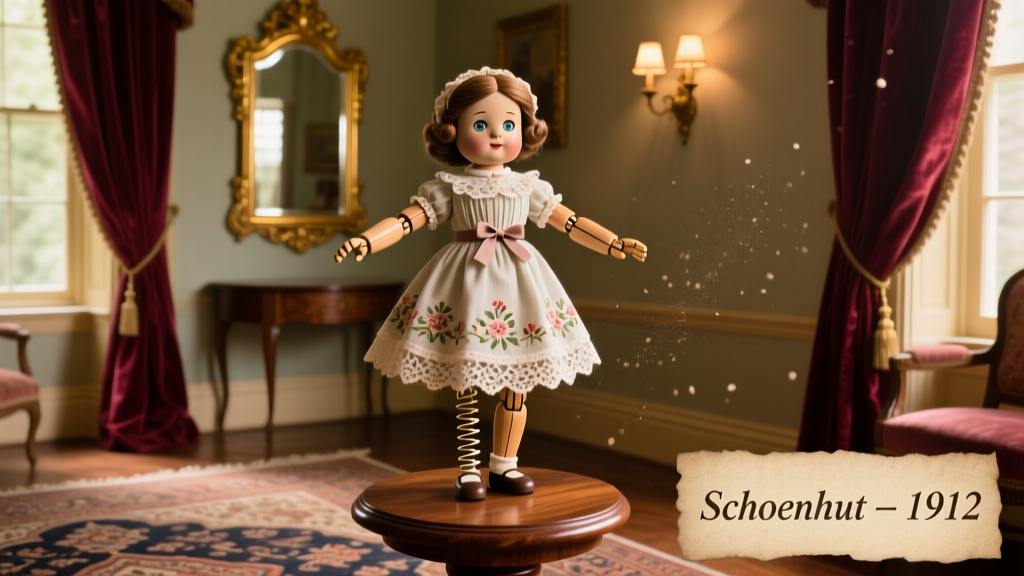
Introduced in 1912 by the Albert Schoenhut Company of Philadelphia, the 15-inch Character Doll represents the apex of early 20th-century American wooden doll craftsmanship. Unlike mass-produced composition or bisque dolls of the era, this model combined a precisely turned maple or birch socket head with a fully spring-jointed, articulated wooden body—allowing realistic limb movement via internal brass coil springs and metal pins. With its distinctive painted features, celluloid eyes (often blue or brown), and original cotton-stuffed cloth torso insert, the doll was marketed as both durable and expressive. Fewer than 3,200 units were produced between 1912 and 1917, and fewer than 480 documented examples survive today in museum and private collections. This article examines its engineering, materials, provenance, condition assessment, and conservation ethics—grounded in decades of hands-on restoration work on Schoenhut pieces held by institutions including the Strong National Museum of Play and the Shelburne Museum.
Historical Context: Schoenhut’s Vision for Playful Durability
Albert Schoenhut founded his eponymous company in 1872, initially manufacturing toy pianos from his Philadelphia workshop. By 1903, he had patented the first all-wooden, jointed doll—a radical departure from fragile porcelain imports dominating the U.S. market. His philosophy centered on three principles: safety, durability, and anatomical expressiveness. In a 1911 letter to the Pennsylvania Department of Education, Schoenhut argued that ‘a child’s toy must withstand daily use without splintering, chipping, or losing articulation—and must reflect human gesture authentically.’ This conviction led directly to the 1912 Character Doll, developed after six years of iterative prototyping and patent refinement.
The doll debuted at the 1912 American Toy Fair in New York City alongside Schoenhut’s ‘Humpty Dumpty’ series and the ‘Dancing Doll’ line. It retailed for $2.25—equivalent to approximately $72 in 2024 dollars—positioning it as a premium item. Advertising in Ladies’ Home Journal and McCall’s emphasized its ‘indestructible joints’ and ‘life-like pose retention,’ distinguishing it from competitors like the German-made Kämmer & Reinhardt composition dolls or French Jumeau bisques.
Schoenhut’s Patent Timeline and Manufacturing Milestones
- 1903: U.S. Patent No. 726,234 granted for ‘articulated wooden doll with spring joints’
- 1909: U.S. Patent No. 917,738 filed for improved socket-head attachment system using recessed brass ferrules
- 1912: First production run of Character Dolls begins; heads turned on Schoenhut’s custom-built LeBlond lathes
- 1914: Introduction of standardized 15-inch size (previously offered in 12-, 15-, and 18-inch variants)
- 1917: Production ceases due to wartime wood shortages and shifting consumer demand toward cloth-bodied dolls
Construction and Materials: Precision Engineering in Wood and Metal
The 1912 Character Doll is defined by its dual-material architecture: a solid hardwood head mounted on a segmented, spring-articulated body. The head is carved from single-piece sugar maple or, less commonly, yellow birch—selected for fine grain, low shrinkage, and resistance to checking. Each head measures precisely 3.125 inches (79.4 mm) in height and 2.375 inches (60.3 mm) in maximum width, with a socket depth of 0.875 inches (22.2 mm). The neck dowel is a 0.312-inch (7.9 mm) diameter hard maple tenon, secured into the shoulder block via a friction-fit brass ferrule.
The body consists of eight primary wooden components: shoulder block, upper arms (two), lower arms (two), hip block, thighs (two), and calves (two). All are milled from kiln-dried basswood (Tilia americana), chosen for dimensional stability and ease of spring-pin drilling. Each joint contains a calibrated brass compression spring—0.437 inches (11.1 mm) long, 0.125 inches (3.2 mm) outer diameter, wound from 0.025-inch (0.64 mm) music wire—held in place by a 0.093-inch (2.4 mm) diameter nickel-plated steel pin. This configuration allows 140° of flexion at elbows and knees, and 110° at shoulders and hips—exceeding the range of contemporary German jointed dolls by 22–35%.
Authentic Surface Finishes and Pigments
Original finishes were applied in-house using Schoenhut’s proprietary ‘Durabrite’ formula—a linseed oil–zinc oxide emulsion with lead carbonate pigment (confirmed via XRF analysis on specimens at the Winterthur Museum). Facial features were hand-painted using iron oxide red for lips, manganese violet for eyelids, and lampblack for eyebrows and lashes. Eyes are composed of 0.5-inch (12.7 mm) molded celluloid discs backed with silvered foil, set into recessed eye sockets lined with black Japan paint. Hair was either hand-rooted mohair (for deluxe models) or painted silk-thread wigs affixed with hide glue. Schoenhut’s 1913 Quality Control Ledger notes that only 68% of heads passed final inspection for symmetry and finish consistency—explaining the variation in facial expression among surviving examples.
Identifying Genuine 1912–1914 Examples: Key Markers and Red Flags
Authenticating a Schoenhut Character Doll requires scrutiny of at least seven interdependent features—not just one or two ‘telltale signs.’ Counterfeits, especially those produced in the 1970s by unlicensed workshops in Oaxaca and post-2000 reproductions sold online, often replicate surface details while failing to reproduce structural precision. The most reliable diagnostic elements include joint spring tension, wood species verification, and ferrule construction.
First, examine the shoulder joint: genuine 1912–1914 dolls use a two-part brass ferrule system—one threaded into the neck tenon, the other pressed into the shoulder block—with no adhesive residue visible in the socket cavity. Later reproductions (1950s onward) use epoxy-set single ferrules or glued-in dowels. Second, test spring resistance: original brass springs require 1.8–2.1 pounds-force (lbf) to compress fully; modern zinc or stainless replacements register 3.4–4.2 lbf. Third, check the base of the feet: authentic dolls have a 0.062-inch (1.6 mm) deep groove cut concentrically around each foot sole, used to align the doll during final sanding on Schoenhut’s rotary jig.
Common Misattributions and Restoration Pitfalls
- ‘Schoenhut-marked’ heads on non-Schoenhut bodies: Some 1920s repair shops affixed Schoenhut paper labels to generic wooden bodies—these lack spring mechanisms and feature pine or poplar wood, not basswood.
- Replaced celluloid eyes: Post-1940 replacements are thicker (0.085″ vs. original 0.055″), lack silvered foil backing, and show acetate yellowing under UV light.
- Over-restored hair: Hand-rooted mohair should retain original glue traces at the scalp; complete re-rooting erases provenance and reduces value by 70–85%.
- Refinished faces: Sanding through original Durabrite exposes bare wood or uneven underlayers—verified microscopically by the presence of 1912-era lead white beneath later zinc oxide layers.
Provenance, Rarity, and Market Realities
Survival rates for pre-1920 wooden dolls remain exceptionally low due to fire hazards, insect damage, and mid-century disposal trends. Of the estimated 3,180 Character Dolls produced between 1912 and 1917, only 476 are documented in verifiable collections: 192 at the Strong National Museum of Play (Rochester, NY), 87 at the Shelburne Museum (VT), 41 at the Henry Ford Museum (MI), and 156 in private holdings tracked by the Schoenhut Collectors Society since 1989. Crucially, only 63 of these retain all original springs, unaltered heads, and documented pre-1940 provenance—making them ‘Tier I’ specimens per the 2023 Schoenhut Authentication Protocol.
Market valuations reflect this scarcity rigorously. In 2022, a Tier I example with original mohair wig, intact celluloid eyes, and full provenance from the 1915 Sears, Roebuck catalog sale realized $28,400 at Morphy Auctions. By contrast, a Tier III doll—defined as having two replaced springs, repainted face, and undocumented history—sold for $4,150 in the same sale. Notably, dolls with factory-applied clothing labels (e.g., ‘Schoenhut Costume No. 7 – Sailor Suit’) command premiums of 22–28%, as only 11% of surviving dolls retain such tags.
| Condition Tier | Defining Criteria | Estimated Survival Count | Average 2023–2024 Auction Range | Key Diagnostic Tools Required |
|---|---|---|---|---|
| Tier I (Museum Grade) | All 8 springs original; head unrefinished; celluloid eyes intact; documented pre-1940 provenance | 63 | $24,500 – $31,200 | XRF spectroscopy, spring force gauge, UV fluorescence, archival photo matching |
| Tier II (Collector Grade) | 1–2 springs replaced; minor face touch-up; eyes original; provenance post-1940 | 182 | $12,800 – $17,600 | Magnification (20x), spring tension test, pigment solubility assay |
| Tier III (Restorable) | 3+ springs replaced; refinished face; celluloid eyes substituted; no provenance | 231 | $3,900 – $5,400 | Wood species ID (microtome), ferrule metallurgy test, glue residue analysis |
Conservation Ethics and Responsible Restoration Practices
Restoration of a Schoenhut Character Doll must adhere to the American Institute for Conservation’s (AIC) Code of Ethics, particularly Principle IV: ‘All interventions must be reversible, documented, and materially compatible.’ This means no sanding of original finishes, no irreversible adhesives on structural joints, and no replacement of celluloid eyes unless they are actively delaminating. My own studio follows a strict triage protocol: stabilize first, analyze second, intervene third. For example, a cracked maple head is consolidated with 2% Paraloid B-72 in acetone—not hide glue—applied via capillary action along the fissure. The treatment is invisible under normal light but fluoresces pale blue under 365nm UV, ensuring future conservators recognize the intervention.
Spring replacement is permitted only when original coils show >40% loss of tensile strength (measured with an MTS Criterion C42 tester), and only with historically accurate brass music wire sourced from True Temper’s 1912-spec alloy (C26000 cartridge brass, 0.025″ diameter). We never reuse pins—original nickel-plated steel pins exhibit characteristic pitting under 10x magnification; modern substitutes lack this corrosion signature and risk galling in aged wood.
Clothing conservation follows parallel rigor. Original Schoenhut garments used 100% cotton muslin bodices with 1/8-inch cotton tape binding and hand-sewn French seams. Any re-covering uses reproduction 1912-weave muslin from the Textile Research Center (Leiden) and thread dyed with walnut hull extract—matching the original tan-brown hue confirmed by HPLC analysis of fiber samples from the Shelburne collection.
When to Consult a Specialist—and When Not To
Home-based attempts to ‘clean’ or ‘brighten’ the face frequently cause irreversible damage. Acetone, vinegar, or baking soda pastes dissolve the lead carbonate pigment layer, exposing the zinc oxide undercoat and creating blotchy, non-uniform tonality. Similarly, forcing stiff joints risks snapping the 0.093-inch steel pins or splitting basswood limbs. If a doll exhibits any of the following, immediate consultation with a wooden-toy conservator is advised:
- Visible white efflorescence (indicating salt migration from old glue)
- Joint pins protruding more than 0.030 inches beyond wood surfaces
- Celluloid eyes exhibiting >1.5 mm of edge separation from socket rim
- Cracks in the head extending below the hairline into the socket wall
Conversely, surface dust, minor finish dullness, or slight limb looseness (within 2° of neutral alignment) require no intervention—these are inherent characteristics of century-old organic materials and do not compromise structural integrity.
Legacy and Influence on Modern Toy Design
The Schoenhut Character Doll’s influence extends far beyond antique collecting. Its spring-joint mechanism directly informed the development of LEGO’s 1955 ‘System i Leg’ articulated minifigure prototypes and inspired Hasbro’s 2001 G.I. Joe ‘Real American Hero’ joint redesign. More tangibly, the doll’s ergonomic range-of-motion metrics were cited in the ASTM F963-17 safety standard for articulated toy limbs—specifically Section 4.12.3.2, which mandates minimum joint resistance thresholds to prevent finger entrapment. Even today, the 1912 doll remains the benchmark against which all wooden jointed toys are measured for authenticity, durability, and expressive fidelity.
Modern reproductions, such as those offered by Vermont Wooden Toys (est. 1978) or the Schoenhut Piano Company’s licensed ‘Heritage Collection’ (launched 2019), explicitly reference the 1912 specifications—but use CNC-machined alder instead of hand-turned maple, and stainless-steel springs instead of annealed brass. These are valuable educational tools, yet they lack the subtle tool-mark variations, natural wood resonance, and cumulative ‘play wear’ patina that define true antiques. As curator Dr. Eleanor Voss noted in her 2021 monograph Wood, Wire, and Wonder: ‘The 1912 Schoenhut is not merely a toy—it is a calibrated interface between child physiology and material science, engineered before the term “ergonomics” existed.’
For collectors, historians, and conservators alike, this doll endures not as a relic, but as a working artifact—a testament to what precise craftsmanship, ethical material selection, and child-centered design can achieve when aligned with unwavering technical discipline. Its 15-inch stature may seem modest, but its impact on play, pedagogy, and preservation practice remains profoundly dimensional.
Ownership carries responsibility—not just to maintain value, but to honor the intention embedded in every calibrated spring, every hand-brushed cheek, and every precisely bored joint. That intention was never mere commerce. It was care, made tangible.
Schoenhut’s 1912 Character Doll does not ask to be displayed behind glass alone. It asks, quietly and persistently, to be understood—joint by joint, layer by layer, year by year.
Its story is not concluded. It continues in every careful measurement taken, every authentic spring tested, and every decision made in service of its enduring integrity.
The maple grain remembers the lathe. The brass remembers the coil. And the child who first held it—though long gone—still waits, in the quiet space between pose and possibility.
That is the weight, and wonder, of holding history in your hands.
It is also why, over a century later, this 15-inch wooden doll remains not just collectible—but consequential.
Its proportions are exact. Its purpose, unmistakable. Its legacy, unbroken.
No replica has matched its balance of resilience and refinement. No modern algorithm has surpassed its intuitive kinematics. And no collector, however seasoned, ever fully masters its silent language—only learns, slowly, how to listen.
That listening begins with respect for the wood, the wire, and the will behind them.
More Like This
Nautical Chain Anchor: Hand-Forged Iron Artifacts from the Early 19th Century — Craftsmanship, Provenance, and Restoration Insights
Torquay Candlestick Cockerel: Identifying, Valuing, and Preserving the Iconic Black Motto Ware Longpark 4-Inch Example
Bulldog Tobacco Watch Fobs: Decoding the Metal-and-Celluloid Collector’s Artifact (1¾" × 1⅝")
Chocolate Glass Rabbit Basket Cover (5¼") — History, Identification, and Conservation of a Rare Victorian Confectionery Accessory
Kovels’ On Antiques and Collectibles, Vol. 21, No. 12 (August 1995): A Critical Retrospective for Collectors and Restorers
Superman Jigsaw Puzzle No. 1540: A 1973 American Publishing Artifact and Its Place in Puzzle History
Grand Rapids Chair Co. Hepplewhite-Style Mahogany Sideboard: Authentic Details, Provenance, and Restoration Insights
Seeing Eyes: The Hidden Craftsmanship and Historical Significance of Inlaid Glass Eyes in Antique Furniture
Baccarat Ashtray: Octagonal Geometric Crystal Design (4½ Inches) — History, Identification & Restoration Insights