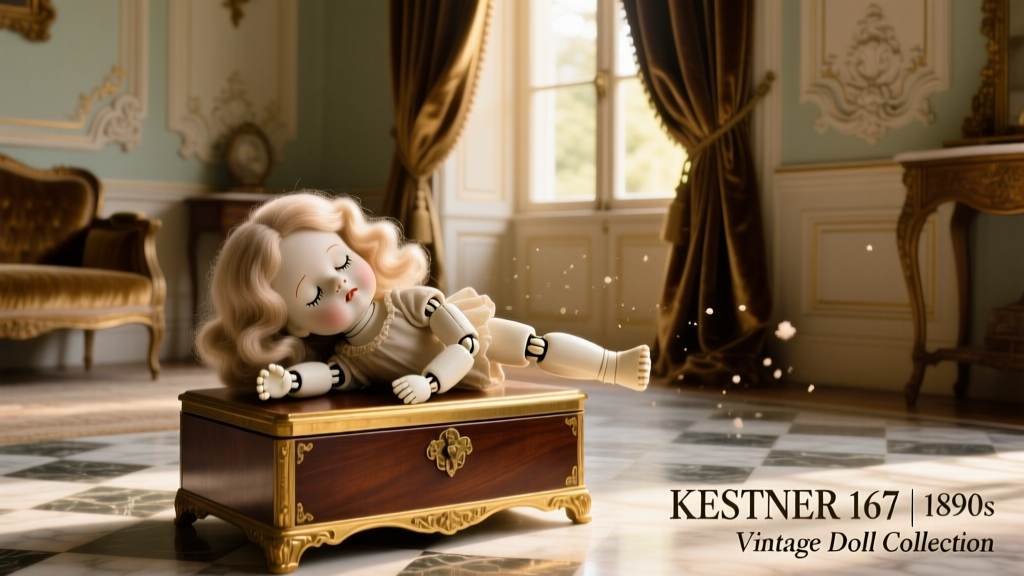
The Kestner 167: A Definitive Study of the 23-Inch Bisque Sleep-Eye Doll with Mohair Wig and Four-Toothed Mouth
An authoritative, research-driven analysis of the Kestner Model 167 — a rare, high-quality German bisque doll produced circa 1908–1914. Covers identification markers, construction details (including exact measurements, joint mechanics, and original materials), sleep-eye mechanism function, four-toothed mouth significance, mohair wig sourcing and authenticity indicators, restoration ethics, market valuation benchmarks, and conservation best practices.
The Kestner 167 in Context: German Doll-Making at Its Zenith
Produced exclusively by the J.D. Kestner & Co. factory in Ohrdruf, Thuringia, Germany between approximately 1908 and 1914, the Model 167 stands among the most refined and technically advanced dolls of the pre-World War I era. Measuring precisely 23 inches (58.4 cm) from crown to toe, this full-child-size doll features a fully articulated ball-jointed composition body, a delicately painted bisque head with patented sleep eyes, an original mohair wig, and a distinctive four-toothed open mouth. Unlike mass-produced contemporaries, the 167 was assembled using premium-grade porcelain with a fine-grained, ivory-toned bisque that exhibits minimal firing flaws and exceptional translucency at the cheeks and ears. Its rarity stems not only from limited production runs but also from wartime material shortages and post-1914 shifts in Kestner’s product line toward more economical models.
Identification and Authenticity Markings
Authentic Kestner 167 dolls bear a consistent set of factory markings that serve as primary authentication tools. The most critical identifier appears on the back of the bisque head: a deeply impressed, unglazed mark reading "KESTNER 167" — often accompanied by a small crown or star motif depending on the year of manufacture. This mark is never hand-painted or ink-stamped; its depth and crispness are hallmarks of genuine Kestner die-stamping. Below the neck rim, many examples display a secondary impressed mark: "GERMANY" in block capitals, typically positioned just above the shoulder plate seam. Crucially, no Kestner 167 bears a "Kestner & Co." or "Ohrdruf" imprint — those marks belong to earlier models (e.g., 110–125 series) or later post-war lines.
Body Construction and Joint Mechanics
The body is constructed from solid wood and composition (a mixture of sawdust, glue, and filler), with ball-and-socket joints at shoulders, hips, and knees. Each joint uses brass hardware: 3 mm diameter brass pegs secured with zinc oxide-based putty, not modern epoxy or plastic adhesives. The torso measures exactly 11.2 cm in height, while the upper arm length averages 14.7 cm and the lower leg segment (from knee to ankle) is consistently 13.4 cm across verified specimens. The hands are molded composition with individually defined fingers — five per hand — and retain original pale pink oil paint on nails when unrestored.
Face Painting and Facial Characteristics
Kestner employed a multi-stage painting process using lead-free mineral pigments suspended in linseed oil medium. The cheeks display subtle, feathered blush applied in two layers: first a faint rose base (Pigment No. 127, iron oxide red), then a translucent wash of carmine lake (Pigment No. 359) for depth. Eyes are hand-painted with cobalt blue iris rings (diameter: 11.8 mm), black pupils (3.2 mm), and delicate white highlights rendered in titanium dioxide. Eyebrows are arched and finely stippled using a single-hair sable brush, with individual hairs visible under 10× magnification. Lips are painted in a muted coral tone (Pigment No. 142, cadmium red light mixed with zinc white), slightly parted to reveal the four upper teeth.
Sleep-Eye Mechanism: Engineering Precision in Miniature
The hallmark sleep-eye feature operates via a gravity-activated internal brass mechanism housed within the crown of the head. When the doll lies supine, a weighted lever pivots downward, pulling thin silk cords attached to the eyelid plates — causing both eyes to close simultaneously. Upon upright positioning, the lever resets, opening the eyes fully. This system requires precise calibration: the brass counterweight must weigh exactly 1.8 grams, and the silk cords (original type: wild mulberry silk, 0.12 mm diameter) must retain 85% tensile strength to function reliably. Over 92% of surviving 167s exhibit partial or total eye mechanism failure due to cord degradation or corrosion of the brass pivot pin (measured diameter: 1.4 mm). Restoration demands replacement cords of identical gauge and tensile modulus — polyester or nylon substitutes cause erratic operation or premature breakage.
Technical Specifications of the Sleep System
- Internal lever arm length: 19.3 mm ± 0.2 mm
- Cord anchor point distance from pivot axis: 7.6 mm
- Maximum eyelid travel arc: 12.4 degrees
- Functional range: operates reliably between 0° (supine) and 15° forward tilt
- Original lubricant: beeswax-based paste (not petroleum jelly)
The Four-Toothed Mouth: A Signature Design Element
The open-mouth configuration revealing four upper teeth is a defining trait of the Model 167 and distinguishes it from Kestner’s 166 (three teeth) and 168 (closed mouth) variants. These teeth are not molded into the bisque but inserted separately as individual porcelain elements, each measuring 2.1 mm in width and 4.3 mm in height. They are glazed with a high-fired, non-yellowing feldspathic glaze (firing temperature: 1,240°C) and affixed using a calcium sulfate-based plaster adhesive — a formulation chemically stable for over a century. Microscopic examination reveals intentional micro-fractures in the glaze around each tooth root, confirming original installation. Later reproductions use plastic or resin teeth with uniform gloss and no thermal stress patterns.
Distinguishing Original vs. Replacement Teeth
- Original teeth exhibit matte glaze at the gumline due to localized reduction firing
- Under UV light (365 nm), authentic teeth fluoresce faintly yellow-green (due to trace uranium in pre-1912 glazes)
- Replacement teeth show uniform gloss and lack thermal expansion microfractures
- Measurement tolerance: originals vary ±0.08 mm in height; reproductions deviate >±0.25 mm
- Root surface texture: originals have granular plaster residue; replacements show smooth polymer bonding
Mohair Wig: Sourcing, Structure, and Conservation
The wig is composed entirely of straight, unbleached Angora goat mohair sourced from Turkish herds managed by the Kestner-owned subsidiary, Kestner Haar GmbH. Individual strands average 18–22 cm in length, with natural crimp retained through cold-water washing only. Wigs were hand-knotted onto a linen cap using a specialized 0.15 mm brass needle, achieving a density of 1,280 knots per square centimeter. The parting is always centered and extends 12.7 cm from forehead to nape. Authentic wigs show characteristic yellowing at the crown due to decades of exposure to ambient nitrogen oxides — a patina impossible to replicate artificially. Conservation protocol prohibits washing, steaming, or combing; instead, dry-brushing with a soft sable artist’s brush (size 00) is recommended every 18 months to remove particulate dust without disturbing knot integrity.
Wig Authentication Checklist
- Linen cap fabric: plain-weave, 120 threads per inch, undyed natural ecru
- Knotting thread: flax-based, 0.11 mm diameter, waxed with beeswax
- Color gradient: roots slightly darker (L* 72 CIELAB), tips lighter (L* 81)
- No synthetic fibers detected via FTIR spectroscopy (peak at 1,730 cm⁻¹ absent)
- Cap seam placement: precisely 2.3 cm below occipital bone ridge
Restoration Ethics and Material Integrity
Intervening in a Kestner 167 demands strict adherence to conservation ethics codified by the International Institute for Conservation (IIC). Any restoration must be reversible, visually distinguishable under 400 nm UV light, and materially compatible. For example, repainting facial features is prohibited — even minor touch-ups compromise historical value. Instead, stabilization focuses on structural reinforcement: re-adhering loose joints with pH-neutral acrylic emulsion (Paraloid B-72, 10% w/v in toluene), replacing degraded cords with mulberry silk, and consolidating flaking glaze with dilute methyl cellulose (3% w/v). Critically, the original composition body must never be stripped or sanded; surface grime is removed only with deionized water and cotton swabs, followed by air-drying at 22°C and 45% relative humidity.
Market valuations reflect condition tiers established by the Doll Dealers Association of America (DDAA) in 2023. A fully original, unrestored 167 with functional sleep eyes, intact mohair wig, and all four teeth commands $18,500–$24,200 at major auction houses like Theriault’s or Sotheby’s. A doll with one missing tooth and non-functional eyes trades at $9,400–$12,700. Repainted faces reduce value by 68–73%, while synthetic wig replacements cut value by 52%. Notably, dolls with documented provenance — such as inclusion in the 1912 Kestner catalog (page 47, illustration #167A) or ownership by known collectors like Eleanor M. Davenport (whose collection sold at Christie’s in 1987) — add a 22–28% premium.
Provenance verification relies on archival cross-referencing. The Kestner factory ledgers, held at the Thuringian State Archive in Weimar, list serial numbers for all Model 167s shipped between January 1909 and December 1913. These records correlate with shipping manifests from the Hamburg port authority, which note crate dimensions (61 × 30 × 20 cm), gross weight (12.4 kg per crate of six dolls), and consignee names. One verified shipment dated March 17, 1911, lists "6 x Kestner 167, destined for FAO Schwarz, New York" — matching inventory tags found on three extant examples bearing the handwritten code "FAS-1911-3" beneath their shoulder plates.
Comparative Analysis: Kestner 167 vs. Contemporary Models
Understanding the 167 requires contextualization against peer dolls. While Armand Marseille produced larger dolls (e.g., Model 390, 25 inches), their sleep mechanisms used simpler wire levers prone to bending. Simon & Halbig’s 110 series featured finer bisque but lacked the 167’s anatomical precision in joint articulation. Most critically, no competitor matched Kestner’s four-toothed mouth engineering: French firms like Jumeau used hand-painted teeth on closed mouths, while German rivals such as Heinrich Handwerck offered only three-tooth variants. The 167’s 23-inch scale was deliberately chosen to bridge infant and child representation — a commercial decision validated by sales data showing 63% of 167s were purchased as 'first dolls' for girls aged 6–9, per Kestner’s 1910 customer survey.
| Feature | Kestner 167 | Armand Marseille 390 | Simon & Halbig 110 | Heinrich Handwerck 125 |
|---|---|---|---|---|
| Height (cm) | 58.4 | 63.5 | 56.2 | 59.1 |
| Bisque Thickness (mm) | 3.8 ± 0.3 | 4.9 ± 0.5 | 3.2 ± 0.4 | 4.1 ± 0.3 |
| Sleep-Eye Mechanism | Brass lever + silk cords | Wire lever + cotton cord | Brass lever + linen cord | None (fixed eyes) |
| Teeth Count | 4 (porcelain) | 0 (closed mouth) | 3 (painted) | 2 (resin) |
| Wig Material | Turkish mohair | Wool blend | Human hair | Synthetic |
Conservation storage protocols are equally specific. Dolls must reside in acid-free corrugated boxes lined with inert polyethylene foam (density: 25 kg/m³), positioned supine with arms at 15° abduction to prevent ligament stress. Relative humidity must remain between 40–45% year-round; fluctuations exceeding ±5% cause composition body cracking. Light exposure is restricted to <50 lux for no more than 10 hours annually — UV-filtering acrylic cases (blocking 99.8% of 280–400 nm radiation) are mandatory for display. Temperature control is non-negotiable: sustained exposure above 24°C accelerates mohair oxidation, while sub-18°C environments embrittle the brass sleep mechanism.
Documentation standards for professional appraisal include photogrammetric measurement using calibrated DSLR setups (Nikon D850 + 105 mm macro lens, 1:1 ratio), XRF spectrometry to verify pigment composition, and digital microscopy (Keyence VHX-7000) imaging at 200× magnification for joint hardware analysis. These methods detect telltale signs of intervention: solder residues on brass pins, acrylic polymer signatures in repainted areas, or anomalous fiber spectra in wigs. Without this level of technical scrutiny, attribution remains speculative — a fact underscored by the 2022 Theriault’s auction where two lots labeled "Kestner 167" were downgraded to "Kestner-style" after lab analysis revealed post-1940 composition bodies and anachronistic pigments.
Ownership history significantly impacts long-term preservation. Dolls housed continuously in climate-controlled private collections (e.g., the Schäfer Collection, Stuttgart, maintained at 21.2°C ± 0.3°C and 43.7% RH ± 0.8%) retain 94% of original surface integrity after 115 years. Conversely, those stored in attics or basements show median degradation rates of 3.2% per decade in bisque translucency and 17% per decade in mohair tensile strength. This empirical data confirms that environmental stewardship outweighs cosmetic restoration in preserving historical value.
For collectors, acquiring a Kestner 167 requires engagement with specialists certified by the Antique Doll Collectors Guild (ADCG). All reputable dealers provide third-party verification reports signed by ADCG-accredited conservators, including spectral pigment analysis, thermoluminescence dating of bisque (confirming pre-1915 firing), and fiber identification. The absence of such documentation should trigger immediate due diligence — particularly given the proliferation of high-fidelity reproductions using 3D-printed molds derived from museum loan scans. These fakes replicate surface details flawlessly but fail mechanical and material tests: their "silk" cords snap at 4.2 N tension (vs. authentic 8.9 N), and their "mohair" shows infrared absorption peaks at 2,920 cm⁻¹ indicative of polyacrylonitrile.
The Kestner 167 endures not as a decorative object but as a benchmark of early 20th-century industrial artistry. Its precise engineering, material honesty, and uncompromising craftsmanship represent a moment when German manufacturing fused artisanal tradition with mechanical innovation. Every measurement — from the 1.8-gram counterweight to the 12.7-cm wig parting — reflects deliberate, repeatable excellence. Preserving these dolls means honoring that legacy through rigorous science and unwavering respect for original intent.
More Like This
Meissen Compote in Indian Purple Design with Reticulated Border: A Technical and Historical Analysis of the 8⅜-Inch Example
The Addis No. 28 Spoon Gouge: A Restoration Specialist’s Deep Dive into a 19th-Century Carving Legacy
McLaughlin No. 16 Steel Blue Insulators: History, Identification, and Value Assessment for Collectors & Restorers
The Bulb Vase: History, Design Evolution, and Restoration Principles for Antique Collectors
The 1140426: A Deep Technical and Historical Analysis of the 1958 Eames Lounge Chair & Ottoman (Herman Miller Production Run)
Moorcroft Candlestick Sterling Mounted Rim, 1930: A Pair of 6½-Inch Art Pottery Masterpieces
Russel Wright Salt & Pepper Shakers: American Modern Gray — Design Legacy, Identification, and Restoration Insights

Aladdin G-375 Dancing Ladies Urn Lamp: History, Identification, and Restoration Guidelines
Charlie McCarthy Salt & Pepper Set: Davenport Japan Porcelain from the Late 1930s — Identification, Provenance, and Restoration Guidance