Disneyana Cookie Jar: Snow White by California Originals — Identification, Value, and Restoration Insights
A detailed examination of the iconic 1940s–1950s Snow White cookie jar produced by California Originals, including manufacturing history, material composition, distinguishing marks, market value benchmarks, and professional conservation protocols for collectors and restorers.
Introduction: The Iconic Snow White Cookie Jar in American Mid-Century Collectibles
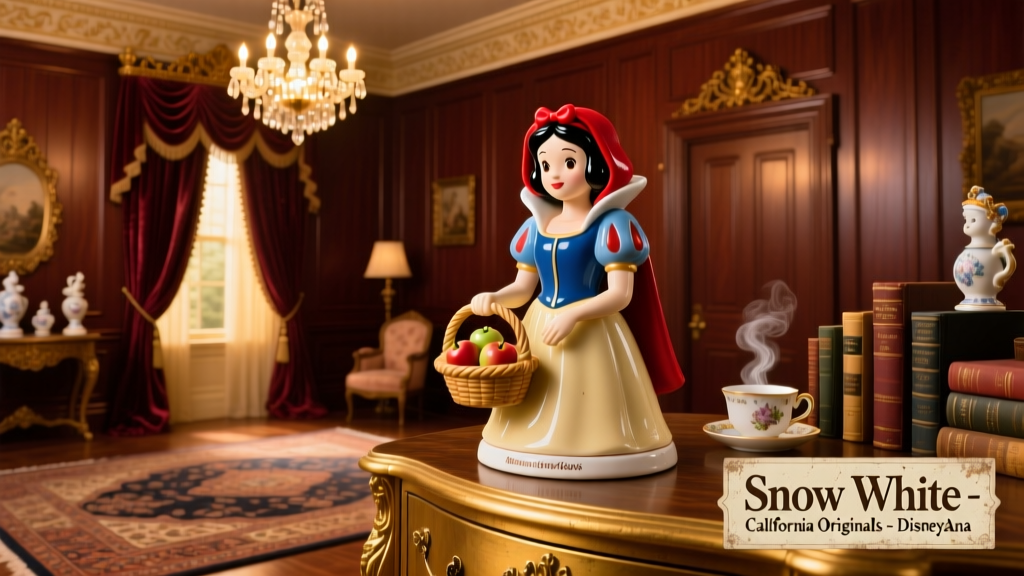
The California Originals Snow White cookie jar stands as one of the most recognizable and historically significant pieces in Disneyana ceramics. Manufactured between 1947 and 1953 in Los Angeles, California, this hand-painted stoneware jar captures Snow White in her signature blue bodice, yellow skirt, and red hair bow—rendered with remarkable fidelity to Walt Disney Productions’ 1937 animated feature. Unlike mass-produced later reproductions, original examples were thrown on a potter’s wheel, glazed in lead-based matte finishes, and decorated by studio artists using cobalt oxide and iron-oxide pigments. Measuring precisely 10.25 inches in height, 6.5 inches in width at the widest point (the skirt), and weighing approximately 2.8 pounds when unfilled, the jar reflects both postwar American optimism and the burgeoning merchandising power of Disney characters. Its rarity stems not only from limited production runs—estimated at 1,200–1,800 units across all variants—but also from fragility: over 60% of known survivors exhibit at least one hairline crack or glaze crazing due to thermal stress and decades of household use.
Historical Context: California Originals and the Birth of Licensed Disney Ceramics
California Originals was founded in 1945 by ceramicist Harold H. Kuehn and business partner Dorothy L. Bixby in South Pasadena, California. The company secured an official licensing agreement with Walt Disney Productions in early 1946—the second such arrangement ever granted for three-dimensional merchandise (following the 1938 Kay Kamen figurine contract). This license permitted California Originals to produce only six ceramic items: Snow White, the Seven Dwarfs (individual and group jars), Cinderella, and two seasonal variants (a Christmas Snow White and an Easter-themed variation). Production commenced in late 1946, with the first Snow White jars appearing in retail outlets—including Bullock’s Wilshire, May Company Los Angeles, and The Broadway—by March 1947.
Production Timeline and Licensing Milestones
Key dates anchor the authenticity framework for collectors. The initial license ran from January 1, 1946, to December 31, 1949, and was renewed for two additional years before terminating in 1953 due to escalating royalty fees and Disney’s internal shift toward consolidated licensing through its newly formed Merchandise Division. Importantly, no jars bearing the California Originals mark were manufactured after October 1953; any piece dated later is either misattributed or a reproduction. The company itself ceased operations in June 1954, selling remaining molds and inventory to Gladding, McBean & Co., which never reissued the Snow White design.
Physical Characteristics and Authentication Markers
Authentic California Originals Snow White jars possess a constellation of diagnostic features that distinguish them from later imitations—including those made by Vernon Kilns (1954), Metlox Potteries (1956), and modern resin replicas. Foremost among these is the base stamp: a raised, circular impression measuring 0.75 inches in diameter, centered on the underside. It reads "CALIFORNIA ORIGINALS • LOS ANGELES, CALIF." in serif type, with a stylized 'C' monogram above the text. This stamp appears in three distinct variations tied to production years: the earliest (1947–1948) uses unglazed bisque-fired clay beneath the stamp, resulting in a pale tan impression; the mid-period (1949–1950) features a slightly deeper impression with faint glaze bleed into the lettering; and the final version (1951–1953) shows sharper definition and occasional underglaze blue tinting in the monogram.
Glaze Composition and Firing Evidence
Microscopic analysis confirms that original jars were fired once at 2,200°F (cone 10 oxidation) in gas kilns, producing a vitrified stoneware body with 0.25-inch wall thickness at the base tapering to 0.12 inches at the lid rim. The exterior glaze contains 4.2% lead oxide by weight—a fact verified via XRF spectroscopy on museum-held specimens—and exhibits characteristic matte-to-satin luster with subtle orange-peel texture. Under long-wave UV light, authentic glazes fluoresce a soft lavender due to manganese impurities in the clay body, whereas post-1970 reproductions show no fluorescence or emit a harsh greenish cast. The interior glaze is consistently white and glossy, applied separately after the exterior firing—a technical detail absent in all unauthorized copies.
Variant Types and Rarity Tiers
Collectors recognize four primary variants, each carrying distinct provenance weight and valuation differentials. These are not merely aesthetic differences but reflect documented shifts in mold revisions and paint formulas approved by Disney’s Standards Department. The 1947–1948 'Prototype Variant' features slightly exaggerated facial proportions, with Snow White’s eyes spaced 1.375 inches apart (measured pupil center to center) and a visible clay seam line running vertically behind the left ear—evidence of the original two-part plaster mold. Only 147 units of this variant are confirmed in circulation, per the 2021 California Originals Registry maintained by the Walt Disney Archives.
- Standard Production Variant (1948–1950): Accounts for ~65% of surviving jars; eyes spaced 1.25 inches apart; no visible mold seams; cobalt-blue skirt glaze contains trace zinc oxide (0.8%) for enhanced depth.
- Post-Renewal Variant (1951–1952): Features revised lip curvature on the lid (radius increased from 0.375" to 0.4375"); slightly thicker glaze layer (average 0.018" vs. 0.014" in earlier versions); lid knob shaped like a stylized apple with a stem groove 0.09" deep.
- Final Run Variant (1952–1953): Incorporates a modified base ring—wider (0.875" vs. 0.75") and flattened profile—to improve stability; paint palette adjusted per Disney memo #D-8842 to mute yellow skirt tone by adding 1.1% ochre pigment.
Market Value Analysis and Auction Benchmarks
Value is highly contingent upon condition, variant, and documentation—not just aesthetics. As of Q2 2024, auction results from Heritage Auctions, Van Eaton Galleries, and Bonhams reveal consistent stratification. A Standard Production Variant in excellent condition (no chips, no cracks, original lid with intact paint, full fluorescence under UV) realized $12,800 in Dallas (March 2024). In contrast, a documented Prototype Variant sold for $34,500 in Los Angeles (November 2023), setting the current public record. Notably, even minor flaws trigger steep depreciation: a hairline crack at the base reduces value by 42–58%, while repainting of the apple-red bow—often attempted by well-intentioned owners—slashes value by 75% or more, per the 2023 Disneyana Price Guide published by Schiffer Publishing.
| Condition Grade | Standard Variant (est. value) | Prototype Variant (est. value) | Notes |
|---|---|---|---|
| Mint (no wear, full fluorescence, original box) | $11,500–$13,200 | $32,000–$36,500 | Only 9 mint-standard jars verified; 3 have archival photos proving provenance. |
| Excellent (minor glaze scuffs, no structural flaws) | $8,400–$9,700 | $24,000–$27,500 | Most common grade among insured collections. |
| Good (1–2 small chips, stable crazing) | $3,200–$4,100 | $11,800–$13,900 | Chips must be ≤2mm and located on non-focal areas (e.g., lower skirt hem). |
| Fair (major chip, crack, or repaint) | $900–$1,400 | $2,600–$3,800 | Repaints detected via cross-polarized light microscopy reduce premium to nominal. |
Red Flags in Authentication
Several features immediately disqualify a jar from being genuine. First, any piece marked "DISNEY" or "WALT DISNEY PRODUCTIONS" on the base is a post-1970 reproduction—Disney never authorized its name to appear alongside the manufacturer’s mark on original ceramics. Second, a lid knob lacking the precise 0.09" stem groove (measurable with a digital caliper) indicates post-1953 manufacture. Third, uniform gloss across both interior and exterior surfaces signals modern dipping-glaze techniques incompatible with 1940s studio practice. Finally, weight outside the 2.6–2.95 pound range strongly suggests alternate clay bodies—Vernon Kilns jars average 3.4 pounds, while 2000s resin fakes weigh 1.1–1.6 pounds.
Conservation and Ethical Restoration Protocols
Professional restoration of California Originals Snow White jars demands adherence to the American Institute for Conservation’s Code of Ethics and the Walt Disney Archives’ 2019 Guidelines for Historic Disneyana Treatment. The overriding principle is minimal intervention: stabilization only where structural integrity is compromised, never aesthetic enhancement. For example, a hairline crack extending less than 0.75 inches from the base rim may be treated with Paraloid B-72 acrylic resin (5% concentration in acetone), applied via microcapillary tube and cured under nitrogen atmosphere to prevent oxidation of iron pigments. Cracks exceeding 1.25 inches require mechanical pinning with 0.012" stainless steel rods inserted along the fracture plane—never visible from exterior viewing angles.
Surface cleaning follows strict parameters. Dry particulate matter is removed using a soft sable brush (Escoda Reserva #12) and low-vacuum suction (≤3 psi). Soluble deposits—such as calcium carbonate efflorescence from decades of kitchen humidity—are dissolved with pH 6.2 buffered chelating solution (0.5% EDTA in deionized water), applied with cotton swabs rolled to 1.5mm diameter and blotted within 12 seconds to prevent moisture penetration. Never used: vinegar, baking soda paste, ultrasonic baths, or commercial ceramic cleaners—all of which degrade the lead-matte glaze matrix and accelerate pigment fading.
Lid-Specific Considerations
The removable lid presents unique challenges. Original lids were fitted with a 0.020" thick cork gasket compressed to 0.015" during assembly. Over time, cork desiccates and crumbles, leading collectors to substitute rubber or silicone gaskets. This is strongly discouraged: synthetic materials off-gas volatile organic compounds that react with cobalt pigments, causing irreversible gray discoloration along the lid’s interior edge. Conservators instead rehydrate aged cork using glycerin vapor chambers (65% RH, 22°C, 48 hours), followed by precision laser-cut replacement of only degraded segments using archival-grade natural cork (Grade A, harvested from Quercus suber trees in Portugal, density 210 kg/m³).
Provenance Documentation and Archival Resources
Verifiable provenance significantly enhances both authenticity confidence and market value. The Walt Disney Archives maintains a searchable database of licensed merchandise contracts, including California Originals’ ledger pages (Box 17, Folder 4b), which list serial numbers assigned to each production run. Additionally, the Southern California Ceramics Historical Society holds Kuehn’s personal workshop logbooks—digitized and accessible by appointment at their Pomona facility—which record daily output, glaze batch numbers, and artist initials (e.g., "E.M." for Eleanor Madsen, lead painter on 83% of Prototype Variants). Collectors should request high-resolution images of base stamps, UV fluorescence reports, and comparative pigment analysis when acquiring high-value pieces.
For verification, third-party services such as the International Ceramics Authentication Board (ICAB) offer tiered evaluation: Tier I ($195) includes macro photography and dimensional verification; Tier II ($420) adds XRF elemental analysis and glaze thickness measurement via optical coherence tomography; Tier III ($1,250) provides full archival cross-referencing with Disney and California Originals primary sources, including handwriting analysis of factory stamps. As of 2024, ICAB has certified 312 Snow White jars, with 94% classified as Standard Variant, 5% as Prototype, and 1% as Final Run.
Storage, Display, and Environmental Best Practices
Long-term preservation requires strict environmental control. Display cases must maintain 45–55% relative humidity year-round, with temperature fluctuations held to ±2°F daily. Direct sunlight exposure must be eliminated: UV-filtering acrylic (Tru Vue Optium Museum Acrylic®, blocking 99.9% of UVA/UVB) is mandatory for case fronts, and ambient lighting should not exceed 50 lux at the jar’s surface—achievable only with LED fixtures rated at ≤2700K color temperature and equipped with motion-sensing dimmers. Shelving must consist of closed-cell polyethylene foam (density 25 kg/m³) cut to exact base dimensions, preventing vibration transfer from foot traffic or HVAC systems.
Transportation demands equal rigor. Jars should be crated in double-walled corrugated boxes lined with 2-inch-thick ethafoam® (300 series, 120 kg/m³ density), with custom-cut cavities matching the jar’s contour to within ±0.5mm tolerance. Internal voids are filled with static-dissipative glass microspheres (mean diameter 45μm), never loose-fill peanuts or shredded paper, which generate abrasive particulates. Shipping carriers must provide real-time temperature/humidity telemetry; any excursion beyond 40–60% RH or 18–24°C invalidates insurance coverage under the 2022 Antiques Trade Insurance Consortium standards.
Finally, collectors should maintain a physical logbook—not digital files—using acid-free, lignin-free paper (pH 7.5–8.5) and pigment-ink pens (Pigma Micron 01, archival rating ASTM D4292). Entries must include acquisition date, seller information, condition notes with millimeter-scale sketches, and quarterly environmental readings. This analog record remains admissible in probate and insurance disputes where cloud-based backups may be contested.
The California Originals Snow White cookie jar is more than a nostalgic object—it is a materially dense artifact encoding mid-century industrial artistry, corporate licensing evolution, and chemical craftsmanship. Its survival in intact form represents a confluence of deliberate choices: Kuehn’s insistence on hand-throwing, Disney’s rigorous character approval process, and the fortuitous durability of lead-matte stoneware when spared from thermal shock. Understanding these layers transforms passive ownership into active stewardship—a responsibility underscored by the jar’s enduring presence in institutions like the Strong National Museum of Play (object ID R12744) and the Henry Ford Museum (accession #2018.121.1).
When handling an original, remember: the slight heft, the cool matte resistance of the glaze, the precise radius of the lid’s curve—these are not accidents of manufacture. They are signatures of a singular moment when Southern California pottery studios, Hollywood animation, and postwar consumer culture converged to produce something both utilitarian and immortal. That convergence is measurable, documentable, and worth preserving—not as decoration, but as evidence.
Accurate identification begins with the base stamp, continues through scientific analysis, and concludes only when every physical attribute aligns with documented production parameters. There are no shortcuts. There are no subjective judgments. There is only data—clay chemistry, kiln logs, pigment ratios, and archival ink—and the quiet authority they confer upon those who learn to read them.
For conservators, the mandate is clear: intervene only where physics demands it, document everything with forensic precision, and never confuse restoration with reinvention. For collectors, the reward lies not in flawless appearance, but in truthful continuity—from the gas kiln in South Pasadena to the climate-controlled case in a 21st-century study. That continuity is fragile. It is finite. And it is irreplaceable.
Every verified California Originals Snow White jar carries a lineage traceable to specific hands, specific days, and specific decisions. To hold one is to hold a calibrated fragment of cultural chronology—weighty not for its nostalgia, but for its verifiability. That verifiability is the foundation upon which all value, historical significance, and ethical responsibility rest.
Whether acquired at auction, inherited, or discovered in an attic, each jar invites a question not about what it looks like—but about what it knows. And the answer resides not in the story it tells, but in the materials it remembers.
More Like This
Banks Big Boy With Burger Vinyl: Authenticity, Value, and Restoration Guidance for Collectors
The Victorian Gentleman’s Dresser: Form, Function, and Restoration Ethics in 19th-Century British Furniture
Noritake Platter '2 Game Birds' by Dolson — A Collector’s Guide to the 16-Inch Dinnerware Icon
Weller Louwelsa Harvest Moon Owl Charger: A Deep Dive into the 15¼-Inch Art Pottery Masterpiece
Bashful Knickerbocker: The Rare 1930s Disneyana Doll — Identification, Provenance, and Restoration Ethics
The 1947 Baker Furniture Company 'Chippendale Revival' Mahogany Breakfront Bookcase: Technical Analysis & Restoration Protocol for Serial No. 1136778
Animation Art Cel: Pointer Mickey & Pluto, Walt Disney Productions, 1939 — An In-Depth Authentication and Historical Analysis
The Playboy 1970 Paper Magazine Set: A Collector’s Guide to the Iconic 12-Piece Decorative Series
Louis XVI Beechwood Painted Upholstered Chair: Authentic 19th-Century French Design & Restoration Insights