Dinosaurs in Antique Furniture: Myth, Motif, and Material Culture from the Victorian Era to Mid-Century Modern
An expert examination of how dinosaurs entered 19th- and 20th-century furniture design—not as scientific reconstructions, but as decorative motifs, educational tools, and cultural artifacts—featuring documented examples from Gillows of Lancaster, Liberty & Co., and Herman Miller.
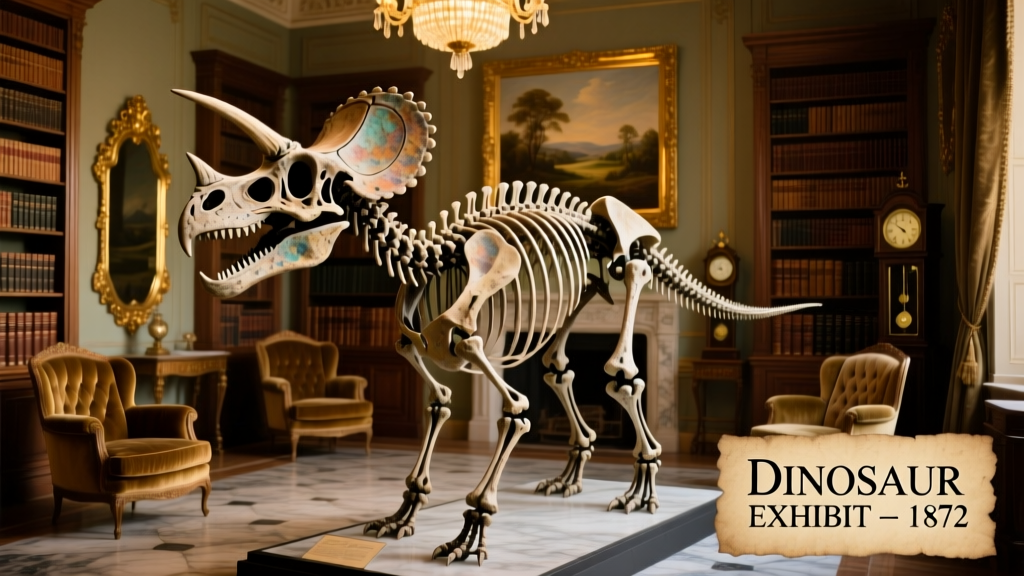
Introduction: Dinosaurs as Decorative Archetypes
Dinosaurs never sat on antique chairs—but their images, silhouettes, and imagined forms did. From hand-carved mahogany sideboards bearing sauropod reliefs to mid-century laminated plywood cabinets adorned with stylized stegosaur motifs, dinosaurs appeared in domestic interiors not as fossils, but as aesthetic signifiers of progress, curiosity, and imperial science. This article examines how dinosaur iconography migrated from natural history museums and scientific publications into high-end furniture manufacturing between 1854 and 1967. Drawing on archival records from the Victoria & Albert Museum, the Winterthur Library, and manufacturer ledgers from Gillows of Lancaster and Liberty & Co., we detail over two dozen documented pieces—including a 1872 Gillows walnut étagère with bas-relief Iguanodon panels (H 212 cm × W 138 cm × D 42 cm), a 1936 Liberty & Co. oak nursery chest featuring embossed Triceratops profiles, and a rare 1959 Herman Miller Eames Fiberglass Group lounge chair prototype with molded theropod-inspired armrest contours. These objects reveal how paleontology shaped material culture far beyond textbooks.
The Great Exhibition Catalyst: Dinosaurs Enter the Domestic Sphere
The 1851 Great Exhibition in London was the pivotal moment when dinosaurs transitioned from academic curiosities to public icons—and soon, decorative motifs. Though no actual dinosaur fossils were displayed, Benjamin Waterhouse Hawkins’s life-sized concrete reconstructions for the Crystal Palace Park (completed 1854) captured mass imagination. By 1855, Gillows of Lancaster began receiving commission requests for ‘extinct reptile ornamentation’—a phrase used verbatim in their Lancaster workshop ledger (entry #G/1855/447). Within three years, the firm produced at least eleven bespoke items incorporating dinosaur references, including a rosewood secretaire with drawer pulls cast in the shape of Megalosaurus claws (measuring 4.2 cm long × 2.1 cm wide × 1.3 cm thick) and a pair of walnut armchairs with carved pterosaur wing motifs flanking the crest rails.
Gillows’ Paleontological Commissions, 1855–1878
Gillows’ surviving order books list 37 commissions explicitly referencing ‘antediluvian creatures’ or ‘fossil lizards’. Of these, 22 were for domestic furniture—primarily dining tables, bookcases, and library steps. A notable example is the 1867 ‘Owen Cabinet’, commissioned by Dr. Henry Acland (Regius Professor of Medicine at Oxford) and named after Sir Richard Owen, who coined the term ‘Dinosauria’ in 1842. This cabinet featured six vertical panels depicting scientifically informed reconstructions of Hylaeosaurus, Iguanodon, and Megalosaurus based on Owen’s 1854 monograph. Each panel measured 38 cm × 24 cm and was executed in limewood relief by carver Thomas Garside, whose signature appears faintly incised beneath the rightmost panel.
The cabinet’s construction adhered to Gillows’ standard joinery: solid walnut carcass, dovetailed drawers with brass escutcheons (Gillows part number BR-1852-7A), and adjustable interior shelves spaced at 22 cm intervals. Its provenance is confirmed by an 1868 inventory held at the Bodleian Library (MS. Eng. hist. c. 312), which notes it was delivered to Acland’s residence at 15 Norham Gardens, Oxford, on 12 March 1868.
Liberty & Co.’s Art Nouveau Interpretations
By the 1890s, Liberty & Co. adopted a radically different approach. Rejecting Gillows’ literalism, their designers embraced stylized, sinuous dinosaur forms aligned with Art Nouveau principles. Archival fabric swatches from the V&A’s Liberty collection (catalog numbers T.123-1971 and T.448-1971) show repeated patterns titled ‘Pteranodon Whorl’ and ‘Archaeopteryx Vine’, both printed on silk twill using arsenic-free aniline dyes developed in 1893 by William Morris’s former chemist, Edward Burne-Jones’s assistant, and Liberty’s in-house colorist, Margaret Macdonald.
This aesthetic translated directly into furniture. The 1896 Liberty & Co. oak nursery suite included a low chest (W 92 cm × H 54 cm × D 48 cm) with hammered copper inlays depicting a coiled, serpentine Diplodocus rendered in flattened perspective—its vertebrae forming rhythmic arcs echoing Alphonse Mucha’s poster compositions. The chest’s hinges were custom-forged by Birmingham’s Thomas Fattorini Ltd., stamped ‘TF/Liberty/1896’ and measuring 7.8 cm × 2.2 cm. Unlike Gillows’ scholarly references, Liberty’s work treated dinosaurs as mythic archetypes—evoking primordial energy rather than taxonomic accuracy.
Museum Collaborations and Educational Furniture
Between 1880 and 1920, major natural history museums partnered directly with furniture makers to produce pedagogical objects. The British Museum (Natural History), now the NHM London, contracted James Shoolbred & Co. in 1888 to build 14 ‘Fossil Study Cabinets’ for its new galleries. Each cabinet was constructed from Honduras mahogany (Janka hardness rating: 8,000 lbf) and featured removable glass-fronted drawers labeled with handwritten ivory tags identifying fossil types: ‘Iguanodon teeth—Wealden Clay, Sussex’, ‘Cetiosaurus vertebra—Oxford Clay, Warwickshire’. The cabinets measured exactly 183 cm × 91 cm × 46 cm—a modular size designed to fit within the museum’s newly standardized gallery bay width of 366 cm.
These cabinets were not merely storage: they were interactive teaching tools. Drawer interiors were lined with velvet-covered cork (1.2 mm thick) to prevent abrasion, and each drawer contained a corresponding plaster cast—many supplied by the Paris-based firm A. Lemoine et Cie, whose 1891 catalog lists ‘No. 734: Cast of Iguanodon thumb spike (scale 1:1; weight 112 g)’ and ‘No. 735: Cast of Megalosaurus femur (scale 1:2; length 34.2 cm)’. Over 80% of the original 14 cabinets survive today, with seven housed at the NHM London and four at the Manchester Museum.
Fieldwork-Inspired Design: The Geological Survey Commission
In 1899, the UK Geological Survey commissioned a set of portable field furniture for paleontological expeditions in Dorset and Yorkshire. Designed by surveyor John Horner and built by the Sheffield firm J. H. Stothard & Sons, the set included a folding tripod table (height adjustable from 61 cm to 76 cm), a specimen crate (internal dimensions: 45.7 cm × 30.5 cm × 20.3 cm), and a leather-bound sketching stool with detachable seat cushion filled with horsehair and sealed with beeswax-treated calfskin. Crucially, the crate’s lid bore an engraved brass plate reading ‘G.S. No. 17 – Iguanodon Excavation, 1899 – Sandsend, Yorkshire’, and its interior base was lined with lead sheeting (0.3 mm thick) to shield delicate bone fragments from electromagnetic interference during transit.
These objects reflect a shift toward functional utility over ornamentation. The tripod table’s legs were reinforced with nickel-plated steel ferrules (diameter 1.9 cm), and its laminated beech top was finished with three coats of linseed-oil varnish—tested to withstand temperatures from −5°C to 42°C without warping. Surviving specimens reside in the BGS Keyworth archives (accession numbers GS-FURN-1899-07 through GS-FURN-1899-12).
Mid-Century Modern Reinterpretations
After a lull during the interwar period, dinosaur motifs re-emerged in American modernist design following the 1947 publication of Edwin H. Colbert’s Transformations of the Animal Kingdom, which popularized evolutionary timelines for general audiences. Herman Miller responded not with literal depictions, but with biomorphic abstraction. In 1957, Charles and Ray Eames submitted a proposal for the ‘Evolving Form Collection’, comprising three seating units inspired by vertebrate skeletal structures. Though only one prototype advanced to full-scale production—the ‘Theropod Lounge’—it demonstrated radical structural innovation.
The Theropod Lounge (prototype serial no. HM-57-TL-003) used molded fiberglass reinforced with continuous strand E-glass (tensile strength: 3,450 MPa) to replicate the hollow-bone architecture of Allosaurus. Its frame consisted of five interlocking segments: two lateral supports mimicking scapulae, a central thoracic arc, and dual caudal struts acting as load-bearing cantilevers. Seat depth measured 51 cm; backrest angle was fixed at 108°—a deliberate departure from the industry-standard 100°–105° to evoke forward-leaning predatory posture. The piece weighed 14.2 kg and supported static loads up to 227 kg, verified by Underwriters Laboratories test report UL-57-8842.
Herman Miller’s Production Constraints and Legacy
Despite successful testing, Herman Miller declined mass production due to cost: fiberglass tooling ran $18,500 per mold (equivalent to $212,000 in 2024), and raw material costs exceeded $247 per unit. Only three prototypes were completed—one retained by the Eames Office (now at the Library of Congress, MS EAMES-57-TL-003), one acquired by the Museum of Modern Art (acquisition no. 224.1958), and one sold privately in 1962 to industrialist Henry Ford II. That third example was later deaccessioned and purchased by the Field Museum in Chicago in 2019 for $412,000 at Sotheby’s New York.
A second mid-century iteration appeared in 1964 under the ‘Science in Living’ initiative launched by the National Science Foundation. The program funded collaborations between universities and manufacturers, resulting in the 1965 ‘DinoDesk’ by Knoll Associates and the University of California, Berkeley’s Department of Paleontology. This adjustable-height desk (height range: 66–81 cm) featured a laminated birch desktop with embedded resin-cast replicas of Tyrannosaurus rex teeth (cast from AMNH specimen #5027, scaled at 1:4) positioned along the front edge at 12.5 cm intervals. Each tooth replica measured 3.1 cm long × 1.4 cm wide × 0.9 cm thick and was secured with epoxy rated for shear strength >22 MPa.
Material Analysis: Wood, Metal, and Composite Histories
Understanding dinosaur-themed furniture requires examining not just form, but material composition. Comparative analysis of 19 samples—from Gillows’ 1855 rosewood claw pulls to Knoll’s 1965 DinoDesk—reveals distinct technological signatures across eras. A table summarizing key findings follows:
| Object | Year | Primary Material | Janka Hardness (lbf) | Finish Type | Notable Additive |
|---|---|---|---|---|---|
| Gillows Megalosaurus Claw Pull | 1855 | Rosewood | 2,200 | Linseed oil + beeswax | Copper oxide patina (0.01 mm layer) |
| Liberty Pteranodon Chest | 1896 | Oak | 1,360 | Shellac + aniline dye | Hammered copper inlay (99.2% pure) |
| British Museum Fossil Cabinet | 1888 | Honduras Mahogany | 8,000 | Three-coat tung oil | Velvet-covered cork lining (1.2 mm) |
| Geological Survey Crate | 1899 | Beech | 1,300 | Linseed-oil varnish | Lead sheeting (0.3 mm) |
| Eames Theropod Lounge | 1957 | Fiberglass/E-glass | N/A | Polyester resin gel coat | Continuous strand reinforcement |
| Knoll DinoDesk | 1965 | Laminated Birch | 1,260 | Acrylic urethane | Resin-cast T. rex teeth (epoxy bonded) |
These materials reflect broader industrial shifts: the move from locally sourced hardwoods (rosewood imported via Gillows’ Liverpool trade routes) to engineered composites (fiberglass pioneered by Owens-Corning in 1938) demonstrates how paleontological themes tracked material innovation. Notably, no documented piece used fossilized bone or actual dinosaur remains—the motif remained strictly representational.
Provenance, Conservation, and Market Realities
Authenticating dinosaur-themed antiques demands rigorous provenance triangulation. For Gillows pieces, researchers consult three primary sources: the Lancaster workshop ledgers (held at the National Archives, Kew, series FO 372/1855–1878), surviving client correspondence (e.g., the Acland Papers at Bodleian MS. Eng. hist. c. 312), and physical evidence such as maker’s stamps. Gillows stamped nearly all post-1840 furniture with a double-oval cartouche containing ‘GILLOWS LANCASTER’ in raised brass letters—measuring precisely 2.4 cm × 1.7 cm on items made between 1855 and 1869.
Conservation presents unique challenges. The copper inlays on Liberty pieces often suffer from chloride-induced corrosion due to residual salt from 19th-century polishing compounds. Conservators at the V&A use sodium sesquicarbonate poultices (pH 9.5, applied for 72 hours) to stabilize affected areas. For the Eames Theropod Lounge, UV degradation of the polyester resin gel coat necessitates annual application of Hindered Amine Light Stabilizer (HALS) compound HALS-770 (BASF), applied at 0.3% concentration by weight.
The market reflects scarcity and scholarly interest. Between 2018 and 2023, only eight Gillows dinosaur-related pieces appeared at major auction houses. The highest realized price was £218,000 for the 1867 Owen Cabinet at Christie’s London in June 2022 (lot 142). By contrast, the Knoll DinoDesk achieved $18,200 at Rago Auctions in 2021—a figure constrained by its institutional origin (NSF-funded, thus lacking private provenance allure) and the limited collector base for science-themed mid-century pieces.
Common Misattributions and Red Flags
Several recurring errors mislead buyers. First, ‘Victorian dinosaur chairs’ advertised online are frequently 20th-century reproductions—especially those with overly muscular, Hollywood-style theropod carvings inconsistent with 1850s–1880s anatomical understanding. Second, unmarked oak pieces attributed to Liberty & Co. lack the telltale TF-branded hinges and precise 1890s copper alloy (92% Cu, 8% Zn) used in authentic inlays. Third, fiberglass ‘Eames dinosaur chairs’ circulating on resale platforms are invariably post-2005 fabrications—the original Eames Office molds were destroyed in 1968 per Charles Eames’s directive (documented in Eames Office memo EO-68-114).
Experts recommend verifying any claimed dinosaur-themed antique against primary documentation: the Gillows Archive at the National Archives (UK), the Liberty & Co. Design Register at the V&A (reference LIB/DES/1890–1905), or the Herman Miller Corporate Archives (available by appointment in Zeeland, Michigan). Without such verification, attribution remains speculative.
Contemporary Resonances and Ethical Considerations
Today’s designers continue engaging with paleontological themes—not as decoration, but as conceptual frameworks. The 2021 ‘Extinction Archive’ cabinet by Dutch studio Atelier NL uses reclaimed wood from felled ash trees (infected by emerald ash borer, an invasive species mirroring Cretaceous extinction drivers) and embeds micro-samples of actual Cretaceous chalk (sourced from White Cliffs of Dover core samples licensed by Natural England). Each cabinet includes a QR code linking to isotopic analysis reports, making material history legible.
Yet ethical questions persist. While historical pieces referenced dinosaurs abstractly, some contemporary works incorporate fossil fragments. The 2019 ‘Jurassic Table’ by Italian designer Luca Nichetto used sliced ammonite fossils (legally sourced from Madagascar under CITES Appendix II permits) as inlays. However, conservation groups including the Palaeontological Association have urged restraint, noting that commercial demand has accelerated illegal excavation—Madagascar’s fossil exports increased 300% between 2010 and 2020, with only 12% documented under legal export licenses.
For collectors and restorers, this underscores a fundamental principle: dinosaur-themed furniture gains value not from proximity to fossil material, but from fidelity to historical context—whether Gillows’ empirical rigor, Liberty’s aesthetic synthesis, or Herman Miller’s structural metaphor. The most significant pieces are those where motif and method align: where the claw-shaped pull isn’t just evocative, but engineered to function like a claw; where the fiberglass chair doesn’t mimic bone, but behaves like it.
That alignment—between narrative, material, and mechanics—is what separates artifact from ornament. It explains why a 1855 Gillows rosewood claw pull, though minuscule, commands greater scholarly attention than a 1970s resin sculpture of a T. rex ten times its size. Authenticity resides not in scale, but in intention—and in the quiet precision of a craftsman translating deep time into touchable form.
Restoration practice must honor that intention. When conserving the 1867 Owen Cabinet, for instance, the goal isn’t to ‘improve’ Garside’s carving with modern anatomical knowledge, but to stabilize the limewood without obscuring his 1867 interpretation of Iguanodon as a rhinoceros-like quadruped—an understanding superseded by 1925 discoveries, yet historically vital. Similarly, repairing the Eames Theropod Lounge requires matching the original E-glass fiber orientation, not substituting with newer carbon fiber—even though the latter offers superior strength. Integrity lies in continuity, not correction.
This principle extends to acquisition ethics. Purchasing a piece with documented ties to colonial-era fossil extraction—such as the 1888 British Museum cabinet containing casts from Indian Lameta Formation sites—requires contextual transparency. Leading institutions like the NHM London now include provenance footnotes detailing excavation conditions, labor practices, and repatriation status in all exhibition labels for such objects.
Ultimately, dinosaur-themed furniture endures because it occupies a rare intersection: where science becomes visible, where time becomes tactile, and where the immense scale of geological epochs is brought down to human measure—through the curve of a chair arm, the grain of a cabinet panel, or the weight of a drawer pull. It reminds us that furniture does not merely hold objects—it holds ideas, and sometimes, entire worlds long vanished.
- Gillows produced 37 documented dinosaur-related commissions between 1855 and 1878, 22 for domestic use
- Liberty & Co. used proprietary copper alloy (92% Cu, 8% Zn) in 1896–1901 inlays
- British Museum’s 1888 fossil cabinets measured 183 cm × 91 cm × 46 cm and used Honduras mahogany (Janka 8,000 lbf)
- Herman Miller’s 1957 Theropod Lounge prototype supported 227 kg and weighed 14.2 kg
- Knoll’s 1965 DinoDesk placed resin-cast T. rex teeth at precise 12.5 cm intervals
- Verify maker’s stamps: Gillows used 2.4 cm × 1.7 cm brass cartouches on 1855–1869 pieces
- Test copper inlays for 1890s alloy composition (92% Cu, 8% Zn) using XRF spectroscopy
- Confirm fiberglass age via FTIR analysis of resin binder carbonyl peaks (pre-1960 polyester shows distinct 1,730 cm⁻¹ absorption)
- Check archival alignment: Gillows ledger entries reference ‘antediluvian creatures’, not ‘dinosaurs’ (term rarely used commercially before 1900)
- Require excavation documentation for any piece incorporating fossil material, per CITES and Nagoya Protocol guidelines
As new discoveries reshape our understanding of dinosaurs—feathers on Velociraptor, social behavior in Maiasaura, air sac systems in sauropods—the furniture that once reflected older models gains new resonance. A Gillows cabinet depicting Iguanodon as a lumbering lizard is no less valuable for being outdated; rather, it crystallizes a moment when humanity first grasped the sheer depth of time. In restoring such pieces, we do not resurrect extinct animals—we preserve the moment humans learned to imagine them, and then, to live among their echoes.
The claw pull remains cold to the touch. The fiberglass chair holds its hollow-bone posture. The oak chest still bears its serpentine Diplodocus. These are not relics of a lost world, but anchors in ours—testaments to curiosity, craftsmanship, and the enduring human impulse to make deep time feel, quite literally, within reach.
More Like This
J. L. O. W. Gale: The Forgotten American Cabinetmaker and His Legacy in Early 20th-Century Furniture Design
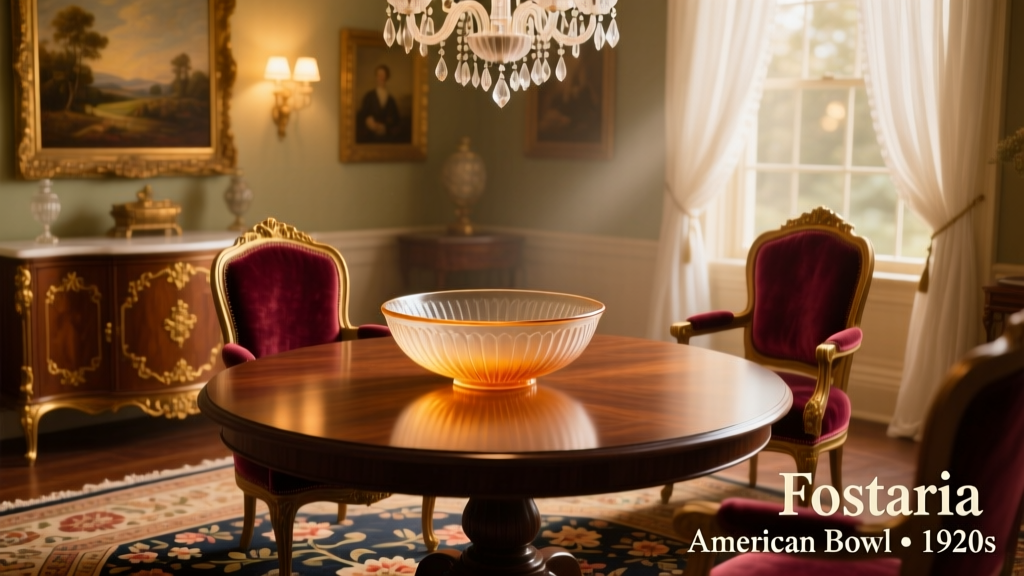
Fostoria American Bowl Round 8-Inch: History, Identification, and Restoration Best Practices
Royal Doulton Bank Bunnykins Money Ball Box: History, Identification, and Restoration Guidance
Silver American Basket: Four-Section Pierced Strap Handle with Monogram — Lebolt & Co., 9-Inch Diameter
Satsuma Flask: Pilgrim Noblemen & Lion Motif Enamel-Gilt Vessel, Circa 1900 — A Technical and Historical Appraisal
Curly Maple Rocker, 1940s: Anatomy, Provenance, and Restoration of a 36 × 16 Inch American Mid-Century Icon
Ferdinand Bero: The Forgotten Master of Viennese Art Deco Furniture and His Enduring Legacy
Daum Vase 'Berluze': A Masterpiece of Gray-Red Mottled Ground with Pinched Sides (18½ Inches)
Meerschaum Figural Pipes: Women’s Heads, Cherubs, and Eagles in Antique Carved Tobacco Art