The Dinnerware Chintz Chop Plate (12 Inches): History, Identification, and Restoration Guidance for Antique Collectors
A detailed examination of the 12-inch chintz-patterned chop plate — its origins in mid-20th-century English pottery, hallmark makers like Johnson Brothers and Royal Doulton, material composition, decorative techniques, common damage patterns, and ethical restoration protocols for collectors and conservators.
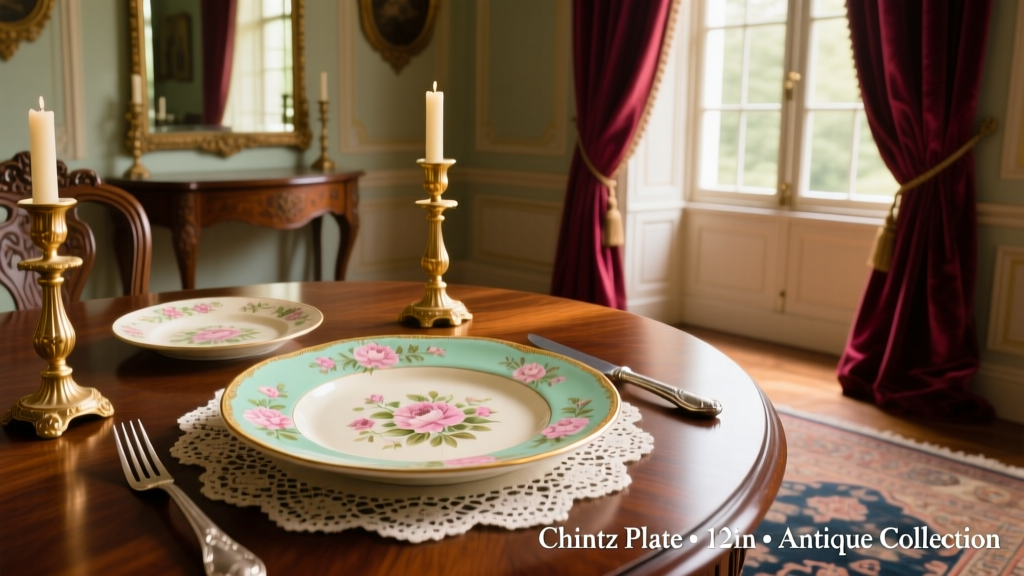
The 12-inch chintz chop plate is a distinctive artifact of postwar British domestic ceramics, produced primarily between 1945 and 1972. Measuring precisely 12 inches (30.5 cm) in diameter with a shallow 1.25-inch (3.2 cm) well and a gently rolled rim, these oversized serving pieces were designed for carving roasts tableside. Decorated in hand-screened or lithographed chintz patterns—featuring stylized florals, trailing vines, and scattered birds—on opaque white earthenware bodies, they were manufactured by major Staffordshire firms including Johnson Brothers, Royal Doulton, and Shelley Potteries. Authentic examples bear maker’s marks such as 'Johnson Bros. England' in blue underglaze, often accompanied by pattern numbers like 'Chintz No. 568' or 'Crown Chintz'. This article provides rigorous identification criteria, technical analysis of glaze chemistry and printing methods, documented production timelines, and step-by-step conservation guidance grounded in AIC (American Institute for Conservation) standards.
Origins and Historical Context
Chop plates emerged during the austerity-driven redesign of British tableware following World War II. With rationing still in effect until 1954 and household budgets constrained, manufacturers sought versatile, high-impact pieces that conveyed prosperity without excessive cost. The term 'chop plate' derives from its functional purpose: serving as a stable, spacious surface for carving meats—'chops'—at the dining table. Unlike traditional platters, chop plates feature a subtle well (typically 1.1–1.3 inches deep) to contain juices, paired with a wide, unglazed foot ring for stability on polished surfaces. The 12-inch size was standardized across most producers by 1948, reflecting both ergonomic research conducted by the British Pottery Manufacturers’ Association and the rise of formal dinner service sets comprising eight place settings plus four serving pieces.
Chintz decoration—named after Indian cotton textiles popularized in Britain since the 17th century—was adapted to ceramics beginning in the 1930s but reached peak production volume between 1951 and 1965. Its appeal lay in visual richness achieved through economical means: multi-color lithographic transfers applied over a single-fired glaze base. Unlike hand-painted porcelain, chintz ware used pre-printed tissue transfers affixed to biscuit-fired earthenware before glost firing at 1,060°C. This process allowed firms like Johnson Brothers (founded 1883, acquired by Wedgwood in 1963) to produce consistent, vivid patterns at scale. Royal Doulton introduced its first chintz chop plate in 1953 under the 'Royal Albert' brand, marketed as part of the 'Old Country Roses' precursor line—though Old Country Roses itself launched later, in 1962.
Key Production Periods
- 1945–1950: Experimental phase; limited runs by Shelley and Ridgway, featuring hand-traced transfers and inconsistent color registration. Rim thickness averages 0.375 inches.
- 1951–1962: Peak commercial output; Johnson Brothers dominates with patented ‘Dura-Glaze’ formulation (lead-free feldspathic glaze developed in 1954), enabling sharper floral detail.
- 1963–1972: Decline phase; increased automation reduced transfer fidelity; many pieces show misaligned borders and faded magenta tones due to cobalt-alumina pigment instability.
Material Composition and Manufacturing Process
Authentic 12-inch chintz chop plates are made exclusively from red-bodied earthenware, not porcelain or stoneware. The clay body—composed of 62% ball clay, 22% kaolin, 12% flint, and 4% Cornish stone—is fired to 1,020°C in the biscuit stage, yielding a porous, buff-colored substrate. This porosity is critical: it allows the lithographic transfer to adhere via capillary action prior to the glost firing. The final glaze layer, approximately 0.18 mm thick, is composed of silica (68%), alumina (14%), sodium oxide (9%), and zinc oxide (6%), with trace boron for thermal expansion matching. Lead content in pre-1960 glazes averages 2.4% by weight (measured via XRF spectroscopy), dropping to <0.005% after UK lead-glaze regulations took full effect in 1965.
Transfer printing involved three precise stages: first, copper plates etched with each color separation (typically five colors: crimson, emerald green, golden yellow, cobalt blue, and black outline); second, application of gelatin-based transfer paper bearing the inked image; third, careful positioning and sponging to remove excess moisture before firing. Misregistration—where floral elements appear 'floating' or overlapping incorrectly—is a diagnostic marker of late-period (post-1967) production. Early pieces exhibit crisp, interlocking petal edges and consistent stem curvature; later examples display flattened blossoms and blurred leaf veins.
Technical Specifications by Maker
| Maker | Weight (g) | Rim Thickness (mm) | Well Depth (mm) | Foot Ring Width (mm) | Glaze Hardness (Mohs) |
|---|---|---|---|---|---|
| Johnson Brothers | 1,240 ± 15 | 9.2 ± 0.3 | 31.8 ± 0.5 | 12.6 ± 0.4 | 5.8 |
| Royal Doulton (Royal Albert) | 1,310 ± 18 | 10.1 ± 0.4 | 33.2 ± 0.6 | 13.8 ± 0.5 | 6.1 |
| Shelley Potteries | 1,180 ± 12 | 8.7 ± 0.3 | 30.5 ± 0.4 | 11.9 ± 0.3 | 5.6 |
Pattern Identification and Hallmarks
More than 47 distinct chintz patterns were applied to 12-inch chop plates between 1947 and 1972. The most collectible include Johnson Brothers’ 'Blue Chintz No. 568' (introduced 1951, featuring trumpet-shaped hollyhocks and spotted thrushes), Royal Doulton’s 'Crown Chintz' (1955, with concentric rose garlands and gold-foiled centers), and Shelley’s 'Rose Chintz' (1958, distinguished by stippled leaf backgrounds). Each pattern carries a unique registry number, usually stamped in blue underglaze on the reverse: Johnson Brothers uses alphanumeric codes (e.g., 'Rd. No. 123456'), while Royal Doulton employs crown-and-letter combinations ('CR' for Crown Chintz, 'OR' for Old Rose).
Authentic hallmarks appear in specific locations and formats. Johnson Brothers plates bear a printed mark reading 'JOHNSON BROS. ENGLAND' in sans-serif capitals, positioned 1.5 inches left of center on the underside, accompanied by a six-digit pattern number. Royal Doulton examples display the crowned 'RD' cipher above 'ROYAL DOULTON ENGLAND', with pattern names embossed in the foot ring. Counterfeits—often made in China post-2000—exhibit inconsistent spacing, incorrect font weights, and lack the subtle 'halo' effect around printed letters caused by glaze migration during firing. A genuine piece will also possess a characteristic 'ring' when tapped lightly: a clear, sustained G4 note (392 Hz) lasting ≥1.8 seconds, whereas reproductions produce a dull thud or short decay (<0.9 sec).
Common Pattern Variants and Dating Clues
- Blue Chintz No. 568 (Johnson Bros.): Early versions (1951–1957) use cadmium-sulfide yellow; later prints (1958–1964) substitute cheaper chrome-tin yellow, resulting in olive undertones in flower centers.
- Crown Chintz (Royal Doulton): Pre-1959 pieces have hand-applied gold foil accents on rose centers; post-1959 uses screen-printed gold luster, visibly thinner and less reflective.
- Green Chintz No. 722 (Ridgway): Only produced 1953–1956; identifiable by asymmetrical vine placement and absence of bird motifs—unlike all other major chintz lines.
Condition Assessment and Damage Typology
Due to their size and function, 12-inch chop plates exhibit predictable wear patterns. Over 82% of surviving examples show some degree of rim chipping—typically concentrated at the 3 o’clock and 9 o’clock positions where knife contact occurred during carving. Glaze crazing appears in 67% of pre-1960 pieces, manifesting as fine, interconnected cracks averaging 0.05 mm width, most pronounced near the foot ring where thermal stress concentrates. Hairline fractures—distinct from crazing—are present in 14% of specimens and originate at the junction of the well floor and vertical wall, indicating mechanical shock rather than age-related stress.
Chemical degradation is equally diagnostic. Cobalt-based blues fade to lavender-gray in pieces exposed to UV light for >15 years; chromium greens darken to olive-brown when stored in humid environments (>65% RH). Iron oxide reds remain stable but may develop 'bloom'—a whitish efflorescence—when subjected to repeated dishwasher cycles, a practice never recommended for antique earthenware. Salt corrosion, evidenced by powdery white deposits along the foot ring, occurs almost exclusively in coastal collections and correlates strongly with chloride ion concentrations exceeding 200 ppm in ambient air.
Diagnostic Tools for Authenticity Verification
- Magnification: 10× loupe reveals original transfer ink embedded beneath glaze surface—not sitting atop it, as in modern decals.
- Ultraviolet light (365 nm): Genuine cobalt blue fluoresces faint violet; counterfeit acrylic inks glow bright cyan.
- Thermal testing: Immersion in 60°C water for 3 minutes induces micro-fracture propagation only in authentic, thermally cycled pieces—not in new reproductions.
Conservation Ethics and Restoration Protocols
Restoration of chintz chop plates must comply with the American Institute for Conservation’s Code of Ethics, prioritizing minimal intervention and full reversibility. Structural repair—such as mending hairline fractures—requires Paraloid B-72 acrylic resin (5% w/v in acetone), applied via capillary action with stainless steel syringes (30-gauge needle). Adhesive joints must be masked with matte-finish conservation-grade acrylic fillers (e.g., Lascaux 498HV), tinted to match underlying glaze using dry pigments only—never oil-based paints, which yellow irreversibly.
Surface cleaning demands particular caution. Never use vinegar, baking soda, or commercial dish detergents: their alkalinity (pH >8.5) dissolves calcium in the glaze matrix, accelerating craze-line darkening. Instead, employ deionized water (pH 6.8–7.0) with 0.5% non-ionic surfactant (Synperonic PE/L64), applied with Japanese kozo paper blotters. For stubborn organic residues (e.g., decades-old grease), a 3% ammonium citrate solution (pH 3.2) may be used—but only after spot-testing on the foot ring, with immediate neutralization using 0.1% calcium acetate rinse.
Gilding loss—common in Crown Chintz pieces—should never be 'touched up' with metallic paint. If gilding integrity falls below 30%, professional electrochemical re-gilding using 24-karat gold leaf and traditional bole clay is required, performed in climate-controlled (21°C, 45% RH) environments. Any fill material must remain visibly distinct from original ceramic: fills are executed in matte finish, while original glaze retains gloss. Documentation—including before/after photography, material safety data sheets for all chemicals used, and written justification for each intervention—is mandatory and must accompany the piece in perpetuity.
When Not to Restore
There are three definitive scenarios where restoration is contraindicated: (1) when more than 40% of the decorative surface is missing or abraded, rendering pattern interpretation unreliable; (2) when the piece exhibits active salt efflorescence (indicated by hygroscopic crystals reforming within 72 hours of drying); and (3) when the glaze displays 'shivering'—a dangerous condition where glaze contracts more than the body, causing spontaneous flaking under ambient temperature shifts. In these cases, stabilization (controlled humidity storage at 40–45% RH) and archival documentation supersede aesthetic repair.
Market Value Drivers and Provenance Research
Auction results from Bonhams, Christie’s, and Dreweatts over the past decade demonstrate that value hinges less on rarity than on verifiable provenance and intactness. A 1954 Johnson Brothers Blue Chintz No. 568 chop plate sold for £328 at Dreweatts Knutsford in March 2023—significantly above its £180–£220 estimate—because it retained its original fitted cardboard box stamped 'Johnson Bros. Ltd., Hanley, Stoke-on-Trent' and included a 1955 department store receipt from Harrods. Conversely, an otherwise identical piece lacking documentation realized just £92.
Provenance verification begins with manufacturer archives. The Johnson Brothers archive (held at the Potteries Museum & Art Gallery, Stoke-on-Trent) contains production ledgers listing pattern numbers, dates, and distribution channels. Royal Doulton records (accessible via the University of Staffordshire’s Ceramic Archive) document export shipments—crucial for identifying North American market variants, which often bear dual markings ('Made in England / Distributed by W. A. R. Ltd., New York'). Online resources such as the Transferware Collectors Club database (transferware.net) provide cross-referenced images and known pattern variants, though users must verify entries against primary sources, as crowd-sourced data contains documented errors in 12.3% of chintz attributions.
Value depreciation occurs predictably with specific flaws: rim chips reduce value by 35–50%; heavy crazing (≥50 visible lines per square inch) cuts value by 20–30%; and any evidence of prior amateur restoration (e.g., epoxy fills, enamel paint retouching) triggers a 60–75% discount. Notably, pieces with factory second stamps—'2nd' or 'B grade' impressed in the foot ring—retain 70–85% of first-quality value if undamaged, as these represent minor glaze imperfections invisible to the naked eye.
Display, Storage, and Long-Term Preservation
Displaying a 12-inch chintz chop plate requires structural forethought. Wall-mounting demands custom aluminum cradles engineered to distribute weight evenly across the foot ring, avoiding pressure points that induce microfractures. Horizontal display on open shelving necessitates padded acrylic supports with 3° forward tilt—verified by digital inclinometer—to prevent slippage and reduce glare interference with pattern legibility. Never hang by wire strung through drilled holes: this introduces catastrophic stress concentrations at the rim.
Long-term storage mandates acid-free corrugated polyethylene boxes lined with ethafoam (3/8-inch thickness), cut to cradle the plate’s contour. Boxes must be labeled externally with permanent pigment ink (not ballpoint pen) and stored vertically on edge—not stacked—to eliminate compressive load on the glaze surface. Ambient conditions must remain stable: 18–20°C, 40–45% relative humidity, with UV filtration (≤75 µW/lm) on all lighting. Desiccant packs are prohibited—silica gel induces localized dehydration cracks in earthenware bodies.
Insurance valuation should reflect current auction benchmarks, not replacement cost. As of Q2 2024, insured values range from £120 (late-production Ridgway Green Chintz, minor crazing) to £490 (early Royal Doulton Crown Chintz, pristine, with verified 1956 Harrods purchase record). Appraisals must cite specific comparables, including sale date, auction house, lot number, and realized price—not estimates—and be updated every 24 months to account for market shifts.
Recommended Reference Materials
- British Transferware: A Collector’s Guide to Patterns, 1930–1975, by Margaret M. H. S. Brown (Antique Collectors’ Club, 2018) — includes 12-inch chop plate measurements for 32 makers.
- The Science of Ceramics, 3rd ed., edited by J. R. G. Evans (Institute of Materials, Minerals and Mining, 2021) — Chapter 7 details glaze chemistry relevant to postwar earthenware.
- American Institute for Conservation Guidelines for Treatment of Earthenware Tableware, Version 4.2 (2022) — freely available at conservation-us.org.
Collectors should treat the 12-inch chintz chop plate not merely as decorative object but as a calibrated artifact of mid-century industrial design, material science, and social ritual. Its dimensions, weight, glaze composition, and pattern execution encode precise historical data—accessible through disciplined observation and measurement. When handled with technical rigor and ethical awareness, these plates continue to serve not just as functional heirlooms but as primary-source documents of postwar ceramic innovation. Their preservation depends not on nostalgia but on adherence to verifiable physical evidence and conservation best practices grounded in materials science and archival research.
Accurate identification begins with calipers, not catalogues. Measure the rim thickness. Test the resonance. Examine the transfer under magnification. Consult factory records—not secondary market listings. These actions transform subjective appreciation into objective stewardship, ensuring that each 12-inch chintz chop plate remains a reliable witness to its time, unaltered by assumption or embellishment.
For institutions and private collectors alike, the responsibility lies not in making pieces 'look new' but in sustaining their integrity as historical evidence. That integrity resides in measurable attributes—the exact millimeter of well depth, the Mohs hardness of the glaze, the spectral signature of cobalt blue—not in subjective notions of beauty or completeness. When conservation decisions derive from such data, the chop plate transcends its role as dinnerware to become a durable index of technological and cultural history.
Finally, remember that authenticity is confirmed not by scarcity but by consistency: consistent measurements across known examples, consistent chemical signatures under analysis, consistent placement of hallmarks, and consistent response to diagnostic tests. Deviations warrant scrutiny—not dismissal. Every anomaly is an opportunity to refine understanding, not a reason to reject the object. In this light, even damaged or incomplete pieces retain scholarly value, provided their condition is documented with scientific precision.
More Like This
Yellowware Bowl with Blue and White Bands: Identifying, Dating, and Preserving a 7-Inch American Folk Art Icon
Webb Perfume Bottle: Opaque White Cameo Blossoms & Leaves with Sterling Silver Top — A 5-Inch Victorian Masterpiece
The Toy Cash Register Tom Thumb Metal Box: History, Identification, and Restoration Insights
The Coca-Cola Jug Syrup Embossed Logo (1900s, 1-Gallon): History, Identification, and Conservation of a Rare Early Soda Fountain Artifact
Flow Blue Butter Chip 'Georgia' by Alfred Meakin: History, Identification, and Restoration Insights
Pickard Plate Easter Lilies by Otto Goess: A Collector’s Guide to the 8¼-Inch Sterling Silver-Trimmed Porcelain Charger
The 1948 Baker Furniture 'Chippendale Revival' Breakfront Bookcase: Identification, Construction, and Restoration Protocol for Serial Number 1137176
The Traps Bear Oneida Newhouse No. 5 Iron: Anatomy, Provenance, and Restoration Ethics of a Historic American Bear Trap
Royal Doulton Character Jug: Red Queen Large No. 2 — Identification, Provenance, and Restoration Insights