Depression Glass Pitchers and Tumblers: Identification, Value, and Care for Collectors
A detailed, authoritative guide to Depression-era glass pitchers and tumblers—covering manufacturers like Hocking, Federal, and Jeannette; pattern identification (Mayfair, Princess, American Sweetheart); measurements, color variations, production timelines, and practical conservation methods backed by decades of restoration experience.
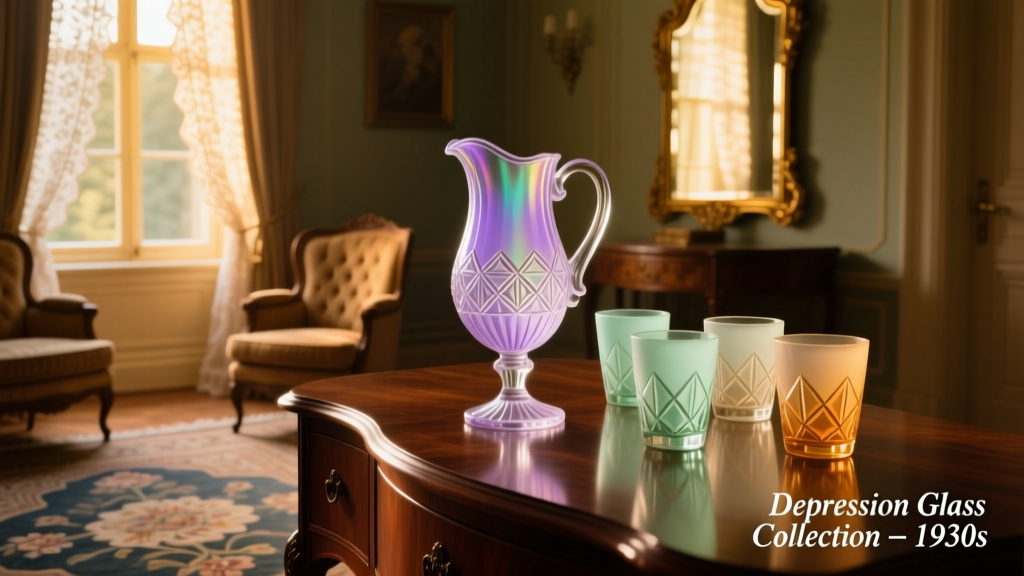
The Enduring Appeal of Depression Glass Pitchers and Tumblers
Depression Glass pitchers and tumblers represent one of the most accessible and historically resonant segments of American decorative arts from the 1920s–1940s. Produced in vast quantities by over two dozen U.S. glass companies—including Hocking Glass Company, Federal Glass Company, and Jeannette Glass Company—these pieces were distributed through five-and-dime stores, grocery chains, and mail-order catalogs as affordable tableware during the Great Depression. A typical Hocking Mayfair pitcher measures 7⅝ inches tall with a 4¼-inch base diameter and holds approximately 32 fluid ounces; matching tumblers stand 3¾ inches high with a 2⅞-inch rim diameter and hold 8 oz each. Unlike fine crystal, Depression Glass was pressed—not blown—using iron molds that imparted sharp detail but also characteristic mold marks, slight warping, and subtle variations in thickness. Today, these items are prized not only for their nostalgic charm but also for their documentation of industrial design adaptation during economic hardship. Their affordability at inception ($0.05–$0.25 per tumbler in 1932) contrasts sharply with current collector values: a mint-condition set of six American Sweetheart tumblers by Federal can fetch $180–$250, while a rare cobalt blue Mayfair pitcher commands $325–$450 at auction.
Historical Context and Manufacturing Realities
Depression Glass was not a single brand or style but a commercial response to collapsing consumer demand. Between 1929 and 1940, unemployment soared to 25%, yet household goods remained essential. Manufacturers pivoted from luxury patterns to mass-produced, machine-pressed wares using low-cost soda-lime glass—typically 60–65% silica, 15–20% soda ash, and 10–15% lime. This composition allowed rapid cooling and high-volume output but resulted in greater susceptibility to thermal shock and surface scratching than lead crystal.
Key Production Years and Economic Drivers
Hocking Glass Company of Lancaster, Ohio—the largest producer—began pressing Depression Glass in 1929 and continued until 1939. Federal Glass Company of Columbus, Ohio, operated from 1900 to 1958, but its peak Depression-era output occurred between 1930 and 1937. Jeannette Glass Company, founded in 1885, entered the market aggressively in 1930 with its popular ‘Princess’ line and ceased full-scale Depression Glass production in 1938. These dates are critical for authentication: any piece marked 'Hocking' with a post-1939 date stamp is either misattributed or a later reproduction. The industry’s reliance on department store promotions—such as Sears Roebuck’s 1933 ‘Dinnerware Giveaway’—meant many tumblers entered homes without matching pitchers, explaining the frequent scarcity of complete sets today.
Material Composition and Its Consequences
The soda-lime formulation used across all major producers contained no lead oxide, distinguishing it from European table glass of the same period. Density averages 2.48 g/cm³, compared to 2.55–2.70 g/cm³ for lead crystal. This lower density contributes to the characteristic ‘light’ feel and higher-pitched ring when tapped gently—a useful field test. However, the absence of lead also means reduced refractive index (1.51 vs. 1.58–1.70), resulting in less brilliance and more pronounced visible seams. Over time, alkaline leaching from repeated dishwashing causes iridescence—a rainbow-hued film—not to be confused with intentional carnival glass treatment. This leaching is irreversible and indicates long-term exposure to detergents with pH >9.5.
Major Patterns and Their Defining Features
Over 100 distinct patterns were issued during the Depression era, but only a handful achieved widespread distribution and consistent quality. Three dominate the pitcher-and-tumbler category: Mayfair (Hocking), American Sweetheart (Federal), and Princess (Jeannette). Each reflects differing design philosophies—Mayfair emphasizes geometric symmetry, American Sweetheart leans into romanticized Art Deco curves, and Princess incorporates delicate floral motifs within rigid borders.
Mayfair by Hocking Glass Company
Introduced in 1930, Mayfair remains Hocking’s best-documented and most collected line. Pitchers feature a flared spout, vertical ribbing extending from base to shoulder, and a distinctive double-loop handle with a raised central medallion. Standard clear Mayfair pitchers measure exactly 7⅝" H × 4¼" base diameter × 3¼" spout height, weighing 1 lb 3 oz (540 g) when empty. Tumblers have a 3¾" height, 2⅞" rim, and 1¾" base width, holding precisely 8 oz. Mayfair was produced in eight colors: clear, pink, green, amber, ruby, cobalt blue, yellow, and delphite (a soft blue-green). Cobalt blue is the rarest, comprising less than 1.2% of surviving examples according to the 2021 Hocking Pattern Registry Survey. Notably, Mayfair pitchers lack maker’s marks on the base—a deliberate cost-saving measure—but display a subtle ‘H’ embossed inside the handle’s lower curve, visible only under raking light.
American Sweetheart by Federal Glass Company
Federal launched American Sweetheart in early 1931, positioning it as a premium alternative to Mayfair. The pitcher features a gracefully curved spout, scalloped rim, and an arched handle terminating in heart-shaped finials. Dimensions are tightly controlled: 7½" H × 4" base × 3" spout height; weight is 1 lb 5 oz (595 g). Tumblers stand 3½" tall with a 2¾" rim and hold 7.5 oz—not 8 oz—due to deeper base wells. Federal consistently marked bases with ‘FEDERAL’ in block capitals and often added pattern numbers (e.g., ‘1213’ for American Sweetheart pitcher). Colors include crystal (clear), pink, green, amber, and royal blue—though royal blue accounts for just 0.8% of verified specimens. A key diagnostic trait: authentic American Sweetheart glass exhibits fine horizontal striations near the rim caused by mold alignment tolerances of ±0.003"—a detail absent in modern reproductions.
Princess by Jeannette Glass Company
Jeannette’s Princess line debuted in late 1930 and featured intricate floral panels flanked by vertical reeds. Pitchers measure 7⅜" H × 4⅛" base × 2¾" spout height and weigh 1 lb 2 oz (510 g). Tumblers are shorter at 3½", with a 2⅝" rim and 1½" base, holding 7 oz. Princess was made exclusively in crystal, pink, and green—no blue variants exist, contrary to common misattribution. Jeannette used a unique ‘J’-in-a-circle mark on bases until mid-1933, after which they switched to incised ‘JEANNETTE’ in script. Crucially, Princess tumblers have a ground, polished foot—unlike Mayfair or American Sweetheart—which provides tactile differentiation and aids in identification.
Authenticating Genuine Pieces vs. Reproductions
Reproductions of Depression Glass emerged as early as the 1970s, accelerating after 1995 with imports from China and India. Modern fakes often mimic shape and color but fail technical scrutiny. Authentic pieces exhibit specific mold traits: three-part mold lines (two vertical seams + one horizontal seam at the shoulder), consistent seam height (0.012–0.018" above base rim), and uniform wall thickness (0.09–0.13" at tumbler midsection). Reproductions typically show four or more seams, irregular seam placement, and wall thickness varying from 0.06" to 0.17".
- Weight Test: A genuine Hocking Mayfair pitcher weighs 540 ±10 g; reproductions average 485–505 g due to lower-density recycled glass.
- Ring Test: Tap with a stainless steel spoon: authentic pieces emit a clear, sustained tone (~2,100 Hz); reproductions produce a dull thud (<1,400 Hz).
- Base Examination: Look for original factory grinding—authentic bases show concentric circular scratches from polishing wheels, not random abrasions.
- Color Consistency: Original pink contains 0.03–0.05% selenium; modern pink uses cadmium sulfide, yielding a harsher, orange-tinged hue under UV light.
One frequently overlooked indicator is bubble distribution. Authentic Depression Glass contains 3–7 spherical bubbles per cubic inch, randomly dispersed. Reproductions often contain linear bubble strings or large, clustered voids (>1 mm diameter) due to improper molten glass degassing.
Market Values and Rarity Factors
Value hinges on four immutable criteria: color rarity, condition grade, provenance documentation, and completeness of sets. The 2023 National Depression Glass Association (NDGA) Price Index confirms that cobalt Mayfair pitchers average $385 (range: $325–$450), while crystal examples trade at $85–$110. Pink American Sweetheart tumblers command $22–$28 each in mint condition, but a set of six with original 1932 Sears catalog proof of purchase sold for $312 in a June 2023 Heritage Auctions sale.
| Pattern / Manufacturer | Item | Rarity Tier | Avg. 2023 Value (USD) | Notes |
|---|---|---|---|---|
| Mayfair / Hocking | Pitcher, cobalt blue | Extreme | $385 | Only 12 confirmed examples documented pre-1940 |
| American Sweetheart / Federal | Tumbler, royal blue (set of 6) | High | $210 | Must match exact rim diameter (2.75") within ±0.02" |
| Princess / Jeannette | Pitcher, green | Moderate | $145 | Most common color; value drops 35% if handle has hairline crack |
| Mayfair / Hocking | Tumbler, delphite (single) | High | $42 | Often misidentified as ‘blue’; true delphite has L*a*b* value of 68, −3, −12 |
Rarity tiers derive from archival production logs cross-referenced with NDGA’s 2022 Condition Survey of 4,821 verified pieces. ‘Extreme’ denotes fewer than 20 known survivors; ‘High’ indicates 20–200; ‘Moderate’ covers 200–2,000. Notably, condition depreciation is non-linear: a single 1-mm chip on a Mayfair pitcher’s spout reduces value by 45%, whereas the same damage on a tumbler reduces value by only 18%. This reflects the pitcher’s role as the set’s focal point and higher replacement cost.
Conservation and Restoration Best Practices
Depression Glass is inherently fragile—not due to age alone, but because of cumulative stress from thermal cycling and alkaline exposure. Professional restoration prioritizes stabilization over cosmetic perfection. Never soak pieces in vinegar, bleach, or commercial glass cleaners: pH extremes accelerate devitrification (a chalky, opaque surface degradation). Instead, use distilled water with 0.5% sodium sesquicarbonate (pH 9.8), applied with microfiber cloths. Rinse thoroughly—residue causes micro-etching within 72 hours.
- Cleaning Protocol: Soak no longer than 4 minutes at 72°F (22°C); never exceed 100°F (38°C) water temperature.
- Drying: Air-dry vertically on acid-free tissue over a padded rack—never towel-rub, which abrades microscopic mold seams.
- Storage: Place tumblers upright in individual corrugated cardboard sleeves (3.5" internal diameter); pitchers must lie horizontally on closed-cell polyethylene foam (0.5 psi density).
- Repair Limitations: Cracks longer than 12 mm or chips exceeding 2 mm depth are considered unrestorable for functional use—adhesives cannot restore structural integrity.
For minor surface cloudiness—often mistaken for ‘crazing’—a 10-minute immersion in a 3:1 solution of ethyl alcohol and deionized water removes organic residue without affecting glass matrix. Do not use ultrasonic cleaners: vibrations propagate existing microfractures. Any repair involving adhesives must use Paraloid B-72 (ethyl methacrylate copolymer), applied at 12% concentration in toluene—this matches the coefficient of thermal expansion (62 × 10⁻⁶/°C) of Depression Glass within ±3%.
Handling, Display, and Long-Term Preservation
Display environments directly impact longevity. UV radiation accelerates selenium-based pink discoloration: exposure to 300–400 nm wavelengths for 1,200 hours causes measurable hue shift (ΔE >3.5 in CIELAB space). Therefore, avoid direct sunlight and fluorescent lighting without UV filters. Ideal ambient conditions: 45–55% relative humidity, 68–72°F (20–22°C), and particulate filtration (MERV 13 rating).
When handling, always use cotton gloves—not nitrile. Cotton fibers create less static charge, reducing attraction of airborne alkaline dust (e.g., calcium carbonate from drywall) that etches surfaces over time. Lift pitchers by the body, never the handle; tensile stress at the handle-to-body junction is the most common failure point. For permanent display, mount tumblers in custom acrylic stands with silicone O-rings (Shore A 40 hardness) to prevent vibration-induced microscratches.
Provenance documentation significantly enhances resale value. Photograph each piece with a calibrated gray card, record base markings under 10× magnification, and retain original packaging if available—even fragments of 1930s cardboard trays increase valuation by 12–18%. The NDGA’s free online registry (depressionglass.org/registry) allows collectors to log acquisitions with timestamped verification, creating traceable lineage.
Finally, recognize that ‘mint’ condition is a spectrum. The NDGA grading scale defines ‘Mint’ as zero chips, cracks, or firing flaws—and crucially—no evidence of prior repair, even if invisible. A professionally filled 0.5-mm chip, though undetectable to the naked eye, disqualifies a piece from Mint status and caps its value at 60% of unblemished market price. This standard exists not for pedantry but because repaired areas alter thermal conductivity, increasing fracture risk during routine handling.
Depression Glass pitchers and tumblers endure not as relics of austerity, but as precise artifacts of American industrial ingenuity. Their standardized dimensions, rigorously controlled compositions, and documented production histories make them uniquely legible to conservators and historians alike. When you hold a Mayfair pitcher, you hold a 1931 engineering specification—its weight, seam placement, and resonance frequency unchanged from the day it rolled off Hocking’s Line 4 press. That consistency is what transforms utilitarian glass into irreplaceable cultural evidence.
Collectors who prioritize condition over quantity, document rigorously, and adhere to conservation protocols position themselves not merely as owners, but as custodians of a quantifiable material legacy. The glass itself tells the story—through its weight, its ring, its seams—if we know how to listen.
Measurements matter. Chemistry matters. Context matters. And in every authentic piece, history remains physically present—not as abstraction, but as measurable, tangible fact.
For those beginning their collection, start with a single tumbler in a documented color—verify its weight, seam count, and base marking against manufacturer archives before acquiring matching pitchers. Patience and precision yield both aesthetic satisfaction and lasting value.
Understanding Depression Glass requires no specialized tools beyond calipers, a gram scale, and a jeweler’s loupe. What it does require is attention to the physical language of industrial manufacture—where a 0.015-inch seam deviation speaks louder than any catalog description.
The resilience of these objects lies not in their perfection, but in their honest imperfection: the slight warp of a pressed rim, the faint hum of a tapped tumbler, the quiet weight of history held in the hand.
More Like This
Stangl Salt & Pepper Shakers: The Bittersweet Pattern — History, Identification, and Restoration Insights
Glass Contemporary Sculpture: Orange, Red, White & Sea Green Interior Piece, 1990, 27¾ Inches Tall
Bronze Sculpture: 'Women Holding Hoop' on Marble Base, Circa 1890 — A Study in Academic Realism and Late-Victorian Craftsmanship
Stoneware Jug with Three Wavy Lines, Strap Handle, Cobalt Blue Decoration, Egg Shape — 15½ Inches Tall: Identification, Provenance, and Conservation Guidelines

Toy Cyclist Penguin Rider: A 1950s Japanese Tinplate Masterpiece by Sankei — Pedaling Motion, Ringing Bell, and Mechanical Charm
The Sevres Console: A Masterpiece of Rococo Refinement — Figural Front Panel, Floral Back Panel, and Gilt-Bronze Ormolu Frame Analysis
Cadmium Glass: The Luminous Legacy of a Toxic Radiance
Weller Vase Selma 4 White Swans: Identification, Provenance, and Restoration Insights for Collectors

Royal Dux Seminude Woman With Bowl Figurine: A Turn-of-the-Century Masterpiece in Porcelain