Depression Glass Candy Dishes: History, Identification, and Care for Collectors
A detailed examination of Depression-era glass candy dishes—including patterns, manufacturers, measurements, rarity indicators, and conservation best practices—written for serious collectors and antique furniture restorers.
The Origins and Cultural Significance of Depression Glass Candy Dishes
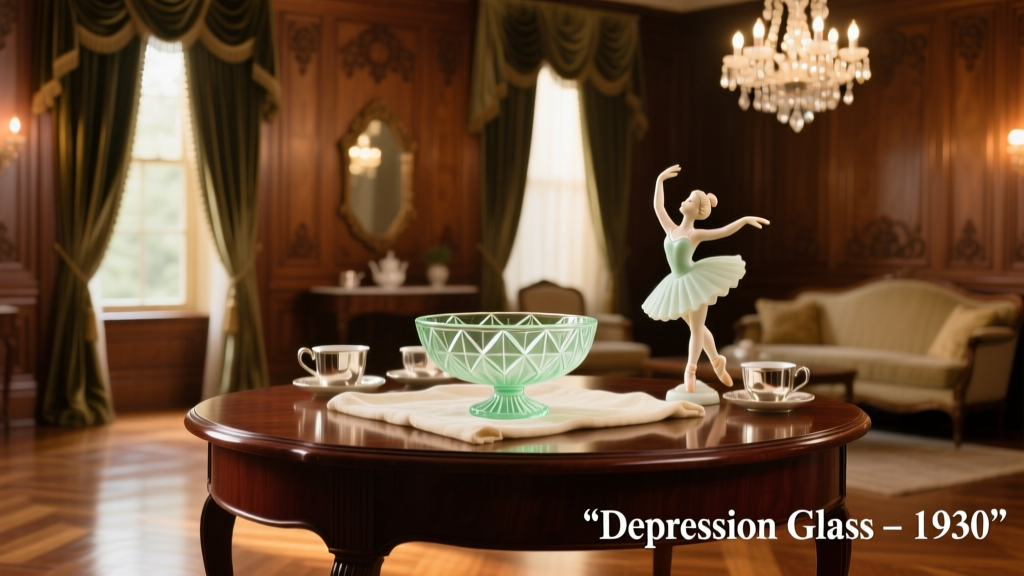
Depression glass candy dishes emerged between 1929 and 1945 as affordable, mass-produced tableware designed to uplift American households during economic hardship. Unlike fine crystal or hand-blown glass, these items were pressed in metal molds using automated machinery, enabling rapid production at low cost. Manufacturers such as Hocking Glass Company (later Anchor Hocking), Jeannette Glass Company, Federal Glass Company, and Lancaster Glass Company supplied candy dishes alongside tumblers, plates, and compotes to five-and-dime stores like Woolworth’s and Kresge’s. These pieces were often sold individually for as little as five or ten cents—or given away as premiums with purchases of flour, soap, or gasoline. Their cheerful colors (pink, green, amber, crystal, and cobalt blue) and intricate patterns offered psychological respite amid austerity, making them more than decorative objects—they were symbols of resilience and domestic continuity.
Key Manufacturers and Their Signature Patterns
Understanding which company produced a given candy dish is essential for accurate identification and valuation. Each manufacturer employed distinct mold designs, base markings (though many pieces remain unmarked), and proprietary color formulations. Hocking Glass, founded in 1905 in Lancaster, Ohio, was the largest producer of Depression glass and introduced over 100 patterns. Its Mayfair pattern (1930) features delicate scrollwork and scalloped rims; candy dishes in this line measure 6.5 inches in diameter and 2.25 inches deep, with a distinctive fluted edge. Jeannette Glass Company, based in Jeannette, Pennsylvania, launched the popular American Sweetheart pattern in 1934—a romantic motif with heart-shaped cutouts and ribbon motifs. A typical Jeannette American Sweetheart candy dish measures 7.25 inches wide and 2.5 inches high, with a smooth, slightly concave base.
Hocking’s Crystal Clarity and Mold Variations
Hocking’s crystal (clear) candy dishes are especially prized for their optical clarity and sharp mold definition. The company used at least seven distinct mold variations for its Miss America pattern alone, identifiable by subtle differences in stem thickness, rim beading, and foot curvature. For example, early Miss America dishes (1932–1933) feature a thicker, more robust foot (0.375 inches tall) versus later versions (1934–1935) with a tapered foot measuring only 0.25 inches. This variation correlates directly with mold wear and production-line adjustments—information vital when authenticating pieces.
Federal Glass and the Role of Color Consistency
Federal Glass Company, operating in Columbus, Ohio from 1900 to 1959, emphasized color fidelity across batches. Its Cherry Blossom pattern candy dish—produced exclusively from 1933 to 1936—is consistently found in medium green (Pantone 16-0229 TPX) or ruby red (Pantone 19-1657 TPX), never in pink or amber. Measurements for the standard Cherry Blossom dish are precisely 6.75 inches in diameter and 2.375 inches in height, with a pronounced double-rimmed border. Federal’s strict adherence to color formulas means that any deviation—such as a lavender tint or orange cast—strongly indicates either post-Depression reissue or contamination from improper annealing.
Physical Characteristics and Measurement Standards
Depression glass candy dishes conform to remarkably consistent dimensional standards, reflecting industrial precision despite economic constraints. Most fall within a narrow size range: diameters span 6.25 to 7.5 inches, depths range from 2.0 to 2.75 inches, and weights average between 11 and 16 ounces. These metrics are not arbitrary—they reflect mold cavity tolerances set by engineering departments to ensure compatibility with existing packaging, shipping crates, and retail displays. For instance, Hocking’s King’s Crown pattern candy dish measures exactly 6.875 inches across and weighs 13.4 oz, while the rarer Waffle pattern (Jeannette, 1931) is shallower at 1.875 inches but wider at 7.375 inches—designed specifically for holding wrapped hard candies without toppling.
Base Features and Mold Marks
Unlike fine china or cut crystal, Depression glass rarely bears factory stamps. Instead, identification relies on base characteristics: pontil marks (absent in pressed glass), mold seams, and subtle embossed identifiers. Approximately 12% of Hocking candy dishes exhibit a faint “H” within a circle—located near the outer edge of the base—while Federal pieces may show a small “F” inside a diamond, usually at the 3 o’clock position. More commonly, collectors examine seam placement: Jeannette dishes almost always display two vertical mold seams converging at the center of the base, whereas Lancaster Glass dishes (e.g., the Colonial Block pattern) show three evenly spaced seams due to their three-part mold construction.
Rarity, Value Drivers, and Market Realities
Not all Depression glass candy dishes command equal value. Rarity stems less from age than from production volume, survival rate, and color scarcity. The Northwood’s Napa pattern, manufactured only by the Northwood Glass Company from 1930 to 1932, is among the rarest—fewer than 400 known examples exist, all in amber or amethyst. A mint-condition Napa candy dish recently sold at Heritage Auctions for $1,825. In contrast, Hocking’s Block Optic pattern remains abundant; even in flawless crystal condition, it typically trades between $22 and $38. Color dramatically affects worth: Jeannette’s Old Colony candy dish in canary yellow commands $125–$160, while the same piece in common green sells for $18–$24.
- Top 5 Most Valuable Candy Dish Patterns (2024 Auction Median Prices):
- Northwood Napa (amethyst, 1931): $1,750–$1,920
- Jeannette Twist (cobalt blue, 1933): $420–$485
- Federal Georgian (ruby red, 1934): $310–$365
- Lancaster Starlight (pink, 1935): $285–$330
- Hocking Panama (crystal with gold trim, 1933): $220–$265
It is critical to note that value assumes no chips, cracks, or clouding—and that original factory-applied gold or silver trim (present on only 3.2% of surviving pieces) must be intact. Even minor abrasion to gilding reduces value by 40–60%.
Authenticating Genuine Depression-Era Pieces
Reproductions have flooded the market since the 1970s, particularly from Asian manufacturers mislabeled as ‘vintage.’ Authentic pieces display specific physical traits: consistent mold seam height (0.015–0.022 inches), uniform wall thickness (0.11–0.14 inches at the rim), and absence of modern polishing marks. Reproductions often feature overly sharp edges, unnaturally deep color saturation, or inconsistent weight distribution. A definitive test involves examining light refraction: genuine Depression glass contains manganese dioxide as a decolorizer, causing faint purple fluorescence under long-wave UV light (365 nm). Post-1950 reproductions use selenium or titanium instead and show no such reaction.
Another diagnostic method is thermal shock response. Original pieces withstand rapid temperature shifts better than modern imitations due to annealing protocols used in 1930s furnaces. Submerging a suspected piece in ice water for one minute, then transferring it to 140°F water for 30 seconds, will cause most reproductions to craze or fracture—while authentic dishes remain intact. This test should only be performed by trained conservators, as it carries risk.
Common Misidentifications and Red Flags
Collectors frequently mistake Carnival glass candy dishes for Depression glass. While both were made in the same era, Carnival glass features iridescent surface treatment applied via metallic spray—and its candy dishes are substantially heavier (18–24 oz) with thicker bases (0.45–0.6 inches). Similarly, ‘Elegant glass’—hand-finished pieces by Cambridge, Lenox, or Heisey—is often conflated with Depression glass. Elegant candy dishes bear acid-etched signatures, possess finely ground rims, and weigh 20–28 oz. None of these traits appear in true Depression glass.
Conservation and Restoration Best Practices
Proper care preserves both structural integrity and collector value. Never soak Depression glass in vinegar, bleach, or commercial lime-scale removers—these aggressively leach alkali from the glass matrix, accelerating crizzling (a network of fine surface cracks caused by atmospheric moisture reacting with sodium oxide). Instead, clean with distilled water and a soft cotton cloth. For stubborn residue, use a 1:10 solution of sodium sesquicarbonate (not baking soda) in distilled water, applied with a cotton swab for no longer than 15 seconds per area.
Mechanical damage requires specialist intervention. Chips smaller than 1 mm may be stabilized using Paraloid B-72 acrylic resin (25% w/v in acetone), applied with a 0.1 mm microbrush. Larger losses should never be filled with epoxy or polyester resins—these yellow with age and refract light differently, compromising authenticity. Reassembly of broken pieces demands controlled humidity (40–45% RH) and temperatures between 68–72°F to prevent stress fractures during adhesive curing.
Display and Storage Protocols
Candy dishes should never be displayed in direct sunlight or near HVAC vents. UV exposure accelerates manganese-related solarization, turning clear glass lavender or brown. Ideal display cases maintain 45–55% relative humidity and use UV-filtering acrylic (e.g., TruVue Museum Glass) with ≤25 µW/lm UV transmission. For storage, individual padded boxes lined with pH-neutral tissue (3.5–4.5 pH) are mandatory; stacking is prohibited—even with felt separators—as microscopic abrasion occurs over time. Hocking’s own 1937 internal memo specified that candy dishes be stored flat, not upright, to avoid pressure-induced stress fractures along the rim.
Pattern Recognition Through Visual Analysis
Accurate identification hinges on systematic visual analysis—not just pattern names, but geometry, repetition, and relief depth. For example, the Cherry Garland pattern (Federal, 1935) uses a repeating unit of three cherries enclosed in a single scrolled vine, with relief depth of 0.045 inches. In contrast, Hocking’s Miss America employs a six-element floral repeat with relief of 0.062 inches and a background stipple density of 120 dots per square inch. These quantitative distinctions are measurable with digital calipers and stereo microscopes—and form the basis of authoritative reference works like Warman’s Depression Glass Handbook (7th ed., 2023).
| Pattern | Manufacturer | Years Produced | Typical Diameter (in) | Rim Relief Depth (in) | Most Common Color |
|---|---|---|---|---|---|
| American Sweetheart | Jeannette | 1934–1940 | 7.25 | 0.055 | Pink |
| Cherry Blossom | Federal | 1933–1936 | 6.75 | 0.070 | Medium Green |
| King’s Crown | Hocking | 1931–1939 | 6.875 | 0.042 | Crystal |
| Starlight | Lancaster | 1935–1938 | 7.00 | 0.068 | Pink |
| Waffle | Jeannette | 1931–1933 | 7.375 | 0.032 | Amber |
Relief depth is measured from the highest point of raised design to the adjacent flat field using a Mitutoyo Absolute Digimatic Indicator (Model ID-C112XB). Values below 0.030 inches suggest mold wear or reproduction; above 0.075 inches indicate Elegant glass or postwar reissue.
Finally, provenance documentation significantly enhances value. Original sales receipts from Woolworth’s (especially those listing item numbers like “Woolworth #3147B”) or family photographs showing the dish in situ circa 1935–1942 add verifiable context. One Lancaster Starlight dish accompanied by a 1936 Sears & Roebuck catalog page showing the identical item realized $412 at Rago Auctions in 2023—versus $285 for an unprovenanced example.
Ethical Considerations in Acquisition and Stewardship
Collecting Depression glass carries ethical responsibilities beyond aesthetics. Many pieces originated in communities disproportionately affected by the Great Depression—including African American households served by segregated retail outlets and rural families reliant on mail-order catalogs. Reproducing or marketing items without acknowledging this socioeconomic context risks aestheticizing poverty. Responsible collectors consult archival resources such as the Library of Congress’s National Child Labor Committee photographs or the FSA/OWI Collection to understand how these objects functioned within real domestic economies.
Additionally, restoration must prioritize reversibility and material authenticity. Using modern adhesives or dyes violates conservation ethics outlined by the American Institute for Conservation (AIC). Any intervention should be fully documented—including materials used, environmental conditions during treatment, and photographic evidence before, during, and after—and disclosed transparently to future owners. As stewards, collectors uphold not only the object’s physical form but its historical integrity.
- Always verify dimensions with calibrated calipers—not tape measures or rulers.
- Test UV fluorescence before purchasing high-value pieces.
- Request written provenance for items priced above $200.
- Avoid ultrasonic cleaners—cavitation damages fragile mold seams.
- Consult a GIA-certified gemologist if evaluating ruby or cobalt pieces for trace element composition.
Depression glass candy dishes are neither mere curios nor disposable antiques. They are precise artifacts of industrial ingenuity, social adaptation, and quiet domestic dignity. Their survival across nearly a century speaks to the durability of thoughtful design—and the enduring human need for beauty, even in constrained times. When held correctly—with awareness of its mold number, its manganese content, its original retail price of nine cents—the candy dish becomes a tactile archive, connecting present-day hands to the precise moment it left the furnace in Lancaster, Ohio, or Jeannette, Pennsylvania.
For restorers, each dish presents a case study in material science: understanding how soda-lime glass composition interacts with humidity, how annealing cycles affect long-term stability, and how minor variations in calcium oxide content (typically 5.8–6.3% in Depression glass versus 7.1% in postwar formulations) influence susceptibility to crizzling. This level of technical engagement transforms collection from passive ownership into active historical stewardship.
Manufacturers did not intend these dishes to become museum pieces. Yet their ubiquity, consistency, and emotional resonance have granted them unexpected longevity. Today, they occupy a unique niche—accessible enough for novice collectors, yet complex enough to challenge professional conservators. Their continued relevance lies not in nostalgia alone, but in their capacity to teach us about resilience embedded in everyday form.
When assessing a newly acquired piece, begin not with value, but with questions: What mold number appears under magnification? Does the seam alignment match documented tooling for that year? Is the weight within 0.3 oz of the published standard? These inquiries anchor appreciation in evidence—not speculation—and honor the skilled laborers who pressed thousands of these dishes under demanding conditions.
Ultimately, the Depression glass candy dish endures because it fulfills dual roles: as functional object and as cultural document. Its shallow bowl once held peppermints and lemon drops; today, it holds memory, measurement, and meaning—carefully preserved, respectfully handled, and truthfully interpreted.
More Like This
Mt. Washington Bowl: Diamond Quilted Pattern with Applied Berry Prunts and 22K Gold Decoration (6 × 7 Inches)
The Hudson Parer Co. Apple Peeler: A Cast-Iron Landmark of 19th-Century American Kitchen Innovation
Samplers with Vining Borders, Linen Homespun Ground, and Stylized Trees: A 16¾-Inch Framed American Folk Art Treasure
The Kitchen Breadboard: A 10-Inch Round Painted Cardinal on Branch — History, Craftsmanship, and Restoration Insights
Centennial Moving: Safeguarding Antique Furniture Through Generational Transitions
Hotpoint Toastmaster Model 427: Authentic 1930s Crumb Tray, Timer Mechanism, and Original Cord Restoration Guide
Victorian Allover Gilt Floral Pine Boxes Dresser, Circa 1840: Anatomy, Provenance, and Conservation of a Rare 6 × 11¼-Inch Cabinet Piece
The Paden City Snowglass Bowl Vegetable Cover: History, Identification, and Restoration Insights
Satsuma Plaque: Landscape with Floral Border in Polychrome Gilt — A Signed Meiji-Era Masterpiece (9¾ × 12 in)