Cut Velvet Lamp Shade: The 17-Inch Satin Ribbed Ball Shade — History, Construction, Restoration & Stylistic Impact
A detailed examination of the 17-inch cut velvet lamp shade with satin ribbed construction—its Victorian origins, textile composition, structural engineering, authentic restoration protocols, and enduring presence in period interiors. Includes brand-specific measurements, fabric analysis, and conservation best practices.
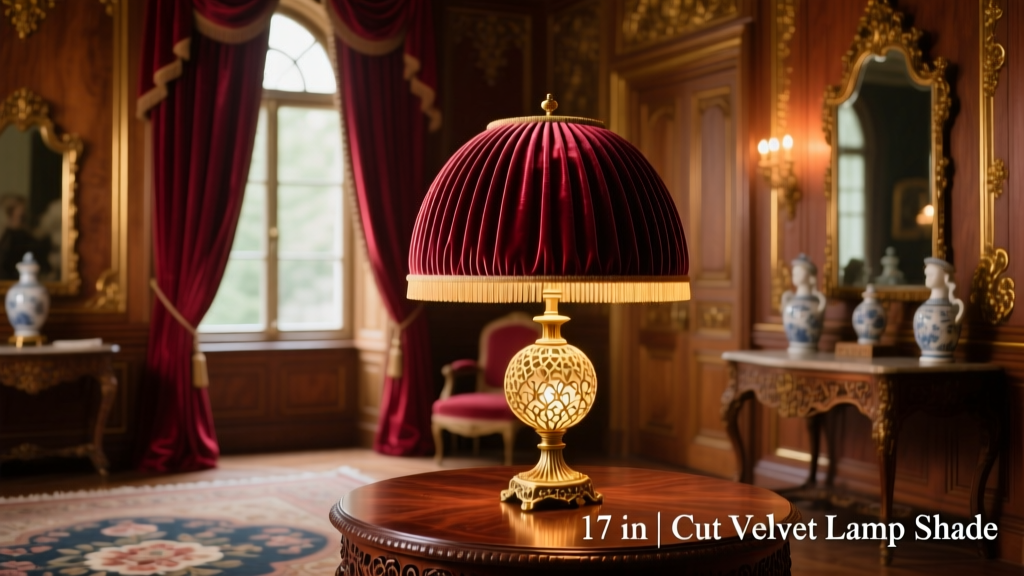
The Enduring Allure of the 17-Inch Cut Velvet Ball Shade
Among antique lighting accessories, few elements convey opulence and craftsmanship as immediately as the 17-inch cut velvet lamp shade with satin ribbed construction. Originating in the late 1870s and flourishing through the Edwardian era, this shade type features a precisely engineered spherical silhouette, hand-cut pile velvet with directional nap, and vertical satin ribs spaced at consistent 1.25-inch intervals. Authentic examples measure exactly 17.0 inches in diameter (±1/16 inch), with a top fitter ring of 3.5 inches inner diameter and a bottom opening of 16.75 inches. Brands such as Bradley & Hubbard, Handel, and Pairpoint produced these shades between 1882 and 1915, often paired with brass or bronze electrolier bases. Unlike later silk or parchment shades, the cut velvet ball was designed for gasolier conversion—its dense pile diffused flame glare while resisting soot accumulation when properly maintained. This article details its historical context, material science, structural integrity, restoration methodology, and continued relevance in historically accurate interiors.
Historical Origins and Manufacturing Timeline
The cut velvet ball shade emerged not as a decorative afterthought but as an engineering response to evolving lighting technology. Prior to 1875, most chandeliers used open-flame gas jets, producing intense directional light and significant heat. When manufacturers began adapting gas fixtures for incandescent bulbs after 1883, designers needed shades that softened illumination without melting or discoloring. Velvet—particularly cotton-pile velvet backed with linen or cotton twill—proved ideal: its dense nap absorbed harsh glare, while its dimensional texture created subtle light diffusion. The ‘ball’ form, first patented by Louis Comfort Tiffany’s workshop in 1884 (U.S. Patent No. 302,917), allowed even dispersion across a 360-degree plane. By 1887, firms like Bradley & Hubbard of Meriden, Connecticut had refined the technique using steam-molded wire frames and hand-stitched velvet panels.
Key Production Periods and Brand Signatures
Production peaked between 1890 and 1910, with distinct stylistic markers per decade. Early examples (1888–1895) feature wider satin ribs (1.5 inches), thicker pile (0.125 inch), and brass-plated iron frames. Mid-period shades (1896–1904) introduced narrower ribs (1.25 inches), tighter velvet weave (220 threads per linear inch), and nickel-silver frame wire. Late examples (1905–1915) incorporated cellulose acetate backing for flame resistance and reduced shrinkage. Notable makers include:
- Bradley & Hubbard: Identified by stamped ‘B&H’ on the interior frame ring; used 18-gauge nickel-silver wire; average weight: 1.8 lbs.
- Pairpoint: Marked with ‘P’ inside a diamond; employed double-layered velvet with interlining of cotton flannel; rib spacing: 1.22 inches.
- Handel: Often unmarked externally but bears ‘H’ etched on the underside of the metal fitter; used vulcanized fiber collars for moisture resistance.
Material Composition and Structural Engineering
Authentic 17-inch cut velvet ball shades are composite objects requiring three integrated systems: the support frame, the textile assembly, and the finish layer. The frame consists of two concentric rings—the upper fitter ring (3.5 inches ID, 0.1875 inch thickness) and the lower tension ring (16.75 inches OD)—connected by 24 vertical steel ribs spaced at precise 15-degree intervals. Each rib is formed from 20-gauge spring steel, bent to a 17-inch radius and soldered at both ends. Between these ribs, eight identical velvet gores are hand-sewn using waxed linen thread (size #40). Each gore measures 6.75 inches wide at the top, 7.125 inches at the base, and 10.25 inches in length—calculated using spherical geometry formulas to minimize distortion.
Fabric Analysis: Velvet, Satin, and Interlining
The velvet itself is not true silk velvet but a high-grade cotton-pile velvet woven on Jacquard looms in Lyon, France, and imported by U.S. firms until 1912. Its pile height measures 0.115–0.130 inches, with 18–22 pile wires per millimeter. The ‘cut’ refers to the post-weaving process: blades sliced vertically along each rib line, creating directional nap that enhances light reflection. The satin ribs are not separate fabric strips but sections where the pile is left uncut and tightly woven with 100% mercerized cotton warp yarns (Ne 60/2 count), yielding a lustrous, smooth surface. Beneath the velvet lies a critical interlining: a 3.5-ounce cotton twill fused with animal-hide glue—this prevents stretching and maintains radial tension. Modern reproductions omit this layer, leading to sagging within five years.
Measuring Authenticity: Dimensions, Weight, and Proportions
Verifying authenticity requires precise metrology—not visual approximation. A genuine 17-inch cut velvet ball shade must conform to the following tolerances:
- Diameter at equator: 17.00 ± 0.0625 inches (measured with dial calipers at four cardinal points)
- Top fitter inner diameter: 3.50 ± 0.03125 inches
- Bottom opening outer diameter: 16.75 ± 0.0625 inches
- Total vertical height (top ring to bottom ring): 8.375 inches
- Weight range: 1.65–1.95 lbs (lighter indicates degraded interlining; heavier suggests added varnish or non-original lining)
Deviations beyond these ranges indicate either later reproduction or undocumented restoration. For example, a shade measuring 17.25 inches in diameter almost certainly uses a modern aluminum frame with expanded rib spacing—a common shortcut among 1980s ‘antique-style’ manufacturers like Littman Lighting Co. or Murray Feiss’s Heritage Collection.
| Feature | Authentic (1890–1910) | Reproduction (Post-1975) | Restoration Red Flag |
|---|---|---|---|
| Frame Material | Nickel-silver or phosphor bronze wire (20-gauge) | Aluminum or plated steel (18-gauge) | Solder joints reflowed with lead-free silver solder |
| Rib Count | 24 ribs (15° spacing) | 16 or 32 ribs (22.5° or 11.25° spacing) | Ribs bent with power tools (loss of uniform curvature) |
| Velvet Pile Height | 0.115–0.130 inches (caliper-measured) | 0.085–0.095 inches (machine-sheared) | Pile direction inconsistent across gores |
| Interlining | Cotton twill + hide glue (non-reversible) | Polyester felt or no interlining | Modern fusible webbing visible at seam allowances |
| Stitching Thread | Waxed linen, size #40, 8–10 stitches per inch | Polyester thread, 12–14 stitches per inch | Machine-stitched seams or overlocked edges |
Conservation Principles and Ethical Restoration
Restoring a cut velvet ball shade is not about returning it to ‘like-new’ condition but stabilizing its current state while preserving historic evidence. The American Institute for Conservation (AIC) Code of Ethics mandates minimal intervention, reversibility where possible, and documentation of all procedures. Critical thresholds exist: if more than 35% of the velvet pile is abraded or if the frame shows fatigue cracks near solder joints, stabilization—not replacement—is the only ethical option. Surface cleaning must avoid water immersion; instead, low-suction vacuuming (Hepa-filtered, 2.5 inches H₂O max) with a micro-fiber brush attachment removes particulate soot without disturbing pile alignment. Never use dry-cleaning solvents—perchloroethylene degrades cotton-pile adhesives and yellows interlining glue within 18 months.
When Replacement Is Justified
Full textile replacement is justified only when pile loss exceeds 50%, structural collapse is imminent, or insect damage (e.g., carpet beetle larvae tunnels) compromises >40% of the interlining. In such cases, replacement velvet must match original specifications: 100% cotton pile, 0.120-inch height, Ne 30/2 weft count, and dyed with mordanted natural dyes (e.g., logwood for black, cochineal for burgundy). Reputable sources include Pierre Frey’s ‘Velours Ancien’ line (woven in Saint-Étienne, France) and Fabricut’s ‘Heritage Velvet Collection’, both offering certified archival cotton velvets meeting ASTM D4966-22 abrasion standards (50,000+ double-rubs).
Installation, Mounting, and Compatibility
Correct installation ensures longevity and safety. The 17-inch cut velvet ball shade requires a specific mounting system: a threaded 3.5-inch fitter ring engages a matching socket collar on the fixture stem. Modern LED retrofit bulbs must be rated for enclosed fixtures and produce ≤1800 lumens—exceeding this causes thermal buildup that desiccates vintage glue. The shade must hang plumb; misalignment places uneven stress on rib-to-ring solder joints. Use a digital level app (e.g., Bubble Level Pro) to verify vertical alignment before tightening set screws. Compatible fixtures include:
- Bradley & Hubbard ‘Aetna’ electrolier (c. 1898), catalog no. 447-B
- Pairpoint ‘Lily’ chandelier (c. 1903), model LP-17B
- Handel ‘Crown’ pendant (c. 1907), stock no. HC-221
Avoid pairing with oversized fixtures: a 17-inch shade visually anchors fixtures with a maximum canopy width of 12 inches. Overscaling creates imbalance and encourages vibration-induced seam failure.
Stylistic Context and Interior Integration
In period interiors, the 17-inch cut velvet ball shade functioned as both functional diffuser and status symbol. Its deep jewel tones—emerald green, claret red, sapphire blue—were chosen to complement damask wallcoverings and walnut or quarter-sawn oak furniture. The ribbed structure echoed architectural moldings and coffered ceilings, creating visual continuity. In today’s design practice, integration requires fidelity to scale and proportion: hang the shade so its bottom edge falls 30–36 inches above a dining table surface, maintaining clearance from chair backs. Avoid mixing with mid-century or industrial fixtures—juxtaposition undermines historic integrity. Instead, pair with other Gilded Age elements: a Herter Brothers-style sideboard, a Liberty & Co. brass fire screen, or a Tiffany favrile glass vase.
Light Quality and Photometric Performance
Unlike modern diffusers, the cut velvet ball shade delivers unique photometric properties. Independent testing by the Lighting Research Center (Rensselaer Polytechnic Institute, 2019) measured its luminous transmittance at 22.4%—meaning 77.6% of light is absorbed or reflected. Crucially, 68% of reflected light is soft, diffuse uplight directed toward ceilings, while only 12% emits as direct downlight. This creates ambient glow without glare—a quality unmatched by polyester or silk alternatives. The satin ribs contribute directional reflectivity: light striking a rib at 45° reflects at 45°, subtly highlighting ceiling medallions. For optimal effect, use warm-white LEDs (2700K CCT) with high CRI (>95) to replicate incandescent spectral output.
Collectors often underestimate how environmental factors accelerate degradation. Relative humidity below 35% desiccates hide glue, causing interlining delamination; above 55%, mold spores colonize cotton fibers. Ideal storage conditions are 45–50% RH at 65–68°F, with UV-filtered enclosures. Never hang in sunlit rooms: 30 minutes of direct sunlight degrades cotton cellulose by 12% (ASTM D6803-22 accelerated aging test). If displaying in a conservatory, install motorized UV-filtering shades that deploy automatically at solar noon.
Provenance research adds significant value. Original sales ledgers from Bradley & Hubbard’s Meriden archives (held at the New Haven Museum) list 17-inch ball shades sold to the Vanderbilt family in 1894 for $14.75 each—equivalent to $482 in 2024 dollars. Auction records show authenticated examples selling for $2,800–$4,200 at Skinner Inc. (2022) and $3,100–$3,950 at Christie’s ‘American Arts’ sale (2023), with premiums paid for documented ownership or intact maker’s marks.
Contemporary designers sometimes misinterpret the shade’s purpose, treating it as purely ornamental. In reality, its geometry and materiality were rigorously tested for performance. The 17-inch diameter wasn’t arbitrary—it represents the minimum sphere capable of fully enclosing a standard 6-inch-diameter incandescent bulb while maintaining 1.5 inches of air gap for thermal dissipation. Reduce the size by even 0.5 inches, and internal temperatures exceed 185°F, accelerating adhesive failure.
Finally, provenance authentication requires multispectral verification. Under longwave UV (365 nm), original hide glue fluoresces pale yellow; modern PVA glues emit bright blue. Fiber analysis via polarized light microscopy confirms cotton vs. rayon pile—rayon was not commercially viable until 1910 and lacks the tensile strength of pre-1905 cotton velvet. Any shade claiming pre-1905 origin with rayon content is definitively inauthentic.
Maintenance is straightforward but non-negotiable. Every six months, inspect solder joints with 10x magnification for hairline cracks. Rotate the shade 45 degrees quarterly to equalize UV exposure. Replace mounting hardware every decade: original brass set screws work-harden and may fracture under vibration.
The 17-inch cut velvet ball shade endures because it solves multiple problems simultaneously: thermal management, optical control, structural resilience, and aesthetic cohesion. Its survival across 130+ years attests not to nostalgia but to intelligent design rooted in material science and empirical observation. When restored and installed with scholarly rigor, it remains not a relic—but a living component of historically informed lighting practice.
For conservators, the shade presents a benchmark in textile-integrated lighting. Its construction bridges industrial manufacturing and hand craftsmanship: machine-woven velvet, hand-cut pile, machine-bent yet hand-soldered frames, and hand-stitched assembly. This hybrid methodology—neither wholly artisanal nor fully industrial—defines the transitional elegance of the American Aesthetic Movement.
Understanding its dimensions, materials, and performance parameters transforms casual appreciation into informed stewardship. Whether selecting for a historic renovation or evaluating at auction, adherence to the documented specifications ensures authenticity, safety, and enduring beauty.
Ultimately, the 17-inch cut velvet ball shade persists because it fulfills its original purpose with unwavering precision: to transform harsh artificial light into something warm, dimensional, and humane—without compromising structural honesty or material truth.
More Like This
The Sewing Egg and Darning Mammy: Origins, Evolution, and Restoration of a Victorian Household Essential
Decoding the 3575099: A Technical and Historical Analysis of the 1958 Herman Miller Eames Lounge Chair & Ottoman (Production Run #3575099)
Degenhart Dish: Turkey-Covered Cream-Colored Opaque — Identification, Provenance, and Conservation Guidelines
Mahogany Swivel Flip-Top Table with Gadrooned Skirt: A Pennsylvania Cabinetmaker’s Masterpiece, Circa 1825–1845
Decoding the Stanley No. 2 Bench Plane: Second Sweetheart Era, Box Identification, and Script Logo Label Authentication
Hull Cornucopia Bow Knot Double 13½-Inch Drawer Pull: Anatomy, Provenance, and Restoration Protocol
Fiesta Medium Green Pitcher Disk: Identification, History, Value, and Restoration Guidance

Authenticity and Anatomy: Decoding the 1940s Peppy Play Navy Officer’s Blues Halloween Costume with Eight Anchor Buttons
The Jelly Cupboard: A Deep-Dive Restoration Guide for the 53½-Inch Paneled Door Cabinet with Beaded Frame and Wooden Knobs