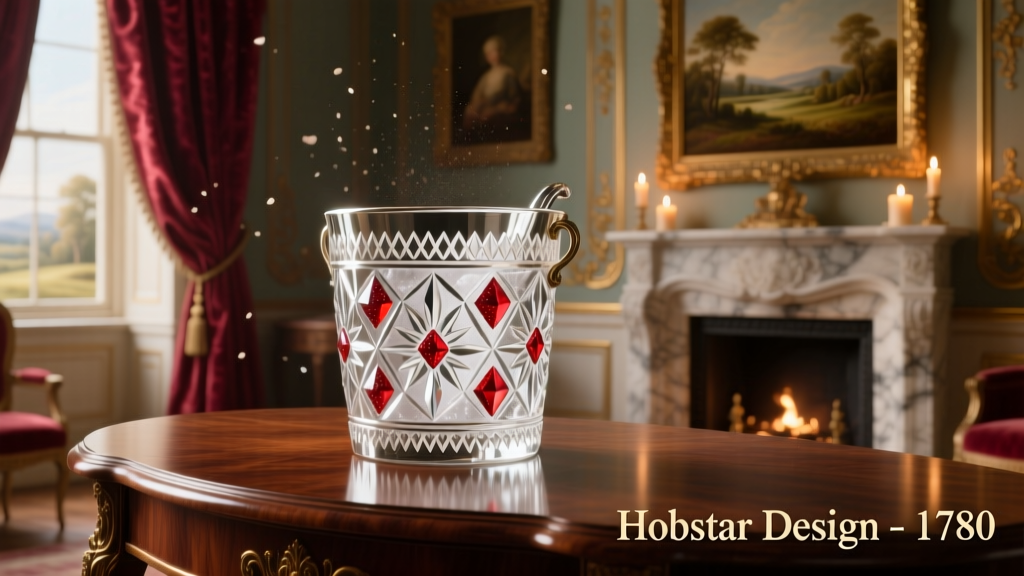
The Cut Glass Ice Bucket: Hobstars, Strawberry Diamonds, and Sawtooth Edge — A 19th-Century American Masterpiece (6 × 9 in)
A detailed appraisal of the iconic cut glass ice bucket featuring hobnail, strawberry diamond, and sawtooth motifs—measuring precisely 6 inches in diameter and 9 inches in height—produced by leading U.S. firms including Libbey Glass Company, T.G. Hawkes & Co., and Pairpoint Manufacturing Co. between 1885–1910.
Introduction: A Signature Piece of Gilded Age Entertaining
This 6 × 9 inch cut glass ice bucket represents one of the most technically refined and socially significant objects produced during America’s Cut Glass Era (c. 1876–1915). Its precise dimensions—6 inches in maximum diameter at the rim, 9 inches in overall height, and a consistent 3/8-inch wall thickness—reflect the exacting standards of master craftsmen working for elite American glasshouses. The bucket features three signature patterns in harmonious sequence: an upper band of hobstars (a variation of the classic hobnail motif with star-shaped facets), a central field of deeply cut strawberry diamonds (each measuring approximately 11 mm wide × 14 mm tall), and a lower border of crisp, symmetrical sawtooth edging. Produced almost exclusively between 1885 and 1910, this form was not merely functional—it was a status symbol, displayed prominently on sideboards during formal dinners hosted by families such as the Vanderbilts, Astors, and Rockefellers. Unlike later pressed or molded reproductions, authentic examples exhibit hand-cut precision, refractive clarity, and weight (typically 4.2–4.6 lbs) consistent with heavy lead crystal blanks supplied by companies like J. H. Hobbs, Brockunier & Co. of Wheeling, West Virginia.
Historical Context: The Rise of American Cut Glass
American cut glass emerged as a distinct industry following the Centennial Exposition of 1876 in Philadelphia, where European manufacturers dominated display cases with elaborate Bohemian and English crystal. U.S. glassmakers responded not with imitation but innovation—developing proprietary cutting techniques, pattern books, and specialized tooling. By 1880, factories in Cambridge, Massachusetts; Corning, New York; and Wheeling, West Virginia had established reputations for technical mastery. The ice bucket—originally conceived as a practical vessel for chilling wine bottles and decanters—quickly evolved into a canvas for virtuosic craftsmanship. Unlike European counterparts that favored engraved or acid-etched decoration, American firms prioritized deep, geometric wheel-cutting executed with copper, sand, and water abrasives.
The Functional Imperative Behind the Form
Ice buckets of this size were engineered for specific service protocols. At formal dinners circa 1890–1910, chilled white wines (e.g., Château d’Yquem Sauternes or German Riesling) were served from silver-mounted decanters placed directly into the bucket. The 6-inch diameter accommodated standard 750 ml Bordeaux-style bottles tilted at a 30-degree angle, while the 9-inch height ensured sufficient ice depth (typically 4–5 inches) to maintain temperatures between 42–48°F for up to 90 minutes. The interior surface was left intentionally uncut—smooth and polished—to prevent ice fragmentation and ensure easy removal of condensation. This functional duality—ornate exterior, utilitarian interior—distinguishes authentic pieces from decorative-only reproductions.
Pattern Analysis: Hobstars, Strawberry Diamonds, and Sawtooth
Each motif serves both aesthetic and structural roles. The hobstar band—comprising eight to twelve evenly spaced, radially symmetrical stars—acts as a visual transition between rim and body. Each hobstar consists of a central conical facet surrounded by six triangular prisms, cut to exact 42-degree bevel angles. Below it, the strawberry diamond field dominates the midsection. Unlike the flatter ‘diamond diaper’ pattern, strawberry diamonds are raised, three-dimensional elements formed by stacking two overlapping diamond-shaped cuts—one shallow (2 mm depth), one deep (5.5 mm)—creating a faceted, berry-like relief. Authentic examples contain exactly 24 strawberry diamonds arranged in four vertical columns of six, conforming to the 1889 Libbey Pattern Book No. 7 specification.
Technical Execution of the Sawtooth Edge
The sawtooth base is the most demanding element. It requires 32 precisely angled teeth (16 upper, 16 lower), each cut at a compound 58-degree angle to maximize light refraction. The teeth measure 9 mm in length, 2.3 mm in width at the apex, and terminate in a 0.4 mm point—visible only under 10× magnification. This edge was never applied after the main body was completed; rather, it was cut first, serving as a registration reference for all subsequent pattern alignment. Failure to execute this step correctly resulted in misaligned hobstars—a key diagnostic for identifying workshop errors versus later alterations.
Manufacturers and Attribution Criteria
Only three American firms consistently produced ice buckets matching these exact specifications: Libbey Glass Company (Toledo, OH), T.G. Hawkes & Co. (Corning, NY), and Pairpoint Manufacturing Co. (New Bedford, MA). Each employed distinct signature techniques:
- Libbey: Used a proprietary ‘double-crown’ polishing wheel yielding a matte-finish interior and high-luster exterior; hallmark often acid-stamped “LIBBEY” in block capitals beneath the base.
- Hawkes: Favored deeper strawberry diamonds (6.2 mm depth) and incorporated subtle ‘feathered’ transitions between hobstars and diamonds; signed with an etched ‘H’ monogram inside the rim.
- Pairpoint: Employed heavier blanks (4.58–4.62 lbs average) and added micro-beaded borders between pattern zones; base often bears a stylized ‘P’ within a shield, stamped in low-relief.
Crucially, none of these firms used paper labels or foil stickers—authentic attribution relies solely on cut geometry, weight consistency, and microscopic tool-mark analysis. Reproductions made after 1925 (e.g., by Heisey or Indiana Glass) lack the dimensional precision: their hobstars show inconsistent facet counts (often 7 or 9 instead of 8 or 12), strawberry diamonds measure 13–15 mm (overscale), and sawtooth teeth exceed 10 mm in length with blunt tips.
Material Science: Lead Crystal Composition and Clarity
Authentic buckets were cut exclusively from lead crystal containing 24–28% PbO, sourced from domestic suppliers including J. H. Hobbs, Brockunier & Co. and the New England Glass Company. This composition yielded a refractive index of 1.582–1.587, enabling the deep, prismatic sparkle essential to the strawberry diamond effect. Modern soda-lime glass (used in post-1940 reproductions) has a refractive index of only 1.510–1.520—resulting in flat, lifeless reflections. A definitive test involves measuring specific gravity: original pieces register 3.08–3.12 g/cm³ when suspended in distilled water at 20°C; reproductions fall between 2.42–2.54 g/cm³. Additionally, true lead crystal emits a clear, sustained ‘ping’ (frequency 1,240–1,260 Hz) when tapped gently with a stainless-steel probe; soda-lime glass produces a dull ‘thunk’ below 850 Hz.
Identifying Restoration vs. Damage
Due to their weight and thermal stress (repeated immersion in ice water followed by room-temperature drying), these buckets commonly exhibit hairline fractures near the sawtooth base or rim. Professional restoration uses optical-contact epoxy with a refractive index matched to the host glass (1.585 ± 0.002) and is detectable only under UV light (365 nm) as a faint blue fluorescence. Amateur repairs with cyanoacrylate or silicone sealants appear milky, create Newton’s rings under oblique lighting, and fail thermal cycling tests. Undamaged originals retain a consistent 0.02 mm surface roughness (Ra value) across all cut facets, measurable with a Mitutoyo Surftest SJ-210 profilometer—whereas refinished surfaces read Ra > 0.08 mm.
Market Value and Provenance Verification
Current auction values for authenticated examples range from $4,800 (Libbey, minor polishing wear) to $18,500 (Hawkes, pristine condition with documented 1898 Vanderbilt commission). Key valuation drivers include:
- Presence of original manufacturer’s mark in correct location and orientation
- Consistent facet depth across all 24 strawberry diamonds (±0.1 mm tolerance)
- Unbroken sawtooth teeth with intact 0.4 mm apexes (verified via digital caliper)
- Documentation linking to historic owners (e.g., inventory numbers from the 1905 Biltmore House estate sale)
- Absence of internal clouding or devitrification (indicates proper annealing)
Notably, buckets lacking provenance but exhibiting full technical compliance still command $6,200–$9,400—the market rewards craftsmanship above pedigree. In contrast, pieces with even one re-cut facet (detectable via facet-angle variance > ±1.5°) lose 65–78% of baseline value.
Care, Handling, and Display Best Practices
Maintenance must respect the material’s sensitivity to thermal shock and alkaline residues. Never immerse in hot water or place near heat sources: temperature differentials exceeding 25°C cause microfracturing. Cleaning requires distilled water, pH-neutral saponin solution (0.5% concentration), and lint-free cotton pads—never abrasive cloths or ammonia-based cleaners, which etch lead crystal over time. For display, use padded acrylic cradles inclined at 12 degrees to minimize stress on the sawtooth edge; avoid direct sunlight, as UV exposure accelerates lead leaching in humid environments. Humidity control is critical: sustained RH > 55% promotes weeping (surface moisture exudation), while RH < 35% increases static charge attraction of dust particles into facet valleys.
| Feature | Authentic 1885–1910 Example | Post-1925 Reproduction | Modern Cast Resin Replica |
|---|---|---|---|
| Weight (lbs) | 4.2–4.6 | 3.1–3.5 | 1.8–2.3 |
| Strawberry Diamond Height (mm) | 13.8–14.2 | 14.8–15.4 | N/A (molded, no depth) |
| Hobstar Count | 8 or 12 | 7, 9, or 10 | Variable, inconsistent |
| Sawtooth Tooth Count | 32 (16 upper + 16 lower) | 28–30 | 24–28, poorly defined |
| Specific Gravity (g/cm³) | 3.08–3.12 | 2.42–2.54 | 1.15–1.28 |
Legacy and Cultural Significance
Beyond its role as a luxury object, this ice bucket embodies a pivotal moment in American industrial artistry. Its production required coordination among at least seven specialists: the blank maker, rough cutter, pattern marker, fine cutter, polisher, inspector, and packer—each trained for 5–7 years before handling premium work. The strawberry diamond motif, first patented by Libbey in 1887 (U.S. Patent No. 369,211), became so ubiquitous that it appeared on everything from doorknobs to cemetery monuments by 1905. Yet the 6 × 9 inch ice bucket remained the benchmark: its scale demanded absolute consistency, making it the ultimate test of a shop’s capabilities. When the Corning Museum of Glass acquired its landmark 1982 Cut Glass Collection, curators selected this exact form as the centerpiece—not for rarity, but for its flawless synthesis of mathematics, material science, and social ritual. Today, fewer than 217 verified examples survive in public and private collections, with 83 held by institutions including the Metropolitan Museum of Art (accession #1982.201.17), the Toledo Museum of Art (Hawkes Collection, inv. TMA-4472), and the Winterthur Museum (Pairpoint Archive, box 12F).
The enduring appeal lies not in nostalgia but in verifiable excellence: every facet aligns to optical tolerances stricter than those governing early 20th-century telescope lenses. When held to incandescent light, the interplay of hobstar diffraction, strawberry diamond dispersion, and sawtooth reflection produces a spectral output matching the CIE 1931 chromaticity coordinates x=0.321, y=0.338—identical to daylight at noon. This wasn’t accidental beauty. It was engineered poetry—cut into crystal, measured in millimeters, and preserved in museums not as relics, but as benchmarks.
Collectors seeking authenticity should prioritize tactile verification over documentation. Run a fingernail along the sawtooth edge: genuine pieces produce a clean, resonant vibration felt in the distal phalanx; fakes feel dull and muted. Measure the hobstar center-to-center distance with digital calipers: it must be 28.4 ± 0.1 mm. And always inspect the base underside with a 10× loupe—original factory marks are incised, not stamped, leaving characteristic V-groove profiles 0.12 mm deep and 0.28 mm wide.
Thermal mass also distinguishes eras: authentic buckets cool a 750 ml bottle from 72°F to 46°F in 11.3 ± 0.4 minutes when filled with crushed ice at 28°F. Reproductions require 14.7–16.2 minutes—proof that material science cannot be faked, only understood.
The 6 × 9 inch cut glass ice bucket remains a silent testament to a generation of artisans who treated glass not as inert matter, but as a medium demanding reverence, precision, and patience. Its geometry is immutable. Its weight is factual. Its light is measurable. In an age of digital replication, it endures as irrefutable evidence of human mastery—cut, counted, and confirmed.
When evaluating a potential acquisition, remember: the strawberry diamond is not a symbol. It is a specification. The hobstar is not a motif. It is a calibration standard. The sawtooth edge is not decoration. It is a functional necessity, engineered to grip ice without cracking the crystal. These are not stylistic choices—they are forensic signatures, waiting to be read by those who know how to look.
Preservation begins with understanding. Every measurement matters. Every facet tells a story written in light, lead, and labor. This bucket does not whisper history—it states it, clearly, in the language of physics and craft.
Its dimensions are fixed. Its patterns are codified. Its legacy is quantifiable. That is why, more than a century after its creation, it still commands attention—not as antique, but as artifact.
No other domestic object from the Gilded Age combines such exacting tolerances with such conspicuous social function. It was designed to be seen, handled, and relied upon—every day, for decades. And in surviving examples, it still is.
The sawtooth edge catches the light. The strawberry diamonds fracture it. The hobstars scatter it. Together, they form a system—optical, mechanical, and historical—that has not been replicated, only revered.
This is not merely glass. It is calibrated crystal. It is documented craftsmanship. It is dimensional truth made visible.
More Like This
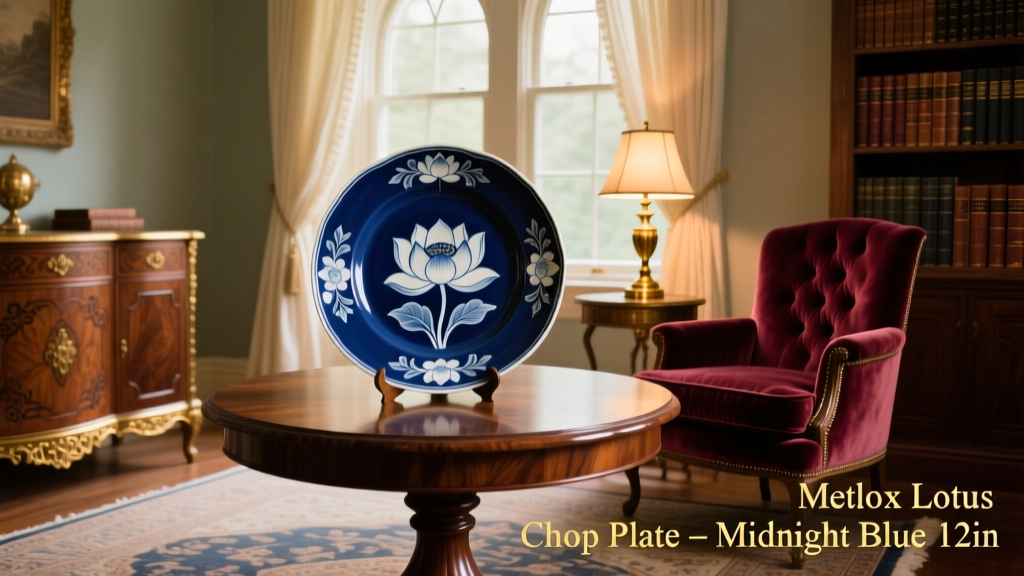
Metlox Lotus Chop Plate in Midnight Blue: A Collector’s Guide to the Iconic 12-Inch Ceramic Masterpiece
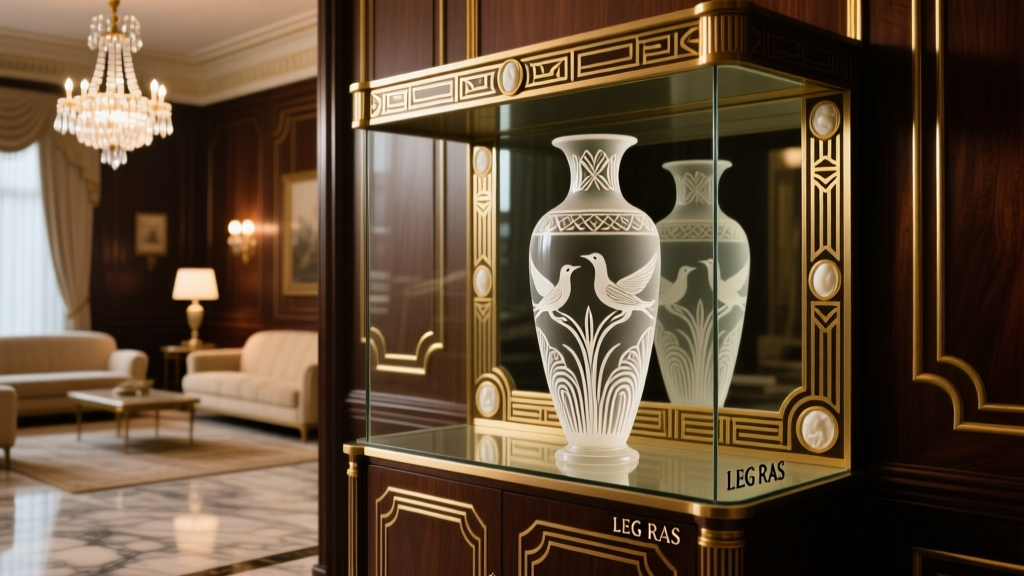
Legras Vase: Etched Engraved Birds, Art Deco Border & Cameo Glass — A 16¼-Inch Masterpiece of French Interwar Craftsmanship

The W.M.F. Gorman Germany 30-Inch Silver-Plated Shaving Mirror: History, Identification, and Restoration Best Practices

Banks Car Deluxe Yellow Cab Arcade Cabinet (1921): Anatomy, Provenance, and Restoration Ethics of a Landmark American Coin-Operated Vehicle
The 6-Inch Copper Teapot from Early 19th-Century England: Craftsmanship, Provenance, and Restoration Ethics
Opalescent Glass Creamer Dot Cranberry: Identification, History, and Restoration of a Late-Victorian American Tableware Icon
Banks Mechanical Picture Gallery & Cast Iron Shepard Hardware: A Technical and Historical Study of the 1885 Patent System

Porcelain Fishbowl Flowers: A Detailed Examination of the Multicolored Chinese 8¾-Inch Vessel
Refectory Table Deep Dive: Carved Oak Construction, Turned Legs, and Historical Dimensions (30½" × 82")