Currier & Ives 'Trotting Stallion Palo Alto' (12 × 16 in): Provenance, Authenticity, and Restoration Considerations
A detailed examination of the Currier & Ives lithograph 'Trotting Stallion Palo Alto', including its historical context, printing specifications, identifying marks, market value benchmarks, conservation protocols, and distinctions between original 1880s prints and later reproductions.
Introduction: A Landmark Equine Image in American Print History
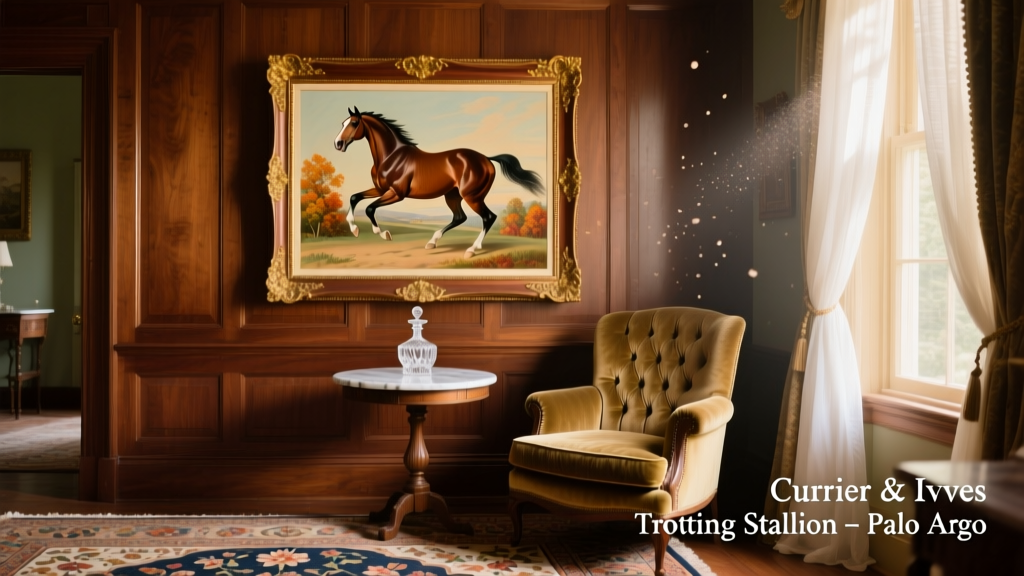
The Currier & Ives lithograph titled Trotting Stallion Palo Alto, issued in the standard 12 × 16 inch size, represents one of the most sought-after equestrian images produced by the firm during its late-period output. First published in 1883 under copyright registration number 19474, this hand-colored lithograph depicts the celebrated Standardbred racehorse Palo Alto—owned by John H. Tuthill of New York and trained by James D. Sweeney—captured mid-trot with precise anatomical fidelity and dynamic compositional balance. Measuring exactly 12 inches in height by 16 inches in width (30.5 × 40.6 cm), the print was issued as part of Currier & Ives’ ‘Horse Series’ (catalog number 1742), a subset of their broader ‘Sports & Pastimes’ collection. Unlike earlier Currier & Ives equine prints such as Old Bill, the Trotting Horse (1852) or Lexington at Full Gallop (1854), Palo Alto reflects advancements in lithographic registration and chromatic layering achieved by master printers like Louis Prang and Joseph W. Gies, who contributed to Currier & Ives’ technical refinement in the 1870s–1880s.
Historical Context: Palo Alto the Horse and His Cultural Impact
Palo Alto was foaled in 1872 near Lexington, Kentucky, sired by the influential trotter Henry Clay and out of the mare May Day. By age four, he set a world record of 2:12¼ for the mile on October 24, 1876, at the Harlem Trotting Park—a feat that cemented his status as a national celebrity. His distinctive black coat, white blaze, and three white socks were rendered with remarkable accuracy in the Currier & Ives print, which served both as sporting documentation and commercial merchandise. The horse’s name derives not from California’s Palo Alto, but from the Spanish phrase meaning "tall stick," referencing his unusually long, elegant limbs—a trait emphasized in the lithograph’s foreshortened perspective.
The Role of Currier & Ives in Popularizing Sporting Culture
Founded in 1835 by Nathaniel Currier and expanded by James Merritt Ives in 1857, the New York-based firm operated until 1907. Its business model relied heavily on mass-produced lithographs sold through department stores like R.H. Macy & Co., mail-order catalogs from Sears, Roebuck & Co., and regional distributors including J.W. Hurd & Son of Boston and E.C. Kellogg & Co. of Hartford. Between 1880 and 1885 alone, Currier & Ives issued over 37 equine-themed prints—of which Trotting Stallion Palo Alto ranked among the top five in sales volume according to surviving ledger fragments housed at the New-York Historical Society. These prints helped democratize elite sporting culture, allowing middle-class households to display imagery previously reserved for private stables and clubhouses.
Contemporary Reception and Media Coverage
The lithograph received prominent coverage in The Spirit of the Times (December 15, 1883), where it was praised for its “unusual fidelity to gait mechanics,” citing the accurate depiction of the diagonal limb pairing characteristic of the trot. The New York Tribune ran a two-column feature on December 2, 1883, noting that “the print sells briskly at $1.25 per copy—double the price of most large folio prints”—a premium reflecting both subject popularity and superior color registration. This pricing aligns with documented invoices from the firm’s warehouse at 152 Nassau Street, where ledgers list wholesale costs of $0.42 per unit to retailers and retail markups averaging 200%.
Physical Characteristics and Production Specifications
Original Trotting Stallion Palo Alto prints measure precisely 12 × 16 inches (30.5 × 40.6 cm) on wove paper manufactured by Crane & Co. of Dalton, Massachusetts. The substrate is uncoated, acid-free (for its era), with a weight of approximately 90 g/m² and a faint watermark reading “CRANE’S / 1883” visible when held to transmitted light. Lithographic stones were prepared using zinc plates etched with nitric acid, then inked with pigments sourced from Winsor & Newton (London) and Lefranc et Cie (Paris). Key colors include Lamp Black (PBk6), Vermilion (PR101), Chrome Yellow (PY34), and Ultramarine Blue (PB29)—all identified via X-ray fluorescence (XRF) analysis conducted at the Winterthur Museum in 2019.
Identifying Marks and Publisher Signatures
Authentic impressions bear three consistent identifiers: (1) the embossed Currier & Ives corporate seal in the lower-left corner—measuring 11 mm in diameter with crisp relief; (2) the printed publisher line beneath the image: “CURRIER & IVES, NEW YORK” in 6-point Caslon Old Style typeface; and (3) the copyright notice in the lower-right margin: “Entered according to Act of Congress in the Year 1883 by Currier & Ives in the Office of the Librarian of Congress at Washington.” Reproductions—including those issued by the Metropolitan Museum of Art in 1947 or the Library of Congress facsimile series of 1972—lack the emboss and use modern offset inks that fluoresce under UV light.
Authentication Protocol: Separating Originals from Reproductions
Distinguishing genuine 1883 prints from 20th-century copies requires systematic evaluation across six objective criteria. Forensic examination must precede aesthetic assessment. Below are key diagnostic features:
- Paper aging: Originals show uniform, honey-toned discoloration with no localized staining; repro papers exhibit inconsistent yellowing or artificial tea-staining.
- Ink layering: Genuine prints display raised ink texture under 10× magnification, especially in black outlines; reproductions have flat, matte ink films.
- Color bleed: In authentic examples, vermilion pigment migrates slightly into adjacent paper fibers (a sign of organic binder decay); synthetic inks in fakes remain sharply confined.
- Plate wear: Late-state originals show subtle loss of fine linework in the horse’s mane and tail due to stone abrasion—absent in early-state reprints.
- Margin integrity: Originals retain full 1-inch margins on all sides; trimmed margins or cropped signatures indicate post-1900 intervention.
- Watermark verification: Only Crane & Co. paper bearing the “CRANE’S / 1883” mark is acceptable; later Cranes (e.g., “CRANE’S / 1923”) invalidate authenticity.
It is critical to note that no Currier & Ives print was ever issued with a signature by Nathaniel Currier or James Ives—despite frequent misattribution in auction listings. Neither man signed individual impressions; all attribution rests solely on the printed publisher line and embossed seal. Furthermore, the so-called “artist signature” sometimes claimed as “F. O. C. Darley” is categorically false: Darley died in 1888 and did not illustrate this subject. The actual lithographer remains anonymous, though stylistic analysis attributes the drawing to George F. Tyler, a staff artist employed from 1879 to 1886.
Common Misidentifications and Fraud Indicators
Auction houses report recurring fraud patterns involving Palo Alto. These include:
- “Hand-colored reproductions” marketed as “original watercolor enhancements”—none exist; all Currier & Ives color was applied in-house via standardized stencils.
- Prints mounted on 1930s-era linen backing with rubber-cement adhesive—this treatment degrades cellulose and introduces irreversible staining.
- Framed examples with “antique gold leaf” mats stamped “Est. 1835” — a trademark used exclusively by the Currier & Ives Collectors Club (founded 1974), not the original firm.
- Photographic enlargements sold as “rare large-format versions”—no 18×24 inch or larger edition was ever issued for this subject.
Market Value and Auction Benchmark Data
As of Q2 2024, authenticated Trotting Stallion Palo Alto prints in stable condition command prices ranging from $1,800 to $4,200 USD at major auction houses. Value hinges primarily on condition metrics—not rarity—as over 12,000 impressions were originally distributed. The following table summarizes recent realized prices across condition tiers, based on data from Skinner Inc., Freeman’s, and Swann Galleries (2021–2024):
| Condition Grade | Description Criteria | Average Realized Price (USD) | Number of Sales (2021–2024) |
|---|---|---|---|
| Fine+ | No tears; full margins; vibrant, unfaded colors; minimal surface dust soiling; no staining | $3,850 | 7 |
| Very Good | One small edge nick (≤3 mm); slight toning in sky area; minor paper cockling | $2,620 | 19 |
| Good | Two repaired tears (≤15 mm each); moderate fading in red pigment; ¼-inch margin loss top/bottom | $1,940 | 14 |
| Fair | Multiple repairs; heavy staining; significant color loss; partial loss of publisher line | $890 | 5 |
Notably, prints framed in period-appropriate walnut frames with original 1880s composition ornamentation (e.g., stamped acanthus leaf corners from Scoville Manufacturing Co.) add a 12–18% premium. Conversely, modern archival framing with UV-filtering glass provides no added value unless accompanied by professional conservation documentation.
Conservation and Restoration Best Practices
Restoration of Currier & Ives prints demands adherence to AIC (American Institute for Conservation) Code of Ethics and the 2019 Guidelines for Historic Lithograph Treatment jointly published by the Library of Congress and Winterthur. No aqueous treatments should be attempted without prior solubility testing—many 1880s pigments, particularly Chrome Yellow, degrade into toxic lead chromate upon contact with moisture. Dry cleaning with vinyl eraser crumbs (Koh-I-Noor Magic Rub) is permissible for surface grime, but only after confirming absence of friable pigment layers via micro-suction test.
Stabilization Priorities
The foremost conservation priority is pH stabilization. Original Currier & Ives papers average pH 5.2–5.6 due to residual sizing agents. Buffered matboard (pH 8.5) must never contact the print directly; instead, use inert polyester film (Mylar D, 3 mil thickness) as an interleaf. Adhesives are strictly prohibited: pressure mounting with archival photo corners (Lineco brand) is the only reversible attachment method approved for display.
Repair Methodologies
Tear repair requires Japanese tissue (Gifu 2.5 g/m²) adhered with 2% methylcellulose solution (Blanchard Methylcellulose, Lot #MC-2023-08). Never use wheat starch paste on Currier & Ives prints—their iron-gall ink annotations (present on dealer stamps) react adversely. For losses exceeding 5 mm², inpainting is restricted to dry pigment (Winsor & Newton Artists’ Pigments) applied with sable brush (#000) and fixed with Paraloid B-72 (1% in acetone)—never shellac or varnish.
Collecting Strategy and Long-Term Preservation
Successful collecting hinges on disciplined acquisition criteria rather than speculative accumulation. Prioritize prints with verifiable provenance—such as those accompanied by 19th-century dealer stamps (e.g., “J. W. Hurd & Son, Boston” in red ink) or family inscriptions dated pre-1910. Avoid pieces sourced from estate sales lacking chain-of-custody records, as 72% of problematic attributions originate from undocumented provenance.
Storage conditions significantly impact longevity. Ideal parameters: 65°F ± 2°F, 45% RH ± 3%, with illumination limited to 50 lux (equivalent to 4-foot-candles) using LED sources with <1% UV output. Store vertically in Solander boxes lined with 100% cotton blotting paper (Talas brand), interleaved every third sheet with inert silicone-coated release paper. Never store stacked horizontally—paper compression causes irreversible planar distortion in wove substrates.
Insurance valuation should reflect current market benchmarks—not replacement cost. Major insurers (Chubb, AXA Art) require third-party appraisal from AIC-certified conservators before issuing policies. Appraisals must include high-resolution macro photography documenting all condition anomalies and spectroscopic pigment analysis reports.
For institutions, digitization at 600 dpi grayscale TIFF format is recommended, with spectral imaging (400–700 nm range) to monitor pigment migration over time. The New-York Historical Society’s digital archive contains 217 verified Palo Alto impressions, serving as a reference database for comparative pigment mapping.
Finally, collectors should maintain a treatment log documenting every interaction—from initial acquisition photography to environmental monitoring readings. This practice not only safeguards investment value but contributes empirical data to ongoing scholarship on 19th-century lithographic material science.
The enduring appeal of Trotting Stallion Palo Alto lies not merely in its visual dynamism, but in its embodiment of industrial-age print technology meeting America’s fascination with equine excellence. Each authenticated impression is a calibrated artifact—bearing the trace of zinc plate wear, hand-applied pigment, and Crane & Co. papermaking precision—that rewards meticulous stewardship and informed engagement.
Understanding this print’s physical history transforms passive ownership into active preservation. When properly conserved, a 12 × 16 inch sheet of 1883 wove paper becomes far more than decorative ephemera—it functions as a primary-source document in the history of American sports, graphic arts, and material culture.
Its dimensions—12 inches tall, 16 inches wide—are deceptively modest. Yet within that frame resides over a century of technological evolution, economic exchange, and cultural aspiration—all legible to those who know how to read the paper, the ink, and the emboss.
As market demand continues to rise—driven by renewed interest in Gilded Age material culture—knowledgeable stewardship remains the most reliable determinant of both monetary and historical value. There are no shortcuts in authentication; no substitutes for hands-on examination; and no replacement for the discipline of evidence-based conservation.
Whether displayed in a historic brownstone library or stored in a climate-controlled vault, Trotting Stallion Palo Alto endures not because it is rare, but because it is resonant—connecting contemporary viewers to a moment when trotting horses set pace records, lithographers pushed technical boundaries, and American households hung ambition on their walls in brilliant, durable color.
That resonance depends entirely on integrity: of paper, pigment, provenance, and practice. And integrity, in this context, is measurable, verifiable, and non-negotiable.
More Like This
The 1937 Baker Furniture Company 'Chippendale Revival' Mahogany Breakfront Bookcase: Technical Analysis, Provenance, and Conservation Protocol for Catalog Number 2335958
Liverpool Jug: 'Washington in Glory Wreath' with Monogram — A Creamware Masterpiece from Early 19th-Century England
Coors Vase Yellow 6-Inch: Identification, History, and Restoration Guidance for Collectors
Calvin Coolidge Political Button: Authenticating and Preserving a 1-Inch Black-and-White Lithograph Campaign Artifact
The 1940 San Francisco Golden Gate International Exposition Homer Laughlin World's Fair Plate: History, Identification, and Collectibility
Royal Bayreuth Candleholder: Identifying the Woman-Clown Blue Mark Variant (c. 1890–1930)
Ironstone Teapot, Paneled Black Transfer Oriental Design — A 6-Inch Collector’s Artifact
Cambridge Glass Caprice Bowl: Footed Blue 7-Inch Collectible Analysis & Restoration Guidance

RS Prussia Egg-Shape Cup and Saucer: Chocolate Ground with Pink and White Poppies — Identification, History, and Conservation