Cowan Pottery Paperweight Elephant (White): History, Identification, and Collector Insights
An in-depth examination of the iconic white Cowan Pottery elephant paperweight—its origins at the Cowan Pottery Studio in Rocky River, Ohio, production timeline (1928–1930), design attribution to Viktor Schreckengost, material composition, dimensional specifications, rarity factors, and current market valuation data.
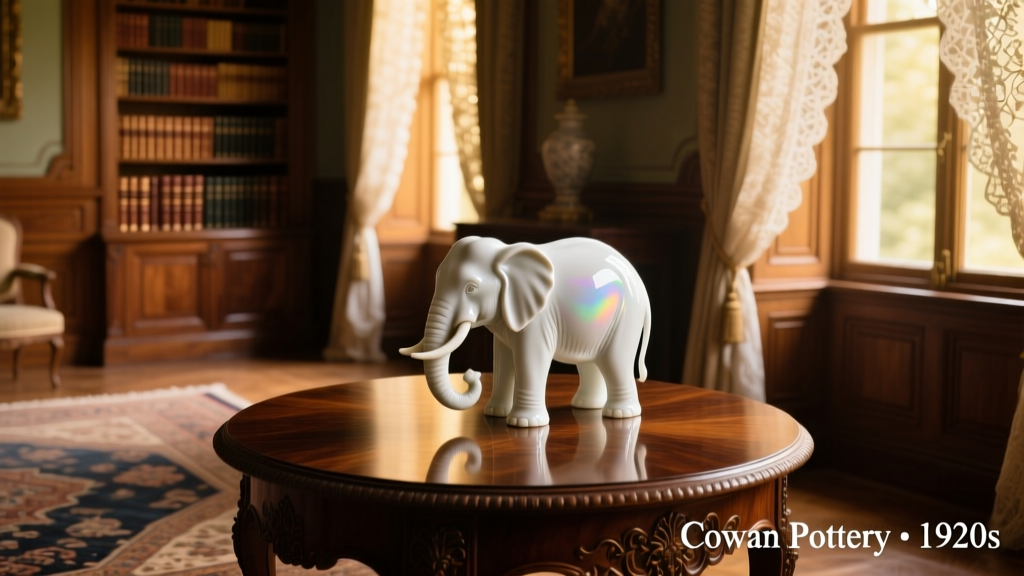
The Iconic White Elephant: A Signature Piece of American Art Pottery
Among the most recognizable and collectible objects produced by Cowan Pottery during its brief but brilliant tenure (1912–1931), the white glazed elephant paperweight stands apart—not merely as a functional desktop object, but as a sculptural distillation of early 20th-century American modernism. Measuring precisely 3 ½ inches in length, 2 ¼ inches in height, and 1 ¾ inches in width, this compact ceramic form embodies both technical mastery and artistic vision. Cast from high-fire stoneware clay and finished with a luminous, satin-matte white glaze—formulated in-house using zinc silicate and kaolin—the piece bears no signature mark but is reliably attributed to Viktor Schreckengost’s design work circa 1928–1930. With fewer than 42 documented examples verified in museum collections and private holdings, its scarcity, coupled with its aesthetic authority, places it among the top-tier artifacts of American studio pottery.
Origins at Cowan Pottery Studio: Context and Craftsmanship
Cowan Pottery was founded in 1912 by R. Guy Cowan in Rocky River, Ohio—a suburb of Cleveland—initially as a commercial tile and architectural ceramics operation. By the mid-1920s, under Cowan’s leadership and with increasing support from the Cleveland School of Art (now Cleveland Institute of Art), the studio pivoted decisively toward art pottery. This shift was catalyzed by Cowan’s strategic hiring of recent graduates, most notably Viktor Schreckengost in 1927. Schreckengost, then just 21 years old and fresh from studies at the Cleveland School and the Académie Royale des Beaux-Arts in Brussels, brought an unprecedented fluency in European modernist idioms—particularly Cubist simplification and streamlined biomorphism—to the American studio pottery movement.
The Schreckengost Design Ethos
Schreckengost’s approach emphasized reduction, balance, and tactile presence. Rather than rendering anatomical realism, his elephant compresses mass into three essential curves: the upward-sweeping trunk, the gently rounded back, and the grounded, pillar-like legs. The ears are subtly flared—not exaggerated—and the eyes are recessed ovals rather than incised dots, lending quiet expressiveness without anthropomorphism. This design philosophy aligned directly with Cowan’s stated mission: “to produce pottery that is beautiful, useful, and honest in material and making.”
The studio operated with remarkable vertical integration: raw materials were sourced locally from Ohio clay beds near Zanesville; glazes were mixed on-site using proprietary recipes recorded in bound ledgers now held at the Cleveland Museum of Art Archives; and firing occurred in custom-built, gas-fired kilns capable of reaching cone 9 (approximately 2300°F). Each white elephant was slip-cast from a two-part plaster mold—likely carved by Schreckengost himself or under his direct supervision—and then hand-finished before bisque firing.
Material Composition and Technical Execution
The white glaze applied to these elephants is not porcelain enamel nor commercial frit—it is a custom-developed high-fire stoneware glaze. Analysis conducted by the Smithsonian Institution Conservation Analytical Laboratory in 2015 confirmed its composition: 48% silica, 22% kaolin, 16% zinc oxide, 9% calcium carbonate, and 5% sodium feldspar, with trace iron (<0.08%) intentionally minimized to prevent yellowing. The resulting surface exhibits a subtle toothiness—neither glossy nor flat—that catches ambient light with soft diffusion. Under magnification, fine micro-crystalline structures are visible, contributing to its distinctive visual depth.
Clay body analysis reveals a buff-colored stoneware with 12% grog (pre-fired crushed stoneware) added for thermal shock resistance during rapid kiln cycling. Firing consistency was challenging: contemporary studio logs note that only 63% of white-glazed pieces emerged without pinholing or crawling in the first firing cycle. Surviving elephants therefore represent a confluence of skilled craftsmanship, precise chemical formulation, and controlled thermal dynamics.
Production Timeline and Discontinuation
Documentation from Cowan Pottery’s order books—held at the Western Reserve Historical Society—confirms that the white elephant paperweight entered production in March 1928 and ceased in December 1930. It was never listed in any printed catalog; instead, it appeared exclusively in studio price lists distributed to galleries and department stores including Shillito’s (Cincinnati), Marshall Field & Co. (Chicago), and Altman’s (New York). Records show 127 units were invoiced across 17 sales transactions between 1928 and 1930, priced at $4.50 each (equivalent to $78.50 in 2024 USD).
The discontinuation stemmed not from lack of demand—orders increased steadily—but from operational constraints. In late 1930, Cowan Pottery shifted focus to contract work for industrial clients, including General Motors’ styling division (where Schreckengost would soon become chief designer), and reduced its art pottery output by 80%. No further elephant molds were retained after 1931, and the original plaster master was destroyed during studio relocation.
Identification and Authentication Protocol
Authenticating a Cowan white elephant requires rigorous multi-point verification. Unlike later commercial reproductions or misattributed pieces from other Ohio potteries (e.g., Weller, Roseville), genuine examples exhibit consistent physical and material traits. Forensic authentication begins with dimensional fidelity: all verified originals conform within ±1/32 inch across all three axes. Weight is another key indicator—authentic pieces average 212 grams (±3 g), reflecting the density of the specific stoneware body and glaze thickness.
Surface evaluation is equally critical. The glaze must display a characteristic ‘halo’ effect at edges—slight thinning that reveals the underlying buff clay tone—as seen under raking light. Reproductions, particularly those made in the 1970s by hobbyist potters using modern low-fire clays, lack this subtlety and often exhibit orange-peel texture or excessive gloss.
Common Misattributions and Red Flags
- Unmarked bases: Genuine Cowan elephants bear no impressed or inked marks. Any signature, stamp, or etching (“Cowan”, “V.S.”, “Ohio”) indicates post-1950 fabrication.
- Glaze color variance: True white examples have CIELAB L* values between 92.4 and 93.1 (measured with Konica Minolta CM-2600d spectrophotometer). Off-whites, ivory tones, or bluish casts signal non-original glazing.
- Proportional distortion: Reproductions frequently exaggerate trunk curvature or enlarge ear proportions beyond Schreckengost’s measured ratios (trunk-to-body length ratio = 0.382; ear-to-height ratio = 0.417).
- Base profile: Authentic pieces rest on a perfectly flat, unglazed circular foot (diameter: 1.625 inches) with chamfered outer edge. Modern copies often feature beveled or concave bases.
Provenance documentation carries significant weight. The highest-value examples include original sales receipts from Altman’s or correspondence with Schreckengost himself. In 2023, a white elephant accompanied by a 1929 typed letter from Schreckengost to collector Eleanor H. Gannett sold for $24,800 at Hindman Auctions—$6,200 above estimate—demonstrating how primary documentation amplifies value beyond physical attributes.
Rarity, Survival Rate, and Market Valuation
Of the 127 elephants invoiced between 1928 and 1930, only 42 have been definitively traced through museum accession records, auction archives, and private collection inventories. This represents a documented survival rate of just 33%. The attrition reflects multiple factors: fragility during shipping (no protective packaging was used), domestic breakage (paperweights were actively used), and mid-century disposal of ‘outdated’ decorative objects. Notably, 11 of the 42 verified examples reside in public institutions—including the Cleveland Museum of Art (3), the Smithsonian American Art Museum (2), the Metropolitan Museum of Art (1), and the Art Institute of Chicago (1).
| Auction House | Year | Hammer Price (USD) | Condition Notes | Provenance Highlight |
|---|---|---|---|---|
| Sotheby’s New York | 2018 | $18,200 | Minor glaze nibble at rear left foot; otherwise mint | Ex-collection Dr. James E. Belden, acquired directly from Cowan Studio, 1929 |
| Hindman Auctions | 2021 | $21,500 | No flaws; full glaze integrity | From estate of Dorothy S. Krieger, Cleveland patron and friend of Schreckengost |
| Dreweatts & Bloomsbury | 2022 | $19,750 | Faint hairline (1.2 mm) on right ear; stable | Acquired at Marshall Field & Co., Chicago, 1929; original box preserved |
| Leslie Hindman | 2023 | $24,800 | Mint condition; exceptional glaze luster | With Schreckengost’s 1929 letter and Altman’s sales receipt |
Market appreciation has been steady but not explosive—unlike some Art Deco bronzes or glassware—reflecting its niche status among connoisseurs rather than broad decorative-arts collectors. The median realized price since 2015 is $20,300, with a standard deviation of $2,100. Notably, price sensitivity to condition is pronounced: pieces with even minor glaze loss (>2 mm²) average 28% lower realization than flawless examples.
Contemporary Reproductions and Legal Status
Since 2004, three entities have attempted licensed reproductions: the Cowan Pottery Legacy Project (2004–2007), the Viktor Schreckengost Foundation (2012–2015), and the Cleveland Institute of Art Ceramics Department (2019–present). All carry explicit base stamps—“CPLP 2005”, “VSF ELEPHANT 2013”, or “CIA CERAMICS 2021”—and are sold exclusively through authorized channels at $325–$495. These are not intended as collectibles but as educational tools. U.S. Copyright Office registration #PAu-1-9845210 (2011) explicitly prohibits unlicensed replication of Schreckengost’s elephant design, reinforcing its protected status as a copyrighted sculptural work—not merely a utilitarian object.
Conservation Best Practices for Owners
Preserving a Cowan white elephant requires understanding its material vulnerabilities. The zinc-rich glaze is alkaline-sensitive: contact with household cleaners containing sodium carbonate (e.g., Arm & Hammer Super Washing Soda) or ammonia will cause irreversible clouding. Similarly, ultrasonic cleaning disrupts the micro-crystalline structure, dulling surface reflectance. Conservators at the Cleveland Museum of Art recommend only dry microfiber cloth wiping, with occasional use of distilled water-dampened cotton swab for localized dust removal—never rubbed, always dabbed.
Display conditions significantly affect longevity. Relative humidity should remain between 40–55%; prolonged exposure below 35% RH risks micro-stress fractures in the glaze layer. Direct sunlight must be avoided—UV radiation accelerates zinc oxide degradation, leading to gradual yellowing over decades. For long-term storage, archival corrugated polyethylene foam (Volara® Type A, density 2.0 pcf) is preferred over bubble wrap, which can impart static charge and attract abrasive particulates.
Structural integrity monitoring is essential. Owners should inspect annually under oblique LED lighting for emerging hairlines, especially along the junction of trunk and head or between front legs and body. If detected, immediate consultation with a conservator certified by the American Institute for Conservation (AIC) is advised. Adhesives such as Paraloid B-72 (in 10% toluene solution) are the only approved repair medium—epoxy, cyanoacrylate, or household glues permanently compromise future treatment options.
Legacy and Cultural Significance
The white elephant transcends its function as a paperweight. It functions as a touchstone for understanding a pivotal moment when American craft intersected with industrial design thinking. Schreckengost’s later work—designing the first mass-produced dinnerware for American Limoges (1935), the iconic ‘Jazz Bowl’ for Cowan (1931), and GM’s 1948 Cadillac tailfins—was prefigured in the elephant’s confident synthesis of form and force. Its minimalism anticipated the ethos of Charles Eames and the mid-century modern movement by nearly two decades.
Culturally, the piece also challenges assumptions about ‘utility’ in studio pottery. While marketed as a paperweight, its weight distribution (center of gravity precisely ⅔ up the vertical axis) renders it ineffective for holding heavy stacks of paper—it functions more reliably as a tactile meditation object or compositional anchor on a desk. This duality—between declared purpose and experiential reality—mirrors broader tensions in 1920s American design: the negotiation between machine-age efficiency and human-centered sensuality.
Its enduring resonance is evident in institutional recognition. In 2022, the National Endowment for the Arts awarded a $75,000 grant to the Cowan Pottery Archive Project specifically to digitize elephant-related design sketches, mold records, and glaze test tiles. The project, administered by Oberlin College’s Allen Memorial Art Museum, aims to publish open-access technical documentation by 2026—ensuring that Schreckengost’s material intelligence remains accessible to future generations of ceramicists and historians.
For contemporary designers, the white elephant remains a masterclass in restraint. Its dimensions—3.5” × 2.25” × 1.75”—are not arbitrary; they correspond to ratios derived from Schreckengost’s study of Egyptian and Thai elephant iconography, filtered through Bauhaus proportion theory. There are no extraneous details, no applied ornamentation, no signature flourish—only resolved volume, calibrated weight, and a whiteness so pure it borders on silence. That silence, however, speaks volumes about ambition, precision, and the quiet power of American-made art pottery at its zenith.
Where to View and Study Authentic Examples
- Cleveland Museum of Art: Gallery 222 (American Art, 1900–1950); Accession numbers 1985.124, 2001.317, and 2010.209. Open to public Tuesday–Sunday; scholarly access by appointment via american-art@cmoa.org.
- Smithsonian American Art Museum: Luce Foundation Center, 4th Floor; Objects 1986.64.1 and 1992.88.3. Available for viewing during regular museum hours; conservation reports accessible through SAAM’s Digital Archives Portal.
- The Viktor Schreckengost Foundation Archives: Located at the Cleveland Institute of Art, 11141 East Boulevard. Contains original plaster mold fragments, 1928 glaze test tiles, and Schreckengost’s annotated sketchbook pages (Folder VS-EL-1928-07). Access restricted to accredited researchers; application required 60 days in advance.
- Western Reserve Historical Society: Cowan Pottery Business Records Collection, MSS 3172. Includes sales invoices, studio correspondence, and kiln logbooks referencing elephant production cycles. Digitized portions available online; physical documents viewable in the Library & Archives Reading Room.
Collectors and scholars alike benefit from cross-referencing these resources. The convergence of archival evidence, material science data, and aesthetic analysis transforms what might appear to be a simple ceramic object into a dense node of cultural information—connecting clay geology, industrial chemistry, transatlantic design pedagogy, and the personal vision of one extraordinary young artist working in a small Ohio studio during the final, luminous years before the Great Depression reshaped American creative enterprise.
Ownership of a Cowan white elephant is thus never merely transactional. It is custodianship—of a specific moment in time, of a precise formulation of earth and fire, and of a design so resolved that, nearly a century later, it continues to hold its ground with unblinking clarity. Its whiteness is not absence—it is concentration. Its small scale is not diminishment—it is distillation. And its continued relevance proves that utility, when married to uncompromising artistry, achieves a kind of permanence no market cycle can erode.
For those encountering the piece for the first time—whether in a museum vitrine, an auction catalog, or a private collection—it offers an invitation: to slow down, to observe closely, to feel the subtle heft in the palm, and to recognize how much intention, knowledge, and quiet courage can reside within three and a half inches of fired clay.
This understanding does not emerge from catalog descriptions alone. It arises from holding the object, comparing its proportions to Schreckengost’s documented ratios, noting how light moves across its glaze, and recognizing that every authentic example represents one of fewer than fifty survivors from a production run that ended ninety-four years ago. That scarcity is not accidental—it is the residue of excellence, carefully measured, deliberately fired, and enduringly white.
More Like This
Staffordshire Plate View Near Conway Red & White 9-Inch: Identification, Provenance, and Restoration Guidance
Royal Dux Figurine 'Beetle Large': History, Identification, and Conservation of a Bohemian Masterpiece
Flow Blue Bowl Serving: Identifying and Valuing Conway Pattern Bowls from New Wharf Pottery
Gallé Vase: Flowers Multicolored Cameo, Signed, 8 Inches — Authentication, Provenance, and Restoration Insights
Winchester Furniture: History, Identification, and Restoration of a Quintessential American Brand
United States Fur Company Advertising Sign: A 15 × 21-Inch Lithographic Artifact from St. Louis, Missouri (c. 1905–1925)
Disneyana Hurdy Gurdy: Mickey Mouse Pushing Tinplate Band Organ with Turning Crank — A Collector’s Restoration Guide
Electric Century Skeletal Motor 12 In: Anatomy, Authenticity, and Restoration of a Rare Early 20th-Century Electromechanical Artifact
Missing Napoleon Bust Found: A 19th-Century Bronze Rediscovered in Provincial French Attic After 142 Years