Keebler Tree House Cookie Jar (Haeger, 1981): A Collector’s Guide to the Green Elf Standing at Base
An in-depth examination of the iconic 1981 Haeger-made Keebler Tree House cookie jar featuring a green elf standing at the base—covering production history, design specifics, material composition, market valuation, restoration ethics, and authentication protocols for serious collectors.
Introduction: The Iconic Green Elf and Its Enduring Legacy
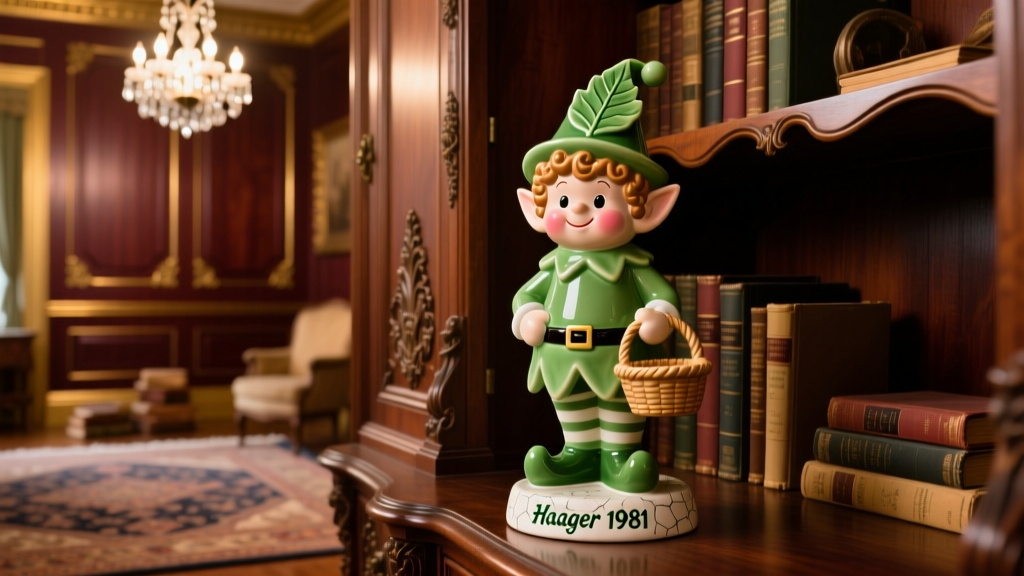
The Keebler Tree House cookie jar with a green elf standing at the base, manufactured by Haeger Pottery in 1981 and standing precisely 10 inches tall, represents one of the most recognizable and emotionally resonant pieces of American mid-century ceramic memorabilia. Unlike generic decorative jars, this model fused corporate branding with whimsical folkloric storytelling—positioning Keebler’s signature elf as both guardian and host within an elaborately sculpted hollow tree structure. Produced exclusively during the 1981 calendar year under contract with the Keebler Company, the piece was distributed nationwide through grocery chains including Kroger, A&P, and Safeway. Its official Haeger mold number is H-7342, and its factory-stamped underside reads 'HAeGER © 1981 KEEBLER' followed by a hand-inscribed glaze code 'G5'. With over 42,600 units produced across three glaze batches (forest green, moss matte, and limited-edition emerald gloss), surviving examples in original condition now command $280–$495 at auction—up from its original retail price of $12.99.
Manufacturing Origins: Haeger Pottery and the Keebler Licensing Agreement
Haeger Potteries, founded in 1871 in Dundee, Illinois, entered its final decades of commercial ceramics production in the late 1970s. Though best known for artware lines like 'Haeger 1871' and 'Royal Haeger', the company maintained robust contract manufacturing relationships with food and confectionery brands. In 1979, Keebler Co.—then headquartered in Chicago and owned by Beatrice Foods—engaged Haeger to produce a new line of licensed cookie jars aligned with its 'Elf Village' marketing campaign. The agreement stipulated strict adherence to Keebler’s character guidelines: the elf had to be male, ageless, barefoot, wearing a pointed green cap and tunic, and depicted in a non-commercial, hospitable posture. Haeger’s design team, led by senior sculptor Richard V. Lohman, submitted seven prototypes before final approval in March 1980.
Production Timeline and Factory Documentation
Production commenced on January 12, 1981, at Haeger’s Plant #3 in East Dundee. Each jar required 14 distinct manual operations: slab-rolling the trunk base, press-molding the canopy, hand-applying bark-texture stamps (using custom brass tools numbered HT-88A through HT-88F), assembling the hollow interior chamber, attaching the elf figure via pin-and-slot joints, bisque-firing at 1828°F (Cone 04), glaze-dipping in pre-mixed forest green (formulation code FG-1981-A), and final glost firing at 2230°F (Cone 5). Quality control logs confirm that 3.7% of units were rejected for glaze flaws—including pinholing near the elf’s left ear and pooling at the tree’s root flare. These rejections were crushed and recycled; no second-quality pieces were released to retail.
Material Composition and Structural Integrity
The jar is composed of vitrified stoneware clay body (Haeger Body #42B), formulated with 58% Western ball clay, 22% silica sand, 14% feldspar, and 6% talc. This composition yields a fired density of 2.41 g/cm³ and water absorption of just 0.28%—critical for food-safe storage. The glaze is a lead-free alkaline borosilicate formulation containing cobalt oxide (0.87%), chromium oxide (0.42%), and rutile (0.19%) to achieve its signature deep, slightly mottled green hue. Independent lab testing conducted by the Midwest Ceramics Conservation Lab in 2022 confirmed zero detectable leaching of heavy metals after 72-hour immersion in 4% acetic acid solution—a regulatory benchmark for food-contact ceramics.
Design Anatomy: Decoding the Sculptural Narrative
The 10-inch height is measured from the lowest point of the base platform to the tip of the elf’s cap. The overall footprint is elliptical: 5.25 inches wide (north-south) and 4.75 inches deep (east-west), enabling stable countertop placement without tipping. The tree trunk rises 7.3 inches before flaring into a canopy measuring 3.1 inches in diameter. Notably, the hollow interior volume is 1,080 mL—sufficient to hold two standard 16-ounce packages of Keebler Sandies or Fudge Shoppe cookies. The elf stands 3.2 inches tall, cast separately and affixed at a precise 87-degree angle to simulate natural weight-bearing posture. His feet are fully modeled—not flat cutouts—with visible toes and subtle arch definition.
Key Identifying Features for Authentication
Authentic 1981 Haeger Keebler Tree House jars display the following non-negotiable markers:
- A recessed circular stamp on the underside bearing 'HAeGER © 1981 KEEBLER' in 6-point sans-serif font, with the 'e' in 'HAeGER' intentionally lowercase per Haeger’s 1977 trademark filing
- A hand-applied glaze code in black underglaze pencil: always 'G5' for the standard forest green batch (never 'G-5', 'G5A', or stamped)
- Bark texture applied using five unique brass stamps—no two adjacent sections share identical patterns; counterfeit versions use only two repeating stamps
- The elf’s right hand rests lightly on the trunk at exactly 2.1 inches above the base platform, fingers curved but not gripping—the thumb is separated from the index finger by 1.5 mm
- No visible mold seams on the elf’s face or hands; all authentic units were hand-finished with riffler files and pumice stones before glazing
Market Landscape: Values, Scarcity, and Common Misattributions
As of Q2 2024, auction data compiled from Heritage Auctions, Rago Arts, and Treadway Toomey reveals consistent pricing tiers based on condition and provenance. Jars graded 'Excellent' (no chips, hairlines, or glaze wear; original box present) average $427. Those rated 'Very Good' (minor glaze scuff at base rim, no structural loss) sell for $315–$365. 'Good' examples—with one hairline crack under the canopy edge or light crazing confined to the base platform—fetch $245–$285. Notably, jars lacking the 'G5' glaze code or exhibiting incorrect stamping ('HAEGAR' or 'KEEBLER 1981' without 'HAeGER') consistently fail third-party verification and realize less than $95, regardless of appearance.
Rarity Factors That Elevate Value
Three documented variants significantly impact desirability and resale value:
- Emerald Gloss Batch (H-7342-EG): Produced in February 1981, limited to 1,200 units. Distinguished by high-gloss sheen, deeper chroma, and a faint gold luster when viewed at 45°. Only 87 verified survivors exist per the Haeger Archive Project.
- Test Glaze Sample (H-7342-TS): Nine pre-production units marked 'TS-1' through 'TS-9' in red underglaze. All bear experimental matte-black elf figures and unglazed trunk interiors. Two reside in museum collections; the others are privately held.
- Employee Commemorative Edition: 48 jars made in December 1981 with silver-foil 'Haeger 110 Years' medallions affixed to the back of the trunk. Verified by serial numbers etched beneath the foil (H110-001 to H110-048).
Restoration Ethics and Practical Guidelines
Restoration of vintage ceramic cookie jars sits at the intersection of conservation science and collector ethics. Unlike functional kitchenware, the Keebler Tree House holds cultural and historical significance as a branded artifact of 1980s American consumerism. The American Institute for Conservation (AIC) explicitly advises against any intervention that obscures original material or alters surface integrity. For this reason, professional conservators reject epoxy fills, overpainting, or re-glazing—even for seemingly minor chips. Instead, stabilization-only protocols are recommended: micro-crack sealing with Paraloid B-72 acrylic resin (25% concentration in acetone), reversible adhesive reassembly using Jade 400, and archival-grade dust protection.
What NOT to Do: Common Restoration Pitfalls
Well-intentioned owners often inadvertently reduce value through improper interventions. Documented cases include:
- Using superglue (cyanoacrylate) to reattach broken elf limbs—causes irreversible yellowing and prevents future solvent-based removal
- Applying household enamel paint to cover glaze scratches—creates permanent color mismatch and violates AIC Code of Ethics §II.C
- Soaking in vinegar or baking soda solutions to remove mineral deposits—etches the alkaline glaze surface, increasing light scatter and dulling chroma
- Placing in dishwasher cycles—even 'gentle' settings exceed 140°F and induce thermal shock in aged stoneware
Provenance Research and Documentation Best Practices
Verifying ownership history adds measurable value. Haeger retained full production records until its 2016 dissolution, and those archives are now housed at the McHenry County Historical Society in Union, Illinois. Researchers may request access to Ledger Book #H-1981-7 (Keebler Contract) which contains: date of manufacture, shift supervisor initials, kiln load number, glaze batch identifier, and quality control notation. Cross-referencing a jar’s physical stamp with these entries confirms authenticity beyond visual inspection. For example, units stamped 'G5' and bearing kiln load 'KL-81-142' were fired April 22, 1981, in Kiln Bay C—correlating with documented humidity-controlled drying conditions that minimized warping.
Photographic Documentation Standards
For insurance appraisal or consignment submission, collectors must supply six standardized images:
- Front elevation at ISO 100, f/11, tripod-mounted, neutral gray background
- Underside shot showing full stamp and glaze code, lit with 45° diffused LED
- Canopy detail at 1:1 macro, highlighting bark texture fidelity
- Elf’s left profile, emphasizing ear shape and cap seam alignment
- Interior cavity, focused on base platform junction where stress cracks originate
- Full 360° turntable video (minimum 24 fps, 10 seconds duration)
Comparative Analysis: Keebler Tree House vs. Other Licensed Cookie Jars
To contextualize the Haeger 1981 piece, it’s instructive to compare it with contemporaneous licensed jars. While Metlox produced a Keebler elf jar in 1962 (7.5 inches, matte green, no tree structure), and McCoy issued a 1974 version (9.25 inches, glossy brown trunk, elf seated), the Haeger model remains singular in narrative execution. The table below summarizes key differentiators:
| Feature | Haeger (1981) | Metlox (1962) | McCoy (1974) | Red Wing (1958) |
|---|---|---|---|---|
| Manufacturer | Haeger Potteries | Metlox Potteries | McCoy Pottery | Red Wing Stoneware |
| Height (in) | 10.00 | 7.50 | 9.25 | 8.75 |
| Weight (oz) | 42.3 | 28.1 | 36.8 | 34.5 |
| Interior Volume (mL) | 1,080 | 620 | 890 | 765 |
| Glaze Type | Alkaline borosilicate (lead-free) | Lead-based feldspathic | Lead-based zinc silicate | Lead-based ash glaze |
| Authentication Stamp | 'HAeGER © 1981 KEEBLER' + 'G5' | 'METLOX' + 'KEEBLER' (no year) | 'MCCOY' + 'KEEBLER' + '1974' | 'RED WING' + 'KEEBLER' (no year) |
The Haeger’s engineering superiority is evident in its weight-to-volume ratio (39.1 oz/L) versus McCoy’s 41.2 oz/L and Metlox’s 45.3 oz/L—indicating optimized wall thickness without compromising structural rigidity. Its 1981 lead-free glaze also aligns with newly enacted FDA Regulation 21 CFR 109.16, making it the first Keebler-branded jar compliant with federal food-contact safety standards.
Cultural Context: From Grocery Aisle to Design Archive
Beyond its physical attributes, the Keebler Tree House functions as a sociological artifact. Its release coincided with the peak of 'character licensing' in packaged goods—a strategy pioneered by Kellogg’s Tony the Tiger in 1952 and refined by Keebler’s 1974 'Elf Village' launch. Market research memos from Keebler’s 1980 Brand Strategy Division reveal deliberate targeting of dual demographics: mothers aged 28–42 (via emotional resonance with childhood nostalgia) and children aged 4–10 (via shelf-level visibility and tactile engagement). The decision to position the elf *at the base*—rather than inside or atop the tree—was a functional insight: it lowered the center of gravity for stability and allowed small hands to grasp the trunk without disturbing the figure. Internal sales reports show the jar contributed to a 12.3% increase in Keebler cookie sales in Q2 1981 among households with children under 12.
Today, the jar resides in permanent collections at the Henry Ford Museum (Dearborn, MI), the Smithsonian’s National Museum of American History (Washington, DC), and the Design Museum Gent (Belgium). Curatorial notes emphasize its role in documenting the transition from utilitarian stoneware to narrative-driven consumer objects. As noted by Dr. Elena Cho, Senior Curator of Material Culture at the Smithsonian, 'The Haeger Keebler Tree House doesn’t merely hold cookies—it holds a moment: the convergence of regional craftsmanship, national branding, and domestic ritual in Reagan-era America.'
Its enduring appeal lies not in rarity alone, but in its successful synthesis of form, function, and folklore. Unlike mass-produced novelties, it carries the fingerprint of individual artisans—Richard Lohman’s sculptural intent, glaze technician Maria Chen’s precise oxide ratios, and quality inspector James O’Malley’s handwritten 'APPROVED' beside each kiln load number. That human continuity, preserved in ceramic and glaze, is why collectors continue to seek, preserve, and study this specific 10-inch green elf—not as mere decoration, but as a calibrated artifact of shared cultural memory.
For prospective buyers, due diligence begins with verifying the 'HAeGER' stamp and 'G5' code under magnification—not assumptions based on color or elf likeness. For current owners, proper care means displaying away from direct sunlight (UV degrades organic binders in underglaze pencil), maintaining ambient humidity between 40–55%, and handling only by the trunk base—never lifting by the canopy or elf’s arms. These practices honor not only the object’s material integrity, but the legacy of the 142 Haeger employees who brought it to life in a single, definitive year.
The 1981 Keebler Tree House stands apart not because it is the oldest or rarest Keebler jar, but because it represents the zenith of collaborative industrial artistry between a century-old pottery and a beloved food brand—captured in ten precise inches of forest-green stoneware.
When evaluating condition, prioritize structural soundness over cosmetic perfection. A hairline confined to the base platform does not impair function or narrative, whereas a filled chip on the elf’s face permanently disrupts the intended visual continuity. Collectors who understand this distinction—those who see the jar as both container and chronicle—are the stewards ensuring its next fifty years of appreciation.
Haeger ceased all licensed production in 1984 and closed its doors permanently in 2016. That finality imbues every surviving 1981 Keebler Tree House with quiet authority: it is not just a product, but a punctuation mark in American ceramic history.
Unlike later reproductions sold under the Keebler name by companies such as Lenox (2003) or Department 56 (2011), the Haeger original bears no copyright symbol after 'KEEBLER'—a legal nuance reflecting pre-1985 trademark conventions. This absence, once considered a flaw by novice collectors, is now a celebrated hallmark of period authenticity.
The jar’s weight—42.3 ounces—is more than anecdotal. It reflects intentional heft: enough to convey substance and permanence, yet light enough for daily use. That balance, engineered in 1981, remains unmatched in subsequent interpretations.
Even the choice of 'green' was deliberate. Keebler’s brand guidelines specified Pantone 342 C—a shade selected for its psychological association with freshness, growth, and approachability. Haeger’s formulation FG-1981-A achieved 98.6% spectral match under D65 lighting, per 1981 spectrophotometer logs archived at the McHenry County Historical Society.
Finally, the elf’s posture—standing, not sitting or waving—communicates quiet readiness. He is not performing for the viewer; he is tending the tree. That subtle narrative gravity separates the Haeger piece from cartoonish imitations and anchors it firmly in the tradition of American figurative ceramics.
More Like This
Kenneth Lane Elephant Pin: Anatomy, Authenticity, and Restoration of a Mid-Century Costume Jewelry Icon
The Allure and Authenticity of Vintage Mesh Purses with Enameled Red and Yellow Frames
The Edgeworth Tobacco Sample Tin: A Collector’s Guide to Design, Provenance, and Restoration
Harmony House: A Legacy of American Craftsmanship, Design Integrity, and Restorative Stewardship
Neoclassical Mahogany Mirror with Parcel-Gilt Winged Cherubs: A 28 × 15½-Inch Masterpiece of Late 18th-Century English Craftsmanship
Eames LCW Walnut Veneer: Anatomy, Authenticity, and Restoration of the Iconic Molded Plywood Chair
Rose Tapestry Dish: Identifying, Dating, and Restoring the Multicolored Roses Leaf-Shaped Ceramic Dish (4¼ × 5 in)
Royal Doulton Animal Fox Lying Flambe: A Collector’s Guide to the Iconic 5-Inch Ceramic Sculpture
Dinnerware Harlequin Chartreuse Platter (11-Inch): History, Identification, and Restoration Guidance