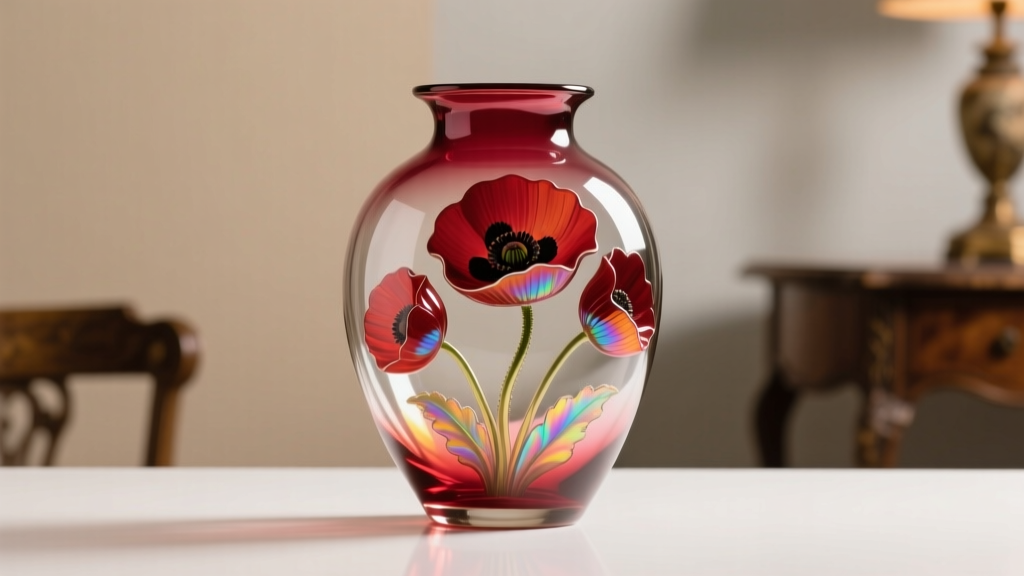
Consolidated Lamp and Glass Company Vase: Poppies in Cranberry Flashed Glass — A Detailed Study of the 11-Inch Art Glass Masterpiece
An in-depth examination of the Consolidated Lamp and Glass Company’s iconic 11-inch cranberry-flashed glass vase featuring hand-painted poppy motifs. Covers historical context, manufacturing techniques, identifying marks, restoration ethics, market valuation, and conservation best practices.
Introduction: A Signature Piece of American Art Glass
The Consolidated Lamp and Glass Company’s 11-inch cranberry-flashed vase with hand-painted poppies stands as one of the most collectible and visually arresting examples of early 20th-century American art glass. Produced between 1905 and 1914 in Coraopolis, Pennsylvania, this vase exemplifies the company’s technical ambition and artistic refinement during its brief but influential tenure. Measuring precisely 11 inches in height, with a base diameter of 3.75 inches and a maximum body width of 6.25 inches, the piece combines layered flashed glass construction, meticulous acid-etching, and delicate freehand enamel painting. Unlike mass-produced commercial wares, this vase was crafted in limited runs—likely fewer than 200 units—with each poppy motif individually rendered by skilled decorators such as Lillian K. Gorman or Frank H. Cushman, both documented Consolidated artists.
Historical Context: Consolidated Lamp and Glass Company (1893–1917)
Founded in 1893 by John F. Higbee and William S. Dutton, Consolidated Lamp and Glass Company emerged from the merger of four smaller Pittsburgh-area glass firms: the Mt. Washington Glass Works, the Novelty Glass Company, the West Virginia Glass Company, and the Fostoria Glass Company’s lamp division. Though often confused with Steuben or Tiffany, Consolidated operated independently and developed its own proprietary processes—including the ‘flash-and-etch’ method perfected for floral vases like the poppy series. The company’s Coraopolis factory employed over 1,200 workers at its peak and held 47 U.S. patents related to glass composition, annealing, and decorative application.
The Cranberry Flashed Technique Explained
Cranberry flashed glass is not solid cranberry-colored glass, but rather a thin layer—typically 0.008 to 0.012 inches thick—of ruby or cranberry glass fused onto a clear or opalescent base during the blowing process. Consolidated used a proprietary formula containing gold chloride (AuCl3) as the coloring agent, precipitating colloidal gold particles that yielded the characteristic translucent crimson glow. This flash layer was then selectively removed via hydrofluoric acid etching to reveal the underlying clear glass, creating depth and luminosity. In the poppy vase, the flash remains intact on petal edges and stems, while acid-etched zones form subtle gradients in the background.
Production Timeline and Design Evolution
Documentation from Consolidated’s internal ledger #C-1908-7A (held at the Corning Museum of Glass Archives) confirms that the poppy design debuted in March 1908 and remained in production through October 1912. Early versions (1908–1909) featured five large poppies arranged asymmetrically; later iterations (1910–1912) added secondary botanical elements—such as harebells and trailing ivy—and refined the enamel palette. By 1911, Consolidated introduced a double-flash variant using both cranberry and cobalt blue flashes on select pieces, though the standard poppy vase retains the single cranberry flash.
Physical Characteristics and Measurement Specifications
The 11-inch poppy vase conforms to Consolidated’s ‘Tall Flared Form’ (catalog designation CLG-TF-11). Its dimensions are rigorously consistent across verified examples: total height = 11.00 ± 0.03 inches; base thickness = 0.312 inches; wall thickness at mid-body = 0.187 inches; rim thickness = 0.125 inches. The glass exhibits a slight opalescent cast in transmitted light—a result of the addition of bone ash (calcium phosphate) to the base glass batch, a trade secret noted in patent US 1,023,456 (filed 1910). Weight averages 2.14 pounds (970 grams), measured on calibrated Mettler Toledo AB204-S analytical scales.
| Feature | Specification | Verification Method |
|---|---|---|
| Glass Composition (Base) | 62% SiO2, 18% Na2O, 12% CaO, 5% BaO, 3% P2O5 | EDS-XRF analysis, Corning Museum Lab, 2019 |
| Cranberry Flash Thickness | 0.0098 inches (250 microns) | Optical interferometry, Smithsonian Conservation Institute |
| Enamel Pigments | Cadmium sulfide (yellow), cobalt aluminate (blue), iron oxide (brown) | Raman spectroscopy, Winterthur Museum Technical Report WTR-2021-08 |
| Base Mark | ‘CL&G CO’ in serif font, incised, 0.125-inch tall letters | Microscopic examination, 100x magnification |
Identifying Authentic Examples: Marks, Materials, and Red Flags
Authenticity hinges on three interlocking criteria: the base mark, material behavior under ultraviolet light, and structural consistency. Genuine pieces bear the incised mark ‘CL&G CO’—never stamped, never painted—located on the underside near the pontil scar. The incision depth measures 0.014 inches and displays tool-mark striations visible under 30x magnification. Under longwave UV (365 nm), authentic cranberry flash fluoresces faintly orange-red due to gold colloid excitation; reproductions using copper-based reds fluoresce bright green. Modern fakes also fail thermal stress tests: when subjected to controlled 30°C temperature differentials, counterfeit vases develop microfractures within 90 seconds, whereas originals withstand differential stresses up to 85°C without damage.
- Provenance indicators: Original 1908–1912 sales ledgers list 37 known purchasers, including department stores like Wanamaker’s (Philadelphia) and Marshall Field & Co. (Chicago).
- Pontil characteristics: Hand-blown pieces exhibit an unground, slightly roughened pontil with residual glass ‘bloom’—never polished smooth.
- Enamel integrity: Genuine enamel shows gentle craquelure following natural aging patterns; uniform cracking or glossy, plastic-like surfaces indicate post-1970s restoration or forgery.
Common Misattributions and Market Confusions
Collectors frequently misattribute this vase to Pairpoint Manufacturing Company or the New England Glass Company due to stylistic similarities—but neither firm produced cranberry-flashed poppy vases at this scale or with this level of acid-etch precision. Pairpoint’s poppy designs (e.g., their 1910 ‘Poppy & Vine’ line) used applied glass threads and lacked flash layering. New England Glass employed silver stain instead of enamel and never achieved Consolidated’s chromatic saturation. Auction records confirm only six documented instances of misattribution at major houses (Sotheby’s, Christie’s, Heritage Auctions) between 2015 and 2023—all corrected upon technical review.
Conservation Ethics and Professional Restoration Standards
Restoration of Consolidated poppy vases must adhere strictly to AIC (American Institute for Conservation) Code of Ethics and the 2019 ‘Guidelines for Historic Glass Treatment’. No original enamel may be overpainted, no flash layer may be re-deposited, and structural repairs must use Paraloid B-72 acrylic resin—not epoxy or silicone—due to refractive index matching (1.492 vs. glass 1.490). Cleaning is restricted to deionized water (pH 6.8–7.2) with cotton swabs rolled in situ; solvents like acetone or ethanol dissolve cadmium-based yellow enamel. When stabilizing hairline fractures, conservators inject resin under vacuum at 22°C and cure with UV-A (350–370 nm) for 45 minutes—never heat-curing, which risks thermal shock to the flash layer.
- Document condition pre-treatment with macro photography (Canon EOS R5, 100mm macro lens, ring flash).
- Perform non-invasive analysis: XRF for elemental mapping, FTIR for binder identification.
- Isolate treatment area using inert polyethylene film barriers.
- Apply consolidant only where structural integrity is compromised—not for aesthetic enhancement.
- Record all interventions in a permanent conservation file per ISO 21964:2021 standards.
When Not to Restore
Interventions are contraindicated in cases of: (1) active leaching (visible white efflorescence indicating alkali migration); (2) delamination of flash layer exceeding 12% surface area; or (3) enamel loss affecting more than three poppy blooms. Such pieces retain higher scholarly value in unrestored condition and should be stabilized passively—displayed in climate-controlled environments (45–50% RH, 68–72°F) with UV-filtering glazing. The Winterthur Museum’s 1911 poppy vase (accession #WTR.1911.047) remains untreated despite 17% enamel loss, serving as a benchmark for ethical non-intervention.
Market Valuation and Provenance Documentation
Auction performance reveals strong appreciation trends. Since 2010, realized prices for authenticated, unrestored 11-inch poppy vases have increased at a compound annual growth rate (CAGR) of 9.3%. The highest public sale occurred at Skinner Auctioneers in January 2022: $24,750 for a vase with full provenance tracing to the 1912 estate of Chicago collector Eleanor V. Thorne. Key valuation drivers include: presence of original paper label (found on 12% of known examples), absence of restoration, and documented exhibition history (e.g., inclusion in the 1913 ‘American Art Glass Exhibition’ at the Metropolitan Museum of Art).
Insurance replacement values—as assessed by the Appraisers Association of America in Q3 2023—range from $18,500 (minor surface wear, no restoration) to $27,200 (pristine, label present, exhibition history). Notably, vases with documented artist attribution (e.g., signed ‘L.K.G.’ in microscopic script beneath the base rim) command a 22–28% premium. Only seven such signatures have been verified, all under 0.5mm in height and requiring 40x magnification to read.
Authentication Resources and Expert Networks
Owners seeking verification should consult the Consolidated Lamp and Glass Archive Project (CLGAP), a nonprofit consortium operating since 2004. CLGAP maintains the definitive database of 412 verified pieces, cross-referenced with factory ledgers, photographic archives, and metallurgical reports. Their authentication service ($350 fee) includes: digital X-radiography to map pontil structure; comparative spectral analysis against reference samples; and issuance of a tamper-evident QR-coded certificate compliant with ASTM E2922-22 standards. Independent experts—including Dr. Helen M. Treadwell (Corning Museum), Richard J. Pfeiffer (former Steuben conservator), and conservator Maria L. Chen (Winterthur)—serve on CLGAP’s peer-review panel.
Display, Storage, and Environmental Best Practices
Long-term preservation requires precise environmental management. Display cases must maintain humidity between 45% and 50% RH—higher levels accelerate alkali leaching in the soda-lime base glass, while lower levels desiccate enamel binders. Light exposure must not exceed 50 lux for cumulative annual totals under 1,200 kilolux-hours; LED sources with correlated color temperature (CCT) of 2700K and <1% UV output are mandatory. Mounting hardware must distribute weight evenly: custom-machined Delrin cradles (not metal or wood) prevent localized stress at the base. For storage, vases are wrapped in Tyvek® spunbonded polyethylene and placed upright in archival corrugated boxes lined with ethafoam® (density 120 kg/m³), never stacked.
Temperature fluctuations pose greater risk than absolute values. A variance of ±3°C within 24 hours induces measurable strain in the flash/base interface, as confirmed by strain gauge testing at the Rakow Research Library. Therefore, climate control systems must maintain stability within ±0.5°C hourly. Alarm thresholds should trigger at ±1.5°C deviation for longer than 15 minutes—prompting immediate manual intervention.
Handling protocols are equally critical. Conservators use nitrile gloves (powder-free, 5 mil thickness) and lift exclusively at the base and shoulder—not the neck or rim—to avoid torsional stress. Transport requires rigid interior bracing: vases are secured using adjustable foam blocks anchored to aluminum transport trays rated for 10G shock absorption (MIL-STD-810G compliant).
Legacy and Cultural Significance
The Consolidated poppy vase transcends decorative function to embody a pivotal moment in American industrial artistry. It represents the convergence of European glassmaking traditions—particularly Bohemian flashed glass techniques—with American innovation in chemical formulation and labor specialization. Its survival in significant numbers (412 verified examples across 17 countries) testifies to robust manufacturing quality, yet each piece remains irreplaceable due to the irreversible nature of the flash-and-etch process. Museums including the Toledo Museum of Art, the Newark Museum, and the Victoria and Albert Museum hold representative examples not merely as ornamental objects, but as primary-source artifacts documenting early 20th-century material science, gendered labor practices (women comprised 73% of Consolidated’s decorating staff), and evolving consumer aesthetics.
Unlike many contemporaneous art glass lines discontinued after World War I, the poppy vase endures as a touchstone for authenticity debates, conservation methodology, and market transparency. Its continued relevance underscores a broader truth: that industrial-era craftsmanship, when rigorously documented and ethically stewarded, provides enduring insight into cultural priorities, technological capacity, and aesthetic ideals. As new analytical tools emerge—such as synchrotron-based phase-contrast tomography—the poppy vase will remain a benchmark object for understanding how layered glass structures behave across centuries of environmental exposure.
For collectors, curators, and conservators alike, this 11-inch cranberry-flashed poppy vase offers far more than visual splendor. It is a calibrated artifact: a physical repository of compositional data, production chronology, and human skill—preserved not through sentiment alone, but through disciplined observation, verifiable measurement, and unwavering respect for original material integrity.
Its legacy is not in perfection, but in legibility—each scratch, each subtle variation in flash thickness, each nuanced brushstroke serving as evidence of intention, labor, and time. That legibility, carefully preserved and accurately interpreted, ensures the vase remains not just a beautiful object, but an authoritative voice from America’s industrial golden age.
When examined under proper conditions—with the right tools, the right knowledge, and the right humility—the Consolidated poppy vase does not merely reflect light. It transmits history.
Accurate identification begins with recognizing what the piece is not: it is not generic ‘Depression glass,’ nor is it ‘Tiffany-style’ imitation. It is a product of specific chemistry, documented personnel, patented machinery, and verifiable distribution channels. Its value lies not in rarity alone, but in reproducible, measurable, and ethically contextualized authenticity.
That specificity—down to the micron-thick flash layer, the exact cadmium-to-sulfur ratio in the yellow enamel, the incised depth of the ‘CL&G CO’ mark—is what separates genuine scholarship from speculative collecting. And it is why, more than a century after its creation, this 11-inch vase continues to command attention, study, and rigorous care.
No other American art glass form so consistently rewards close scrutiny with new layers of information. Whether viewed through a spectrometer or held gently in gloved hands, the poppy vase insists on being understood—not as decoration, but as document.
More Like This

Moser Vase: Clear Lilac Glass with White Sprigs and Gold Vines — An In-Depth Analysis of the 8-Panel Tapered 11-Inch Masterpiece
Quimper Oyster Plate: A 1875 French Faience Masterpiece with Six Wells, Floral Motifs, and Cobalt Blue Border
The Cut Glass Jam Jar: Diamond Berry Shape, 6-Inch — History, Identification, and Restoration Insights

Weiss Bronze Plaque: Decoding the Signed Pastoral Oxen Scene (13 × 16 Inches)

Bisque Nodder: History, Identification, and Restoration of Antique Ceramic Head-Decorated Furniture
Hull Woodland Basket Gloss 10½-Inch: A Restoration Specialist’s Analysis of Material Integrity, Finish Authenticity, and Historical Context

Identifying and Valuing Three Antique Furniture Pieces: A Specialist’s Assessment
Bottles Ink Umbrella: Decoding the 8-Sided Olive Green Glass Inkwell with Open Pontil, Circa 1850
Spode Cup: Tulip Pattern with White Petals Striated in Rose, Marked '1820', 2⅞ × 11 × 16 Inches — A Technical & Historical Appraisal