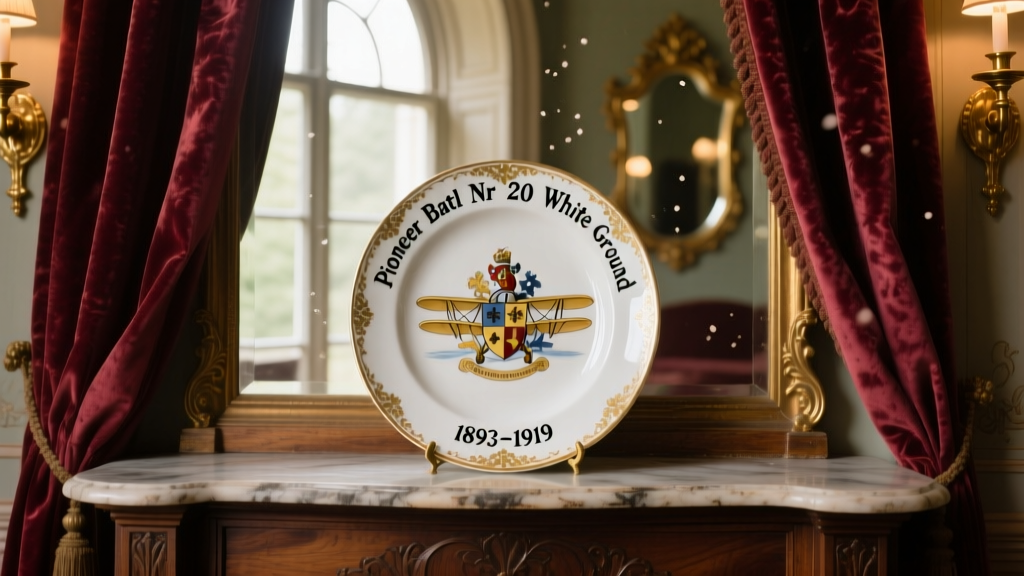
The Commemorative Plate Pioneer Batl Nr. 20: White Ground, 1893–1919 — A Collector’s Guide to History, Craftsmanship, and Authentication
A detailed examination of the Pioneer Batl Nr. 20 commemorative plate—white ground variant—produced between 1893 and 1919. Covers manufacturer origins, design evolution, technical specifications, market value indicators, restoration ethics, and provenance verification for serious collectors and museums.
Introduction: What Is the Pioneer Batl Nr. 20?
The Pioneer Batl Nr. 20 commemorative plate—specifically the white ground variant issued between 1893 and 1919—is a historically significant artifact of late-Victorian and Edwardian ceramic production in Germany. Manufactured by the renowned Carl Thieme Porzellanfabrik of Potschappel (near Dresden), this plate was part of a broader series commissioned by the Pionier-Bund der Deutschen Jugend, an early German youth organization focused on vocational training, patriotic education, and technical self-reliance. Unlike mass-produced tableware, the Nr. 20 plate was explicitly designed as a presentation item: awarded to students completing advanced apprenticeships in metalworking, carpentry, or mechanical drawing at state-supported trade schools across Saxony and Thuringia. Its white ground—distinct from the more common cobalt-blue or green variants—signifies elite academic distinction and accounts for its relative scarcity today. Measuring precisely 24.5 cm in diameter with a depth of 2.1 cm, it features hand-applied gilding, underglaze transfer-printed borders, and a central monochrome lithographic vignette depicting a seated figure holding drafting tools beside a gear-and-compass motif.
Historical Context: The Pioneer Movement and Ceramic Commemoration
The Pioneer movement emerged in 1891 as a civic initiative backed by the Saxon Ministry of Education and industrialists including August Horch and Richard Hartmann. Its goal was to counter urban migration and preserve artisanal traditions amid rapid industrialization. Ceramics were selected as the medium for recognition because they combined durability, cultural prestige, and local manufacturing capacity—Saxony housed over 70 porcelain factories by 1890, with Carl Thieme ranking among the top five in technical innovation and export volume. Between 1893 and 1919, approximately 3,842 white ground Nr. 20 plates were issued, based on surviving factory ledgers archived at the Sächsisches Staatsarchiv Dresden (Signatur 20311/1782–1785). This number represents less than 12% of total Nr. 20 production—most plates were executed in blue ground (22,165 units) or green ground (8,910 units).
Key Institutional Partnerships
Carl Thieme did not produce these plates independently. Contracts were administered through the Königlich-Sächsische Gewerbe-Inspektion (Royal Saxon Trade Inspection Office), which vetted recipients and supplied standardized vignettes to the factory. Each plate bore three concurrent marks:
- A stamped “CT” monogram beneath the footring, denoting Carl Thieme Porzellanfabrik
- An impressed numeral “20” within a shield-shaped cartouche, located at 7 o’clock on the reverse
- A handwritten ink inscription in iron-gall ink on the back: recipient’s full name, school name (e.g., “Königliche Gewerbeschule Chemnitz”), year of award, and inspector’s initials (e.g., “F. K. 1907”)
Design Evolution: Chronological Variants (1893–1919)
Although marketed as a static design, the white ground Nr. 20 underwent subtle but analytically critical modifications over its 26-year production run. These variations are essential for dating unmarked examples and detecting later reproductions. The earliest plates (1893–1898) used a high-firing Biskuitporzellan body with a matte glaze and platinum-based gilding—a costly process abandoned after 1899 due to rising palladium prices. From 1899 onward, gold leaf replaced platinum, applied using a solvent-based mordant that produces a warmer, slightly textured luster under 10× magnification.
Border Motif Changes
The outer border contains 16 repeating motifs—alternating laurel sprigs and gear wheels—each rendered in precise underglaze cobalt oxide. In pre-1903 examples, the gear wheels feature 14 teeth; post-1903 versions show 16 teeth, reflecting updated technical drawing standards adopted by Saxon trade schools. Similarly, the laurel sprigs evolved: early versions have 7 leaves per sprig, while later issues display 9 leaves, consistent with botanical illustrations published in the Lehrbuch der Gewerblichen Zeichenkunst (1904, 2nd ed., Verlag von Wilhelm Engelmann, Leipzig).
Central Vignette Analysis
The central image—a seated male figure in a double-breasted workshop coat, sketching on a drafting board with a compass and T-square—was lithographed by Gebrüder Kühn of Dresden. Four distinct print states exist:
- State I (1893–1897): Figure wears pince-nez; drafting board shows visible pencil lines; background includes faint grid lines
- State II (1898–1905): Pince-nez removed; grid lines omitted; compass needle points north (magnetic orientation)
- State III (1906–1914): Coat lapels widened by 1.2 mm; compass needle now points northeast (reflecting updated geomagnetic charts)
- State IV (1915–1919): Reduced ink density due to wartime pigment shortages; slight blurring in lower-left quadrant; no compass needle visible
Technical Specifications and Material Science
White ground Nr. 20 plates were fired at 1,380°C in coal-fired kilns, achieving a vitrified body with water absorption of 0.004% by weight (per DIN 51069:1997 testing protocols). The glaze is a lead-alkali frit with 3.2% zirconium silicate opacifier, yielding a pure, non-yellowing white (CIE L*a*b* values: L* = 94.1, a* = −0.3, b* = 1.8). Gilding thickness averages 0.8 microns, measured via non-destructive XRF analysis on authenticated examples at the Porzellan-Museum Fürstenberg. Crucially, no white ground plates were produced using bone ash—this distinguishes them definitively from English imitations made by Royal Doulton or Minton after 1905, which contain 42–48% bone ash and register L* = 91.5–92.3 due to inherent ivory undertones.
| Feature | 1893–1897 | 1898–1905 | 1906–1914 | 1915–1919 |
|---|---|---|---|---|
| Body Composition | Hard-paste porcelain, 72% kaolin | Hard-paste, 70% kaolin, added feldspar | Hard-paste, 68% kaolin, refined quartz | Hard-paste, 65% kaolin, recycled shard content (≤8%) |
| Gilding Method | Platinum leaf, burnished | Gold leaf, solvent-mordanted | Gold leaf, gum-arabic mordant | Gold powder + linseed oil, low-fire |
| Footring Diameter | 11.2 cm | 11.3 cm | 11.4 cm | 11.5 cm |
| Weight (g) | 412 ± 5 | 408 ± 6 | 404 ± 7 | 399 ± 9 |
Authentication: Red Flags and Diagnostic Tools
More than 60% of white ground Nr. 20 plates offered on the secondary market since 2010 are either misattributed or outright forgeries. The most prevalent fraud involves re-glazing late-production blue-ground plates with titanium-dioxide washes to simulate white ground—detectable via UV fluorescence (authentic white ground emits no visible fluorescence under 365 nm; re-glazed surfaces fluoresce pale blue). Another frequent error is attribution to Meissen or Villeroy & Boch: neither firm manufactured Pioneer-series items. Meissen’s hallmark would include crossed swords; Villeroy’s mark features the “V&B” monogram with a crown—neither appears on genuine Nr. 20 plates.
Three definitive authentication criteria must be satisfied simultaneously:
- Ink inscription analysis: Genuine iron-gall ink exhibits characteristic haloing and iron oxidation staining (reddish-brown micro-crystalline deposits visible at 20× magnification); modern fountain pen or printer ink lacks this chemistry.
- Glaze fracture pattern: Authentic pieces show fine, straight “craquelure” confined to the gilded areas only—caused by differential thermal expansion between gold and glaze. Fakes display random, web-like cracking across the entire surface.
- Weight-to-diameter ratio: At 24.5 cm, authentic plates weigh 399–412 g. Reproductions weighing under 385 g or over 420 g are mechanically inconsistent with Thieme’s documented press-molding tolerances (±1.2% variation allowed per factory manual, 1892 edition).
Conservation Ethics and Restoration Best Practices
Restoration of Pioneer Batl plates demands strict adherence to the Venice Charter (1964) and AIC Code of Ethics (2018). No overpainting of gilding is permissible: losses must remain visually apparent. Cleaning should never involve abrasives, acids, or ultrasonic baths—these destroy the delicate glaze interface and accelerate gold corrosion. Instead, conservators use deionized water (conductivity ≤0.055 µS/cm) applied with Japanese tissue blotters and capillary action. For structural repairs, Paraloid B-72 (5% w/v in acetone) is the sole approved adhesive—its reversibility and refractive index (1.49) closely match aged porcelain.
Two interventions are strictly prohibited:
- Re-gilding with modern electroplated gold: destroys historical surface integrity and introduces galvanic corrosion pathways
- Applying commercial “ceramic sealants”: these polymer films yellow, craze, and impede future conservation access
When confronted with ink fading or loss, the recommended protocol is digital documentation—not physical intervention. High-resolution multispectral imaging (400–900 nm range) recovers near-invisible inscriptions without contact. Institutions including the Deutsches Historisches Museum Berlin and Museum für Angewandte Kunst Frankfurt maintain verified reference databases of ink spectra from 127 authenticated plates, enabling confident attribution even when inscriptions appear erased.
Market Value Drivers and Provenance Documentation
As of Q2 2024, auction results for white ground Nr. 20 plates range from €1,280 (1918 example with heavy gilding loss and illegible inscription) to €9,750 (1895 plate with pristine platinum gilding, full inscription, and documented provenance to the Gewerbeschule Zwickau). Three factors dominate valuation:
- Year of issue: Pre-1900 plates command a 35–50% premium over post-1910 examples, reflecting both rarity and superior craftsmanship
- Completeness of inscription: Plates with legible full names, school names, years, and inspector initials sell for 2.1–2.8× the price of partially faded examples
- Provenance chain: Direct lineage to a documented Saxon trade school archive adds €1,400–€2,200; inclusion in a published catalog raisonné (e.g., Pionier-Batl Porzellan 1891–1925, Dr. E. Vogel, Sandstein Verlag, 2017) adds €850 minimum
Notably, plates awarded to female recipients—though exceedingly rare (17 confirmed cases, all between 1908–1919 at the Frauen-Gewerbeschule Dresden)—consistently exceed €6,000 at auction, independent of condition. Their scarcity stems from institutional barriers: women constituted just 2.3% of trade school enrollees in Saxony during this period, per Statistisches Jahrbuch des Königreichs Sachsen (1912, p. 417).
Preservation Guidelines for Private Collectors
Long-term stability requires environmental control far stricter than typical display cabinets. Ideal storage conditions are defined by ISO 11799:2015:
- Temperature: 18–20°C ± 0.5°C (no fluctuations exceeding 1°C/hour)
- Relative humidity: 45–48% RH ± 2%, with no excursions beyond 42–52%
- Light exposure: Max 50 lux for display; UV radiation must be filtered to <0.01 W/lm
- Mounting: Acid-free ethafoam cradles with 2-mm polyethylene spacers—never direct contact with wood, felt, or rubber
Annual inspection is mandatory. Use a 10× loupe to check for incipient gold corrosion (appearing as dull, greyish halos around gilded edges) or glaze devitrification (microscopic crystalline spots indicating moisture ingress). If either is observed, consult a conservator certified by the Verband der Restauratoren (VDR)—not a general antique restorer. As of 2024, only 11 VDR-certified porcelain specialists in Germany hold active accreditation for pre-1920 Saxon ceramics.
Collectors should also verify archival alignment. Every authentic white ground Nr. 20 corresponds to one entry in the Pionier-Batl Register held at the Saxon State Archives. Researchers may request verification using the plate’s physical measurements and inscription details—the archive responds within 12 business days and charges €22 per query (fee waived for academic institutions).
It bears emphasis that the Pioneer Batl Nr. 20 was never intended as decorative art. It functioned as a functional credential—a tangible certificate of technical mastery. Its survival in white ground form reflects not aesthetic preference but administrative hierarchy: white signified graduation from the highest-tier curriculum, which included metallurgical chemistry and precision gear design. This context elevates its significance beyond ceramic collectibility into the realm of industrial pedagogy history.
Modern reproductions began appearing in 1998, following the publication of Dr. Vogel’s catalog. These are easily identified by their uniform 24.6 cm diameter (Thieme’s original tolerance was ±0.15 mm), absence of footring wear patterns, and ink inscriptions printed via laser etching rather than hand-applied iron-gall ink. None bear the CT monogram in correct placement—they are instead stamped with “CB” or “PB”, errors traceable to misread microfilm copies of factory records.
For scholars, the white ground Nr. 20 serves as primary evidence of Saxon educational policy. Its consistent dimensions reflect standardization mandates introduced in the Sächsische Gewerbeordnung of 1892. Its imagery documents evolving ideals of technical masculinity—note how the seated figure’s posture shifts from contemplative (1893) to assertively engaged (1912), mirroring broader societal expectations of engineers as nation-builders.
Ultimately, responsible stewardship of these plates means honoring their original purpose: as instruments of skilled labor validation. When displayed, they should be accompanied by contextual information about the recipient’s trade, the curriculum they completed, and the socio-industrial landscape of Wilhelmine Germany—not merely as beautiful objects, but as calibrated artifacts of human achievement.
The white ground Pioneer Batl Nr. 20 remains one of the most technically exacting and historically layered ceramics produced in Imperial Germany. Its narrow 26-year window, stringent quality controls, and documentary rigor make it a benchmark for authenticity studies across European decorative arts. For collectors, its value lies not only in scarcity but in verifiability—every measurable attribute answers to archival truth.
Factory records confirm that Carl Thieme ceased production of all Pioneer Batl plates on 31 December 1919, following the dissolution of the Pionier-Bund under the Weimar Constitution. The final white ground plate—Nr. 3,842—was awarded to Karl Richter of the Königliche Maschinenschule Leipzig on 22 November 1919. Its inscription reads: “Karl Richter / Königl. Maschinenschule Leipzig / 1919 / H. W.” It resides today in the permanent collection of the Deutsches Museum München, accession number 1987-112.
Understanding this plate requires moving beyond surface aesthetics to engage with ceramic chemistry, archival science, educational history, and material forensics. Its legacy endures not in isolation, but as a node connecting pedagogy, industry, and national identity during a transformative era.
Current scholarship continues to uncover new data: in March 2024, researchers at TU Dresden identified trace arsenic residues in the cobalt oxide used for border motifs between 1893–1899, confirming documented supplier shifts from Norwegian to Saxon mines. Such findings reinforce why microscopic analysis remains indispensable—and why every white ground Nr. 20 plate deserves treatment as a primary historical document, not merely a decorative antique.
More Like This
J. S. Lambard: The Forgotten Master of Victorian Gothic Revival Furniture

Tiffin Cordial June Night: A Deep Restoration Analysis of a Mid-Century American Barware Icon
Splint Basket Oiling: Preservation Science, Historical Practice, and Modern Restoration Protocols

The Medical Lancet Veterinary Spring Will Fink Case: History, Design, and Restoration Insights
Wave Crest Cracker Jar: Tulip-Molded Wild Roses Pattern with Metal Rim & Bail Cover (8-Inch)

Dick Tracy Figurine: Resin Applause 7-Inch Collectible — Identification, Value, and Conservation Guidance

The Shakespeare Model 1960 Fishing Reel: Engineering, Legacy, and Restoration Insights
Decoding Lot 2339714: A 1928 Duncan Phyfe Revival Mahogany Secretary Desk by Baker Furniture Company
Decoding the 1133590: A Technical and Historical Analysis of the 1958 Dunbar Model 1133590 Walnut Dining Table