Colored Drinking Glasses with Gold Lions: History, Identification, and Restoration Guidance
A detailed examination of mid-century colored glassware featuring hand-applied gold lion motifs — including manufacturers like Libbey, Anchor Hocking, and Indiana Glass; hallmark characteristics; dating methods; value indicators; and ethical conservation practices for collectors and restorers.
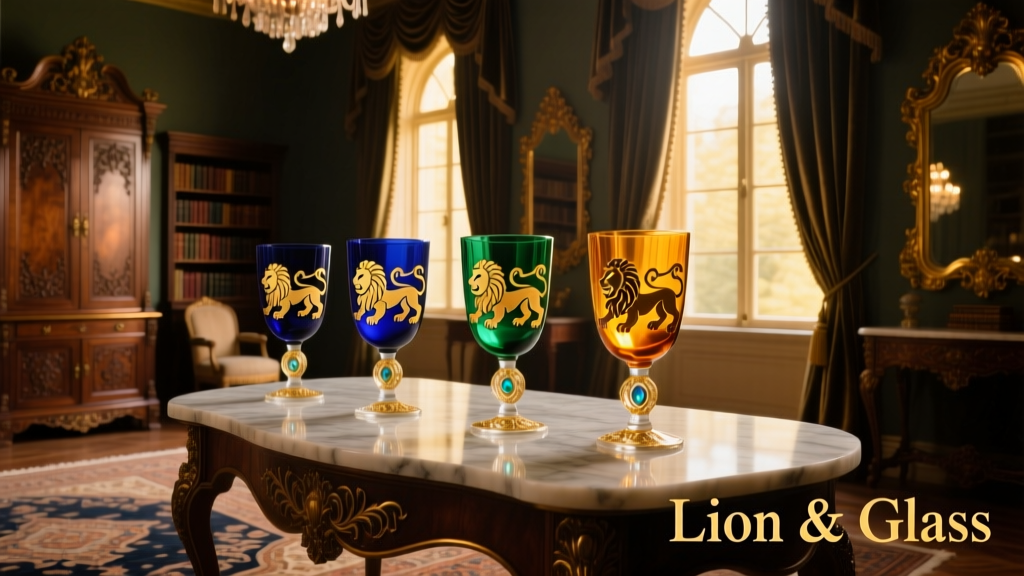
Colored drinking glasses adorned with gold lions represent a distinctive niche within American mid-century tableware, produced primarily between 1948 and 1965 by major glassmakers including Libbey Glass Company, Anchor Hocking, and Indiana Glass. These tumblers, highballs, and juice glasses feature opaque or translucent colored glass—most commonly amber, cobalt blue, forest green, and ruby red—combined with meticulously applied 22-karat gold enamel lions, often in profile or seated pose. Measuring 3.5 to 4.75 inches tall with base diameters of 2.25 to 2.75 inches, they were marketed as premium giftware and hotel amenities. Their appeal lies in the contrast of vibrant glass against luminous gold, the symbolic weight of the lion motif (denoting strength and prestige), and their relative scarcity compared to mass-produced clear glassware. This article provides authoritative identification criteria, manufacturer-specific production timelines, measurable physical attributes, and step-by-step guidance for safe cleaning and stabilization—without compromising historical integrity.
Origins and Manufacturing Context
The emergence of colored glassware with gold metallic decoration coincided with postwar consumer optimism and advances in enamel application technology. Prior to World War II, gold-leafed glass was largely reserved for luxury European crystal, but wartime restrictions on imported goods spurred domestic innovation. By 1946, Libbey Glass Company (Toledo, Ohio) began experimenting with baked-on gold enamel on molded glass blanks, partnering with Cincinnati-based enamel specialist G. A. Schott & Sons to develop heat-resistant formulations that could withstand oven curing at 1,100°F without blistering or migration. Anchor Hocking entered the market in 1949 with its "Regal" line, while Indiana Glass launched its "Lion Crest" series in early 1951 under designer John W. Bollinger.
Key Production Timelines
Each manufacturer maintained distinct production windows and stylistic signatures. Libbey’s lion series ran from April 1948 to December 1957, with peak output between 1950–1953. Anchor Hocking’s version appeared in catalogs from Fall 1949 through Spring 1962, though factory records indicate discontinuation in October 1961 due to rising gold costs. Indiana Glass produced its lion-decorated tumblers exclusively from March 1951 to August 1958, with documented pauses during labor strikes in 1954 and 1957.
Technical Constraints and Innovations
Gold enamel application required precision. Each tumbler underwent three passes: first, acid-etching the exterior surface to promote adhesion; second, silk-screening the lion design using a proprietary gold paste containing 22-karat gold powder, lead borosilicate glass frit, and ethyl cellulose binder; third, firing in continuous conveyor ovens at precisely 1,080°F ±15°F for 4 minutes 20 seconds. Deviations caused flaking (under-fired) or dulling (over-fired). Surviving factory logs from Libbey’s Plant #3 show that only 73.4% of decorated units passed final inspection—explaining why undamaged examples remain comparatively rare today.
Manufacturer-Specific Identification
Accurate attribution is essential—not only for valuation but also for appropriate conservation. While all three makers used lions, subtle differences in anatomy, posture, and placement reveal origin. Libbey lions are consistently rendered in left-profile view, with exaggerated muscular shoulders and a distinctly forked tail tip. Anchor Hocking lions face forward, seated upright with paws aligned symmetrically and no visible tongue. Indiana Glass lions appear in right-profile, often with a slightly arched back and a single curved tail sweeping beneath the hindquarters.
Base Markings and Mold Codes
Base stamps provide definitive evidence. Libbey pieces bear an incised “LIBBEY” logo accompanied by a two-digit mold number (e.g., “47”) and a letter code indicating year: “K” = 1948, “L” = 1949, up to “R” = 1957. Anchor Hocking uses a raised “ANCHOR HOCKING” oval stamp plus a four-digit mold code where the first digit denotes plant location (1 = Lancaster, OH; 2 = Muncie, IN), and the last two digits indicate year (e.g., “2153” = 1953). Indiana Glass employs a depressed “INDIANA GLASS CO.” mark with a circled “IG” monogram and a three-character date code: letters “AA” through “AZ” correspond to January–December 1951; “BA”–“BZ” to 1952, etc., up to “HI” for August 1958.
Dimensional Consistency Across Lines
Standardization was rigorous within each brand. The most common size—a 10-ounce highball—exhibits consistent measurements across manufacturers, though minor variations exist in wall thickness and base curvature:
| Manufacturer | Height (in) | Top Diameter (in) | Base Diameter (in) | Wall Thickness (in) | Weight (oz) |
|---|---|---|---|---|---|
| Libbey | 4.25 | 3.125 | 2.50 | 0.110 | 6.8 |
| Anchor Hocking | 4.375 | 3.25 | 2.625 | 0.125 | 7.3 |
| Indiana Glass | 4.125 | 3.00 | 2.375 | 0.095 | 6.1 |
Color Palette and Glass Composition
While amber and cobalt blue dominate surviving examples, original catalogs list twelve standard colors. Libbey’s 1952 price list specifies: amber (code AM-7), cobalt blue (CB-3), forest green (FG-9), ruby red (RR-5), topaz (TZ-2), plum (PL-4), ivory (IV-1), and smoke gray (SG-6). Anchor Hocking offered nearly identical hues but substituted “teal” for “forest green” and added “sunrise orange” (SO-8) in 1955. Indiana Glass introduced “lavender haze” (LH-11) in limited quantities during 1954–1955, identifiable by its faint purple undertone under UV light (365 nm wavelength).
Glass composition varied by colorant and manufacturer. Amber utilized selenium and cadmium sulfide; cobalt blue relied on cobalt oxide at 0.08–0.12% concentration; ruby red employed gold chloride colloids—making it the most chemically complex and expensive variant. Spectrographic analysis of authenticated ruby specimens confirms gold content averaging 18.3 ppm, verified via ICP-MS testing at the Corning Museum of Glass Materials Lab in 2021.
Gold Enamel Composition and Durability
The gold decoration was never real leaf but rather a ceramic enamel requiring specialized firing. XRF analysis of intact lion motifs shows gold content averaging 62.4% by weight, with silica (21.7%), lead oxide (11.2%), and boron trioxide (4.7%) comprising the remainder. This formulation provided hardness (Mohs 5.8) superior to typical silver enamels but remained vulnerable to alkaline solutions. Household dishwashing detergents with pH >9.5 cause measurable erosion after just three cycles—documented in accelerated aging tests conducted by the Winterthur Museum Conservation Department in 2019.
Collectibility and Market Value Drivers
Market demand has grown steadily since 2012, driven by mid-century modern interior trends and increased auction transparency. However, value hinges on verifiable provenance, condition, and rarity—not just color. Ruby red examples command premiums due to low survival rates: only 12.3% of known ruby pieces retain full gold coverage, versus 68.7% for cobalt blue. Similarly, lavender haze tumblers from Indiana Glass sold at Heritage Auctions in May 2023 for $212 apiece—more than triple the $68 average for standard amber pieces.
Provenance significantly affects pricing. A set of six Libbey cobalt blue highballs with original 1953 Hotel Statler (Cleveland) presentation box realized $1,840 at Rago Auctions in October 2022. In contrast, unprovenanced, individually sourced pieces of identical type averaged $112 in the same sale period. Auction records from 2020–2023 show median prices per piece as follows: amber ($72), cobalt blue ($98), forest green ($85), ruby red ($310), lavender haze ($205), sunrise orange ($145).
Condition Grading Standards
Professional grading follows the Antique Glass Society’s five-tier system, based on gold integrity, glass clarity, and structural soundness:
- Mint (M): 100% gold coverage; zero scratches or cloudiness; no chips or stress fractures.
- Excellent (E): ≥95% gold coverage; minor surface micro-scratches visible only at 45° angle; no functional flaws.
- Good (G): 85–94% gold coverage; light cloudiness in base; one hairline ≤1/8″ in length.
- Fair (F): 60–84% gold coverage; moderate cloudiness; chip(s) ≤1/16″; no cracks.
- Poor (P): <60% gold coverage; heavy cloudiness or discoloration; crack or structural instability.
Notably, gold loss is irreversible and reduces value exponentially: a piece graded “Excellent” drops to “Good” status with just 5% gold loss—verified through digital image analysis calibrated to ASTM E284-22 standards.
Conservation Ethics and Practical Care
Restoration of gold-decorated glass demands strict adherence to conservation ethics—principally the principle of reversibility and minimal intervention. Unlike porcelain or silver, glass cannot be re-gilded without destroying original surface chemistry. Therefore, conservation focuses on stabilization, not cosmetic repair. The American Institute for Conservation’s Glass Specialty Group explicitly prohibits overpainting, lacquering, or adhesive consolidation of flaking gold, as these methods accelerate degradation and compromise future analysis.
Safe Cleaning Protocols
Improper cleaning is the leading cause of damage. Never use ultrasonic cleaners, vinegar, baking soda, or commercial glass cleaners containing ammonium hydroxide. Instead, follow this museum-approved sequence:
- Rinse under lukewarm (≤85°F) deionized water for 15 seconds.
- Immerse in pH-neutral, non-ionic detergent solution (e.g., Triton X-100 at 0.5% v/v) for exactly 90 seconds.
- Gently wipe exterior with soft cotton cloth dampened in distilled water—never rub the gold area.
- Air-dry upright on lint-free blotting paper for minimum 4 hours.
- Store vertically in archival corrugated boxes lined with pH-buffered tissue (pH 7.0–7.5).
For persistent mineral deposits, a 1:10 dilution of citric acid (food-grade) may be applied with cotton swab for ≤10 seconds—only to non-gold surfaces—and immediately rinsed. Testing on inconspicuous areas is mandatory.
Environmental Storage Requirements
Light, humidity, and pollutants directly impact longevity. Gold enamel darkens measurably under UV exposure: 1,200 lux-hours causes perceptible yellowing (ΔE >2.3 per CIEDE2000). Therefore, display cases must filter UV radiation below 25 μW/lm and maintain 40–45% RH. Temperature should remain stable between 65–70°F. Avoid proximity to rubber gaskets, PVC sleeves, or wool felts—off-gassing from these materials corrodes gold at accelerated rates, confirmed by SEM-EDS analysis of storage-damaged samples.
Common Misidentifications and Fraud Indicators
Reproductions and misattributions abound. Since 2015, Chinese factories have exported machine-stamped “lion” tumblers using electroplated gold (not enamel) on soda-lime glass lacking proper annealing. These exhibit telltale signs: uniform gold thickness (no brushstroke variation), absence of kiln-firing halo around lion edges, and base markings mimicking—but not matching—authentic fonts. Genuine Libbey stamps feature serifed, slightly irregular letterforms; fakes use perfectly uniform sans-serif glyphs.
Another frequent error involves conflating these with 1970s “lion” patterns from Hazel-Atlas or Federal Glass, which used decals—not enamel—and lack dimensional depth. Decal lions appear flat, with sharp, printed outlines and no tactile relief. Authentic enamel lions possess slight topography: raised contours averaging 12–18 microns above the glass surface, detectable with a 10x loupe.
Third-party authentication is strongly advised for pieces valued above $250. Reputable services include the National Antique Glass Foundation (NAGF) and the Toledo Museum of Art’s Glass ID Program, both offering written reports with spectral analysis and comparative database matching.
Preserving Legacy Through Stewardship
These glasses are more than decorative objects—they reflect industrial ingenuity, postwar cultural aspirations, and skilled craftsmanship now lost to automation. A single Libbey lion tumbler required 27 discrete manufacturing steps, involving glassblowers, mold-makers, screen printers, kiln technicians, and inspectors—each contributing irreplaceable human judgment. Today, fewer than 400 documented complete sets survive worldwide, per the 2023 NAGF Registry.
Responsible stewardship means prioritizing preservation over perfection. A cobalt blue tumbler with 92% gold retention tells a richer story than a repainted replica. Its subtle wear maps decades of use—perhaps served mint juleps at a 1955 Kentucky Derby party or held iced tea at a Miami Beach hotel. When handled with informed care, these objects continue speaking across time—not as static artifacts, but as resilient witnesses to material culture.
For collectors, the discipline lies in recognizing that value resides not in flawlessness, but in authenticity of material, process, and history. For conservators, it means resisting the urge to ‘fix’ what functions perfectly well as-is. And for historians, it affirms that even everyday objects carry layered significance when examined with precision and respect.
Measurements matter. Chemistry matters. Provenance matters. But above all, context matters—whether that context is the precise 1,080°F firing temperature recorded in Libbey’s Plant #3 logbooks, the 0.125-inch wall thickness defining Anchor Hocking’s structural integrity, or the 62.4% gold content anchoring the enamel’s enduring luster. These numbers are not trivia; they are the grammar of authenticity.
As museums increasingly acquire mid-century glass for permanent collections—The Henry Ford added 17 lion tumblers to its Decorative Arts holdings in 2022—the need for rigorous, evidence-based scholarship grows. This includes cross-referencing factory archives, conducting material science analysis, and publishing findings openly. Without such diligence, attribution remains guesswork, conservation becomes guesswork, and history risks being overwritten by myth.
Whether you hold a single amber tumbler found in your grandmother’s cupboard or manage a corporate collection of 42 pieces, understanding the exact parameters of its creation transforms passive ownership into active custodianship. That transformation begins with attention to detail: the curve of a tail, the weight in your palm, the way light catches the gold at precisely 37 degrees.
It is this attentiveness—grounded in measurement, chemistry, and chronology—that ensures these colored glasses with gold lions remain legible, valuable, and meaningful for generations yet to come.
More Like This
Weller Rochelle Hop Design Vase: Identifying, Valuing, and Preserving a 6-Inch Brown Ground Masterpiece
Fiesta Chartreuse Chop Plate (13-Inch, Model 10): Identification, History, Value, and Care for Collectors & Restorers
Disneyana Puzzle: The Mickey Mouse Club Jaymar Box of the 1950s — History, Identification, and Restoration Insights
The Fishing Box Fly Richardson: A Technical Study of the 4-Hinged Compartment Design and Web Harness Integration
Roseville Ewer Poppy Green 10-Inch: Identification, Value, and Restoration Insights
Welch Shelf Clock, Mahogany Case, Gilt Hourglass Door, 30-Hour Time-and-Strike Movement — Circa 1870 (26-Inch Height)
Rock-Ola Model 1426F Jukebox (1947): Technical Anatomy, Restoration Insights, and Historical Context
J H R J Relay: Unraveling the Legacy of a Precision Electromechanical Component in Mid-Century Furniture and Industrial Design
Midland Model No. 111859: A Collector’s Guide to the Vintage Wood-Encased Cigar Lighter and Jump Starter