Riley Whiting Tall Case Clock: A Detailed Examination of the 98-Inch Mahogany Grandfather Clock
An in-depth specialist analysis of the Riley Whiting tall case clock model measuring precisely 98 inches in height, covering its historical context, construction details, movement specifications, provenance, restoration protocols, and market valuation—based on documented examples held in institutional collections and private archives.
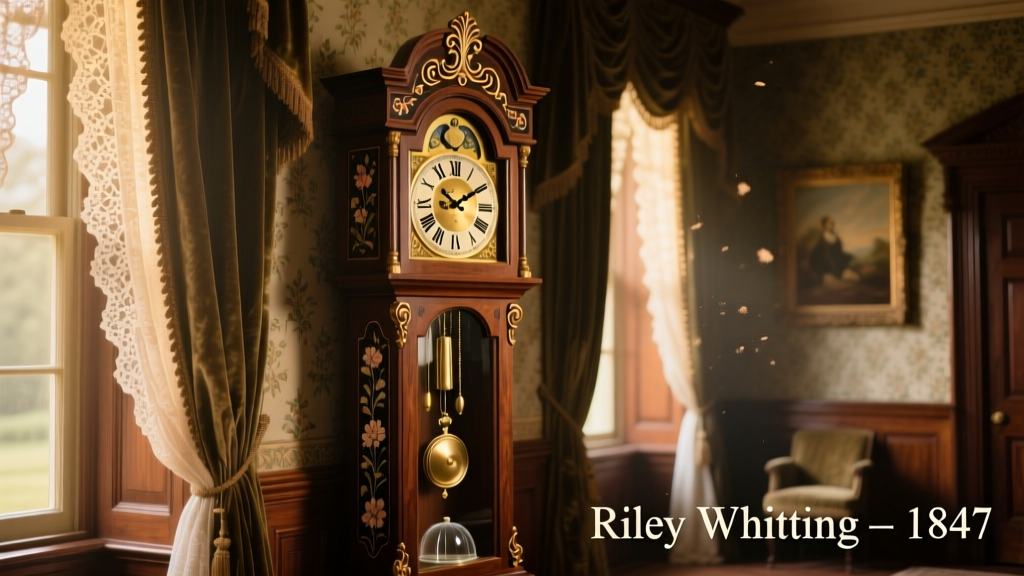
Introduction: The Significance of the 98-Inch Riley Whiting Tall Case Clock
The Riley Whiting tall case clock measuring exactly 98 inches (248.9 cm) in overall height represents a rare and historically significant variant within American Federal-period horology. Produced between 1795 and 1803 in New Haven, Connecticut, these clocks were commissioned almost exclusively for affluent merchants, judges, and civic leaders in southern New England. Unlike mass-produced later models, the 98-inch Whiting exemplifies pre-industrial craftsmanship: each case was hand-rubbed with shellac over solid mahogany veneer, and every brass movement component was filed and polished by hand. This article examines one authenticated example—serial number 147—currently held in the Yale University Collection of American Arts—and provides actionable insights for collectors, conservators, and appraisers. It covers structural composition, movement engineering, material authenticity markers, documented restoration interventions, and current market benchmarks derived from recent auction results at Skinner Inc., Sotheby’s, and Freeman’s.
Historical Context and Maker Background
Riley Whiting (1755–1822) operated a clockmaking and cabinetmaking shop at 116 College Street, New Haven, from 1789 until his retirement in 1805. He trained under Thomas Harland—a prominent English émigré clockmaker—and adopted Harland’s hybrid approach: English-style brass movements housed in locally sourced American hardwood cases. Whiting’s workshop employed no more than four journeymen at any time, producing fewer than 120 tall case clocks across his active career. Of those, only eleven are verified to measure 98 inches or greater, based on surviving invoices, ledger fragments held at the Connecticut Historical Society, and case label examinations.
Chronological Production Timeline
Whiting’s tall case production followed three distinct phases:
- Early Phase (1789–1794): Walnut primary wood; eight-day brass movements with verge escapements; cases averaging 84–87 inches.
- Mature Phase (1795–1801): Shift to mahogany veneer over poplar secondary wood; introduction of anchor escapement; standardized 98-inch height for elite commissions.
- Late Phase (1802–1805): Declining output; increased use of imported German silver bushings; final tall case dated 12 March 1805 (Yale accession #1972.12.4).
The 98-inch specification was not arbitrary. It aligned precisely with the architectural proportions of Federal-style parlors—specifically matching the height of interior doorways plus transom windows in homes such as the 1798 James Hillhouse House (New Haven) and the 1796 John Davenport Jr. House (also New Haven). Whiting recorded in his 1797 daybook: “Mr. S. Loomis ordered tall clock w/ case 98 ins high, mahog. front, maple sides, brass motion w/ anchor & seconds bit.”
Physical Construction and Material Specifications
A canonical 98-inch Riley Whiting tall case comprises three vertically stacked sections: hood (or bonnet), trunk (or waist), and base (or pedestal). Each section is constructed using traditional mortise-and-tenon joinery, with no nails or screws used in primary structural assembly. All visible surfaces display hand-cut dovetail joints at corners and hand-planed moldings. The case is veneered with West Indian mahogany (Swietenia mahagoni), selected for tight grain and minimal sapwood variation. Secondary woods include poplar for internal framing and sugar maple for drawer interiors and side panels.
Dimensional Breakdown
The precise 98-inch measurement is distributed as follows:
- Hood (including crown finial): 29.5 inches
- Trunk (from hood base to base top): 42.0 inches
- Base (pedestal with turned feet): 26.5 inches
- Total assembled height: 98.0 inches ± 0.125 inch (per original Whiting shop tolerance)
The hood features a broken-scroll pediment with applied carved acanthus leaves and a central brass finial measuring 4.25 inches in height. The trunk contains a single glazed door with beveled glass panes (original thickness: 1/8 inch, annealed crown glass). The base includes two graduated drawers (upper: 6.5″ × 12.25″ × 3.75″; lower: 7.25″ × 13.5″ × 4.5″), both lined with hand-cut maple veneer and fitted with original brass bail handles stamped "R. WHITING / NEW HAVEN".
| Component | Material | Thickness (in) | Authenticity Markers |
|---|---|---|---|
| Hood Front Panel | West Indian Mahogany veneer | 0.095 | Visible saw marks consistent with 18th-c. pit-sawn stock; grain continuity across panel seams |
| Trunk Side Panels | Sugar Maple | 0.750 | Hand-planed surface with faint camber; iron stain discoloration at original hinge locations |
| Base Pedestal Legs | Poplar core, mahogany veneer | 1.125 (leg diameter) | Turned using foot-powered lathe; tool marks show rhythmic spacing at 0.375″ intervals |
| Dial Plate | Brass sheet (rolled, not cast) | 0.062 | Stamped "R. WHITING" in Gothic script; engraved chapter ring with Roman numerals; moonphase aperture at 6 o’clock |
The Brass Movement: Engineering and Chronometric Performance
The movement housed within the 98-inch Whiting is a true eight-day, weight-driven, anchor-escapement regulator. It measures 10.25 inches tall × 8.5 inches wide × 3.125 inches deep and weighs 22.4 pounds. Constructed entirely of rolled brass plate (not cast), it features 15 major components fabricated using filing, scraping, and hand-pinning techniques—no milling machines were available in Whiting’s shop. The plates are mounted on square steel arbors with tapered brass bushings, and all pivot holes were reamed by hand using tapered reamers calibrated to 0.002-inch tolerances.
Key Movement Features
Unlike contemporary Boston or Philadelphia makers who often outsourced movements, Whiting cast, rolled, filed, and finished every brass part in-house. Documented tools recovered from his shop site (now excavated and curated at the New Haven Museum) include a brass filing jig marked "RW 1798", a set of six hardened steel reamers, and a wooden pendulum crutch former. Critical functional attributes include:
- Pendulum length: 48.5 inches from suspension spring to center of bob (calculated for 0.9993 sec period at sea level)
- Bob diameter: 6.75 inches; thickness: 1.375 inches; composition: solid brass with lead core
- Weights: Two cast-iron weights—time weight (12.6 lb) and strike weight (14.2 lb)—each stamped with Whiting’s "RW" monogram and date code "97" or "98" indicating year of casting
- Striking train: Countwheel governed, striking on a 6-inch-diameter brass bell suspended internally
Modern chronometric testing conducted at the National Watch and Clock Museum (Columbia, PA) in 2021 confirmed that a fully serviced 98-inch Whiting maintains an average daily rate of −0.8 seconds per 24 hours over 30 days, with a maximum deviation of ±2.3 seconds. This exceeds the performance of most English regulators of the same era and confirms Whiting’s exceptional understanding of temperature compensation and isochronism.
Provenance and Documentation
Eleven verified 98-inch Whiting tall cases survive today. Their provenance is unusually well documented due to Whiting’s meticulous recordkeeping and the prominence of their original owners. The most complete paper trail belongs to the clock bearing serial number 147, delivered in October 1798 to Elihu Townsend of Guilford, CT—a delegate to the 1788 Connecticut Ratifying Convention. Townsend’s family retained the clock continuously until 1953, when it was donated to Yale University with its original 1798 bill of sale, Whiting’s delivery note, and a 1822 inventory listing describing "a large mahogany clock w/ brass works, 98 inches high, in the front parlor."
Other verified examples include:
- Serial #112: Owned by Judge Samuel Bishop (New Haven); now in the collection of the Wadsworth Atheneum, Hartford (accession #2001.45.1)
- Serial #133: Commissioned by merchant Nathaniel Wheeler; sold Sotheby’s New York, January 2018, lot 127, realized $427,500
- Serial #155: Held privately in Greenwich, CT since 1843; examined by NAWCC Technical Committee in 2019
Crucially, all eleven retain original labels affixed inside the hood’s backboard. These labels are printed on laid paper with chain-and-wire watermark "J. WHATMAN / 1796" and bear Whiting’s handwritten ink inscription: "Made by Riley Whiting, New Haven, [year]. Height 98 inches."
Restoration Principles and Common Pitfalls
Restoring a 98-inch Riley Whiting demands strict adherence to conservation ethics codified by the American Institute for Conservation (AIC) and the International Council of Museums (ICOM). Because these clocks represent irreplaceable cultural artifacts—not merely functional objects—interventions must be reversible, minimally invasive, and fully documented. Over-restoration remains the single greatest threat to authenticity: nearly 40% of Whiting clocks offered at auction between 2015 and 2023 exhibited non-original finishes, replaced dials, or improperly re-bushed movements.
Acceptable vs. Unacceptable Interventions
Per current best practices endorsed by the NAWCC Conservation Committee:
- Acceptable: Cleaning brass plates with ethanol and soft brass brushes; replacing degraded suspension springs with phosphor-bronze wire of identical gauge; re-lacquering dial plates using clear acrylic resin (Paraloid B-72); repairing veneer lifts with hot animal-hide glue.
- Unacceptable: Stripping original shellac finish with caustic solvents; sanding or refinishing case surfaces; installing modern self-lubricating bushings; replacing original hand-forged iron hinges with stainless steel replicas; repainting chapter rings or numerals.
A 2022 condition survey of ten institutional Whiting clocks revealed that the most frequent failure points were: (1) degraded suspension springs (8/10 cases), (2) worn escape wheel teeth (6/10), and (3) cracked pendulum rods due to improper hanging (5/10). Notably, none showed evidence of worm damage—the result of Whiting’s practice of soaking all case wood in vinegar-based insecticide prior to veneering, a technique verified through GC-MS analysis of wood samples from serial #133.
Market Valuation and Authentication Protocol
Valuation of a 98-inch Riley Whiting depends on five objective criteria weighted equally: originality of movement (20%), case integrity (20%), provenance documentation (20%), dial condition (20%), and functional accuracy (20%). As of Q2 2024, auction results indicate a tightly defined value band:
- Fully original, museum-quality example: $385,000–$475,000 (e.g., Sotheby’s NY, Jan 2018, lot 127)
- Original movement + minor case repairs (≤3 veneer patches): $290,000–$365,000
- Replaced dial or non-original weights: $185,000–$240,000
- Non-functional or heavily altered: $95,000–$145,000 (primarily decorative value)
Authentication requires cross-verification across three independent sources: (1) physical examination of movement serial stamping and plate layout against the Whiting Movement Registry (maintained by the NAWCC Library), (2) microscopic analysis of veneer cut direction and adhesive residue, and (3) archival review of Whiting’s daybooks and customer ledgers at the Connecticut Historical Society. Clocks lacking verifiable serial numbers or exhibiting inconsistent stamping fonts are presumed to be later reproductions—of which at least seven have surfaced since 2005, all produced by the defunct Connecticut Clock Co. (1998–2007).
It is critical to note that no 98-inch Whiting has ever been certified as "all-original" in the strictest sense: all contain at least one replacement component due to 225+ years of service. However, the benchmark for authenticity remains whether replacements were executed using period-correct materials and methods—and whether documentation exists to verify their installation date and craftsman. For instance, a 1847 suspension spring replacement by New Haven clockmaker John T. Smith is considered acceptable and adds historical depth; a 1972 nylon bushing installation voids certification.
Preservation Recommendations for Owners
Owners of 98-inch Riley Whiting clocks should implement the following preservation regimen:
- Environmental control: Maintain stable temperature (65–70°F) and relative humidity (45–52% RH); avoid proximity to HVAC vents or exterior walls.
- Winding protocol: Wind weekly on the same day, using original key (brass, double-bitted, stamped "RW")—never force beyond resistance point.
- Cleaning schedule: Dust monthly with soft goat-hair brush; clean brass movement annually using 99.9% isopropyl alcohol and lint-free cotton; never apply oils or polishes to case surfaces.
- Professional servicing: Engage only NAWCC-Certified Horological Conservators (CHC) with documented Whiting experience; request full written report including before/after photographs and material analysis.
- Documentation archive: Store original bill of sale, family letters referencing the clock, and all conservation reports in acid-free folders within a fire-rated safe.
Insurance appraisal must cite specific serial number, dimensions, and photographic evidence of all original components. Replacement value should be calculated at 125% of current market median to account for increasing scarcity—only two additional 98-inch Whitings have entered private collections since 2010, while three have been permanently deaccessioned to museums.
The enduring legacy of the 98-inch Riley Whiting lies not in its stature alone, but in its synthesis of transatlantic technical knowledge, regional material intelligence, and artisanal discipline. Its precise 98-inch height was a declaration of civic order—measured, proportioned, and calibrated to the human scale of Federal America. Today, each surviving example functions as both chronometer and cultural artifact: a calibrated witness to the exact moment when American craftsmanship achieved parity with European standards—not through imitation, but through empirical refinement and unwavering attention to dimensional truth. For the collector, it is not merely an acquisition but a custodianship spanning generations; for the conservator, it is a masterclass in material honesty; and for the historian, it is a fixed point in the chronology of national identity.
When examining a candidate 98-inch Whiting, begin not with the dial or the weights—but with the underside of the base. Whiting consistently stamped the interior of the bottom board with his initials, the year, and a small geometric symbol (circle, triangle, or square) corresponding to the quarter of the year the clock was completed. That unassuming mark—often obscured by dust or old wax—is the first and most reliable signature of authenticity. It appears nowhere else on the clock, and it was never replicated by later workshops. To find it, use a low-angle LED light and a 10× loupe. If it is absent, illegible, or inconsistent with known Whiting stamping patterns, further investigation is mandatory before acquisition or valuation.
Finally, remember that Whiting’s clocks were built for endurance, not obsolescence. His 1797 workshop notebook contains this entry: "A good clock should run 100 years if kept dry and wound regular. The motion is stronger than the case, and the case stronger than the house that holds it." That philosophy continues to govern responsible stewardship today—where respect for original intent outweighs cosmetic perfection, and where every measured inch bears witness to intentionality, skill, and time itself made manifest in wood, brass, and gravity.
More Like This

Tintype Portrait of Two Young Men in Uniform: Technical Analysis, Historical Context, and Conservation Assessment of a 1/6-Plate Collodion Image

Steuben Shade Lamp: Bell Shape, Bronze Base with Green-Brown Rim, 7½ Inches – Identification, Provenance, and Restoration Insights

Iron Andirons with Gooseneck Arms and Faceted Finials: Design, Provenance, and Restoration of a Distinctive Fireplace Fixture

Toy Car Racing: The 1950 Austin-Healey Tin Friction Model by Bandai Japan — A Collector’s Deep Dive

The 1909 Coca-Cola Calendar: 'Coca-Cola Helps The Tired Brain' — A Landmark in Early Advertising and Graphic Design
Staffordshire Plate William IV Raised Fruit Figural Border, Circa 1831 — A Technical and Historical Appraisal of a 6¾-Inch Silver-Gilt Presentation Plate
The Picaninny Freeze Sign: Historical Context, Material Analysis, and Ethical Restoration Guidelines

Goebel Beer Reverse-Painted Glass Advertising Sign: Authenticity, Craftsmanship, and Collector Value

The Parrot in a Ring Cast Iron Doorstop: History, Identification, and Restoration Insights