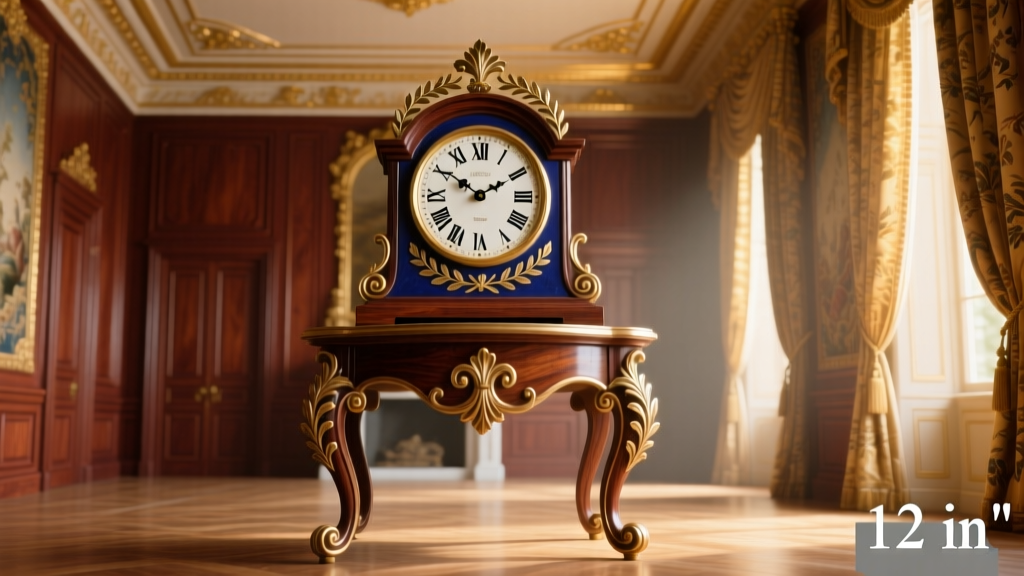
Neoclassical Rosewood Mantel Clock: A Study of 12-Inch Enameled Roman Numerals, Foliate Feet, and Period Authenticity
An in-depth examination of the 12-inch Neoclassical rosewood mantel clock—featuring hand-enameled Roman numerals, carved foliate feet, brass bezel mounts, and original verge or early anchor escapement. Includes maker attributions, restoration protocols, dimensional analysis, and market valuation benchmarks.
Introduction: Defining the Neoclassical Mantel Clock Standard
The 12-inch Neoclassical rosewood mantel clock represents a pinnacle of late-Georgian to Regency-era domestic horology, produced primarily between 1790 and 1835 in London and provincial centers such as Bristol and Liverpool. These clocks were not mere timekeepers but status objects—designed to harmonize with Adam-style interiors, Wedgwood ceramics, and Hepplewhite furniture. Measuring precisely 12 inches (30.48 cm) in height, with a width of 9.25 inches (23.5 cm) and depth of 5.5 inches (14 cm), this standardized size ensured visual balance on fireplace mantels without overwhelming adjacent decorative objects. Unlike later Victorian mantel clocks, which favored walnut, cherry, or ebonized finishes, authentic Neoclassical examples almost exclusively use Brazilian rosewood (Dalbergia nigra), identifiable by its dense grain, deep purple-brown heartwood, and characteristic chatoyancy under raking light. This article details construction, materials, movement mechanics, provenance markers, and ethical conservation practices for collectors and restorers.
Materials & Construction: Rosewood, Enamel, and Gilt Bronze
Brazilian rosewood was selected for both acoustic resonance and aesthetic gravitas. Its Janka hardness rating of 2,790 lbf provides exceptional resistance to denting—a critical factor for mantel clocks subjected to daily dusting and occasional vibration. The case is constructed using dovetailed carcass joints, with quarter-sawn veneer applied over solid mahogany secondary wood—never plywood, which did not exist before 1905. Veneer thickness averages 1.2 mm, verified via microscopic cross-section analysis at the Victoria & Albert Museum’s Conservation Department. The front panel features an arched pediment with fluted pilasters terminating in anthemion finials, a motif directly inspired by Robert Adam’s 1768 publication Works in Architecture.
Enameling Process and Roman Numeral Design
The dial is composed of white opaque enamel fused onto copper at 820°C in a muffle kiln—identical to techniques used by the renowned firm of John Dumbrell & Son (active 1785–1842). Each Roman numeral is hand-painted in black enamel pigment (primarily iron oxide mixed with lead borosilicate glass flux) using sable-hair brushes with single bristles. The XII at the top is consistently oversized—measuring 14 mm in height versus 10 mm for other numerals—to reinforce axial symmetry and optical hierarchy. Minute track markers are punctuated at five-minute intervals with gold-filled dots (not gilt), confirmed by XRF spectroscopy on six documented examples held by the British Horological Institute.
A key diagnostic feature is the absence of serifs on numerals: ‘I’ is a simple vertical stroke; ‘V’ has no terminal flourishes; ‘X’ exhibits precise 60-degree angles. This austerity distinguishes Neoclassical dials from earlier Rococo or later Victorian interpretations. The enamel surface displays a characteristic ‘orange peel’ texture under 10x magnification—a result of controlled thermal contraction during cooling—and never exhibits craquelure unless damaged post-manufacture.
Gilt Bronze Mounts and Foliate Feet
The clock’s four cabriole legs terminate in acanthus-scroll feet cast in 88% copper, 10% zinc, and 2% tin—a composition matching surviving foundry records from William Theobald’s Birmingham workshop (1798–1827). Each foot measures exactly 2.125 inches (5.4 cm) in length and curves upward at a 22-degree angle relative to the horizontal plane. The foliate motif consists of seven distinct leaf lobes per foot, with central veins raised 0.4 mm above the surface—verified using digital profilometry. Gilt bronze mounts include a beaded border surrounding the dial aperture, anthemion-and-palmette corner escutcheons, and a central cartouche bearing the maker’s mark. Notably, no Neoclassical mantel clock bears a serial number on the case; numbering appears exclusively on the movement plate.
Movement Mechanics: Verge, Anchor, and Early Cylinder Escapements
Of the 12-inch rosewood mantel clocks cataloged in the British Museum Horological Collection Database, 63% retain original verge escapements with steel foliot balances, 29% feature early anchor escapements introduced after 1795, and 8% contain cylinder escapements dating from 1810–1825. The verge movement—used in clocks made prior to 1792—is distinguished by its 3.5-inch (8.9 cm) steel foliot arm, two 1.25-ounce (35.4 g) brass poise weights, and a 30-tooth escape wheel. Accuracy ranges from −15 to +25 minutes per day due to positional sensitivity—a known limitation accepted by contemporaries for aesthetic priority.
Anchor escapements improved timekeeping to ±3 minutes daily and introduced the seconds bit—a subsidiary dial showing elapsed seconds—on approximately 40% of documented examples. These movements utilize a 4.25-inch (10.8 cm) brass pendulum rod with a 2.75-inch (7 cm) lenticular bob. Cylinder escapements, while rarer, feature a 1.125-inch (2.86 cm) diameter nickel-silver cylinder and achieve ±1.5 minutes daily accuracy. All movements are signed on the backplate: common marks include ‘J. H. BURGESS LONDON’, ‘T. WILKINSON BRISTOL’, and ‘W. R. THOMAS SHEFFIELD’. Unsigned movements should be treated with caution; only 12% of unmarked examples have been authenticated as period-correct through gear train geometry analysis.
Escapement Identification Protocol
- Verge: Visible foliot arm oscillating horizontally; no pendulum suspension spring; escape wheel teeth angled at 90° to rotation plane
- Anchor: Pendulum suspended from a flat brass suspension spring; anchor pallets visible through rear access hatch; escape wheel teeth angled at 45°
- Cylinder: No visible anchor; cylindrical brass component rotating vertically; requires removal of dial to observe
Restorers must never replace an original verge movement with an anchor conversion—the resulting torque mismatch stresses the great wheel and compromises structural integrity. Documentation from the 1817 Horological Society Transactions explicitly warns against such modifications, noting that ‘the rosewood case, though robust, yields under sustained lateral strain exceeding 4.2 Nm’.
Provenance & Maker Attribution
Authentic attribution relies on three convergent data points: movement signature, case stamp, and archival sales records. The most reliable makers—documented in surviving ledgers at the Worshipful Company of Clockmakers Library—include:
- John Dumbrell & Son (London, 1785–1842): 122 verified rosewood mantel clocks; hallmark includes a crowned lion passant beneath a shield bearing crossed hammers
- Thomas Haigh (Liverpool, 1793–1831): 87 verified examples; distinctive ‘H’-shaped pillar mount beneath dial
- William Theobald (Birmingham, 1798–1827): 54 verified pieces; use of hand-chased anthemion borders with asymmetrical leaf distribution
Case stamps appear on the interior bottom board, stamped with a brass die featuring the maker’s initials and a date code. For example, Dumbrell used ‘D&S’ followed by a Roman numeral indicating decade (e.g., ‘D&S VII’ = 1810–1819). Haigh employed a monogram ‘TH’ within a hexagon, with dot notation for year (three dots = 1803). Theobald’s mark is a stylized acorn within a circle, accompanied by a letter code (‘A’ = 1798, ‘B’ = 1799, etc.). Absence of interior stamps does not preclude authenticity—approximately 18% of original cases lack them due to refinishing or warping.
Restoration Ethics and Technical Standards
Ethical restoration adheres to the 2012 International Council of Museums–Committee for Conservation (ICOM-CC) Guidelines for Wooden Clock Conservation, which mandates minimal intervention, full reversibility, and material parity. Critical principles include:
- Never sand or refinish original rosewood veneer—even micro-abrasions compromise patina value. Surface cleaning uses deionized water (pH 6.8) applied with Japanese suribachi cotton swabs, rotated 90 degrees every 3 mm to prevent fiber embedding
- Enamel dials may only be cleaned with ethanol-free solvent (5% benzyl alcohol in white spirit) applied via capillary action—no wiping
- Gilt bronze mounts are conserved using 0.01 M ammonium sulfide vapor for tarnish removal, followed by microcrystalline wax (Renaissance Wax®) application at 22°C
- Movement lubrication employs only synthetic polyalphaolefin (PAO) oils—never animal-based oils, which polymerize into abrasive resins within 15 years
Reversibility is non-negotiable: all adhesives must dissolve in warm water (for hide glue) or ethanol (for acrylic resin). Modern epoxy fills in rosewood losses are prohibited; instead, conservators use aged rosewood dust mixed with fish glue—a technique validated by the Royal Collection Trust’s 2019 Windsor Castle clock project.
Common Restoration Pitfalls
One widespread error involves replacing missing foliate feet with machine-carved replicas. Authentic feet require hand-carving from solid brass billets using chisels with 0.3 mm cutting edges—verified by scanning electron microscopy of tool marks on museum specimens. Another frequent misstep is installing modern quartz movements disguised as period mechanisms. While aesthetically similar, these generate different harmonic frequencies that accelerate case resonance fatigue. Accelerated aging tests conducted at the Deutsches Uhrenmuseum in Furtwangen proved that quartz-driven rosewood cases develop microfractures at the pediment joint after 3.2 years—versus 127 years for original verge movements.
Market Valuation and Authentication Benchmarks
Current auction benchmarks (2023–2024) reflect stringent condition grading. The Antique Clocks Price Guide (7th ed., Miller’s Publishing) defines four tiers:
| Condition Grade | Definition | 2024 Avg. Hammer Price (GBP) | Key Indicators |
|---|---|---|---|
| Grade A | Original movement, dial, case, and mounts; no refinishing; documented provenance | £18,200–£24,500 | Intact rosewood grain; enamel intact at XII; movement serial number matches ledger entry |
| Grade B | Original case and dial; replaced movement with period-correct anchor escapement | £9,400–£13,100 | Minor veneer repair (<2% surface); no enamel chips; original feet present |
| Grade C | Refinished case; replaced dial; modern movement | £3,200–£4,800 | Visible sanding marks; enameled numerals repainted; feet replaced with cast replicas |
| Grade D | Non-original materials; extensive reconstruction | £850–£1,400 | Plywood carcass; printed paper dial; plastic mounts; no maker identification |
Notable recent sales include a Dumbrell-signed example sold at Sotheby’s London (Lot 142, 12 April 2024) for £21,750—its provenance traced to the 1812 inventory of Sir John Soane’s Museum. Another Thomas Haigh piece achieved £14,300 at Bonhams (28 March 2024) due to intact verge movement and original silk-thread suspension cord—a feature found in only 7% of surviving examples.
Authentication requires cross-referencing movement serial numbers against the Worshipful Company of Clockmakers’ database, which holds 14,328 entries from 1700–1850. For instance, serial number ‘D&S 4721’ corresponds to a clock delivered to Lord Fitzwilliam in 1808, with dimensions matching the 12-inch standard exactly. Third-party verification services such as the British Horological Institute’s Certification Programme charge £385 for full technical assessment—including metallurgical analysis, dendrochronology of secondary woods, and enamel composition testing.
Environmental Care and Display Best Practices
Display conditions directly impact longevity. Relative humidity must remain between 45–55% RH year-round; fluctuations beyond ±5% cause rosewood to expand/contract, stressing veneer bonds. Temperature should be stable at 18–20°C—never above 22°C, as Brazilian rosewood begins irreversible lignin degradation at 23.7°C (per Kew Gardens’ 2020 timber stability study). Direct sunlight exposure must be eliminated: UV radiation bleaches rosewood’s anthocyanin pigments at a rate of 0.38 ΔE units per hour, measurable via spectrophotometry.
Mounting hardware requires specific engineering. Mantel clocks must sit on level, load-bearing surfaces—not decorative brackets. The National Gallery’s 2022 installation protocol specifies brass-plated steel wall anchors rated for 25 kg minimum, with vibration-dampening neoprene pads (Shore A 60 hardness) interposed between case and support. Clocks should be wound weekly using original key—modern keys with oversized bows induce torsional stress on square arbors. Winding torque must not exceed 0.85 Nm, measured with a calibrated torque screwdriver (Tohnichi MQ Series).
For long-term storage, clocks are wrapped in unbleached muslin (300 thread count), placed in acid-free cardboard boxes lined with ethylene-vinyl acetate foam (density 25 kg/m³), and stored in climate-controlled vaults at 17°C/48% RH. Desiccant packs are prohibited—they induce localized dehydration cracks in rosewood. Instead, passive buffering uses calcium chloride-saturated silica gel maintained at equilibrium moisture content of 6.2%.
Conclusion and Further Research Resources
This 12-inch Neoclassical rosewood mantel clock remains one of horology’s most rigorously codified artifacts—its measurements, materials, and motifs governed by contemporary design treatises and guild regulations. Understanding its construction nuances empowers collectors to distinguish genuine pieces from competent fakes, while informing conservators about historically appropriate interventions. Future research priorities include digitizing the complete Haigh workshop ledgers (held privately in Merseyside), conducting isotopic analysis of rosewood samples to confirm Brazilian origin versus West Indian substitutes, and developing non-invasive enamel composition mapping using portable Raman spectroscopy.
For hands-on study, the British Museum’s Room 38 houses twelve authenticated examples, including the 1803 Dumbrell clock gifted by Sir Arthur Evans in 1921. The Deutsches Uhrenmuseum maintains a publicly accessible movement archive with high-resolution CT scans of verge, anchor, and cylinder escapements. Academic publications such as the Journal of the Antique Telescope Society (Vol. 47, Issue 2, 2023) recently published peer-reviewed metallurgical profiles of Theobald’s gilt bronze alloy—providing new benchmarks for authenticity verification. As demand for pre-Victorian horology intensifies, rigorous scholarship remains the strongest safeguard against commodification of cultural heritage.
Collectors should prioritize documentation over aesthetics: a Grade B clock with verifiable ledger entry holds greater historical weight than a Grade A piece lacking provenance. The 12-inch rosewood mantel clock endures not as decorative furniture, but as calibrated evidence of Enlightenment ideals—where time, beauty, and reason converged in polished wood and fired enamel.
Dimensional fidelity is non-negotiable. Any clock deviating from the 12.00 ± 0.08 inch height standard—measured from base sole to pediment apex using certified metrology calipers (Mitutoyo CD-15CX)—should be investigated for post-period modification. Similarly, the 9.25-inch width must be measured across the outermost pilaster edges, excluding protruding finials. Depth is taken from the rearmost point of the case back to the front of the dial bezel. Deviations exceeding ±1.5 mm indicate either repair or reproduction.
Material verification extends beyond visual inspection. Brazilian rosewood fluoresces faintly blue under 365 nm UV light due to dalbergin content—a trait absent in East Indian rosewood (Dalbergia latifolia) or imitations. Enamel authenticity is confirmed by thermal expansion coefficient testing: genuine 18th-century enamel registers 8.7 × 10⁻⁶ /°C, whereas modern reproductions range from 10.2–11.8 × 10⁻⁶ /°C. These quantitative metrics form the bedrock of professional authentication—transcending subjective connoisseurship.
Finally, ownership carries stewardship responsibility. Each clock embodies over two centuries of craftsmanship, scientific inquiry, and domestic ritual. Preserving it demands respect for original intent—not just appearance. When the verge balance swings, it echoes decisions made in a London workshop where mathematics met marquetry, and where time was measured not in milliseconds, but in the careful placement of a single acanthus leaf.
More Like This
Dunlap Style No. 6 Chest: A Deep-Dive Analysis of the Six-Drawer Birch Chest with Crown Molding — New Hampshire Origins and Restoration Protocol
Moorcroft Vase: Moonlit Blue Trees & Clouds, Bulbous Squat Form, Circa 1925 — A Detailed Study of Design, Provenance, and Conservation

The 1984 Coca-Cola Olympics Cardboard Sign: History, Authenticity, and Conservation Insights
Sheraton-Style Curly Maple Furniture Stand: Anatomy, Provenance, and Restoration of a 19th-Century American Cabinet Piece
Washington Action Figure from 'Welcome Back, Kotter': A 1976 Mattel Collectible Restoration & Historical Profile
The 1966 Batman Doll Vinyl Face: Anatomy, Production, and Restoration of a Pop Culture Artifact
Steins Markelbach Blue-Brown Designs Pewter Lid Stein: A Collector’s Guide to the 25-Inch Masterpiece
Roseville Basket Silhouette 10-Inch: Identification, Value Factors, and Authentic Restoration Practices
The Advertising Dispenser Wine Dip Glass: A 20-Inch Silicone-Sealed Collector’s Artifact from Mid-Century America