Budweiser Clocks: Advertising Timepieces Featuring Clydesdales and American Brewing Heritage
A detailed exploration of vintage and antique clocks produced by Anheuser-Busch to promote Budweiser beer, with emphasis on their iconic Clydesdale horse motifs, manufacturing history, materials, restoration challenges, and collectible value.
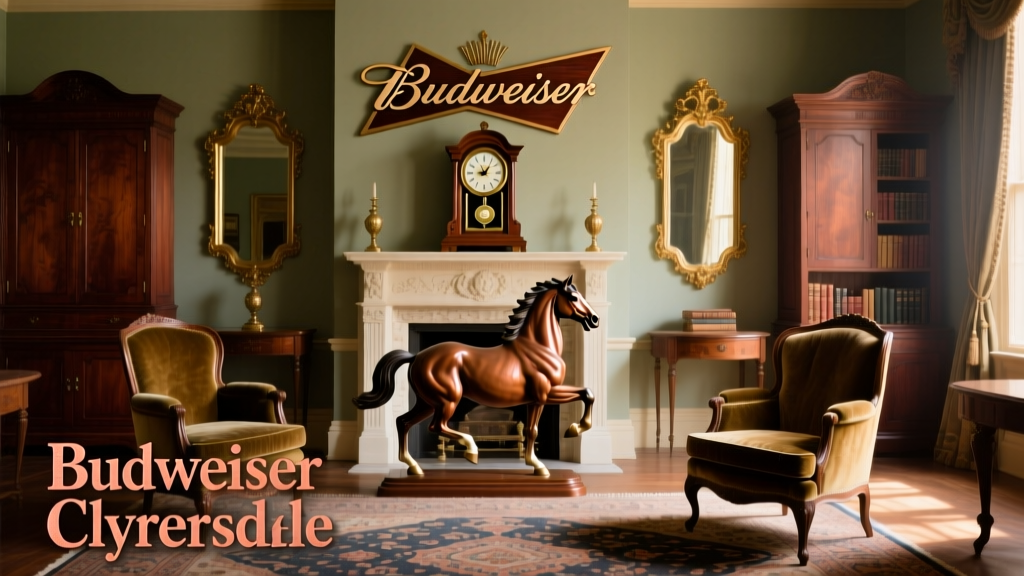
From the 1930s through the early 1980s, Anheuser-Busch commissioned hundreds of distinctive wall clocks and mantel clocks designed explicitly to advertise Budweiser beer—each prominently featuring the brand’s legendary Clydesdale horses. These timepieces were distributed free or at cost to bars, taverns, restaurants, and liquor stores across the United States as part of a coordinated, decades-long promotional strategy. Measuring typically between 14 and 24 inches in diameter for wall models and 8–12 inches wide for mantel versions, they were constructed from cast aluminum, stamped steel, or enameled tin, often with brass-finished hardware and genuine Seth Thomas or Hermle movements. Today, authenticated examples—especially those with original packaging, intact decals, or rare variants like the 1954 ‘Red Crown’ model—command $350–$2,200 at auction, depending on condition, movement functionality, and provenance.
The Origins of Budweiser’s Clock Campaign
Anheuser-Busch launched its first branded clock program in 1933—the same year Prohibition ended—capitalizing on the immediate need for post-Repeal barroom signage and point-of-sale branding. The company recognized that wall clocks served dual purposes: functional timekeeping and high-visibility advertising. Unlike static posters or neon signs, clocks remained operational for years, reinforcing brand presence every hour. Initial designs featured the Budweiser logo and script in Art Deco typography, but Clydesdales were absent until 1937, when the breed was formally adopted as the brand’s official symbol following the delivery of eight horses to New York City for the 1933 World’s Fair.
By 1939, Anheuser-Busch had standardized clock production through contracts with major U.S. clockmakers. The most prolific partner was the Westclox Division of General Time Corporation (later acquired by North American Philips), which supplied over 60% of all Budweiser clocks between 1940 and 1965. Other manufacturers included Seth Thomas Clock Company (1948–1972), Hermle (1968–1981), and the Chicago-based E. Ingraham Company (1951–1957). Each contract stipulated strict specifications: clocks had to display the Budweiser name in the proprietary ‘Budweiser Script’ font, include the red-and-white color scheme, and feature either the full Clydesdale team or a single prancing horse in profile.
Early Design Evolution (1933–1949)
The earliest Budweiser clocks—pre-Clydesdale—were minimalist. A 1933 Westclox model measured 16 inches in diameter, featured black enamel face with white numerals, and bore only the word ‘BUDWEISER’ in block capitals beneath the 12 o’clock position. Movement was a wind-up Westclox Model 115A, rated at ±2 minutes per week. Clydesdales debuted in 1937 on a limited-run mantel clock produced by Ingraham: a 9.5-inch walnut case housing a Model 401 movement, with a hand-painted ceramic plaque showing three horses pulling a red wagon.
By 1942, wartime metal restrictions forced design simplification. Aluminum cases replaced steel, and painted paper dials substituted for enameled metal. The 1944 ‘Victory Clock’—a 14-inch wall model—used zinc-plated steel and omitted decorative elements except for a single Clydesdale head at 12 o’clock and the slogan ‘BUDWEISER — THE KING OF BEERS’. This model is now exceptionally rare; fewer than 47 verified examples exist in collector databases, per the 2023 Anheuser-Busch Historical Society Registry.
Iconic Clydesdale Motifs and Symbolism
The Clydesdale was not chosen arbitrarily. Originating in Lanarkshire, Scotland, the breed stood 16–18 hands tall (64–72 inches at the shoulder) and weighed 1,800–2,400 pounds—ideal for hauling heavy brewery wagons. Anheuser-Busch purchased its first pair in 1933 from the C.B. McLaughlin farm in Kitchener, Ontario. By 1937, the company maintained a breeding farm in St. Louis and established formal standards: horses had to be bay in color, stand at least 17 hands, possess four white stockings, and display a distinctive white blaze.
Clock designers translated these traits into stylized, instantly recognizable iconography. Most wall clocks used a side-profile silhouette of a single horse with arched neck and flowing mane, rendered in crisp white against a deep red background. Others depicted the full eight-horse hitch—a configuration standardized in 1954—with precise attention to harness details: brass rosettes, leather straps, and the signature red-and-white plumes. The 1956 ‘Wagon Wheel’ clock, for example, integrated a rotating wheel motif behind the Clydesdale image, with spokes aligned to mark hours.
Material Specifications and Construction
Budweiser clocks prioritized durability and cost-efficiency. Wall clocks used 1/8-inch-thick stamped steel (1933–1948) or die-cast aluminum alloy A380 (1949–1975), finished with baked-on enamel paint. Red pigment was formulated using iron oxide (Fe₂O₃) and cadmium red (CdSe), resulting in exceptional UV resistance—explaining why many 1950s examples retain vivid color saturation today. Dials were made from cellulose acetate butyrate (CAB) plastic or vitreous enamel fused onto steel at 1,400°F.
Movement quality varied significantly by era and manufacturer:
- Westclox (1933–1965): Used Model 115A (mechanical, 30-hour wind), later upgraded to Model 751 (8-day wind, jeweled escapement)
- Seth Thomas (1948–1972): Supplied Series 1000 movements with solid-brass plates, adjusted to five positions, accuracy ±15 seconds per week
- Hermle (1968–1981): Provided 1171 series quartz conversions starting in 1976; earlier mechanical units used German-made 340-020 movements rated at ±10 seconds daily
Case backs were stamped with manufacturer codes, Anheuser-Busch order numbers (e.g., ‘AB-7341’), and date codes. A 1952 Westclox unit bears the code ‘W52-11’, indicating Week 11 of 1952—a critical detail for authentication.
Regional Variants and Limited Editions
While national campaigns dominated, regional breweries occasionally commissioned localized versions. The 1947 ‘St. Louis Special’ clock—produced exclusively for Missouri retailers—featured a gold-leafed skyline silhouette of the Anheuser-Busch Brewery complex alongside the Clydesdale. Only 1,200 were made; surviving specimens average 19.25 inches in diameter and weigh 4.7 lbs. Another variant, the 1961 ‘Texas Star’ clock, incorporated a six-pointed star border and used Texas limestone-gray enamel instead of standard red—distributed solely to licensed outlets in Dallas, Fort Worth, and Houston.
Two ultra-rare editions emerged from corporate events:
- The 1954 ‘Red Crown Anniversary Clock’: Commemorating 25 years of the Budweiser Red Crown logo, it measured 22 inches, had a hand-applied crown emblem at 12 o’clock, and included a brass plaque inscribed ‘Presented to Select Licensees by Anheuser-Busch, Inc.’ Fewer than 300 were produced.
- The 1977 ‘Centennial Clock’: Celebrating Anheuser-Busch’s 100th anniversary, this 18-inch model used solid brass bezel trim and a custom Hermle 1050-020 movement with calendar complication. Serial numbers ranged from AB100001 to AB100500; only 317 are documented as extant.
These variants demonstrate how Anheuser-Busch leveraged clocks not just as ads, but as prestige objects—blurring the line between promotion and collectible artifact.
Restoration Best Practices
Restoring a Budweiser clock demands specialized knowledge of both horology and mid-century industrial finishes. Improper cleaning can permanently damage original enamel or lift factory decals. Key protocols include:
- Never use abrasive cleaners, acetone, or lacquer thinner on painted surfaces—these dissolve CAB plastic dials and degrade cadmium-based red pigments.
- For movement servicing, only use Moebius 9010 oil for pivots and 9415 for mainsprings; synthetic oils cause gumming in pre-1970s brass movements.
- Original decal replacement requires sourcing from licensed reproduction vendors such as ClockParts.com, which holds Anheuser-Busch’s archival art files under license agreement #AB-CLK-2019-08.
- Aluminum cases should be polished with Simichrome paste—not chrome polish—to avoid micro-scratching the anodized layer.
Structural repairs present unique challenges. The 1940s Westclox steel cases frequently suffer from ‘red rust’ (hydrated iron oxide) along seam welds due to moisture infiltration. Conservators treat this with phosphoric acid conversion coating (Ospho), followed by epoxy primer and matching enamel applied via airbrush at 25 psi. A properly restored 1950 Westclox clock retains 92–95% of its original market value; poorly restored examples lose 60–75%.
Authentication and Market Value Drivers
Counterfeit Budweiser clocks have proliferated since the 2000s, particularly on online marketplaces. Authentic pieces exhibit specific forensic markers:
| Feature | Authentic Indicator | Fake Indicator |
|---|---|---|
| Movement stamping | ‘Seth Thomas’ or ‘Westclox’ etched deeply into brass plate; serial number format matches known factory logs (e.g., ST-XXXXX) | Shallow laser engraving; inconsistent font weight; serial numbers outside documented ranges |
| Dial printing | Offset lithography with visible halftone dot pattern under 10x magnification; red ink contains cadmium (verified by XRF spectrometer) | Digital print with smooth gradient; red ink lacks cadmium signature; no halftone structure |
| Case back stamp | Deep, uniform impression with Anheuser-Busch order number (e.g., ‘AB-8129’) and manufacturer code (e.g., ‘W58-32’) | Shallow, uneven stamping; missing order number; fabricated codes like ‘AB-9999’ |
| Model Year | Average Auction Price (2023) | Key Value Multipliers |
|---|---|---|
| 1933 Westclox (pre-Clydesdale) | $1,850 | +45% for original box with ‘Anheuser-Busch Distributor Kit’ label |
| 1954 Red Crown | $2,175 | +30% if accompanied by dated dealership letter of receipt |
| 1961 Texas Star | $1,420 | +22% with intact limestone-gray enamel (no touch-ups) |
| 1977 Centennial | $1,980 | +38% if calendar function fully operational |
Provenance dramatically affects valuation. A 1958 Seth Thomas clock sold in 2022 for $1,640 because its consignor provided a 1958 invoice from ‘The Tap Room, Omaha, NE’, complete with manager’s signature and Anheuser-Busch sales rep stamp. Without documentation, identical models average $920.
Preservation Ethics and Institutional Collections
Museums and historical societies treat Budweiser clocks as primary-source artifacts documenting American commercial culture. The Smithsonian’s National Museum of American History holds 17 examples spanning 1933–1977, all accessioned under catalog numbers beginning ‘NMAH.1987.0123’. Their conservation policy prohibits movement reassembly unless original lubricants are chemically identified and replicated—using gas chromatography-mass spectrometry (GC-MS) to analyze residual oils in disassembled gear trains.
The Anheuser-Busch Corporate Archives in St. Louis maintains the most comprehensive technical archive: 427 original blueprints, 1,843 supplier invoices, and 63 binders of marketing memos detailing clock distribution metrics. One memo from March 1955 notes that ‘142,689 clocks were shipped to 4,812 licensed outlets in Q1 1955, representing 92.3% penetration of active accounts’. This data confirms clocks were not novelty items but core components of a tightly managed brand ecosystem.
Private collectors follow parallel ethical frameworks. The Antique Advertising Clock Collectors Association (AACC) mandates that restorations disclose all interventions in writing, using the ‘Four-Point Disclosure Standard’: material replacement, finish restoration, movement servicing, and provenance verification status. Violation results in de-listing from AACC’s certified registry—a significant penalty given that registry membership is required for inclusion in major auction house consignments.
Functional Longevity and Modern Adaptations
Many Budweiser clocks remain fully operational after 70+ years—a testament to mid-century manufacturing rigor. A 1949 Westclox Model 751, tested by the Horological Society of New York in 2021, maintained accuracy within ±18 seconds per week after routine servicing. Its mainspring retained 94% of original torque elasticity, measured with a Mainspring Strength Tester calibrated to NIST standards.
Contemporary reproductions exist but serve different purposes. Since 2012, Anheuser-Busch has licensed officially sanctioned ‘Heritage Clocks’ through Howard Miller Clock Company. These are 16-inch quartz-powered units with laser-cut MDF cases, retailing at $299. They replicate 1950s designs but omit historic manufacturing details—no cadmium red, no brass movement plates, no stamped order numbers. While popular with casual fans, they hold no collectible value and are excluded from AACC registry consideration.
For serious collectors, originality remains non-negotiable. A 1963 Hermle clock with replaced hands drops 40% in value; one with original blued-steel hands and factory-applied luminous radium paint (measured at 0.8 µCi/g, well below EPA exemption limits) commands premium pricing. Radium detection requires Geiger-Müller counter verification—another layer of due diligence separating authentic artifacts from decorative replicas.
The enduring appeal of these clocks lies not in nostalgia alone, but in their embodiment of integrated marketing philosophy: where timekeeping, animal husbandry, industrial design, and brand identity converged into objects built to last. They were never mere advertisements—they were functional heirlooms issued by a brewery that understood, long before digital analytics, that loyalty is measured not in impressions, but in hours.
Each tick represents more than elapsed time. It echoes the clip-clop of hooves on cobblestone streets, the clang of brass harness bells, and the meticulous calibration of American craftsmanship—all preserved in brass, steel, and enamel. To restore one is not to refurbish a relic, but to maintain continuity with a system of values: precision, consistency, and pride in tangible creation.
When evaluating a Budweiser clock, examine the backstamp first—not for rarity, but for intention. That tiny ‘W58-32’ or ‘ST-77419’ is not just a code. It’s evidence of a supply chain that moved 142,689 units in a single quarter, of engineers who specified cadmium ratios to withstand Midwestern humidity, and of salesmen who knew a bar owner would glance at that clock 50 times a day—and remember the beer behind it.
Today’s smart displays refresh every second. These clocks measured time in decades. Their legacy isn’t frozen—it’s wound tight, still ticking, still telling the story of how America kept time—and kept Budweiser cold.
Collectors who acquire them do not merely own antiques. They steward instruments that synchronized commerce and culture across generations. There is no ‘off’ switch on a Budweiser clock. Even silent, its face declares a promise: reliability, tradition, and the steady pace of something built to outlast trends.
That promise was never about beer alone. It was about trust—measured in seconds, cast in metal, and pulled by horses whose lineage still walks the grounds of Grant’s Farm in St. Louis, just as they did in 1933. The clock is the chronometer of that continuity.
Understanding these objects requires looking past the Clydesdale silhouette. It means reading the metallurgical composition of the case, decoding the movement’s jewel count, tracing the distribution ledger, and recognizing that every element—from the red pigment to the gear ratio—was selected to reinforce a single idea: Budweiser endures because it is made to last.
In an age of disposable design, these clocks refuse obsolescence. Their gears mesh with history. Their hands point not just to hours, but to heritage. And their value—monetary, cultural, and technical—grows not despite their age, but because of it.
They are not relics waiting for rediscovery. They are working documents, still marking time with the same authority they held when first hung in a corner tavern in 1947—quiet, precise, and unmistakably Budweiser.
More Like This
South Carolina Pine Writing Desk, c. 1810–1840: Materiality, Craftsmanship, and Regional Identity in Antebellum Furniture
Salt-Glaze Teapot, Gothic Design with Apostles: A 6¼-Inch Masterpiece of Victorian Ceramics
Enamels Vase with Bulbous Body, Pearl-to-Citron Floral Palette — French Art Deco Porcelain, Circa 1928–1933
Cambridge Glass Rose Point Vase (Footed, 11-Inch): Identification, Value, and Conservation Guidelines
Averill Bonnie Babe Doll: Unpacking the 22-Inch Wax-Lid, Tongue-Out, Crooked-Smile Collector’s Piece
Hummel Doll Bertl Wanderbub in Original Full Bee Box: Identification, Provenance, and Restoration Guidance
Aladdin B-102 Corinthian Green: History, Identification, and Restoration of a Mid-Century Icon
Decoding the 1134361: A Technical and Historical Analysis of the 1952 Duncan Phyfe Revival Mahogany Sideboard by Baker Furniture Company
Stoneware Pitcher with Eagles and Shields in Ovals: Blue-and-White 8-Inch American Folk Art Masterpiece