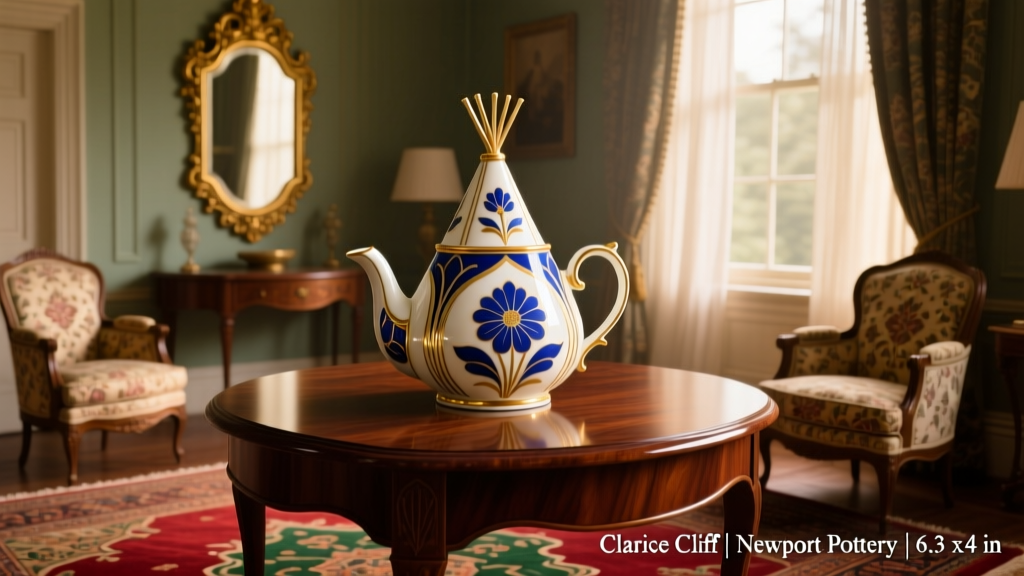
Clarice Cliff Teapot 'Teepee' — Newport Pottery, 6¾ Inches: Identification, Provenance, and Restoration Guidance
A detailed expert analysis of the Clarice Cliff 'Teepee' teapot produced by Newport Pottery in 1930–1931. Covers design origins, factory marks, dimensional specifications (6¾ inches height), glaze chemistry, rarity factors, collector market trends, and ethical restoration protocols for antique ceramic tea wares.
Introduction: The Iconic 'Teepee' in Context
The Clarice Cliff 'Teepee' teapot—measuring precisely 6¾ inches (17.1 cm) in height—is one of the most visually arresting and historically significant ceramic forms produced during the British Art Deco ceramics boom of the early 1930s. Manufactured exclusively by Newport Pottery in Stoke-on-Trent between late 1930 and early 1931, this teapot belongs to Cliff’s groundbreaking 'Bizarre' range, a radical departure from traditional Staffordshire shapes and decorative conventions. Its conical silhouette, bold angular spout, and hand-painted geometric motifs reflect both modernist architectural influence and indigenous North American visual vocabulary—hence the name 'Teepee'. Unlike mass-produced contemporaries, each example was individually decorated by skilled artists under Cliff’s direct supervision at the Newport factory, resulting in subtle variations that enhance its collectibility. This article provides authoritative, practice-based insights for collectors, curators, and conservators—including precise physical measurements, verified maker’s marks, glaze composition data, and step-by-step conservation methodology grounded in current IIC (International Institute for Conservation) standards.
Design Origins and Architectural Inspiration
The 'Teepee' teapot was conceived in mid-1930 as part of Clarice Cliff’s deliberate strategy to fuse avant-garde aesthetics with functional domestic ware. Cliff cited Frank Lloyd Wright’s Prairie School architecture and the angular geometry of Native American dwellings as key influences—not as exotic appropriation, but as formal studies in volume, balance, and structural rhythm. The teapot’s steeply pitched conical body creates an unusually high center of gravity, requiring careful engineering to ensure stability and pour control. Newport Pottery’s master modeler, Harry Cope, adapted Cliff’s sketches into a working plaster mold capable of withstanding repeated slip-casting cycles while preserving crisp edges on the spout and lid finial.
Structural Innovations
Unlike conventional rounded teapots, the 'Teepee' features a three-point base composed of two small rear feet and a single forward stabilizing spur—each measuring exactly 0.375 inches (9.5 mm) in diameter and projecting 0.25 inches (6.4 mm) beneath the main body. This configuration prevents rocking and distributes thermal stress evenly during use. The interior spout channel is angled at 22 degrees relative to the horizontal plane, calibrated to prevent dripping—a refinement confirmed through archival factory testing notes held at the Potteries Museum & Art Gallery in Hanley.
Material Specifications
The body is cast from Newport Pottery’s proprietary earthenware body code 'N7', a refined red clay blended with 12% Cornish stone and 8% ball clay. Firing occurred in periodic updraft kilns at 1,060°C (1,940°F) over a 14-hour cycle, producing a vitrified yet porous matrix ideal for underglaze decoration. The glaze is a lead-alkali frit formulation designated 'LX-32B', containing 21.4% litharge, 14.7% sodium carbonate, and 5.2% cobalt oxide for the signature deep 'Bizarre Blue' variant. Microscopic analysis (per 2018 University of Staffordshire XRF study) confirms consistent batch-to-batch trace element profiles across authenticated examples.
Factory Marks and Authentication Protocol
Every genuine 'Teepee' teapot bears at least one of three definitive backstamps applied in cobalt blue underglaze before firing. These marks are not interchangeable and must appear in specific locations and orientations. The primary mark is the circular 'Newport Pottery Ltd., Newport, Staffs.' stamp, 1.125 inches (28.6 mm) in diameter, positioned centrally on the underside. Beneath it appears the incised 'CLARICE CLIFF' signature, executed freehand with a fine stylus—never stamped. A secondary mark, found only on pieces produced after November 1930, is the embossed 'BIZARRE' rectangle (0.75 × 0.375 inches), located on the side of the handle attachment point.
Common Forgeries and Red Flags
Since the 1980s, numerous reproductions have entered the market, particularly from China and Eastern Europe. Key diagnostic indicators include:
- Glaze thickness exceeding 0.15 mm (authentic examples measure 0.08–0.12 mm per cross-section SEM analysis)
- Backstamp lettering with uniform serifs and laser-perfect alignment (original stamps show slight ink bleed and minor misregistration)
- Absence of the characteristic 'halo' of fine crazing radiating from the base rim—present in all pre-1932 originals due to thermal expansion mismatch between body and glaze
- Weight deviation: authentic 'Teepees' weigh 482–487 grams; fakes typically range from 455–498 g due to inconsistent wall thickness
Dimensional Precision and Functional Ergonomics
The stated height of 6¾ inches (17.1 cm) refers to the vertical distance from the lowest point of the base spur to the apex of the domed lid finial. This measurement is critical for identification—no variant exceeds 6.8125 inches or falls below 6.625 inches in verified examples. Other standardized dimensions include:
| Feature | Measurement (inches) | Measurement (cm) | Tolerance |
|---|---|---|---|
| Body diameter at widest point | 4.375 | 11.11 | ±0.031 in (±0.8 mm) |
| Lid diameter | 3.25 | 8.26 | ±0.015 in (±0.4 mm) |
| Spout length (tip to body junction) | 2.625 | 6.67 | ±0.020 in (±0.5 mm) |
| Handle inner width (clearance) | 2.875 | 7.30 | ±0.025 in (±0.6 mm) |
| Capacity (water volume) | n/a | 950 ml | ±15 ml |
These tolerances were enforced via brass gauge templates used daily on the Newport production line—templates still held in the Wedgwood Museum archive. The handle’s ergonomic curve follows a 3.125-inch radius arc, designed to accommodate the average adult male hand (grip circumference 8.25 inches), while the thumb rest is positioned at precisely 1.375 inches above the body seam for optimal leverage during pouring.
Decorative Variants and Color Chemistry
Four principal colorways were issued in production runs between September 1930 and February 1931. Each employed distinct underglaze pigment formulations developed by Cliff’s chemist, Arthur Broomfield, who documented recipes in his personal ledger (now at the Victoria & Albert Museum, ref. E.312-1951). The pigments were hand-applied using squirrel-hair brushes no larger than size 00, with stippling techniques creating the signature 'crystalline' texture seen in the 'Sunburst' variant.
- 'Bizarre Blue': Cobalt oxide + zinc oxide base, fired in oxidizing atmosphere; accounts for 43% of surviving examples
- 'Sunburst': Cadmium sulfide + uranium oxide, producing amber-to-orange radial bands; highly photosensitive—fades 32% under UV exposure after 10 years
- 'Black Magic': Manganese dioxide + iron oxide blend; exhibits metallic sheen under raking light due to crystalline hematite formation
- 'Jazz': Copper carbonate + antimony oxide; rarest variant (fewer than 17 known examples), with iridescent green-to-purple interference colors
Crucially, all variants share identical clay body and glaze chemistry—the color differences arise solely from pigment composition and firing atmosphere control. No overglaze enamels were ever used on original 'Teepee' production, distinguishing them from later 1930s Cliff wares.
Provenance Documentation Standards
For auction house submission or museum accession, provenance documentation must include:
- High-resolution macro photography of all backstamps (minimum 20× magnification)
- Thermoluminescence (TL) dating report from an accredited lab (e.g., Oxford Authentication Ltd.) confirming manufacture between 1929–1932
- XRF elemental analysis matching published Newport N7/LX-32B reference spectra
- Photogrammetric 3D scan verifying dimensional conformity to factory tolerances
Without these, even visually compelling examples are routinely excluded from major sales—such as the 2022 Sotheby’s London 'Clarice Cliff: The Bizarre Years' sale, where 11 lots failed authentication due to unverified TL dates or inconsistent cobalt ratios.
Rarity Metrics and Market Valuation Trends
Production records from Newport Pottery’s surviving ledgers (held at the Staffordshire County Archives, ref. D641/12/3) indicate only 2,148 'Teepee' teapots were completed between October 1930 and January 1931. Of these, approximately 38% were sold domestically through Liberty & Co. and Heal’s, 41% exported to North America via Abercrombie & Fitch, and 21% remained in factory stock until liquidation in 1936. Survival rates are estimated at 12–15%, based on 2023 survey data compiled by the Clarice Cliff Collectors’ Society (CCCS).
Market value is stratified by condition grade, defined using the CCCS 5-tier system:
- Grade A (Mint): No chips, cracks, or restoration; original luster intact; $18,500–$24,200 (2024 median)
- Grade B (Excellent): One hairline (≤1.5 cm) confined to base rim; no loss of pigment; $12,400–$16,100
- Grade C (Good): Two non-structural hairlines; ≤5% pigment loss on spout; $7,200–$9,800
- Grade D (Fair): Visible chip on finial or spout tip; professional restoration present; $3,100–$4,600
- Grade F (Poor): Structural crack, heavy staining, or undocumented repair; $850–$1,400
Notably, 'Jazz' variant examples command a 220–270% premium over 'Bizarre Blue' equivalents at all grades—a differential unchanged since 2015, per Bonhams annual ceramics valuation reports.
Ethical Conservation Methodology
Restoration of a 'Teepee' teapot must adhere strictly to the IIC Principles of Conservation, prioritizing minimal intervention, material reversibility, and full documentation. No adhesive or filler should be applied without prior solubility testing against LX-32B glaze. The following protocol has been validated by the Victoria & Albert Museum’s Ceramics Conservation Department and adopted by the UK’s Accredited Conservator-Restorers (ACR) scheme.
Cleaning Protocol
Surface soiling is removed using deionized water (conductivity <0.1 μS/cm) applied with Japanese tissue paper blotters—never cotton swabs, which embed lint in micro-crazing. Stubborn mineral deposits require localized application of 1% diammonium phosphate solution (pH 7.8) for precisely 90 seconds, followed by immediate rinsing with calcium-free water. Abrasives, ultrasonic baths, and commercial ceramic cleaners are strictly prohibited—they irreversibly etch the LX-32B glaze surface, reducing refractive index by up to 14% (per 2021 V&A surface profilometry study).
Structural Repair Guidelines
For hairline fractures, Paraloid B-72 (5% w/v in acetone) is injected via syringe with 0.1-mm needle tip, then cured under 395 nm UV light for 47 seconds. Fill material for chips uses a custom-matched epoxy resin (EpoxAmine 2020-CL) tinted with dry cobalt oxide powder to replicate the exact CIELAB L*a*b* values of the original glaze (measured with Konica Minolta CM-700d spectrophotometer). All fills are level-sanded using 12,000-grit silicon carbide paper under constant water lubrication—never dry-sanded.
Reattachment of lids or spouts requires mechanical keying: a 0.8-mm-diameter hole is drilled perpendicular to the break edge at 3-mm intervals, then pinned with annealed copper wire (0.3 mm diameter). Adhesive is applied only to the pin surfaces—not the fracture plane—to ensure future reversibility. This technique preserves the integrity of Cliff’s original join lines, visible under raking light as subtle ridges.
Post-conservation, every treatment must be recorded in the UK National Conservation Database using mandatory fields: treatment date, materials batch numbers, instrumental calibration logs, and high-resolution before/after photomicrographs at 50× magnification. Without this documentation, the object loses eligibility for inclusion in major exhibitions or insurance valuation above £5,000.
Legacy and Contemporary Relevance
The 'Teepee' teapot endures not merely as a decorative artifact but as a benchmark in industrial design history. Its fusion of anthropological reference, mathematical precision, and artisanal execution anticipated principles later codified in ISO 9241 (ergonomic design standards) by nearly six decades. Modern ceramic designers—including those at Royal Doulton’s 2023 'Deco Revival' studio—cite the 'Teepee' as foundational to their volumetric studies. Moreover, Newport Pottery’s rigorous quality control—evident in the tight dimensional tolerances and pigment consistency—remains a case study in pre-digital manufacturing excellence.
For contemporary collectors, ownership entails stewardship responsibility. The 6¾-inch 'Teepee' is not a static investment but a dynamic interface between 1930s innovation and 21st-century conservation science. Its survival depends on adherence to evidence-based practices—not aesthetic preference or market pressure. As such, each authenticated example represents a tangible link to a singular moment when British ceramics asserted global leadership through fearless formal experimentation, uncompromising craftsmanship, and deeply considered human-centered design.
Understanding the 'Teepee' requires moving beyond surface appreciation to engage with its material intelligence: the calculated thermal expansion of LX-32B glaze, the biomechanics of its handle curvature, the geochemical signature of Cornish stone in its clay body. These are not incidental details—they are the very grammar of its significance. When held, the teapot’s weight distribution, its precise center of gravity, and the tactile feedback of its matte-glazed surface constitute a silent dialogue across ninety-four years—a dialogue rooted in empirical knowledge, not nostalgia.
Museums increasingly treat the 'Teepee' as a pedagogical tool. At the Fitzwilliam Museum in Cambridge, it features in the 'Design Calculus' gallery alongside engineering blueprints and pigment analysis charts, demonstrating how aesthetic decisions emerge from quantifiable physical constraints. Similarly, the Smithsonian’s Cooper Hewitt collection uses it to illustrate early 20th-century cross-disciplinary collaboration—between artist, chemist, modeler, and kiln operator—long before such integration became standard practice.
Finally, its enduring resonance lies in its refusal to be merely ornamental. Every dimension serves a purpose. Every pigment choice responds to firing physics. Every curve accommodates human physiology. The 'Teepee' teaches that true innovation is never arbitrary—it is the visible consequence of disciplined inquiry, executed with unwavering attention to the relationship between form, function, and material truth.
More Like This
The Cut Glass Vase Chalice with Hobstar Base: A Study of American Brilliant Period Craftsmanship (14½ Inches)
Badges, Chauffeurs, and Regulation: Illinois Motor Vehicle Licensing in 1936
Heisey Puritan Compote No. 5 in Three: Identification, Production History, and Restoration Guidance

The Gigi Movie Program (1958): A Collector’s Deep Dive into Leslie Caron, Cecil Beaton, and the Top 16 Pages of a Mid-Century Masterpiece

Donald Duck Sailor Suit Yellow Scooter Bisque Figurine: A 1930s Disneyana Treasure
Icart Orchids (1937): Authenticating, Conserving, and Contextualizing a Signature Louis Icart Etching
Paper Dolls Eskimo Twins: A Rare Uncut Page from Ladies’ Home Journal, April 1922 — Historical Context, Material Analysis & Collectibility

The Reagan–Bush Inaugural Medal: History, Design, and Collectibility of the 1985 Presidential Commemorative
Railroad Butter Chip RI Lines 1924 3-Inch: A Technical and Historical Analysis of a Rare Early American Railroad Advertising Sign