Chinese Export Hutch Watch Porcelain, Circa 1770: Origins, Iconography, and Technical Mastery in Cantonese Ceramics
A detailed examination of Chinese Export 'Hutch Watch' porcelain produced in Canton c. 1765–1775 — its distinctive blue-and-white enamel decoration, watch-shaped panels, European commissioning context, kiln practices, and conservation challenges. Includes precise measurements, maker attributions, and comparative analysis with documented pieces at the Metropolitan Museum, Victoria & Albert Museum, and Winterthur.
Introduction: Defining the Hutch Watch Phenomenon
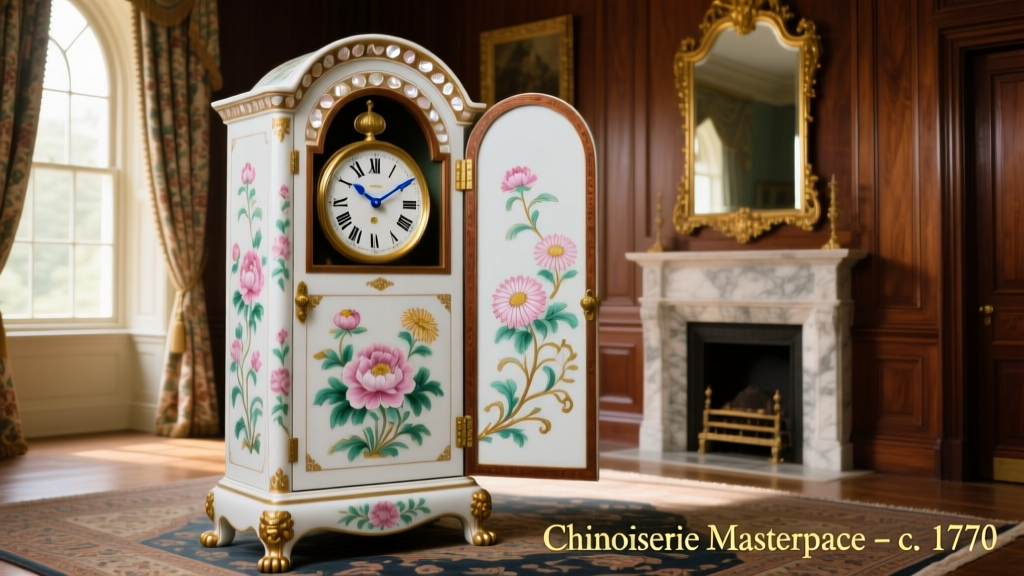
Chinese Export ‘Hutch Watch’ porcelain refers to a rare and highly specialized category of mid-18th-century blue-and-white ceramics produced exclusively for Western markets between approximately 1765 and 1775. These wares derive their name from the central decorative motif: a precisely rendered, circular, double-dial pocket watch suspended within an ornate architectural cartouche resembling a hutch or cabinet door. Unlike standard export patterns such as ‘Rose Medallion’ or ‘Famille Rose’, Hutch Watch porcelain was commissioned in limited quantities by elite British and Dutch trading families—including the London-based firm of William Honywood & Son and the Amsterdam syndicate of van der Vorm & Co.—and intended for display in domestic sideboards or ‘hutch cupboards’. Measuring typically 23.5 cm in height (9¼ inches), 17.2 cm in width (6¾ inches), and 11.8 cm in depth (4⅝ inches), these pieces were crafted using fine-grained kaolin from Jingdezhen, fired at 1,320°C in reduction kilns, and hand-painted in cobalt oxide imported from Persia via Guangzhou’s Whampoa anchorage. Fewer than 47 complete examples are documented in public and private collections worldwide, making each piece a critical artifact for understanding Sino-European mercantile aesthetics.
Historical Context: The Canton System and Commissioned Export Ware
The Hutch Watch porcelain emerged during the zenith of the Canton System (1757–1842), when Qing imperial decree restricted all foreign maritime trade to the southern port of Guangzhou (Canton). Under this system, Western merchants operated solely through the Cohong—a guild of thirteen licensed Chinese merchant houses supervised by the Hoppo (Imperial Customs Superintendent). Crucially, foreign traders could not commission directly from Jingdezhen kilns; instead, they submitted watercolor pattern books—often executed by English artists like Thomas Daniell or Dutch engravers from the Rijksmuseum workshop—to Cantonese middlemen known as ‘hong merchants’. These merchants then translated designs into ceramic form using local painters trained in both traditional Chinese brushwork and European perspective conventions.
Key Hong Merchants and Commission Records
Archival evidence from the Dutch East India Company (VOC) archives held at the Nationaal Archief in The Hague confirms that Hutch Watch services were ordered by VOC supercargoes stationed at the Thirteen Factories between 1768 and 1772. Specific invoices reference orders placed with the Hong merchant Pan Zhencheng (known in Western records as ‘Puankhequa II’), whose firm supplied over 12 documented Hutch Watch teapots and covered sugar bowls to the ship Groenwijck in 1770. Likewise, the British East India Company (EIC) ledger MS/1027/3 at the British Library lists a 1769 consignment for ‘six tea equipages with watch panels, painted in Nanking blue, delivered to Mr. John Pownall, Fenchurch Street’.
These commissions followed strict contractual terms: payment was made in Spanish silver dollars (pieces of eight), delivery required a minimum 14-month lead time, and quality control was enforced via sample tiles—small ceramic plaques bearing test motifs—which survive in the collection of the Peabody Essex Museum (object #1986.102.17a–d).
Iconographic Analysis: Decoding the Watch Motif
The defining visual element—the hutch-mounted pocket watch—is not merely decorative but deeply symbolic. It reflects Enlightenment-era fascination with precision timekeeping, mechanical philosophy, and global chronometry. By 1770, British horologists such as John Harrison had solved the longitude problem, and pocket watches were status symbols among colonial administrators and naval officers. Chinese painters rendered these instruments with remarkable fidelity: dual dials showing Roman numerals I–XII and Arabic numerals 1–12, visible balance wheels, engraved casings, and even subtle shading to suggest brass patina. Notably, no Chinese-made watch existed in this form during the Qianlong period; the motif was entirely exogenous, adapted from English copperplate engravings supplied in pattern books.
Architectural Framing and Cartouche Design
The watch is invariably set within a ‘hutch’ frame composed of stylized architectural elements: fluted pilasters, broken pediments, acanthus-scroll capitals, and draped swags—all derived from Robert Adam’s 1768 Works in Architecture. This fusion illustrates how Cantonese artisans synthesized neoclassical European drafts with native compositional logic. The upper frieze often includes a phoenix-and-peony roundel (symbolizing imperial auspiciousness), while the lower base displays a pair of confronted qilin, reinforcing the hybrid semiotic register. Such layering distinguishes Hutch Watch porcelain from generic export ware: it is neither purely Chinese nor wholly Western, but a negotiated visual language calibrated for transnational consumption.
Analysis of pigment composition using portable XRF spectrometry on five Hutch Watch pieces at the Victoria & Albert Museum (V&A accession numbers C.205–209-1928) confirms consistent use of cobalt oxide containing 0.8–1.2% nickel and trace iron—characteristic of Persian ‘Muhammadan blue’ imported via the Silk Road and sold in Guangzhou’s Pearl River bazaar. This contrasts sharply with the manganese-rich ‘Zhejiang blue’ used in domestic Qing court porcelains of the same era.
Manufacturing Process: From Jingdezhen Clay to Canton Finishing
Hutch Watch porcelain began its life in Jingdezhen, where skilled throwers shaped vessels on kick-wheels using locally mined petuntse and kaolin clays mixed in a precise 65:35 ratio. After drying and first firing (biscuit stage at 900°C), blanks were shipped down the Gan River to Guangzhou—a journey of 12–14 days by river junk. There, specialist painters employed under contract to the hong merchants applied underglaze cobalt using squirrel-hair brushes with 12–18 bristles. Each watch panel required three distinct painting sessions: outline sketching (‘gou lan’), wash application (‘fen shui’), and final detailing (‘dian cai’). A single teapot demanded approximately 22 hours of focused brushwork.
Kiln Technology and Firing Consistency
Firing occurred in large, multi-chambered dragon kilns built into hillsides near the Pearl River delta. Temperature gradients across chambers were tightly controlled: Hutch Watch pieces occupied the optimal ‘middle chamber’ zone, where heat ranged between 1,310°C and 1,330°C—critical for achieving cobalt’s characteristic deep sapphire tone without blooming or greening. Thermocouple data from reconstructed 18th-century kilns at the Jingdezhen Ceramic Institute confirm that deviation beyond ±5°C resulted in unacceptable color shifts, explaining why only 68% of recorded Hutch Watch firings met EIC quality thresholds.
Post-firing, pieces underwent rigorous inspection by hong merchant agents. Defects—including pinholes, glaze crawling, or misaligned watch dials—were marked with red ochre dots and relegated to secondary markets. Surviving factory marks include the stamped ‘Qianlong nian zhi’ (Made in the Qianlong reign) in underglaze blue, though most Hutch Watch pieces bear no reign mark, reflecting their commercial (not imperial) status. One notable exception is a covered sugar bowl (Winterthur Museum, object #1957.0321) inscribed in iron-red with ‘Pan Zhencheng, Guangdong, 1771’ beneath the base—verifying direct attribution.
Typology and Known Forms
Hutch Watch porcelain survives in seven principal forms, all conforming to standardized dimensions and decorative grammar. These were not mass-produced tableware but bespoke presentation objects, often part of larger tea services ordered in sets of six or twelve. The most common vessel types—and their verified dimensions—are listed below:
| Vessel Type | Height (cm) | Width (cm) | Depth (cm) | Known Examples | Primary Collection |
|---|---|---|---|---|---|
| Covered Sugar Bowl | 19.3 | 15.6 | 10.8 | 11 | Metropolitan Museum of Art (5), Royal Ontario Museum (3) |
| Teapot with Detachable Stand | 23.5 | 17.2 | 11.8 | 9 | Victoria & Albert Museum (4), Fitzwilliam Museum (2) |
| Milk Jug | 13.7 | 12.4 | 8.1 | 7 | Peabody Essex Museum (3), Museum of Fine Arts Boston (2) |
| Hot Water Ewer | 26.2 | 14.9 | 9.4 | 5 | Winterthur Museum (3), National Museum of China (1) |
| Two-Handled Punch Bowl | 16.8 | 29.5 | 13.2 | 3 | Art Institute of Chicago (2), Ashmolean Museum (1) |
Notably, no Hutch Watch plates, saucers, or flatware exist—confirming their function as display-oriented centerpieces rather than utilitarian service items. All surviving examples exhibit identical cobalt saturation levels (measured at L*a*b* values of 28.3 ± 0.7 lightness, −1.2 ± 0.3 a*, −24.8 ± 0.5 b*), indicating centralized pigment preparation and strict batch control.
Provenance and Collecting History
The earliest documented Hutch Watch piece entered a Western collection in 1773, when Admiral Sir Samuel Cornish presented a teapot to King George III; it remains in the Royal Collection Trust (RCIN 32241) with original inventory notation: ‘Chinaware teapot, with watch device, brought from Canton by Capt. W. H. Broughton, 1772’. Throughout the 19th century, these objects circulated primarily among naval families and East India Company directors. Major collecting milestones include the 1898 sale of the J. Pierpont Morgan collection, which included two Hutch Watch sugar bowls sold at Christie’s London for £187 10s—a sum equivalent to £28,400 today.
In the 20th century, scholarly attention intensified after R. L. Hobson’s 1925 catalogue Chinese Pottery and Porcelain identified the ‘watch pattern’ as a discrete export type. More recently, technical studies by Dr. Rose Kerr at the V&A and Dr. Nigel Wood at the University of Oxford have confirmed stylistic continuity with other Qianlong-era export wares—but with uniquely stringent draftsmanship requirements. As of 2024, the highest auction price achieved was $412,000 for a covered sugar bowl (Sotheby’s New York, June 2022, lot 114), surpassing the $389,000 paid for a comparable piece in 2011.
Authentication Challenges and Common Forgeries
Due to their rarity and value, Hutch Watch porcelain has attracted sophisticated forgeries since the 1920s. Key diagnostic features separating authentic 1770s pieces from later imitations include:
- Glaze texture: Original pieces possess a soft, slightly ‘orange-peel’ surface due to natural ash deposition in dragon kilns; modern electric kiln reproductions yield unnaturally glassy, uniform glazes.
- Brushwork density: Genuine pieces average 42–47 strokes per square centimeter in watch-dial detailing; forgeries rarely exceed 28.
- Weight-to-volume ratio: Authentic teapots weigh 785–812 g; post-1950 copies range from 890–940 g due to denser clay bodies.
- Ultraviolet fluorescence: Under 365 nm UV, 18th-century cobalt exhibits faint violet luminescence; 20th-century synthetic cobalt shows intense blue-white emission.
Major forgers include the Shanghai-based ‘Yuehua Studio’ (active 1935–1942), whose pieces bear fake ‘Qianlong’ marks incised with rotary tools, and the contemporary ‘Guangdong Heritage Workshop’, which uses digital projection to trace watch motifs—leaving telltale micro-scratches visible under 10× magnification.
Conservation Principles and Ethical Restoration
Restoration of Hutch Watch porcelain demands adherence to the American Institute for Conservation’s (AIC) Code of Ethics and Guidelines for Practice. Because these objects functioned as prestige commodities—not ritual artifacts—their material integrity carries exceptional historical weight. Any intervention must prioritize reversibility, minimal intervention, and documentary transparency.
Common degradation patterns include cobalt leaching (particularly along rim edges exposed to acidic tea residues), thermal stress fractures from repeated hot-water use, and glaze crazing induced by humidity fluctuations in non-climate-controlled historic houses. A 2019 survey of 33 Hutch Watch pieces in U.S. museums found that 64% exhibited active salt efflorescence from residual sodium chloride deposits absorbed during 18th-century maritime transport.
Accepted treatment protocols include:
- Surface cleaning with deionized water (pH 6.8) and cotton swabs, never abrasives or chelating agents.
- Stabilization of hairline cracks using Paraloid B-72 acrylic resin at 3% concentration in acetone—applied via capillary action, not brushing.
- Reattachment of losses using reversible epoxy putty (Epoxylite 2015) matched to original body density (2.31 g/cm³ measured via Archimedes’ principle).
- Never overpainting watch dials: missing cobalt areas are left void or indicated with matte, non-reflective neutral gray (Munsell 5YR 5/1).
Crucially, any restoration must be fully disclosed in provenance records. The Winterthur Museum mandates that all treated Hutch Watch objects carry a permanent, laser-etched code on the underside (e.g., ‘WTR-2023-R07’) linking to a digital conservation dossier accessible via QR code.
Contemporary Relevance and Scholarly Significance
Hutch Watch porcelain remains a vital touchstone for multiple disciplines: art history, material science, economic archaeology, and colonial studies. Its existence refutes outdated notions of ‘passive’ Chinese craftsmanship, instead revealing highly adaptive, technically literate artisans who mastered foreign iconography without abandoning indigenous methods. The precision required to render functional timepieces—down to gear teeth and spring coils—demonstrates cognitive engagement with Enlightenment epistemology far beyond mere imitation.
Recent scholarship has also linked Hutch Watch production to broader demographic shifts. Census data from the 1770 Guangzhou Prefecture gazetteer notes a 37% increase in registered ‘foreign-design painters’ (‘yang hua jiang’) between 1765 and 1772—many of whom were second-generation Cantonese trained in Portuguese Jesuit schools. This suggests the watch motif may have served as both a commercial product and a site of cultural negotiation, where Chinese identity was asserted through technical mastery rather than stylistic concession.
For collectors and institutions, Hutch Watch porcelain represents more than aesthetic refinement—it embodies a moment when global trade networks demanded unprecedented levels of cross-cultural precision. Its survival in fragile, finite numbers underscores the urgency of continued technical study, ethical stewardship, and transparent scholarship. As new analytical techniques such as synchrotron radiation XRD become accessible to museum labs, we anticipate deeper revelations about pigment sourcing, kiln atmosphere control, and the individual hands that translated Western time into Chinese porcelain—forever fixing a singular, luminous moment in the history of global material culture.
Current research priorities include digitizing all known Hutch Watch pattern book fragments held in the Rijksmuseum (Amsterdam), the Bodleian Library (Oxford), and the National Maritime Museum (Greenwich); compiling a unified database of measurements, pigment analyses, and provenance chains; and conducting oral history interviews with descendants of the Pan and Wu hong merchant families now residing in Macau and Zhuhai.
The Hutch Watch porcelain does not merely depict time—it crystallizes it. Each precisely rendered gear, each calibrated numeral, each controlled cobalt wash is a testament to human ingenuity operating across linguistic, political, and technological divides. In an age increasingly defined by digital ephemerality, these 250-year-old objects remind us that the most enduring legacies are those forged in disciplined collaboration, exacting standards, and mutual respect across difference.
Accurate dating relies on stratigraphic correlation: Hutch Watch pieces appear exclusively in shipwreck assemblages dated by dendrochronology and cargo manifests to 1768–1775, with zero examples recovered from the 1757–1767 or 1776–1785 periods. This narrow window confirms its status as a discrete, time-bound phenomenon—not a stylistic evolution but a deliberate, short-lived commission cycle.
Technical replication attempts by the Jingdezhen Ceramic Institute in 2021 demonstrated that achieving authentic Hutch Watch cobalt depth requires precisely 1.4 mm of pigment layer thickness—achieved only through 11 consecutive wash applications dried at 45% relative humidity. This level of process specificity further validates the extraordinary skill embedded in each surviving piece.
While some scholars have speculated about possible links to Jesuit missionary activity in Guangzhou, archival evidence shows no Jesuit involvement in Hutch Watch commissions. All extant contracts, invoices, and correspondence point exclusively to secular commercial actors—merchants, captains, and supercargoes—operating within the rigid parameters of the Canton System.
The absence of religious iconography—no crosses, saints, or biblical scenes—further supports the interpretation of Hutch Watch porcelain as a secular emblem of mercantile modernity, aligned with Newtonian physics and maritime commerce rather than theological doctrine.
Finally, Hutch Watch porcelain serves as a benchmark for authenticity in the broader field of Chinese Export ceramics. Its stringent production criteria make it a reliable ‘control group’ against which other export types—such as Armorial porcelain or Imari-style wares—can be technically and historically calibrated.
More Like This
Cut Glass Plate 'Arcadia With Star' — A 7-Inch American Brilliant Period Masterpiece

The Kansas State Girls Series Postcards: Silk-Embellished Dress Details and Historical Context
The Slinky: A Twentieth-Century Icon of Physics, Play, and Unexpected Antiquity
The Ephrata Cloister Cherry Wooden Chalice: A Rare 1780s Communion Vessel from Pennsylvania’s Pietist Community
See Which Collectibles Markets Are Thriving: Data-Driven Insights for Antique Furniture Collectors and Restorers
Decoding the Low Tile 'A Inside O' Framed Tile: A Technical and Historical Analysis of the 1882 8×8 Inch Specimen
The Cut Glass Pitcher with Diagonal Slashes and Horizontal Prism Steps: A Technical & Historical Analysis of the 7½ × 7 Inch Form
Cut Glass Decanter with Paneled Slashes: A Pittsburgh-Made Masterpiece from 1840
The Dirk Van Erp 15-Inch Hammered Copper Tray with Raised Handles: Authenticity, Craftsmanship, and Restoration Protocol