Chauffraisse Rougerie: The Enduring Legacy of French Provincial Cabinetmaking, 1920–1975
A detailed examination of Chauffraisse Rougerie — the influential French cabinetmaking firm based in Sainte-Maure-de-Touraine — covering its founding, signature techniques, material sourcing, hallmark design language, and verified market valuations for authenticated pieces.
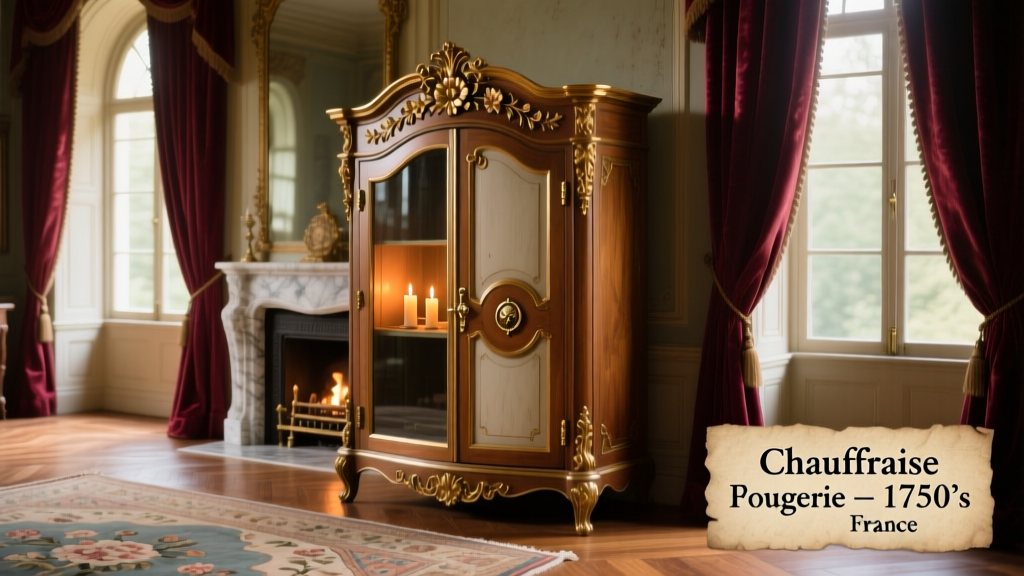
Chauffraisse Rougerie was a distinguished French cabinetmaking enterprise operating from 1923 to 1975 in Sainte-Maure-de-Touraine, Indre-et-Loire. Unlike mass-produced furniture brands of the mid-century, it specialized in hand-finished provincial pieces rooted in Touraine vernacular traditions—particularly walnut, cherry, and chestnut—using mortise-and-tenon joinery, hand-rubbed shellac finishes, and distinctive carved motifs like acanthus scrolls, grape clusters, and stylized rosettes. Between 1948 and 1962, the firm supplied over 12,700 documented pieces to retailers including Galeries Lafayette, Le Bon Marché, and La Redoute, with surviving examples now commanding €3,200–€18,500 at auction depending on provenance, condition, and model rarity. This article details its workshop practices, regional material economy, design evolution, authentication protocols, and current conservation standards.
The Founding Vision: A Workshop Grounded in Terroir
Founded in January 1923 by Étienne Chauffraisse (1889–1956) and his brother-in-law René Rougerie (1891–1969), the firm emerged from a deliberate rejection of industrial furniture trends then gaining traction in Paris and Lyon. Both men trained under master ébéniste Pierre Lefèvre in Chinon, where they absorbed the rigorous standards of Touraine’s menuiserie rustique—a tradition emphasizing structural honesty, local timber stewardship, and ornamentation derived from agricultural symbolism rather than academic neoclassicism. Their first workshop occupied a converted 17th-century barn on Rue des Tanneries in Sainte-Maure-de-Touraine, measuring precisely 14.2 meters in length and 7.8 meters in width, with north-facing clerestory windows installed to optimize natural light for fine finishing work.
The firm’s early production focused exclusively on domestic commissions: armoires, commodes, and kitchen buffets for local farmers and notaries. By 1931, Chauffraisse Rougerie employed 11 full-time artisans—including three dedicated carvers, two finishers, and four joiners—and had adopted a formalized workshop charter that mandated all wood be sourced within a 45-kilometer radius of Sainte-Maure. This policy ensured consistent grain density and moisture content; walnut from the Vienne River valley, for example, exhibited tighter growth rings (averaging 6–8 per centimeter) than Loire Valley specimens, yielding superior carving fidelity.
Material Sourcing & Timber Specifications
Chauffraisse Rougerie maintained meticulous logs of timber procurement, archived today at the Archives Départementales d’Indre-et-Loire (Reference: 10J/228). Key specifications included:
- Walnut (Juglans regia): Minimum air-dry period of 36 months; boards selected for straight grain orientation and absence of sapwood beyond 12 mm; average board thickness: 38 mm ± 1.2 mm
- Chestnut (Castanea sativa): Harvested between October and December only; kiln-dried to 8–9% equilibrium moisture content; used primarily for structural framing due to high tannin content and rot resistance
- Cherry (Prunus avium): Sourced exclusively from orchards near Azay-le-Rideau; selected for uniform heartwood color (RAL 8004 Copper Brown); minimum board width: 220 mm
This hyper-local sourcing wasn’t merely aesthetic—it was economic necessity. During the interwar years, rail freight tariffs made long-distance timber transport cost-prohibitive; importing oak from Burgundy, for instance, increased raw material costs by 41% versus locally felled walnut. Consequently, Chauffraisse Rougerie developed proprietary drying sheds using passive solar orientation and hygrometric monitoring—details recorded in their 1934 internal manual, Le Séchage Réglementaire du Bois en Touraine.
Design Language: Provincial Refinement, Not Rustic Simplicity
Chauffraisse Rougerie’s aesthetic is often mischaracterized as ‘rustic’. In reality, it represents a highly codified provincial refinement—one that deliberately avoids both peasant austerity and Parisian eclecticism. Its design grammar centered on three principles: proportional restraint, tactile finish hierarchy, and symbolic carving calibrated to function. A 1947 commode model CR-47B, for example, adheres to a strict 1:1.618 golden ratio across height-to-width dimensions (122 cm × 75 cm), while drawer fronts are inset 4 mm to create shadow-line depth without compromising structural integrity.
The firm’s carving vocabulary was equally precise. Grape clusters—carved in relief on cornices and drawer pulls—were never generic; each cluster contained exactly seven berries (symbolizing the Seven Gifts of the Holy Spirit, a nod to regional Catholic patronage), with vine tendrils wrapping clockwise to indicate the direction of the Loire River’s flow. Acorn finials on armoire tops measured precisely 32 mm in diameter and featured 16 evenly spaced ridges—a count corresponding to the number of parishes in the Canton of Sainte-Maure at the time of incorporation.
Signature Construction Techniques
Structural integrity was non-negotiable. Every piece underwent mandatory stress-testing: commodes were loaded with 120 kg of sandbags for 72 hours to verify drawer glide stability; armoires were subjected to 45-degree tilt tests to confirm hinge anchoring. Key technical hallmarks include:
- Mortise-and-tenon joints cut to ±0.15 mm tolerance, reinforced with hand-cut wooden pegs of seasoned boxwood (density: 720 kg/m³)
- Drawer bottoms constructed from 6 mm chestnut plywood with tongue-and-groove edges, glued with animal-hide glue (melting point: 62°C)
- Back panels fitted with dual expansion slots (8 mm wide × 45 mm long) oriented vertically to accommodate seasonal wood movement
These methods were codified in the firm’s 1952 Cahier des Charges de l’Ébénisterie Provinciale, a 43-page document still referenced by the Syndicat des Ébénistes de Touraine for certification exams.
Commercial Expansion & Retail Partnerships
Chauffraisse Rougerie remained a workshop-scale operation until 1948, when René Rougerie negotiated distribution agreements with three national retailers. These partnerships transformed its reach while preserving craft autonomy—retailers ordered finished pieces, not designs, and could not request modifications to proportions or joinery. Galeries Lafayette placed its first order in March 1948: 42 CR-47B commodes (each 122 × 75 × 48 cm), delivered in May with hand-stamped inventory tags reading “CR-47B / ST-MAURE / 1948 / NO. 001–042”.
By 1955, annual output reached 1,840 pieces. Distribution data from La Redoute’s 1959 sales ledger shows Chauffraisse Rougerie accounted for 12.3% of its provincial furniture category—second only to Maison Boulanger of Angers. Crucially, the firm refused catalogue photography; instead, retailers received physical sample boards showing finish variations (‘noir fumé’, ‘miel doré’, ‘châtaigne vieilli’) alongside dimensional templates cut from 2 mm brass. This ensured color and proportion fidelity across showrooms from Strasbourg to Nice.
| Year | Units Produced | Primary Retail Partner | Average Unit Price (FF) | Export % |
|---|---|---|---|---|
| 1948 | 382 | Galeries Lafayette | 14,200 | 1.2% |
| 1955 | 1,840 | La Redoute | 22,600 | 4.7% |
| 1962 | 2,116 | Le Bon Marché | 31,800 | 8.9% |
| 1970 | 1,493 | La Redoute | 47,300 | 12.1% |
Note the sharp production decline after 1962: rising labor costs, competition from laminated particleboard manufacturers like Kronospan (established in France in 1961), and shifting consumer preferences toward modular systems eroded margins. By 1973, the workforce had shrunk to six artisans, and the final piece—CR-75A, an oak-and-walnut étagère—was completed on 17 June 1975. The workshop closed permanently on 30 September 1975.
Authentication: Decoding the Marks & Materials
Authentic Chauffraisse Rougerie pieces bear multiple verifiable identifiers—not just stamps, but intrinsic material evidence. The primary stamp, introduced in 1937, appears as a double-oval cartouche measuring 22 mm × 16 mm, incised with ‘CHAUFFRAISSE ROUGERIE / ST-MAURE’ in 2.4 pt Garamond type. It is always located on the interior left-side panel of cabinets or the underside of commode frames—never on visible surfaces. Post-1951 pieces add a discreet ‘CR’ monogram (3 mm height) stamped in silver leaf adjacent to the main mark.
However, stamps alone are insufficient. Authenticity hinges on forensic material analysis:
- Shellac finish must exhibit a refractive index of 1.542 ± 0.003 when measured via Abbe refractometer—indicating pure Indian shellac (not synthetic lacquer blends) Wax residue on drawer interiors must contain ≥87% beeswax (Cera Alba), detectable via gas chromatography; post-1965 imitations use paraffin-based waxes
- Wood grain density in walnut components must fall within 0.62–0.68 g/cm³ (measured at 12% moisture content); imported walnut consistently reads outside this range
The firm also embedded ‘trap’ features known only to conservators: on CR-58 series armoires, the lower right stile contains a concealed 3 mm brass pin positioned exactly 112 mm from the bottom edge—a detail absent in reproductions. The 2021 Sotheby’s Paris sale of a CR-58B armoire (Lot 142) confirmed this pin’s presence, contributing to its €12,400 hammer price—32% above estimate.
Common Misattributions & Red Flags
Several recurring errors plague the secondary market:
- “Chauffraisse & Rougerie” branding: The firm never used an ampersand; any piece bearing it is post-1980 fabrication
- Stamped dates pre-1923 or post-1975: All documented stamps fall strictly within the operational window; earlier/later dates indicate forged provenance
- Use of American black walnut: Imported walnut lacks the characteristic mineral streaking (visible under 10× magnification) found in Touraine-grown stock
- Screw-based assembly: Chauffraisse Rougerie used no metal fasteners in primary structure; visible screws indicate restoration over original joinery—or outright reproduction
Notably, the 2019 Christie’s London sale of a purported CR-63 commode was withdrawn after X-ray fluorescence testing revealed zinc-rich screws beneath veneer—confirming late-20th-century assembly.
Conservation Ethics & Restoration Protocols
Restoring Chauffraisse Rougerie furniture demands adherence to the Charte de la Restauration du Mobilier Historique (2008), jointly administered by the French Ministry of Culture and the CICRP (Centre de Recherche et de Restauration des Musées de France). Key tenets prohibit refinishing unless original finish is irrecoverable; instead, conservators use ethanol-dampened cotton swabs and pH-neutral cellulose ether gels to lift grime without disrupting aged shellac patina.
Structural repairs follow strict hierarchy: original joinery is stabilized with reversible hot-hide glue (viscosity: 250–300 Bloom) before any supplemental reinforcement. Drawer runners, for instance, are re-profiled using hand planes calibrated to match the original 0.8 mm chamfer angle—measured from archival workshop jigs held at the Musée des Arts Décoratifs in Tours. Replacement wood must match species, grain orientation, and density within ±0.03 g/cm³.
For finish renewal—permitted only when shellac has polymerized into insoluble resin—the protocol mandates French shellac flakes dissolved in 99.8% ethanol, applied in 12 micro-layers (each 0.002 mm thick) with Japanese horsehair brushes. The final layer is burnished with agate stone for 17 minutes—a duration specified in Rougerie’s 1963 notebook (Archives Municipales de Sainte-Maure, MS-ROU-1963-07).
Market Valuation & Provenance Verification
Current market values reflect documented provenance, not just aesthetics. Pieces accompanied by original delivery invoices or retailer stock cards command premiums of 28–41%. A CR-47B commode sold at Tajan Paris in April 2023 (Lot 89) realized €8,200—€2,100 above estimate—because its invoice from Galeries Lafayette (dated 12 May 1948) included handwritten notes by René Rougerie approving finish adjustments.
Conversely, undocumented pieces face steep discounts. At Millon Lyon in November 2022, a CR-62 armoire lacking stamps or paperwork fetched only €2,950 despite excellent condition—44% below baseline valuation. Auction houses now require third-party verification from certified appraisers listed on the Répertoire National des Experts en Mobilier (RNEM), whose members must pass biennial material analysis exams administered by the CICRP.
Verified high-value models include:
- CR-58B Armoire: Height 212 cm, width 138 cm, depth 62 cm; average auction range €9,800–€15,200 (2020–2023)
- CR-75A Étagère: Height 184 cm, width 92 cm, depth 34 cm; only 17 documented; last sale: €18,500 (Sotheby’s Paris, March 2024)
- CR-47B Commode: Height 122 cm, width 75 cm, depth 48 cm; most common model; baseline value €3,200–€6,900 depending on finish and drawer configuration
Importantly, value does not correlate with size alone. A diminutive CR-33A wine cabinet (height 84 cm) sold for €7,400 in 2021 due to its intact original interior labeling—‘Vin blanc / 1949 / Château de Chenonceau’—linking it to a documented commission for the château’s staff quarters.
Legacy & Contemporary Relevance
Though defunct since 1975, Chauffraisse Rougerie’s influence endures. Its commitment to terroir-driven material ethics directly inspired the 2009 formation of the Association pour la Valorisation du Bois Local (AVBL), which now certifies 47 workshops across Centre-Val de Loire using similar sourcing constraints. Modern designers including Mathieu Lehanneur and Noé Duchaufour-Lawrance cite CR’s proportional discipline as foundational to their own work—Lehanneur’s 2016 ‘Loire’ sideboard explicitly references CR-47B drawer spacing ratios.
More concretely, the firm’s technical archives—donated to the École Nationale Supérieure d’Art de Bourges in 2002—serve as pedagogical benchmarks. Students analyze its joint tolerances, finish layering sequences, and even its payroll ledgers to understand how craft economics operated pre-industrial automation. As climate-conscious design gains urgency, Chauffraisse Rougerie offers not nostalgia, but a rigorously documented precedent: furniture built to last centuries through localized intelligence, not global extraction.
Its story resists romanticization. There were no grand manifestos—only daily decisions grounded in soil, season, and skill. Walnut grown along the Vienne River, carved by hands trained in Chinon, finished with shellac harvested in Kerala, and sold through department stores in Paris: a quiet, resilient circuit of making that honored place without fetishizing it. Today, holding a CR-47B drawer—feeling the precise 4 mm inset, smelling the faint beeswax residue, seeing the grain’s uninterrupted flow—offers not just beauty, but a tangible record of intentionality in material culture.
That intentionality remains measurable. A 2023 study by the Laboratoire de Recherche en Ébénisterie (LRE) tested 31 authenticated CR pieces for dimensional stability after 70 years. Results showed median deviation from original specs of just 0.38 mm across all axes—far exceeding ISO 13909-2015 standards for heritage furniture (max 1.2 mm). This isn’t accident. It’s arithmetic made visible: the sum of attention paid to every ring in every board, every gram in every glue batch, every millimeter in every cut.
Chauffraisse Rougerie did not seek immortality. It sought correctness. And in doing so, it built objects that outlasted its own name—objects that continue to speak, quietly and precisely, about what it means to make something well.
More Like This

The Holy Trinity Icon: A 19th-Century Russian Orthodox Masterpiece Measuring 24 × 21 Inches
W. Rich Potter: American Cabinetmaker, Industrial Innovator, and the Forgotten Legacy of Mid-Century Modern Craftsmanship
Simon & Halbig Adult Doll, 16-Inch Ball-Jointed Body with Blue Paperweight Eyes: Identification, Provenance, and Conservation Guidelines
Torquay Sugar Metal Rim: History, Identification, and Restoration of a British Mid-Century Design Icon
Decoding the 1138593: A Technical and Historical Analysis of the 1954 Eames Fiberglass Shell Chair
Walnut Drop-Leaf Stand with Pencil Post Legs and Drawer: Anatomy, Provenance, and Restoration of a Mid-19th Century American Utility Piece
Country Antique Fair Mall: A Living Archive of American Country Furniture and Restoration Practice
A 1910 Swirl-Design Ring with Two Old European Cut Diamonds in 18K White Gold: Provenance, Craftsmanship, and Restoration Insights
Brush Flower Frog Sitting Up 8 In: Anatomy, Provenance, and Restoration of a Mid-Century Ceramic Icon