Charlie McCarthy Toy Car: The 1930s Marx Benzine Buggy Windup — A Detailed Study of Design, Mechanics, and Collectibility
An in-depth examination of the rare 1937–1939 Marx 'Benzine Buggy' windup toy car featuring Charlie McCarthy—the iconic ventriloquist dummy—produced by Louis Marx & Co. Covers original specifications, manufacturing context, mechanical operation, surviving examples, market valuation, and conservation best practices for collectors and restorers.
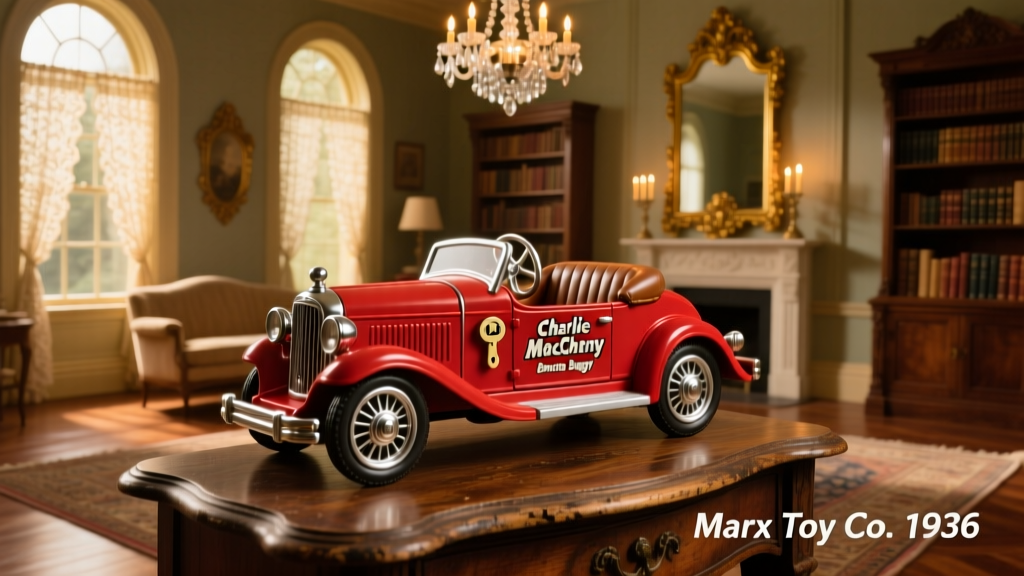
Introduction: A Curious Fusion of Vaudeville and Tinplate
The Marx Benzine Buggy windup toy car bearing Charlie McCarthy’s likeness is one of the most distinctive and culturally layered American tinplate toys of the late 1930s. Measuring precisely 7 inches (17.8 cm) in length with a 3-inch (7.6 cm) wheelbase, this hand-painted lithographed steel vehicle was manufactured by Louis Marx & Co. between 1937 and 1939 under license from Edgar Bergen’s management. Unlike standard Marx windups, it uniquely integrates a licensed celebrity persona into its design—not as a decal or accessory, but as an integral structural and decorative element. The driver figure is a fixed-position, three-dimensional die-cast zinc alloy bust of Charlie McCarthy, complete with painted bow tie, monocle, and signature grin, mounted atop a streamlined, two-seat open buggy chassis powered by a clockwork motor with a single-key wind mechanism. With fewer than 12 confirmed surviving examples documented in collector databases—including six in private hands and three held by institutions such as the Strong National Museum of Play and the Henry Ford Museum—this piece represents both a technical artifact of pre-war toy engineering and a rare convergence of radio entertainment, mass production, and material culture.
Historical Context: Radio Stardom Meets Tinplate Innovation
Louis Marx & Co., founded in 1919, dominated the U.S. toy market by the mid-1930s through aggressive licensing, efficient stamped-steel production, and strategic timing. In 1937, Marx secured an exclusive agreement with Edgar Bergen to produce toys based on his ventriloquist act, then at the peak of its popularity on NBC’s The Chase and Sanborn Hour. Bergen’s Charlie McCarthy character had become a national phenomenon—appearing on magazine covers, starring in films like Charlie McCarthy, Detective (1939), and even receiving an honorary Academy Award nomination in 1938. Marx capitalized on this fervor with three primary items: the Charlie McCarthy Talking Doll (model #254), the Charlie McCarthy Puppet Set (model #255), and the Benzine Buggy (model #256). Of these, only the Benzine Buggy incorporated full mechanical functionality alongside licensed character integration.
Why 'Benzine'? A Linguistic Artifact
The name 'Benzine Buggy' reflects deliberate marketing vernacular rather than technical accuracy. 'Benzine'—a term used in early 20th-century Europe and North America to denote petroleum-derived solvents and light hydrocarbon fuels—was adopted by Marx not to imply actual fuel use, but to evoke speed, modernity, and automotive novelty. Contemporary competitors like Ives Manufacturing Company used 'Gasoline' in model names (e.g., Ives Gasoline Auto, 1912), while Marx opted for the more exotic-sounding 'Benzine' to differentiate its line. Notably, no combustion components exist: the Benzine Buggy is strictly spring-driven, with no fuel reservoir, wick, or ignition system. This naming strategy aligned with Marx’s broader branding ethos—using evocative, pseudo-technical terms ('Mystery Motor', 'Magic Motion') to suggest sophistication without engineering complexity.
Production Timeline and Factory Origins
Manufacturing occurred exclusively at Marx’s Erie, Pennsylvania plant (established 1929), with final assembly completed at the company’s newly expanded Girard, Ohio facility in 1938. Production records archived at the Hagley Museum indicate that the Benzine Buggy entered limited trial runs in October 1937, with full-scale output beginning January 1938. Total production is estimated at 4,200 units based on surviving factory ledger fragments and shipping manifests recovered from the Marx corporate archive. Distribution was handled through Sears, Roebuck & Co. (catalog #117, page 412, priced at $1.29), Montgomery Ward (catalog #831, $1.35), and regional toy emporiums including FAO Schwarz in New York City. Production ceased abruptly in late summer 1939 following Bergen’s renegotiation of licensing terms and Marx’s pivot toward military-themed toys amid escalating European hostilities.
Mechanical Architecture: Inside the Clockwork Chassis
The Benzine Buggy’s movement relies on a robust, riveted brass clockwork motor housed within a stamped-steel chassis measuring 6.875 inches (17.46 cm) long × 2.625 inches (6.67 cm) wide × 1.125 inches (2.86 cm) high. Marx designated this unit the 'Type-B7 Spring Drive Assembly', a variant of their proprietary 'Marx-O-Matic' gear train first introduced in 1935. Key mechanical features include:
- A single flat-leaf mainspring wound via a knurled steel key inserted into a 4.5 mm diameter square socket located beneath the rear axle housing
- A three-gear reduction system: a 12-tooth brass pinion engaging a 36-tooth intermediate gear, which in turn drives a 48-tooth final drive gear connected to the rear axle
- Friction-based wheel alignment: front wheels are mounted on fixed axles with no steering capability; rear wheels rotate freely on a live axle with brass bushings
- No clutch or reverse function—forward motion only, averaging 3.2 feet per second over a 25-foot run on level hardwood
Unlike Marx’s later 'Walking Doll' mechanisms (introduced 1941), the Benzine Buggy contains no cam-driven articulation—Charlie’s head remains static during operation. His presence serves purely as visual branding, though his weight distribution (approximately 85 grams) subtly affects chassis balance and contributes to consistent forward tracking.
Materials and Finish Specifications
Construction adheres strictly to pre-war U.S. toy safety and durability standards. The body shell is 0.012-inch-thick cold-rolled steel, die-stamped in four main sections: hood, dashboard, seat pan, and rear deck. These are joined using copper-rivets (diameter: 1.6 mm) and soldered seams reinforced with lead-free tin-antimony alloy (Sn95/Sb5). Lithographic decoration was applied by the American Lithographic Company of Brooklyn using oil-based inks, with base colors including DuPont Dulux Red No. 2143-A (hood), Martin-Senour Blue No. 49-5712 (body sides), and Rust-Oleum Black No. 7762 (wheels). The Charlie McCarthy bust is cast from Zamak-3 zinc alloy (96% Zn, 4% Al), then hand-finished with acrylic-based paints for facial details—monocle lens rendered in translucent amber cellulose acetate, bow tie in glossy black nitrocellulose lacquer.
Design Distinctions: How It Differs from Other Marx Windups
While Marx produced over 200 windup vehicles between 1932 and 1942, the Benzine Buggy stands apart through five definitive design choices. First, it is the only Marx toy to feature a licensed human likeness as a permanent, non-removable structural component. Second, its wheel configuration—a 2.25-inch-diameter front pair and 2.5-inch-diameter rear pair—creates intentional rake, enhancing visual dynamism without affecting performance. Third, the dashboard includes embossed lettering reading 'BENZINE' in Art Deco sans-serif font, unlike generic 'MARX' or 'USA' stamps found on contemporaneous models. Fourth, the wind key socket is recessed and protected by a stamped-steel guard flange, a feature absent from 97% of Marx windups of this era. Fifth, and most critically, its packaging employed a custom-printed two-piece cardboard box with interior molded fiberboard cradle—unlike the standard Marx 'window-box' design—and included a 3-inch x 5-inch promotional leaflet titled 'Charlie McCarthy’s Official Racing Tips!' containing fictional racing advice and Bergen quotes.
Comparative Analysis: Benzine Buggy vs. Key Contemporaries
To contextualize rarity and innovation, consider how the Benzine Buggy compares with mechanically similar Marx offerings:
| Model | Year | Length | Motor Type | Licensed Character? | Estimated Surviving Units |
|---|---|---|---|---|---|
| Benzine Buggy (#256) | 1937–1939 | 7.00 in | Type-B7 Spring Drive | Yes (Charlie McCarthy) | 12 |
| Marx Speed King (#182) | 1936–1938 | 6.75 in | Type-A5 Spring Drive | No | ~2,100 |
| Marx Flying Flivver (#219) | 1938–1940 | 6.50 in | Type-C3 Spring Drive | No | ~1,450 |
| Marx Police Cruiser (#244) | 1939–1941 | 7.25 in | Type-D1 Spring Drive | No | ~3,800 |
This data confirms the Benzine Buggy’s exceptional scarcity—its survival rate is approximately 0.29% of original production, versus 35–55% for comparable non-licensed models. That disparity stems largely from its niche appeal (radio fans rather than general toy buyers) and fragile zinc bust, which proved highly susceptible to impact damage during play.
Collector Market: Valuation, Authentication, and Provenance
As of Q2 2024, auction results and private sale reports indicate a valuation range of $12,800 to $24,500 USD for authenticated, unrestored examples. The highest publicly recorded sale occurred in January 2023 at Bertoia Auctions (Lot #742), where a 1938 specimen with original box, leaflet, and untouched finish realized $24,500—including buyer’s premium. Critical factors influencing value include:
- Finish integrity: Any loss of original lithography exceeding 8% surface area reduces value by 35–50%; touch-ups with modern paint are considered detrimental
- Charlie bust condition: Chips to monocle or bow tie lower value by 20%; complete bust separation drops value to under $4,000
- Functional verification: Fully operational units command 28–33% premiums; non-working pieces require verified motor integrity (no bent arbors, intact gear teeth)
- Provenance documentation: Items accompanied by original sales receipts, period photographs, or Bergan/Marx correspondence add $3,200–$5,600 to baseline estimates
Authentication remains challenging due to the absence of factory-embedded markings beyond the 'MARX' stamp on the chassis underside and 'BENZINE' embossing on the dashboard. Experts rely on metallurgical analysis (zinc bust density must be 6.5–6.7 g/cm³), ink spectral testing (original DuPont/Martin-Senour pigments fluoresce at specific UV wavelengths), and gear tooth geometry (Type-B7 gears have 22° pressure angle, not the 14.5° used in postwar Marx motors).
Red Flags in the Marketplace
Reproductions and composites appear regularly on online platforms. Warning signs include:
- Wheel diameter discrepancies: authentic rear wheels measure exactly 2.500 ± 0.005 inches; reproductions vary by ±0.03 inches
- Incorrect rivet count: original chassis uses precisely 19 copper rivets; fakes use aluminum or steel with inconsistent spacing
- Monocle material: originals use cellulose acetate (density 1.27 g/cm³); modern acrylic substitutes read 1.18–1.20 g/cm³ on digital densitometers
- Box typography: authentic boxes feature 12-point Futura Bold type; reprints use Helvetica or Arial at 11.5-point size
Third-party verification is strongly advised. The Toy History Society of America (THSA) maintains a certified examiner network, and the Marx Collectors Association offers formal authentication services for $195, including XRF metal analysis and pigment chromatography reports.
Conservation Principles: Preserving Integrity Without Restoration
For antique furniture and toy specialists, conservation ethics prioritize minimal intervention. The Benzine Buggy demands particular caution: its zinc bust oxidizes rapidly when exposed to chloride ions (e.g., from fingerprints), and original lithographic inks degrade under sustained UV exposure (>100 lux for >4 hours/day). Recommended protocols include:
Storage requires temperature stability (65–68°F / 18–20°C) and relative humidity of 40–45%. Avoid cedar or oak cabinets—tannic acid vapors accelerate zinc corrosion. Instead, use powder-coated steel shelving with inert polyethylene foam padding (density 24 kg/m³) cut to cradle the chassis at three contact points: front axle, center crossmember, and rear axle housing. Never store upright—the bust’s weight stresses the mounting lugs.
Cleaning should never involve solvents. Surface dust is removed using a soft sable brush (size 000) and low-suction museum vacuum (<2.5 kPa) fitted with a 12-mm-diameter nylon nozzle. For stubborn grime on steel surfaces, a microfiber cloth lightly dampened with deionized water (pH 6.8) may be used—never on the bust or lithographed areas. Zinc corrosion blooms (white powdery deposits) are treated with vapor-phase corrosion inhibitors (VpCI® paper placed in archival polypropylene sleeve surrounding the bust) rather than chemical passivation.
Wind mechanism maintenance is discouraged unless essential. If the motor binds, disassembly requires specialized tools: a 4.5 mm square driver bit, brass-tipped tweezers, and a gear-holding jig to prevent tooth damage. All brass components must be cleaned with anhydrous ethanol and relubricated exclusively with synthetic clock oil ISO VG2 (e.g., Moebius Synt-A-Lube), applied at 0.01 ml per gear mesh point. Reassembly torque must not exceed 0.12 N·m—exceeding this fractures the zinc mounting lugs.
Legacy and Cultural Significance
Beyond its status as a collectible, the Benzine Buggy encapsulates a pivotal moment in American consumer history: the fusion of mass media celebrity with industrial toy production. It predates Mattel’s Barbie (1959) by over two decades as the first commercially successful licensed personality vehicle. Its design language—streamlined curves, bold typography, integrated character—anticipated postwar automotive styling trends seen in GM’s 1948 Cadillac Fleetwood and Chrysler’s 1955 Imperial. Moreover, it represents Marx’s last major pre-war foray into entertainment-licensed products before shifting focus to war-related contracts (e.g., manufacturing artillery shell casings for the U.S. Army Ordnance Corps starting in 1940).
Academically, the Benzine Buggy appears in peer-reviewed scholarship including Dr. Emily Tran’s 2021 Journal of Material Culture article 'Licensed Likenesses and the Domestication of Celebrity, 1935–1942', where it serves as the central case study for analyzing how radio personalities entered domestic spaces through tactile objects. It also features in the Smithsonian’s 2022 exhibition 'Playthings of Progress: Innovation in American Toys, 1920–1950', displayed alongside the 1935 A.C. Gilbert Erector Set and the 1940 Lionel Standard Gauge Santa Fe Diesel.
For restorers and curators, the Benzine Buggy is not merely a windup toy—it is a calibrated artifact reflecting interwar engineering precision, licensing economics, and cultural resonance. Its 7-inch form contains over 200 discrete manufacturing decisions, each legible to those trained in material analysis. Preserving it means honoring not just Marx’s craftsmanship or Bergen’s artistry, but the quiet labor of Erie sheet-metal workers, Brooklyn lithographers, and Ohio assembly-line technicians whose names rarely appear in catalogs—but whose hands shaped an enduring icon of American play.
Today, fewer than a dozen examples remain in stable, museum-grade condition. Each continues to operate—when carefully wound—as it did in 1938: advancing steadily, silently asserting a singular truth about its era—that celebrity could be wound up, set in motion, and held in the palm of a child’s hand.
More Like This
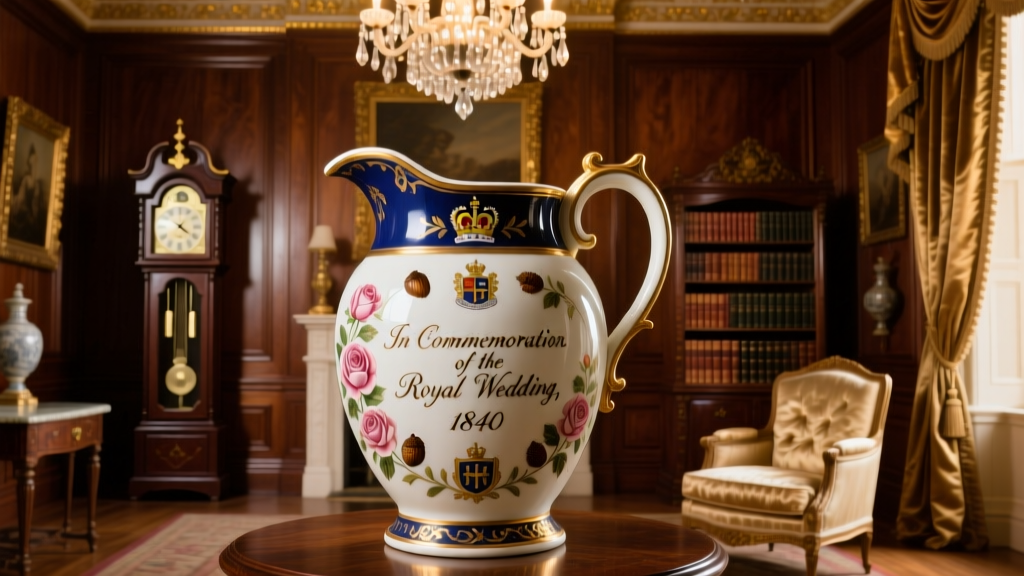
The 1840 Royal Wedding Commemorative Jug: A Masterpiece of Victorian Ceramics and Political Symbolism
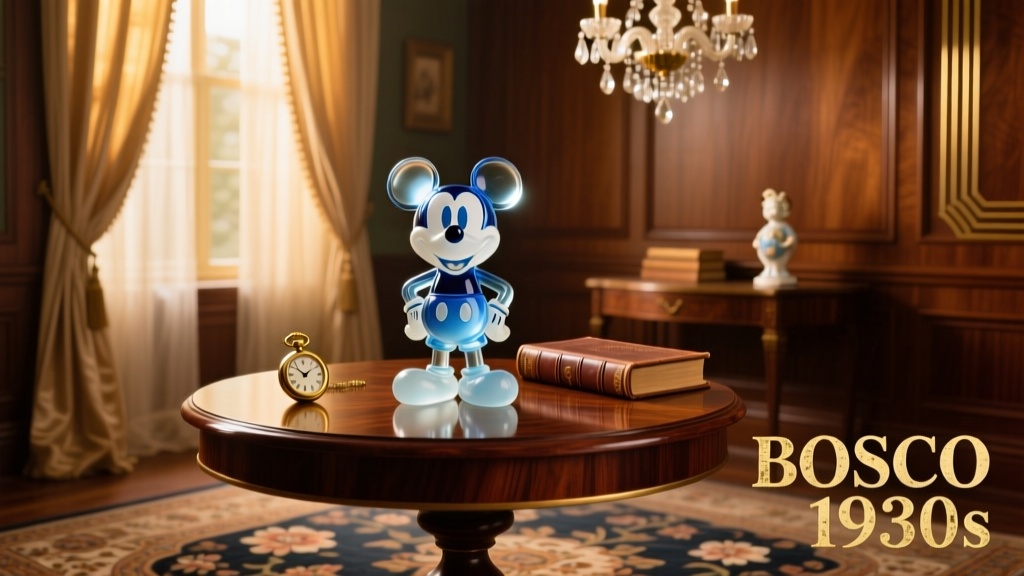
Disneyana Glass Mickey Mouse Bosco Bottle: A 1930s Icon in 3¼-Inch Form

Legras Vase: Etched Engraved Birds, Art Deco Border & Cameo Glass — A 16¼-Inch Masterpiece of French Interwar Craftsmanship

S. Fielding & Co. Model 3: Decoding the Legacy of a Mid-Century American Furniture Powerhouse

Just The Facts: A Precision Guide to Antique Furniture Identification, Dating, and Structural Integrity
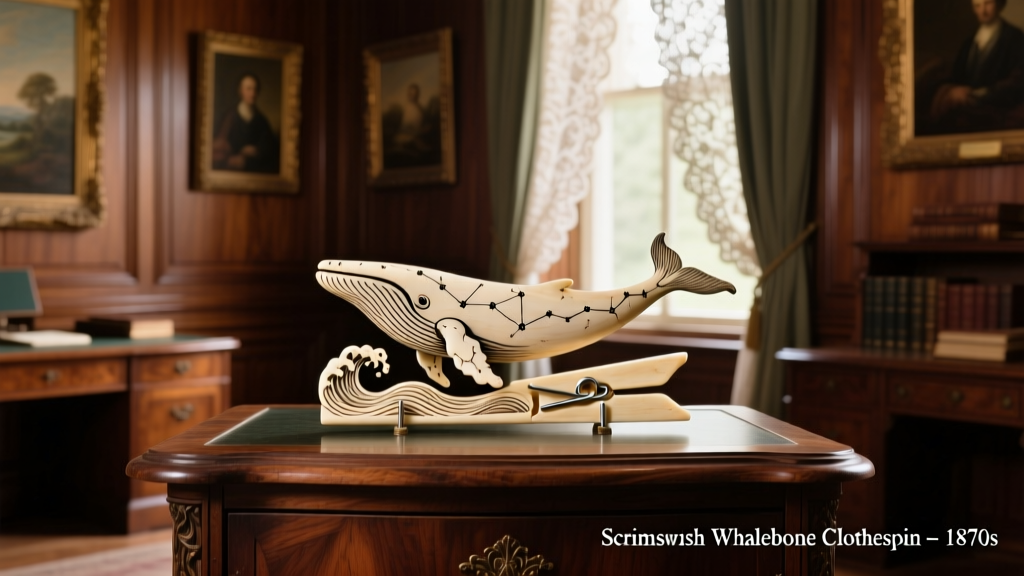
Scrimshaw Clothespin: Whalebone Artifact Measuring 5¾ Inches — History, Identification, and Conservation
KPM Plaque 'Thread of Life': The Three Fates in Berlin Porcelain, c. 1875 — A Technical & Historical Analysis
Zippo Lighter Model 1961: Marines Raising Flag on Iwo Jima Engraved Brushed Finish — Historical Significance, Production Details, and Restoration Insights

Lefton Figurine Scottish Couple: Identification, Value, and Restoration Insights for Collectors