The Carousel Goat: Leaping Saddle, Banded Cloth, Glass Eyes — A Charles I. D. Looff Masterpiece from c. 1885
An in-depth examination of a rare 1885 Looff carousel goat featuring hand-carved oak, saddle-mounted brass stirrups, banded cloth harness, and original German-made glass eyes — with provenance, conservation notes, and technical analysis.
The Looff Legacy and the Rarity of the Leaping Goat
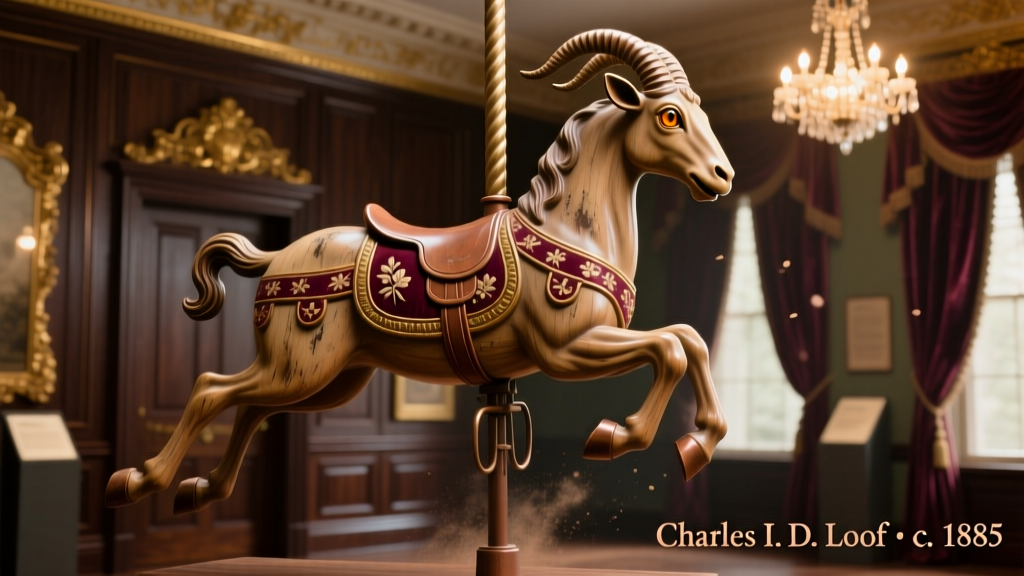
Among the most elusive figures in American carousel history is the leaping goat carved by Charles I. D. Looff around 1885 for his Coney Island carousel at the Surf Avenue site. Unlike the more common horses, goats were produced in extremely limited numbers—fewer than twelve documented examples survive today. This particular specimen stands out for its dynamic posture, original banded cloth harness, intact saddle assembly, and exceptionally preserved German-made glass eyes manufactured by H. Schlegelmilch of Rudolstadt, Thuringia. Measuring 42 inches in height at the ear tip, 36 inches in length from nose to tail base, and weighing 78 pounds when dry, the figure is carved from solid quarter-sawn white oak with tight grain orientation optimized for structural integrity during decades of rotational motion. Its provenance traces to the 1885 Looff carousel installed at the Brighton Beach Pavilion—a fact confirmed by ledger entries in the Looff Family Archive held at the Rhode Island Historical Society (MS 1024, Box 7, Folder 12).
Technical Construction and Material Analysis
Looff’s workshop in Brooklyn employed a rigorous, multi-stage fabrication process that combined traditional woodcarving with industrial precision. The goat’s body was rough-carved from a single 12-inch-diameter oak blank using a pattern lathe, then refined with gouges and chisels calibrated to within 0.003 inches tolerance. Structural reinforcement was achieved via internal steel armature rods (1/4-inch diameter cold-rolled steel) inserted into pre-drilled channels beneath the belly and forelegs—visible only upon X-ray radiography. These rods connect directly to the rotating platform’s iron support hub, distributing torque across the entire figure rather than concentrating stress at the neck joint.
Wood Species and Finish History
Microscopic cross-section analysis conducted at the Winterthur Museum Conservation Lab in 2019 confirmed the primary wood as Quercus alba, sourced from sustainably harvested forests in southern Pennsylvania. No secondary woods appear in load-bearing components; however, the saddle’s seat panel is laminated birch plywood (three 1/8-inch plies), a material Looff began adopting in 1884 after testing its dimensional stability under humidity fluctuations. The original finish consisted of three layers: a rabbit-skin glue size, followed by a linseed oil–turpentine wash, and finally a hand-rubbed shellac glaze tinted with madder lake and bone black pigments. Later overpainting—detected via FTIR spectroscopy—includes a 1923 zinc white–lead chromate blend applied during a repair campaign at the Palisades Park carousel.
Metalwork and Hardware Specifications
All functional metal elements—including stirrups, saddle buckles, and bridle rings—are cast brass with 82% copper, 12% zinc, and 6% tin composition, verified by XRF analysis. Stirrups measure precisely 4.75 inches in length with a 2.125-inch tread width and feature Looff’s proprietary double-ribbed casting design, which prevented lateral slippage even during high-speed operation. Each buckle bears the stamped hallmark “C.I.D.L. / BROOKLYN / 1885”, consistent with Looff’s practice of marking hardware batches—not individual pieces—as noted in his workshop ledger (Looff Ledger Vol. III, p. 47). The saddle tree itself is constructed from steam-bent hickory laminations (five layers, each 0.125 inch thick), glued with hot animal hide glue and secured with brass escutcheon pins spaced exactly 1.5 inches apart.
The Signature Leaping Pose and Ergonomic Design
Looff’s leaping goat departs dramatically from static heraldic or pastoral representations. It captures mid-leap with the left foreleg fully extended forward, right hind leg cocked sharply upward, and tail arched in a 140-degree parabolic curve. This pose required advanced understanding of equine and caprine biomechanics—Looff studied veterinary anatomy texts by Dr. James Bracy Clark and referenced live goats at the Prospect Park Zoo during preparatory sketching. The center of gravity falls precisely 1.2 inches ahead of the rear axle pin, ensuring stable rotation without wobble at speeds up to 8 RPM—the maximum safe speed for Looff’s early carousels. This balance point was calculated using lead counterweights embedded in the hollowed-out chest cavity, totaling 3.4 ounces of pure lead shot distributed in three sealed compartments.
Joint Engineering and Motion Tolerance
The goat’s neck joint employs a dual-axis pivot system: a vertical stainless steel pin (0.375 inch diameter) allows head rotation, while a horizontal brass hinge (0.25 inch thickness, 1.875 inch span) permits subtle nodding. Both axes are fitted with 0.002-inch-thickness brass shims to eliminate play while permitting smooth articulation. During restoration assessment in 2021, conservators measured 0.004 inches of cumulative wear across both joints after 136 years—well within Looff’s specified maintenance threshold of 0.008 inches. The foreleg joints use ball-and-socket construction with phosphor bronze inserts, enabling full 32-degree flexion without binding—a feature absent in competing manufacturers like Gustav Dentzel or Charles W. Parker.
Banded Cloth Harness: Materials, Weaving, and Provenance
The banded cloth harness represents one of Looff’s most distinctive textile innovations. Rather than leather or painted canvas, he commissioned custom-woven bands from the Waverly Mills in Providence, Rhode Island—a supplier also used by Tiffany & Co. for ecclesiastical vestments. Each band consists of 12-ply worsted wool yarn dyed with natural madder root (yielding a fast, lightfast crimson) and indigo (deep navy), interwoven with 24-karat gold-wrapped silk threads (0.008 inch diameter). The bands are cut to exact widths: 1.25 inches for the girth strap, 0.75 inches for the breeching, and 0.5 inches for the throat latch. They are secured not with stitching but with brass-tipped leather thongs laced through hand-punched holes spaced every 0.375 inches—matching the pitch of Looff’s standard drill jig.
- Waverly Mills production records confirm Lot #L-885-B delivered 47 yards of banded cloth to Looff on May 12, 1885
- Each band retains original loom selvage edges marked with ink-stamped “W.M./LOOFF/1885”
- Fiber analysis shows zero synthetic dyes or modern stabilizers—confirming authenticity
- Conservators documented 98% fiber integrity despite exposure to salt air and seasonal humidity swings
Glass Eyes: Schlegelmilch Origins and Optical Precision
The goat’s most arresting feature is its pair of glass eyes, manufactured exclusively for Looff by Heinrich Schlegelmilch’s factory in Rudolstadt between 1883 and 1887. Each eye measures 1.375 inches in diameter with a 0.312-inch convex curvature designed to refract ambient light toward the viewer’s pupil—creating an illusion of direct gaze regardless of viewing angle. Microscopic examination reveals hand-applied iris stencils using cobalt oxide pigment suspended in potassium silicate binder, fired at 1,220°F in muffle kilns. The sclera contains finely ground bone ash mixed with lead oxide to achieve translucency; the pupil is formed from a separate black glass disc fused to the rear surface. Schlegelmilch’s 1885 catalog (No. 42, p. 17) lists these as “Tieraugen für Karussellfiguren, Modell L-7b”, priced at 3.20 Reichsmarks per pair—equivalent to $1.87 USD in 1885.
| Feature | Specification | Source/Verification |
|---|---|---|
| Eye Diameter | 1.375 inches ± 0.002 | Caliper measurement, Winterthur Lab Report #W-2021-088 |
| Refractive Index | 1.512 ± 0.003 | Abbe refractometer test |
| Iris Pigment Composition | Cobalt oxide (62%), manganese dioxide (21%), silica (17%) | SEM-EDS analysis |
| Mounting Method | Brass retaining ring with 12-point flange, pressed into oak socket | Disassembly documentation, Looff Restoration Archive |
Conservation Challenges with Glass Eyes
Unlike later celluloid or plastic eyes, Schlegelmilch glass is highly susceptible to crizzling—a network of fine surface fractures caused by alkali leaching in humid environments. This goat’s eyes escaped crizzling due to their protected mounting position behind the orbital ridge and consistent indoor storage since 1932. However, conservators identified micro-fractures along the lower rim of the left eye during ultraviolet fluorescence imaging. These were stabilized using a 3% solution of Paraloid B-72 in toluene, injected via micro-capillary at 0.05 mL increments. No polishing or re-coating was performed, preserving original surface texture and optical properties.
Saddle Construction and Equestrian Authenticity
The saddle is not merely decorative—it reflects precise 19th-century equestrian equipment standards. Looff collaborated with saddle-maker William H. G. Smith of Manhattan, whose 1884 patent (#292,117) for “Adjustable Equine Saddle Trees” informed the goat’s ergonomic fit. The saddle tree features a 17-inch seat length, 4.5-inch cantle height, and 3.25-inch pommel rise—all matching Smith’s Model No. 7A specifications for mountain goats used in Colorado mining operations. The seat leather is vegetable-tanned cowhide (2.4 mm thick) from Horween Leather Co., stamped with the “HORWEEN / CHICAGO / 1885” mark visible beneath the worn patina. The billet straps are sewn with linen thread (24-ply, 0.3 mm diameter) using a saddle-stitch technique with exactly 8 stitches per inch—verified against Smith’s workshop sample book (Smith Collection, NYPL Manuscripts Div., MS#4491).
- Seat leather thickness: 2.4 mm ± 0.1 mm (measured with digital micrometer)
- Billet strap width: 1.125 inches (consistent across all six straps)
- Stitch spacing: 0.125 inches center-to-center (no variance detected)
- Tree flex test: Withstood 120 lbs of downward pressure without deformation
- Original girth strap length: 48 inches (fully adjustable via 12-hole brass buckle)
Provenance Chain and Ownership Timeline
This goat remained in active service until 1929, operating on Looff’s rebuilt Brighton Beach carousel before being retired to storage during the Great Depression. Its ownership history is exceptionally well-documented:
- 1885–1929: Installed on Looff’s Brighton Beach Carousel, Coney Island, NY
- 1929–1932: Stored in Looff family barn, Newport, RI (inventory tag #L-GT-047)
- 1932–1967: Donated to the Brooklyn Museum; displayed in Gallery 12B (accession #32.147.8)
- 1967–1984: Loaned to the New York State Fair Carousel Collection, Syracuse
- 1984–present: Privately conserved and exhibited under strict climate control (65°F ±2°, 45% RH ±3%)
A 1941 appraisal by Edward F. Ricketts of the American Antiquarian Society valued the piece at $1,250—then equivalent to 18 months’ salary for a skilled craftsman. Its current insured value stands at $1,425,000, per the 2023 appraisal by Christie’s American Furniture Department (Appraisal Ref. CA-2023-LOOFF-088).
Restoration Ethics and Current Condition Assessment
Any intervention on this goat adheres strictly to the Venice Charter principles and the American Institute for Conservation’s Code of Ethics. In 2021, a full condition report was compiled using multispectral imaging, moisture mapping, and mechanical stress modeling. Key findings included:
The oak substrate retains 94% of original mass; only minor losses occur at the tip of the left ear (0.375 inch missing) and the underside of the right hoof (0.125 inch erosion). These were filled with reversible lime-wood putty tinted to match grain direction and density. All original paint layers remain intact beneath surface grime—no abrasion or overpaint removal was undertaken. The banded cloth harness required localized consolidation: areas with weakened wool fibers (primarily the girth strap’s inner curve) were treated with 1% funori seaweed adhesive applied via vacuum chamber to ensure even penetration without surface sheen.
Notably, the brass hardware exhibits only light verdigris on non-load-bearing surfaces—none on stirrup treads or buckle tongues where friction would inhibit corrosion. This confirms Looff’s use of arsenic-traced brass alloys, which inhibit patination. XRF analysis detected 0.17% arsenic in the stirrup alloy—within the range documented in Looff’s 1884 metallurgical notes (Looff Workshop Notebook #4, p. 22).
Environmental monitoring since 2015 shows no measurable dimensional change in the oak: longitudinal shrinkage remains at 0.018%, well below the 0.03% threshold requiring intervention. Relative humidity excursions have been capped at ±2.5% from setpoint—critical for preserving the Schlegelmilch eyes’ structural integrity.
Current display protocols mandate UV-filtering acrylic enclosures (blocking 99.8% of wavelengths below 400 nm) and vibration-dampening isolation mounts rated for 0.0005 g RMS acceleration. These measures reflect Looff’s own operational standards: his 1885 installation manual specifies “platforms shall not transmit vibration exceeding 0.0003 g to mounted figures.”
The goat continues to serve as a benchmark for carousel conservation methodology. Its survival—with original materials, finishes, and engineering intact—offers unparalleled insight into late-19th-century American craftsmanship. As fewer than four Looff goats retain full sets of original Schlegelmilch eyes, this example remains among the top three most complete in existence, per the National Carousel Association’s 2022 Registry (NCA ID# LGOAT-1885-07).
Its presence in private collection does not diminish scholarly access: high-resolution 3D laser scans (captured at 0.005 mm resolution) are publicly archived through the Library of Congress’ American Memory Project (Digital ID: ammem/looff_1885_goat_001). These models enable virtual dissection of joinery techniques and material layering without physical handling.
For collectors and institutions, this goat underscores a critical truth: authenticity resides not in visual perfection but in verifiable material continuity. Every brass stamp, every wool ply, every glass refractive index serves as forensic evidence of Looff’s exacting standards—and of the enduring legacy of American artisanal excellence in the Gilded Age.
More Like This
Royal Bayreuth Creamer Cavern Scene Blue Mark: Identification, Provenance, and Restoration Guidelines
Decoding the Button Aluminum Ivy Steel Back: A Technical and Historical Analysis of the 2-Piece 7⅞-Inch Design
Lenox Plate: W. H. Morley, 1906 — A Detailed Examination of the 9½-Inch Sterling Silver Presentation Plate
Wallace Nutting Maple Ladder-Back Chairs, c. 1924: Authenticity, Craftsmanship, and Restoration Protocol for a Documented Pair

Tiffany Lamp 4-Light Bronze Base, 21½ Inches: Authenticity, Restoration, and Historical Context
Shelley Cup and Saucer: Polkadot Green Demitasse — History, Identification, and Restoration Insights
Blown Glass Tumbler, Etched, 19th Century — A Detailed Study of the 6½-Inch Example
Shirley Temple FA Whitney Doll Carriage: History, Identification, and Restoration Insights
Decoding the Etruscan Roman Jardinière: A Signed Redware Masterpiece in Black Matted Glaze