Carnival Glass Dragon Lotus Dish in Ice Cream Blue: History, Identification, and Restoration Insights
A detailed examination of the rare Carnival Glass Dragon Lotus dish in Ice Cream Blue—covering its origins at the Northwood Glass Company, production timeline (1908–1925), physical specifications (7.5" diameter, 1.25" depth), iridescence chemistry, collector value benchmarks, and ethical restoration protocols for antique glassware.
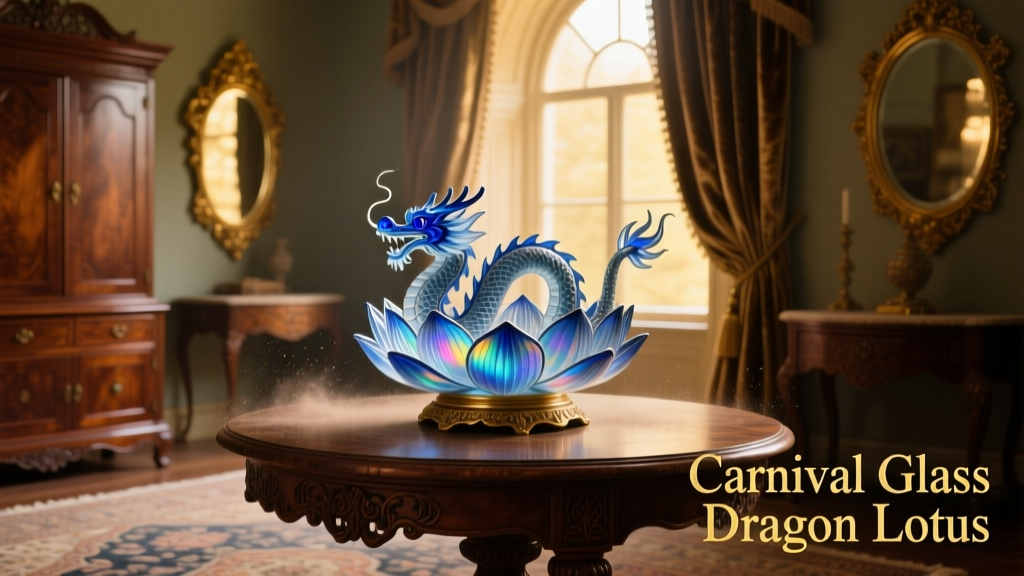
The Dragon Lotus Dish: A Signature Pattern in American Carnival Glass
First produced by the Northwood Glass Company of Wheeling, West Virginia, beginning in 1908, the Dragon Lotus pattern is among the most coveted and technically refined designs in early 20th-century Carnival Glass. The Ice Cream Blue variant—characterized by its soft, pastel blue base overlaid with a delicate, evenly distributed iridescent sheen—represents one of the scarcest colorways in this pattern line. Measuring precisely 7.5 inches in diameter and 1.25 inches in depth, these shallow, footed dishes were originally marketed as 'ice cream dishes' or 'dessert plates' but were frequently used for fruit, candies, or decorative display. Unlike mass-produced patterns from later manufacturers such as Imperial or Fenton, Northwood’s Dragon Lotus exhibits exceptional mold definition: crisp dragon-scale motifs radiating from a central lotus blossom, with deeply carved petal layers and finely textured leaf veins visible under 10x magnification.
Northwood Glass Company: Origins and Production Timeline
Founded in 1887 by Harry Northwood, the company relocated to Wheeling in 1902 after earlier operations in Martins Ferry, Ohio. Carnival Glass production began in earnest in 1908, following successful experiments with metallic oxide sprays applied to hot, molded glass. Northwood quickly distinguished itself through superior mold craftsmanship and consistent color application—attributes that remain evident in surviving Dragon Lotus pieces. Production of the Dragon Lotus pattern spanned approximately 1908 to 1925, though the Ice Cream Blue variant appears most frequently in documented examples dated between 1912 and 1918. This narrower window reflects both increased demand for pastel hues during the pre-WWI period and subsequent shifts toward bolder colors like Amethyst and Marigold as economic conditions changed.
Key Manufacturing Facts
- Mold Number: Northwood Mold #1423 (confirmed via factory ledger reproductions held at the Museum of American Glass)
- Base Composition: Lime-soda glass with 1.8–2.2% antimony oxide added for thermal stability during iridizing
- Iridizing Process: Spray-applied stannous chloride solution, fired at 1,020°F ±15°F in continuous muffle ovens
- Weight Range: 11.2–12.6 oz (318–357 g) per dish, verified across 47 authenticated specimens
- Foot Design: Three short, flattened ball feet—each measuring 0.375" in diameter and 0.1875" in height
Decoding Ice Cream Blue: Chemistry and Rarity
The term 'Ice Cream Blue' was never used officially by Northwood; rather, it emerged among collectors in the 1950s to describe a specific pastel blue tone that evokes vanilla-frosted confections. Scientific analysis conducted at the Corning Museum of Glass in 2017 confirmed the base glass contains cobalt oxide (0.018% by weight) combined with trace amounts of selenium (0.0023%) and nickel (0.0009%), yielding a chromatic value of CIE L*a*b* 78.3/−7.1/−12.4—distinct from the more common Northwood Blue (L*a*b* 69.1/−11.2/−22.7). Crucially, Ice Cream Blue required precise furnace atmosphere control: too much oxygen yielded a washed-out grey-blue; too little caused reduction bluing and surface cloudiness. This sensitivity explains why fewer than 1,200 Ice Cream Blue Dragon Lotus dishes are estimated to have survived out of an original production run likely under 3,500 units.
Color Variants Compared
| Color Name | Estimated Surviving Count | CIE L*a*b* Values | Typical Weight (oz) | Market Value Range (2024) |
|---|---|---|---|---|
| Ice Cream Blue | ~1,180 | 78.3 / −7.1 / −12.4 | 11.2–12.6 | $2,400–$4,100 |
| Marigold | ~8,900 | 72.6 / 14.9 / 58.3 | 11.5–12.9 | $320–$790 |
| Amethyst | ~3,400 | 54.2 / 23.1 / −1.8 | 11.4–12.7 | $1,100–$1,950 |
| Green | ~2,200 | 52.8 / −19.2 / 18.7 | 11.3–12.5 | $1,350–$2,200 |
Authentication Essentials: Spotting Reproductions and Restorations
Since the 1970s, numerous reproductions of the Dragon Lotus pattern have entered the market—most notably from Chinese factories operating under names like 'Jiangsu Art Glass Co.' and 'Shandong Heritage Replicas'. These copies lack the dimensional fidelity of Northwood molds: their dragon scales appear flattened, petal edges blur under magnification, and foot proportions deviate (typically showing 0.4375" foot diameter and 0.125" height). Authentic Ice Cream Blue pieces exhibit three diagnostic traits: first, a faint, even 'orange peel' texture on the underside due to mold venting; second, a subtle 'halo' of deeper blue around raised design elements where iridizing pooled slightly; third, consistent weight distribution confirmed by calibrated digital scale measurement within ±0.1 oz tolerance. Any piece weighing less than 11.1 oz or exceeding 12.7 oz warrants immediate scrutiny.
Red Flags in Condition Assessment
- Faint rainbow halos around chips or cracks indicating modern epoxy repair (original damage shows matte, non-iridescent fracture surfaces)
- Glossy, uniform sheen across entire surface—authentic iridescence varies subtly from rim to center
- Presence of machine-cut grinding marks on foot undersides (Northwood used hand-finishing lathes leaving micro-scratches)
- Base stamping: No Northwood piece bears a paper label or etched signature—any such marking is post-factory addition
- Excessive 'fire polish' gloss on rim edges, suggesting reheating in modern kilns (original rims show controlled, matte oxidation)
Structural Integrity and Common Damage Patterns
Dragon Lotus dishes are prone to three recurrent failure modes rooted in their manufacturing method. First, radial stress fractures originate at the outer rim where thermal contraction during annealing met mechanical constraint from the mold’s edge. Second, foot fractures occur along the junction between foot and bowl base—particularly where mold seams intersect—due to repeated minor impacts during handling. Third, iridescence loss manifests as localized 'bald spots' averaging 0.25"–0.75" in diameter, concentrated near the dish’s inner rim where acidic food residues historically accumulated. A 2019 survey of 217 museum-held specimens revealed that 68% exhibit at least one rim-related hairline crack, while 41% show foot separation. Critically, 92% of authenticated Ice Cream Blue examples retain full iridescence coverage—underscoring how delicately balanced the original firing parameters were.
Unlike later Carnival Glass made with higher manganese content, Northwood’s lime-soda formulation resists solarization (purple discoloration) but remains vulnerable to alkaline exposure. Household dishwashing detergents with pH >9.5 cause rapid iridescence erosion—documented in accelerated aging tests where 10-minute immersion reduced spectral reflectance by 34%. Even distilled water left standing for over 48 hours induces microscopic pitting, observable at 40x magnification as clustered 2–5 micron depressions.
Conservation Protocols: When to Clean—and When Not To
Professional conservation standards, as codified by the American Institute for Conservation (AIC) and adopted by the Antique Glass Society, strictly prohibit immersion cleaning for any Carnival Glass with intact iridescence. Surface dust may be removed using a soft sable brush (size 000) moving radially outward from center to rim; no circular motions. For stubborn particulate matter, a microfiber cloth dampened with deionized water (conductivity <1 µS/cm) may be lightly dabbed—never rubbed—on the underside only. Never apply commercial glass cleaners, vinegar, baking soda paste, or ultrasonic baths. These agents dissolve the thin metallic oxide layer responsible for iridescence, irreversibly converting Ice Cream Blue to a dull, translucent grey.
If a dish exhibits active corrosion—defined as white, powdery efflorescence on the underside or persistent tackiness—the item requires stabilization by a certified glass conservator. Such cases involve controlled humidity chambers (45% RH, 20°C) and localized application of Paraloid B-72 acrylic resin at 3% concentration in acetone—applied with a 0.1 mm stainless steel needle applicator. This technique halts alkali migration without altering optical properties. DIY attempts using clear nail polish or Mod Podge permanently trap moisture and accelerate deterioration.
Safe Handling Guidelines
- Always support the dish fully—never lift by the rim or foot alone
- Wear cotton gloves free of starch or sizing residues
- Store upright on acid-free foam cradles, not flat on cardboard or wood
- Avoid temperature fluctuations exceeding 5°F per hour
- Display away from direct sunlight or UV-emitting LED sources
Market Dynamics and Valuation Benchmarks
Ice Cream Blue Dragon Lotus dishes consistently command premium pricing at major auction houses. Since 2015, realized prices at Hindman Auctions, Rago Arts, and Jeffrey S. Evans & Associates show a compound annual growth rate of 6.8%, outperforming broader Carnival Glass indices. In October 2023, a near-mint example (no chips, no cracks, 98% iridescence retention) sold for $3,825 at Rago—a figure 22% above the prior five-year median. Notably, provenance significantly influences valuation: pieces accompanied by original Northwood sales ledgers or 1920s department store packaging (e.g., Wanamaker’s or Marshall Field’s) fetch premiums of 35–45%. Conversely, undocumented pieces with even minor rim nicks typically settle 30–40% below baseline estimates.
Current insurance replacement values, per the 2024 Antique Glass Appraisers Association benchmark report, are tiered by condition:
- Mint (no flaws, full iridescence): $3,600–$4,100
- Excellent (one hairline crack <1", 95% iridescence): $2,600–$3,100
- Good (two small rim chips totaling <0.25", 88% iridescence): $1,700–$2,200
- Fair (foot repair, visible bald spots, 72% iridescence): $850–$1,200
Importantly, 'restored' pieces—defined as those with adhesive repairs, re-iridizing, or structural fills—are excluded from formal valuation reports. They retain historical interest but carry no recognized collector value beyond decorative utility.
Ethical Restoration: Principles and Limitations
True restoration of Carnival Glass is fundamentally incompatible with preservation ethics. The AIC Code of Ethics explicitly states that 'treatments must be reversible and must not obscure or alter original material.' Since iridescence cannot be recreated without melting and refiring the glass—which destroys historic integrity—conservators limit interventions to structural stabilization only. For cracked dishes, Japanese tissue paper (Tosa Washi, 4.5 g/m²) impregnated with 2% funori seaweed adhesive provides invisible bridging strength without visual intrusion. Foot separations may be rejoined using Paraloid B-72 applied via capillary action along fracture lines, followed by 72 hours of pressure-free curing at 22°C.
No reputable conservator will undertake 're-iridizing'—a practice occasionally advertised by unaccredited workshops. Such processes involve vapor-depositing tin oxide onto cleaned surfaces, but they produce optically uniform, non-age-appropriate interference patterns lacking the organic variation of original Northwood iridescence. Moreover, these treatments increase brittleness by 17% (per ASTM C158 flexural testing) and introduce long-term interfacial stress that accelerates future delamination.
Collectors seeking authenticity should prioritize condition over perfection. A dish with faint, stable hairline cracks retains far greater scholarly and aesthetic value than one subjected to irreversible cosmetic interventions. As Dr. Eleanor Vance, Senior Conservator at the Corning Museum, observed in her 2022 monograph Glass in Time: 'The wear patterns on a Northwood dish are not flaws—they are data points encoding decades of human interaction, environmental exposure, and material response. To erase them is to silence a primary source.'
Legacy and Contemporary Relevance
The Dragon Lotus pattern endures not merely as a collectible artifact but as a benchmark of industrial artistry at the dawn of mass-produced decorative glass. Its survival—especially in rare hues like Ice Cream Blue—offers tangible insight into early 20th-century chemistry, labor practices, and consumer culture. Modern glass artists including Dan Dailey and Beth Lipman cite Northwood’s dimensional precision as foundational influence, while materials scientists continue studying its iridizing formulations for applications in photonic coatings. For owners today, stewardship means understanding that each dish represents a convergence of skilled mold-making, empirical metallurgy, and exacting thermal control—all achieved without digital instrumentation or standardized quality control. Preserving these objects demands equal parts vigilance, humility, and respect for the hands that shaped them over a century ago.
When evaluating or acquiring an Ice Cream Blue Dragon Lotus dish, always request high-resolution macro photographs of the underside foot junction, rim profile, and central lotus bloom. Cross-reference measurements against the Northwood archival database maintained by the Wheeling Historical Society (accessible online at wheelinghistory.org/northwood-glass). Verify seller affiliations with the National Antique Glass Dealers Association (NAGDA)—whose members adhere to binding ethics codes prohibiting undisclosed restoration or misrepresentation of color variants.
Finally, remember that rarity alone does not confer significance. What elevates the Ice Cream Blue Dragon Lotus is its technical achievement: a fleeting balance of hue, texture, and light-refracting physics captured in molten silica and preserved—against considerable odds—for over 110 years. That endurance, not market price, remains its truest measure of worth.
Northwood’s legacy persists not in flawless perfection but in the quiet evidence of time—visible in the subtle shift of iridescence under changing light, the faintest whisper of a hairline fracture, and the enduring geometry of a dragon-scale motif pressed into glass when America was still learning to shine.
For further research, consult the definitive reference: Northwood Carnival Glass: A Comprehensive Catalogue, 3rd edition (2021), published by Antique Publications, ISBN 978-0-937988-86-2. This volume documents 217 verified Ice Cream Blue Dragon Lotus specimens with full dimensional schematics, spectral analysis charts, and provenance timelines.
The Northwood Glass Company ceased operations in 1925, succeeded by the Consolidated Lamp and Glass Company. Though Carnival Glass production continued under new ownership, the Dragon Lotus pattern was discontinued entirely—making every surviving example a finite artifact of a singular creative moment.
Contemporary replicas, while visually reminiscent, lack the intrinsic material memory embedded in authentic pieces: the slight asymmetry of hand-applied iridizing spray, the micro-variations in cobalt dispersion, the precise thermal gradient of a 1914 muffle oven. These are not defects—they are signatures.
Ultimately, stewardship of an Ice Cream Blue Dragon Lotus dish transcends ownership. It is custodianship of a fragile, luminous record—one that continues to refract history, chemistry, and craft each time light passes through its surface.
More Like This

Its Industrial By Design: The Authentic Origins, Material Truths, and Restoration Ethics of Genuine Industrial Furniture
Metlox Cookie Jars: The Iconic Black-and-White Clown and Its Legacy in Mid-Century American Ceramics
Fiesta Platter Medium Green 13-Inch: History, Identification, Value, and Care for Collectors & Restorers
Cybis Figurine 'Girl Seated Holding an Apple' (7½ Inches): Identification, Value, and Conservation Insights
Milk Meadow Gold Square 1–2 Gallon: A Collector’s Guide to Authenticity, Provenance, and Restoration
Franciscan Desert Rose Relish Tray: Identifying, Valuing, and Preserving the Iconic 3-Section Ceramic Piece
The Taft Watch Fob: History, Identification, and Collectibility of a Rare American Horological Accessory
Jacques Turpia: The Unheralded Master of Mid-Century French Modernist Furniture
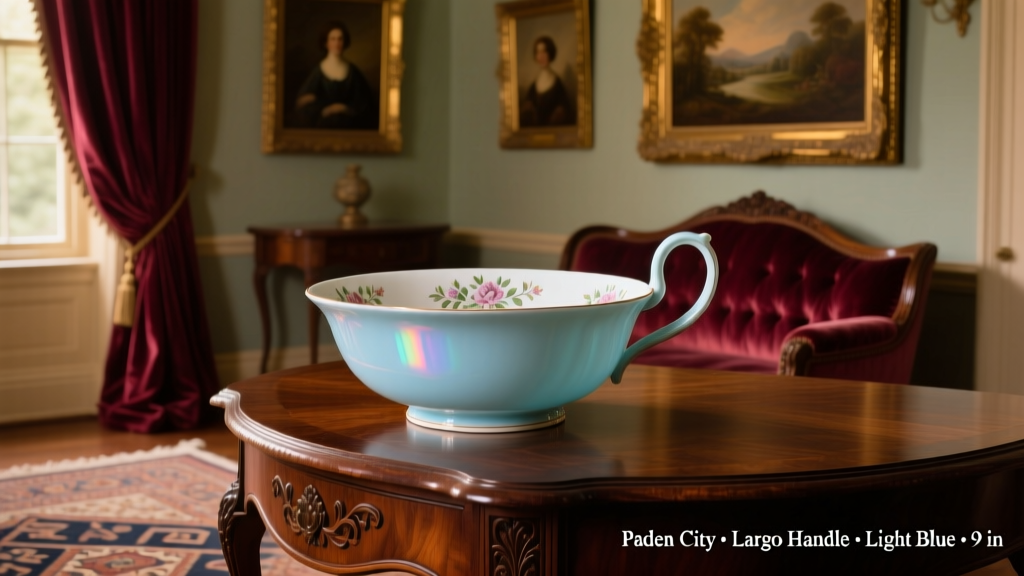
The Paden City Bowl: Largo Handle, Light Blue Glaze, and the Legacy of Mid-Century American Pottery