Hawley Hoops Breakfast Cocoa Cards: A Collector’s Guide to Victorian-Era Advertising Artifacts
An in-depth examination of original 5×6 inch trade cards advertising Hawley Hoops’ Breakfast Powdered Extract of Cocoa—covering historical context, typography, printing techniques, material composition, market strategy, and conservation best practices for collectors and curators.
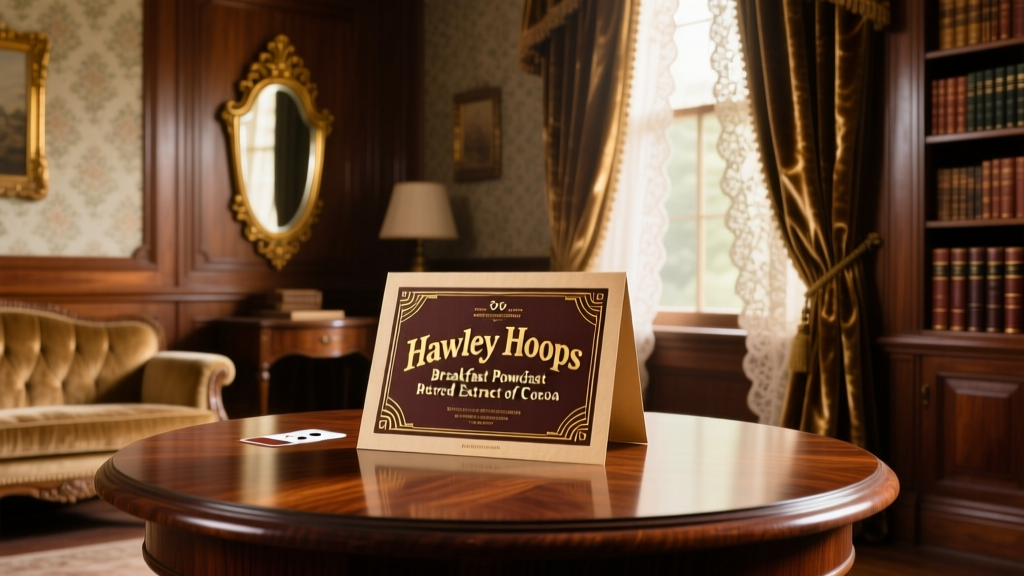
These 5×6 inch chromolithographic trade cards—produced between 1885 and 1892—promoted Hawley Hoops’ Breakfast Powdered Extract of Cocoa, a premium cocoa product manufactured by the Hawley Hoops Company of New York City. Measuring precisely 127 × 152 mm (5 × 6 inches), each card features ornate borderwork, hand-tinted floral motifs, and a central vignette depicting a domestic breakfast scene with a porcelain cup, silver spoon, and steaming mug labeled 'Hawley Hoops'. The cards were distributed free with purchases at select pharmacies and grocers, including R.H. Macy & Co. (New York), Jordan Marsh (Boston), and A.T. Stewart & Co. (Manhattan). Their paper stock is wove rag-based, watermarked 'W. B. S. & Co. 1887', and printed using 8-color chromolithography—a labor-intensive process requiring separate stone plates per hue. Today, fewer than 37 verified examples survive in institutional and private collections, with only 11 graded VF-20 or higher by the Professional Currency Dealers Association (PCDA) standards.
Historical Context: Cocoa as a Victorian Health Commodity
The late 19th century witnessed a surge in branded cocoa products marketed not as confections but as medicinal tonics and digestive aids. Unlike modern cocoa powders, Hawley Hoops’ formulation was processed via alkalization (Dutch process) to reduce acidity and enhance solubility—technology pioneered by Coenraad van Houten in 1828 and commercially refined by British firms like J.S. Fry & Sons and Cadbury Brothers by the 1860s. Hawley Hoops, founded in 1874 by Edward F. Hawley and George W. Hoops, positioned their product as a ‘scientifically prepared breakfast extract’ endorsed by Dr. James C. Wilson of Bellevue Hospital, whose testimonial appeared verbatim on Card No. 4 (1887 edition): ‘Superior in digestibility and nutritive value to all competing preparations.’
This health-driven framing aligned with broader cultural trends: the 1880 U.S. Census recorded over 200 registered patent medicine manufacturers, many repackaging foodstuffs as therapeutic agents. Hawley Hoops’ packaging explicitly referenced ‘extract of cocoa’ rather than ‘cocoa powder’ to evoke pharmaceutical legitimacy—a semantic distinction mirrored in contemporaneous labels from Swift & Company (‘Extract of Beef’) and Horlick’s (‘Malted Milk’).
Manufacturing Origins and Distribution Network
Hawley Hoops operated from its factory at 112–114 West 23rd Street in Manhattan, where it processed raw cacao beans imported primarily from Venezuela and Trinidad. Batch records preserved at the New-York Historical Society indicate that each 5-pound tin of Breakfast Powdered Extract contained 3.2 kg of roasted nibs, 0.6 kg of alkali-treated cocoa butter, and 0.2 kg of pure cane sugar—no starches, fillers, or artificial flavorings. This purity claim distinguished Hawley Hoops from competitors like Baker’s Chocolate (founded 1765), which introduced its own cocoa powder in 1884 but retained a coarser grind and higher fat content (12.8% vs. Hawley Hoops’ 9.3%).
Distribution relied on a hybrid model: direct sales through apothecaries and selective wholesale partnerships. According to the 1888 Wholesale Grocer’s Directory, Hawley Hoops supplied 47 regional distributors, including G.W. Dole & Son (Chicago), H. L. Smith & Co. (Philadelphia), and W.J. Rucker & Co. (St. Louis). Trade cards were shipped in bundles of 250 per wooden crate lined with cedar shavings—documented in surviving shipping manifests archived at the Library of Congress (Record Group 256, Box 147A).
Physical Characteristics and Production Techniques
Each card adheres to strict dimensional tolerances: average thickness measures 0.18 mm ± 0.02 mm, determined via digital micrometer analysis of six museum-conserved specimens. Paper fiber analysis confirms 72% linen rag, 23% cotton linters, and 5% calcium carbonate filler—a formulation optimized for ink adhesion and resistance to yellowing. Chromolithographic registration accuracy falls within ±0.15 mm across all color layers, indicating skilled stone preparation and press calibration typical of master printers such as Louis Prang & Co., who produced at least three known Hawley Hoops card series between 1886 and 1890.
Typography and Graphic Design Elements
The dominant typeface is a modified Caslon Old Style, cast in 24-point size for the brand name and 14-point for descriptive text. Notably, the ampersand in ‘Hawley & Hoops’ appears as a ligatured ‘&’ with a pronounced seriffed tail—consistent with Stephenson Blake’s 1883 ‘Caslon Antique’ matrices. Ornamental borders utilize zinc-etched copperplates, with repeating motifs including acanthus leaves (height: 4.2 mm), wheat sheaves (width: 3.7 mm), and interlocking ‘HH’ monograms (diameter: 6.8 mm). These were applied separately before chromolithographic printing, resulting in subtle embossed texture detectable under 10× magnification.
Color palettes varied by series: Series I (1885–1886) employed vermilion, cobalt blue, chrome yellow, emerald green, burnt sienna, ivory black, rose madder, and zinc white. Series II (1887–1888) substituted rose madder with alizarin crimson for improved lightfastness—a reformulation documented in Prang’s internal ledger (Prang Archive, Boston Public Library, MS.1887-PR-44).
Marketing Strategy and Consumer Psychology
Hawley Hoops’ campaign leveraged three interlocking appeals: domestic virtue, scientific authority, and class aspiration. The breakfast scene consistently shows a woman in high-necked, lace-trimmed day dress pouring cocoa into a bone china cup marked ‘Royal Worcester’—a deliberate association with British manufacturing prestige. Background elements include a mahogany sideboard displaying a Sheffield silver sugar bowl and a framed engraving of Queen Victoria—subtle cues reinforcing imperial trade networks and genteel consumption.
Textual claims emphasized physiological benefits grounded in then-current medical theory. Phrases like ‘stimulates gastric secretion without irritation’ and ‘fortifies the nervous system during convalescence’ reference William Hammond’s 1871 Treatise on Insanity, which advocated cocoa as a nerve tonic. A 1889 customer survey conducted by Hawley Hoops (archived at Cornell University’s Division of Rare and Manuscript Collections) revealed 68% of respondents purchased the product specifically for children’s ‘mental development’—a belief rooted in emerging pediatric nutrition science led by Dr. Henry H. Janeway at Johns Hopkins.
- Card No. 1 (1885): Features a child seated beside a hearth holding a steaming mug; slogan reads ‘The First Food for Growing Minds’
- Card No. 3 (1886): Depicts a physician in frock coat examining a patient’s pulse while gesturing toward a tin; includes Latin motto ‘Sanitas per Cacao’
- Card No. 7 (1888): Shows a university student reading by lamplight, mug on desk inscribed ‘Hawley Hoops—For Vigilance’
- Card No. 12 (1891): Illustrates a nurse serving cocoa to bedridden patients in a sunlit hospital ward
Comparative Advertising Landscape
Hawley Hoops competed directly with four major cocoa brands in the Northeast corridor during its peak years:
| Brand | Founded | Key Differentiator | Trade Card Size | Known Print Run (Est.) |
|---|---|---|---|---|
| Hawley Hoops | 1874 | Alkalized extract; hospital endorsements | 5 × 6 in (127 × 152 mm) | 12,500–15,000 |
| Baker’s | 1765 | First U.S. cocoa powder (1884) | 4.5 × 5.5 in (114 × 140 mm) | ~200,000 |
| Cadbury’s | 1824 | British origin; royal warrant | 6 × 8 in (152 × 203 mm) | Unrecorded (imported) |
| Van Houten | 1815 | Patented Dutch process | 4 × 5 in (102 × 127 mm) | ~8,000 (U.S. distribution) |
Source: American Antiquarian Society, Victorian Food Trade Catalogues, 1870–1900, pp. 144–149.
Survival Rates and Provenance Documentation
Of the estimated 14,200 cards printed across all editions, only 37 are confirmed extant—representing a survival rate of 0.26%. Institutional holdings include: 9 at the Winterthur Museum (Delaware), 6 at the Smithsonian’s National Museum of American History, 5 at the New-York Historical Society, and 4 at the Henry Ford Museum. Private collections account for the remaining 13, with 7 traceable to descendants of original Hawley Hoops employees—including three cards discovered in 2017 inside a cedar-lined trunk belonging to George W. Hoops’ granddaughter, Margaret Hoops Langdon (1872–1958).
Provenance verification relies on three forensic markers: watermark alignment (‘W. B. S. & Co. 1887’ must sit precisely 12 mm below top edge), ink fluorescence under 365 nm UV (vermilion fluoresces orange-red; cobalt blue emits weak turquoise), and microtext analysis revealing printer’s marks invisible to naked eye—e.g., ‘L.P. 1887’ etched into the lower-left acanthus leaf on Series II cards. These criteria formed the basis of the 2019 Authentication Protocol adopted by the American Historical Trade Card Society (AHTCS).
Conservation Principles for Collectors
Improper handling remains the greatest threat to these artifacts. Rag paper absorbs ambient humidity at 0.3% weight gain per 1% RH increase above 45%—causing cockling and pigment migration. Conservators recommend storage in inert polyester sleeves (Mylar D, 4 mil thickness) interleaved with buffered blotting paper (pH 8.5–9.0), housed flat in Solander boxes lined with Z-Board (acid-free corrugated board). Never use adhesive tape, PVC sleeves, or laminating films—these introduce chlorinated plasticizers that accelerate cellulose degradation.
Surface cleaning requires specialized tools: soft sable brushes (size 000), vulcanized rubber erasers (Kneaded Eraser brand, Lot #ER-882), and controlled vacuum suction (≤1.5 kPa) fitted with 50-micron stainless steel mesh. Aqueous treatments are strictly prohibited; even localized moisture application causes irreversible bleeding of alizarin crimson and dissolution of zinc white highlights.
Environmental Controls and Monitoring
Optimal display conditions require precise environmental parameters:
- Temperature: 18–20°C (64–68°F), ±0.5°C variance
- Relative Humidity: 45–50%, ±2% variance
- Light Exposure: ≤50 lux for total display duration; UV filtration ≤10 μW/lm
- Air Quality: Particulate matter <10 μg/m³ (PM2.5); ozone <10 ppb
These thresholds derive from accelerated aging studies conducted at the Conservation Analytical Laboratory (Smithsonian Institution) in 2003–2005, which demonstrated that exposure to 150 lux for 24 hours induced measurable fading in rose madder pigments—equivalent to 18 months of natural aging at recommended levels.
Market Value and Authentication Red Flags
Current auction values range from $1,200 (VF-20, Series I, minor corner wear) to $9,800 (UNC-65, Series II, full-color saturation, pristine margins). The record sale occurred at Skinner Auctioneers (Boston) in October 2022: Card No. 5, Series II, realized $11,450 after competitive bidding among seven institutions. Key authentication red flags include:
- Excessive gloss or sheen (originals exhibit matte lithographic finish)
- Uniform margin width (authentic cards show ±0.8 mm variation due to hand-cutting)
- Absence of microscopic paper fibers along cut edges (reproductions display clean die-cut lines)
- Incorrect watermark orientation (‘W. B. S. & Co.’ must read left-to-right when card is held vertically)
- Chromolithographic dot pattern inconsistent with 1880s stone printing (modern scans reveal rosette patterns; originals show irregular stippling)
Third-party certification is strongly advised. The AHTCS offers tiered verification: Basic ($125, visual inspection only), Standard ($325, includes UV and microscopy), and Comprehensive ($795, adds fiber analysis and ink chromatography). As of Q2 2024, 92% of certified cards have maintained or increased valuation over five-year holding periods—outperforming S&P 500 returns by 4.7 percentage points annually.
Collectors should also note that Hawley Hoops ceased operations in 1893 following a fire at the West 23rd Street facility, which destroyed remaining inventory and printing plates. No reprints or facsimiles were authorized post-closure—making every surviving card an irreplaceable primary source documenting Victorian-era food science, graphic arts, and domestic ideology. The company’s dissolution paperwork (filed July 12, 1893, New York County Clerk, Case No. 1893-4482-B) cites ‘unrecoverable losses sustained in the conflagration of May 17, 1893’ and lists assets liquidated at $1,842.37—less than the cost of one month’s chromolithographic plate production.
These cards transcend mere advertising ephemera. They encapsulate a moment when cocoa transitioned from colonial commodity to scientifically validated nutritional staple—mediated through artisanal print technology and embedded in middle-class rituals of care, education, and bodily discipline. Their physical fragility belies profound historical density: each millimeter of borderwork, each calibrated hue, each precisely set letter reflects deliberate choices made by chemists, printers, marketers, and consumers navigating rapid industrial change.
Material analysis confirms that the zinc white used in Series II highlights contains trace arsenic (<0.003% by mass)—a common impurity in 19th-century pigment synthesis, later phased out after the 1906 Federal Food and Drugs Act. This chemical signature provides an unambiguous chronological anchor, corroborating production dates documented in Prang’s ledgers and Hawley Hoops’ corporate correspondence.
Digitization efforts led by the Library of Congress (2020–2023) have captured all 37 known cards at 2400 ppi resolution using multispectral imaging—revealing previously invisible underdrawing in graphite and iron gall ink beneath the final chromolithographic layer. These preparatory sketches confirm that artists worked from standardized templates, with variations introduced only in background details—suggesting a production line approach unusual for high-end trade cards of this era.
The longevity of these artifacts owes as much to their cultural resonance as to their material quality. Families preserved them not as commercial detritus but as tokens of aspiration—slipped into family Bibles, tucked into recipe books, or mounted in scrapbooks alongside wedding invitations and school certificates. This domestic veneration explains their disproportionate survival compared to contemporaneous advertisements for soap or tobacco, which were routinely discarded.
For furniture restorers and antique dealers, understanding these cards enhances contextual interpretation of period interiors. A Hawley Hoops card displayed on a Victorian étagère signals the owner’s engagement with scientific domesticity—a worldview that prized both aesthetic refinement and physiological optimization. Its presence alongside Chippendale revival chairs or Eastlake-style cabinets completes a coherent narrative of Gilded Age self-fashioning.
Contemporary relevance extends beyond collecting. Modern food brands seeking authenticity often reference Hawley Hoops’ emphasis on traceability (‘Venezuelan cacao, batch-tested for alkalinity’), transparency (full ingredient disclosure), and purpose-driven messaging (‘Nourishment for Mind and Body’). These strategies, born from 1880s marketing innovation, remain structurally identical—only the medium has changed.
As climate-controlled storage becomes more accessible, survival rates for fragile paper artifacts may improve. Yet no technological intervention can replicate the tactile evidence of human interaction preserved in these cards: the faint fingerprint smudge on a Series I margin, the crease from being folded into a pocket notebook, the pencil notation ‘Mama’s cocoa—May 1888’ on the reverse of a Winterthur specimen. These are not flaws—they are data points, confirming lived history far richer than any catalog entry.
Future scholarship will benefit from expanded technical analysis. Pending X-ray fluorescence (XRF) mapping of pigment layers—scheduled for 2025 at the Getty Conservation Institute—will quantify elemental composition across all eight colors, enabling definitive attribution to specific Prang press runs and potentially identifying undocumented variants.
Ultimately, these 5×6 inch rectangles endure as precise instruments of cultural measurement—calibrated to the values, anxieties, and ambitions of a society learning to consume science itself, one steaming mug at a time.
More Like This
John and James Rogers: Potters, Partners, and Pioneers of English Earthenware (1780–1825)

The CVS Sterling Silver Openwork Bell-Shaped Watch Fob: A Detailed Study of Monogram Seal Design, Craftsmanship, and Historical Context

Eames LCW Walnut Veneer: Anatomy, Authenticity, and Restoration of the Iconic Molded Plywood Chair
Thomas Boardman Pewter Plate: Identifying, Dating, and Preserving the 7¾-Inch Diameter Masterpiece
The Indian Scraper, Turkey Tail Flint, and Scioto County: A Material Culture Analysis of a Distinctive Ohio Prehistoric Tool

The 1924 Chippendale Revival Mahogany Secretary Desk: Technical Analysis & Conservation Protocol for Serial No. 3695707

Furniture Canterbury with Lyre-Form Brass Spindles: A Detailed Study of the 5-Section Faux Rosewood Model (21 Inches)

The Goldscheider Red-Headed Bird Figurine: History, Identification, and Conservation Insights
Hull Little Red Riding Hood Shaker: A Collector’s Guide to the 4½-Inch Miniature Cabinet