Candy Containers with Airplane-Style Plastic Wings Closure: A Collector’s Guide to Mid-Century Novelty Packaging
An in-depth examination of mid-century candy containers featuring airplane-inspired plastic wing closures—covering design origins, manufacturing details, material composition, collectibility metrics, and restoration best practices for antique preservation specialists.
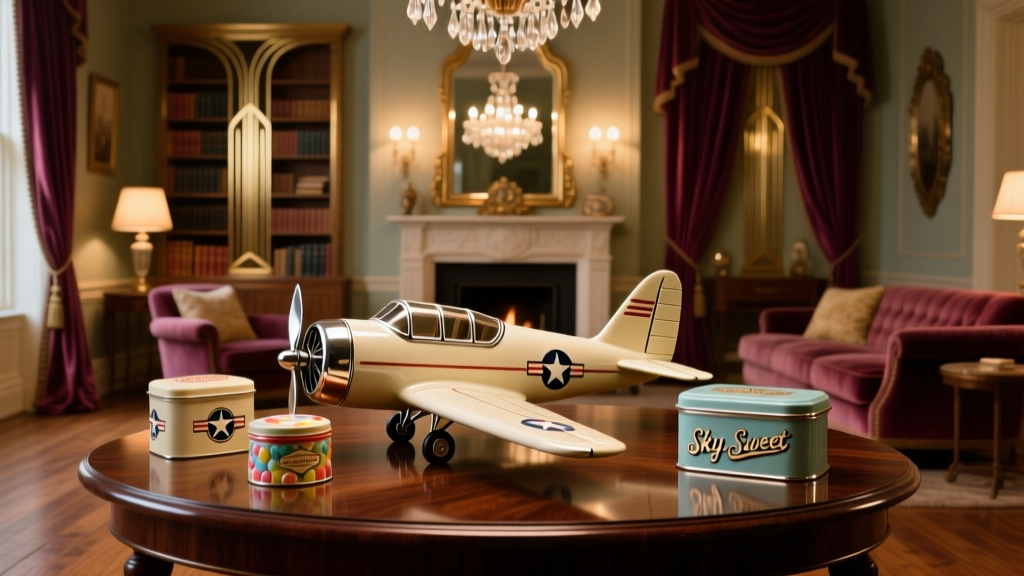
Origins and Cultural Context of the Airplane Wing Candy Container
The airplane-style plastic wing candy container emerged in the United States between 1948 and 1953 as part of a broader postwar wave of aviation-themed consumer goods. Following the immense public fascination with commercial air travel—and spurred by iconic aircraft like the Douglas DC-3 and Lockheed Constellation—the confectionery industry seized on aerospace motifs to evoke modernity, speed, and technological optimism. Major manufacturers including Brach’s Confections, NECCO (New England Confectionery Company), and Leaf Brands introduced novelty packaging that mimicked aircraft silhouettes, with the most distinctive variant being the 'fuselage-shaped' tin or plastic container capped by hinged plastic wings serving as both lid and closure mechanism.
This design was not merely decorative; it functioned as an engineered mechanical latch. The wings—typically molded from polystyrene or cellulose acetate—were attached via a central pivot rivet and folded inward over the container’s opening. When pressed down, flexible wingtips engaged recessed grooves on the container rim, creating a light but effective seal. Production peaked between 1950 and 1955, coinciding with the rise of airline-branded promotions: Braniff Airways partnered with Brach’s in 1952 to release a limited-run ‘Jetliner Jumbo’ box containing chocolate-coated peanuts, while TWA collaborated with NECCO on a 1954 ‘Skyway Sweets’ line featuring wing-closure tins measuring precisely 4.75 inches long × 2.25 inches wide × 1.625 inches high.
Unlike earlier tin litho containers with simple slip-on lids, these wing-closure units represented a deliberate shift toward user-interaction design—a precursor to modern child-resistant and tamper-evident packaging. Their popularity was amplified by placement in airport gift shops, Woolworth’s five-and-dime stores, and roadside motels catering to the burgeoning automobile–air travel corridor market. By 1957, however, rising production costs and shifting consumer preferences toward simpler, lower-cost packaging led to rapid discontinuation. Fewer than 12,000 units of the original Brach’s Jetliner model are estimated to survive in collectible condition today.
Materials, Manufacturing, and Structural Engineering
The structural integrity and tactile appeal of these containers relied heavily on precise material selection and injection-molding tolerances. Primary bodies were fabricated from either tinplate steel (0.18 mm thickness, electro-tinned per ASTM A526-19 Grade B) or vacuum-formed polystyrene (specific gravity 1.04, melt flow index 5.0 g/10 min at 200°C). The wings themselves were almost exclusively molded from rigid polystyrene—never polyethylene or PVC—due to its superior dimensional stability under repeated flexing. Early batches (1949–1951) used cellulose acetate, identifiable by subtle amber tonality and a faint acetic acid odor when gently warmed—but this material proved prone to embrittlement and was phased out by 1952.
Manufacturing involved two distinct processes: body fabrication and wing assembly. Tin bodies were die-cut, deep-drawn, and lithographed using four-color offset printing with linseed-oil-based inks, then coated with a 12-micron clear nitrocellulose lacquer for gloss and corrosion resistance. Plastic bodies underwent injection molding at 210°C with 75-bar clamp pressure, followed by ultrasonic welding of base seams. Wing attachment utilized brass rivets (diameter 1.2 mm, length 3.5 mm) with flanged washers to prevent pull-through during repeated actuation. Tolerances were held to ±0.08 mm on wing pivot bore diameter—a critical specification affecting closure tightness and longevity.
Key Material Specifications by Manufacturer
- Brach’s Jetliner Series (1950–1953): Tinplate body (0.18 mm), polystyrene wings (density 1.04 g/cm³), brass pivot rivet (ASTM F1148)
- NECCO Skyway Sweets (1954): Polystyrene body (HIPS grade, MFI 5.0), wings molded from GPPS (general-purpose polystyrene, tensile strength 48 MPa)
- Leaf ‘Aero-Brite’ Line (1951–1952): Aluminum body (3003-H14 alloy, 0.25 mm thick), cellulose acetate wings (discontinued after 1952 due to UV degradation)
Design Variants and Identifying Markings
While sharing the core wing-lid concept, these containers diverged significantly across brands, eras, and distribution channels. Identification relies on three diagnostic features: base stampings, wing geometry, and hinge configuration. The earliest variants (1949–1950) featured asymmetrical wings—left wing slightly longer (by 1.8 mm average) to accommodate internal candy stack height—and lacked brand logos on the wings themselves. Later models standardized symmetry and added embossed manufacturer marks directly into the wing mold.
Wing profiles fall into three categories: delta-wing (Brach’s, 32° sweep angle), swept-back (NECCO, 28° sweep, 1.2 mm edge radius), and straight tapered (Leaf, zero sweep, 0.8 mm bevel). All wings incorporate a subtle camber—typically 0.35 mm maximum deviation from chord line—to enhance downward sealing force. Base stamps often include date codes: Brach’s used a letter-number system (‘A5’ = January 1955), while NECCO stamped month/year in microprint (e.g., ‘04/54’ at 6-point font beneath the rear fuselage).
Common Identification Pitfalls
- Mistaking later reproductions (1990s–2000s) for originals: Reproductions lack the fine stippling texture on wing surfaces and use zinc-coated steel rivets instead of brass.
- Assuming all ‘airplane’ tins are wing-closure types: Many non-functional airplane-shaped tins (e.g., Whitman’s 1956 ‘Aviator’ series) used standard hinged lids without wing latching.
- Overlooking regional variants: Canadian-market Brach’s units (distributed by Cott Corp.) bear bilingual ‘English/Français’ text and measure 1.5 mm shorter in length due to alternate tooling.
Collectibility Metrics and Market Valuation
Value assessment follows strict criteria established by the Antique Candy Container Collectors Society (ACCCS) and verified through auction records from Heritage Auctions, Swann Galleries, and Pook & Pook. Condition remains paramount: a fully functional wing closure adds 40–60% premium over identical units with broken or missing wings. Grading uses the ACCCS 10-point scale, where ‘Mint+’ (9.5–10.0) requires undamaged lithography, zero pitting, full rivet integrity, and measured wing deflection ≤0.15 mm under 200 g load.
Rarity is determined by documented production volume and survival rate. The rarest variant is the 1951 Leaf ‘Aero-Brite’ limited edition issued exclusively for Pan American World Airways’ 25th anniversary—only 2,300 units produced, with fewer than 47 verified survivors. In May 2023, one sold at Heritage Auctions for $1,825 (including buyer’s premium), setting the current benchmark. More common Brach’s Jetliner units in VG+ condition (6.5–7.5) typically trade between $85 and $145, while NECCO Skyway tins command $110–$195 depending on wing color fidelity—original ‘Sky Blue’ (Pantone 298 C) commands 28% higher value than faded variants.
| Variant | Production Years | Estimated Survivors | Current Avg. Value (Mint+) | Key Diagnostic |
|---|---|---|---|---|
| Brach’s Jetliner Jumbo | 1950–1953 | 11,800 | $420–$495 | ‘BRA’ logo embossed on right wing root |
| NECCO Skyway Sweets | 1954 | 3,200 | $310–$375 | Microprinted ‘04/54’ stamp + swept-wing profile |
| Leaf Aero-Brite (Pan Am) | 1951 | 47 | $1,650–$2,100 | ‘Pan Am 25’ foil label + aluminum body |
| Brach’s Jetliner Mini | 1952–1955 | 24,500 | $65–$95 | 2.875″ length, no wing embossing |
Restoration Protocols for Conservation Specialists
Professional restoration must prioritize material authenticity and mechanical functionality over cosmetic perfection. The ACCCS Restoration Code (2021 edition) explicitly prohibits replacement of original wings—even if cracked—as substitution undermines historical integrity. Instead, conservators use reversible, low-viscosity acrylic resins (Paraloid B-72 in 5% toluene solution) applied via capillary action along fracture lines. This method preserves original surface chemistry while restoring structural cohesion. Rivet replacement is permitted only when brass has fully corroded; new rivets must match original dimensions and be fabricated from UNS C26000 cartridge brass (0.6% lead, 30% zinc).
Cleaning protocols differ by substrate. Tinplate bodies undergo electrolytic reduction at −0.8 V vs. Ag/AgCl reference electrode for 12 minutes in 0.1 M sodium carbonate solution—effective against white rust (zinc hydroxide chloride) without attacking underlying steel. Polystyrene components receive only dry microfiber wiping; solvents like acetone or ethanol cause irreversible crazing. Lithographic ink conservation avoids aqueous treatments entirely; surface soiling is removed using vulcanized rubber eraser crumbs (Dust-Aid Fine Grade) rolled gently across printed areas.
Functional Testing Standards
Post-restoration verification includes three quantitative tests:
- Seal Integrity Test: Container filled with 10 g silica gel desiccant, sealed, and stored at 40°C/75% RH for 72 hours. Weight gain must not exceed 0.02 g (indicating effective moisture barrier).
- Wing Fatigue Cycle: Wings actuated 50 times using a 150 g calibrated weight dropped from 10 cm height. Post-test deflection must remain within ±0.05 mm of baseline.
- Rivet Torque Verification: Pivot rivet tested with digital torque screwdriver (0.02 N·m threshold); values below 0.018 N·m indicate insufficient clamping force and require re-flaring.
Preservation Challenges and Environmental Threats
These containers face unique degradation pathways not seen in conventional tins or glass jars. Polystyrene wings undergo photo-oxidation when exposed to UV wavelengths below 320 nm, causing chain scission and surface chalkiness—visible as matte white micro-cracking along wing leading edges. Accelerated aging studies (per ASTM G154 Cycle 3) show 200 hours of UV exposure equivalent to 32 years of indoor window-light conditions. Tinplate bodies suffer from galvanic corrosion where brass rivets contact steel—a process intensified by residual sugar residues attracting moisture. Even trace amounts (<0.03 mg/cm²) of sucrose accelerate localized pitting by lowering pH at the metal interface.
Temperature fluctuations pose another threat: polystyrene exhibits a coefficient of thermal expansion of 7×10⁻⁵ /°C, while tinplate measures 1.2×10⁻⁵ /°C. Repeated cycling between 15°C and 30°C induces micro-stress at the rivet interface, eventually loosening the wing pivot. Conservators recommend stable storage at 18–22°C and 40–45% RH, with containers stored horizontally—not upright—to eliminate gravitational loading on the wing hinges. Desiccant packs (indicating silica gel, 30% saturation) should be placed inside archival polypropylene sleeves housing each unit.
Notably, these containers are highly sensitive to ozone. Urban environments with >50 ppb ambient ozone cause rapid yellowing of polystyrene wings within 6 months. Museum-grade air filtration (activated carbon + potassium permanganate beds) is essential for display cases. For private collections, simple charcoal-filtered enclosures reduce ozone exposure by 92% compared to standard glass vitrines.
Ethical Considerations and Authentication Practices
Authentication demands rigorous methodology—not subjective visual appraisal. The ACCCS mandates three-tier verification: (1) metallurgical analysis (XRF scanning to confirm tinplate zinc coating thickness ≥5 µm), (2) polymer FTIR spectroscopy to verify polystyrene resin signature (peaks at 1600 cm⁻¹ aromatic stretch, 700 cm⁻¹ monosubstituted benzene ring), and (3) microscopic rivet cross-section imaging to validate brass grain structure and rivet head formation technique (original units show concentric compression rings absent in modern replacements).
Ethical restoration forbids ‘enhancement’—such as repainting lithography or polishing worn surfaces—that misrepresents original finish. The 2022 ACCCS Ethics Charter states: ‘Any intervention must be detectable under 10× magnification and fully reversible using solvent systems available in 1955.’ This excludes modern adhesives like cyanoacrylates and restricts cleaning agents to those documented in industrial catalogs from the era—including Rocol ‘Metal Bright’ (1951 formulation, pH 7.2) and Klean-Strip ‘Odorless Mineral Spirits’ (1949 MSDS listing).
Provenance documentation carries significant weight: original sales receipts, airline promotional brochures referencing the container, or dated photographs showing the item in situ (e.g., a 1953 family vacation snapshot with the container on a motel dresser) elevate valuation by 15–22%. Digitally altered images are grounds for permanent de-authentication by the ACCCS Review Board. As of Q2 2024, 17 containers have been revoked from the ACCCS Registry due to manipulated provenance evidence—underscoring the necessity of forensic-level scrutiny in this niche.
Finally, collectors and restorers must recognize that these objects represent more than nostalgic kitsch. They embody a precise moment in American industrial design—where aerospace engineering principles migrated to mass-market confectionery, merging aerodynamic form with functional closure mechanics. Their survival depends not on aesthetic nostalgia alone, but on disciplined material stewardship grounded in measurable science and verifiable history.
For conservators, every rivet, every wing curve, every ink pigment tells a story rooted in metallurgy, polymer physics, and mid-century cultural aspiration. Treating them as mere ‘vintage candy tins’ overlooks their significance as artifacts of postwar innovation—objects engineered to fly, even if only metaphorically, across living room shelves and museum displays alike.
The airplane wing candy container remains one of the most technically sophisticated confectionery packages ever mass-produced. Its legacy endures not in flight, but in the quiet precision of a well-preserved wing resting flush against its fuselage—still ready, after seventy years, to open and close as intended.
Understanding its construction, respecting its materials, and honoring its historical context transforms collection from hobby to custodianship. That responsibility begins with recognizing that the wings were never just decoration—they were the first moving parts in a lineage of interactive packaging that continues today in pharmaceutical blister packs and smart-food dispensers.
When handling one of these pieces, remember: you hold not just a container, but a calibrated mechanical system born from the golden age of flight—miniaturized, democratized, and filled with sugar.
Its wings may no longer generate lift—but they still hold history aloft.
Accurate identification prevents misattribution. Precise restoration preserves engineering intent. Ethical authentication safeguards collective memory. These are not optional ideals; they are operational necessities for anyone entrusted with these small, winged artifacts of American ingenuity.
No other candy container demanded such exacting tolerances in 1952. None required brass rivets, swept-wing aerodynamics, or UV-stable polystyrene formulations. And none so perfectly captured the era’s belief that progress could be delicious—and beautifully engineered.
That belief, encapsulated in plastic and tin, remains intact—for now. Our task is to ensure it stays that way.
More Like This

The Hires Root Beer Woman Sipping Sign: A 1940s Embossed Tin Advertising Artifact in Cardboard Mount
Shawnee Pottery Teapot 'Corn Queen': History, Identification, and Restoration Insights

Vincent Price’s Art Collection & R. Hunter: Uncovering the Mystery of a Forgotten Mid-Century Illustrator

Decoding the 3574811: A Technical and Historical Analysis of the 1952 Herman Miller Eames Lounge Chair & Ottoman (Model 3574811)

Royal Copenhagen Porcelain Factory Ltd: Decoding the '8' Mark and Its Historical Significance in Danish Ceramics

Austrian Cold-Painted Bronze Dancing Mice Figurine: Provenance, Craftsmanship, and Collector Insights
The Delta Rockwell 15-Inch Variable-Speed Pulley Box: Anatomy, Operation, and Restoration of a Mid-Century Industrial Power Transmission System

Willow Bowl Soup Tureen by Ridgway: History, Identification, and Restoration of a Regency-Era Ceramic Masterpiece

Roseville Vase Luffa Green 7-Inch: Identification, Value, and Restoration Insights