1969 Union Pacific Railroad Centennial Calendars: Design, Production, and Collectibility of a Mid-Century Corporate Commemorative
An in-depth examination of the official 1969 Union Pacific Railroad Centennial calendars—covering their graphic design origins, printing specifications, distribution channels, surviving examples, market valuation trends, and conservation challenges for collectors and museums.
Introduction: A Corporate Celebration in Twelve Panels
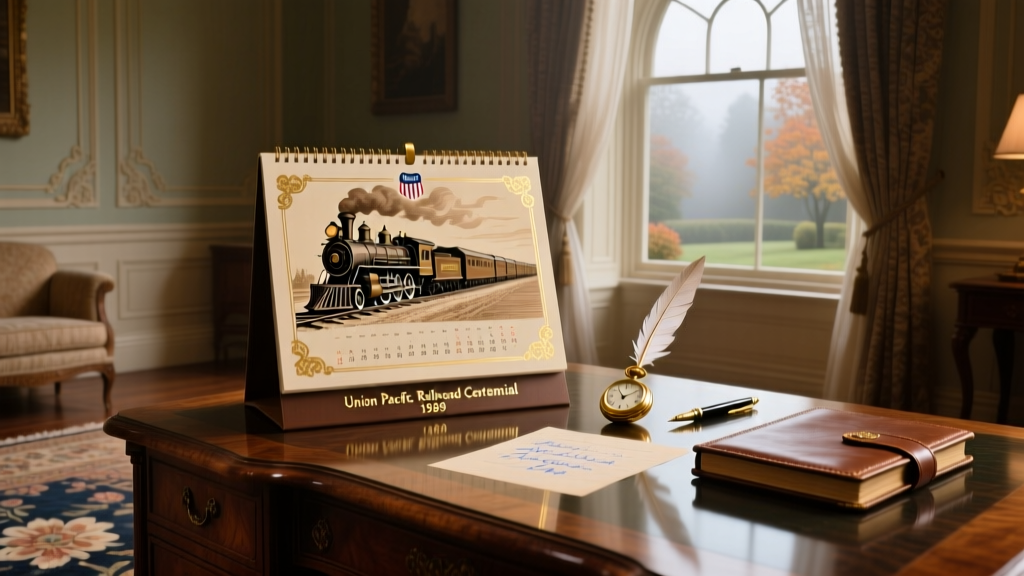
The 1969 Union Pacific Railroad Centennial calendars represent a distinctive intersection of American industrial heritage, mid-century graphic design, and corporate commemorative publishing. Produced to mark the railroad’s 100th anniversary—dating from its 1869 Golden Spike ceremony at Promontory Summit, Utah—these wall calendars were distributed free of charge to employees, railfans, travel agents, and select business partners between October 1968 and January 1969. Unlike mass-market retail calendars, these were high-fidelity promotional artifacts commissioned by UP’s Public Relations Department under the direction of Vice President Robert C. Hoxie. Measuring precisely 22 inches tall by 14 inches wide (55.9 × 35.6 cm) when fully opened, each calendar featured a robust 100-lb. coated cover stock and 60-lb. text-weight interior pages printed by the Western Printing & Lithographing Company of Milwaukee, Wisconsin—a firm known for its work with National Geographic and the U.S. Government Printing Office.
Historical Context: From Golden Spike to Centennial Year
The Union Pacific Railroad was incorporated on July 1, 1862, under the Pacific Railroad Act signed by President Abraham Lincoln. Its construction eastward from Omaha, Nebraska, culminated on May 10, 1869, when UP’s No. 119 met Central Pacific’s Jupiter at Promontory Summit—driving the ceremonial golden spike that completed the First Transcontinental Railroad. By 1969, UP had evolved from a federally subsidized enterprise into a publicly traded transportation conglomerate operating over 9,200 miles of track across 23 states. The centennial initiative spanned an entire year and included a dedicated Centennial Train (UP #7001–#7004), restoration of historic locomotive UP 844, and publication of the authoritative Union Pacific: The Story of a Great Railroad by Maury Klein (1969, Crown Publishers).
The Centennial Calendar Program
Unlike earlier UP promotional items—such as the 1939 ‘Streamliner’ desk calendars printed by Brown & Bigelow—the 1969 calendars were conceived as archival-quality collectibles. The Public Relations Department allocated $127,400 (equivalent to approximately $1.12 million in 2024 dollars, adjusted using the CPI Inflation Calculator) for calendar production, marketing collateral, and distribution logistics. Approximately 225,000 units were printed across three distinct editions: the Standard Wall Calendar, the Deluxe Desk Calendar (8.5 × 11 inches, spiral-bound with embossed UP logo), and the Limited-Edition Collector’s Folio (only 1,200 copies, housed in a custom 12 × 16-inch clamshell box lined with navy-blue velvet).
Design and Art Direction: The Work of John S. Larkin & Associates
Union Pacific retained Minneapolis-based John S. Larkin & Associates—a firm with prior commissions from Northwest Airlines and 3M—to oversee visual identity for the centennial. Lead designer James R. Voss (1932–2017), a graduate of the University of Minnesota School of Architecture and Landscape Architecture, developed the calendar’s typographic system and layout architecture. The cover featured a bold, custom-drawn sans-serif typeface named ‘Centennial Bold,’ designed in-house and never commercially licensed. Each month displayed a historically accurate, full-color lithograph depicting significant UP milestones: January showcased the 1869 Golden Spike ceremony; April featured the 1904 introduction of the ‘Big Boy’ 4-8-8-4 steam locomotive; August highlighted the 1955 delivery of EMD E9 diesel units painted in the newly introduced ‘Armour Yellow’ livery.
Production Specifications and Print Process
All 1969 UP Centennial calendars were printed using a six-color offset lithographic process—Cyan, Magenta, Yellow, Black, Reflex Blue (Pantone 286 C), and Warm Red (Pantone 186 C)—to achieve precise color fidelity for UP’s official branding palette. The cover stock was supplied by the St. Regis Paper Company (now part of Georgia-Pacific) as ‘Regal Gloss 100 lb. Cover,’ while interior pages used ‘Regal Offset 60 lb. Text.’ Binding for the wall calendar employed heavy-duty brass grommets (0.25-inch diameter) set 1.5 inches from the top edge, allowing secure hanging on standard drywall screws. Notably, the December page included a perforated, detachable ‘Centennial Certificate’ measuring 5.5 × 8.5 inches, printed on 80-lb. cotton-fiber paper with raised-letter embossing of the UP shield logo.
Content Accuracy and Historical Oversight
Every image and caption underwent rigorous fact-checking by UP’s newly formed Historical Society Committee, chaired by retired General Manager W. B. Hackett. This committee cross-referenced all visuals against primary source material held in the Union Pacific Museum Archives in Omaha—including original photographs, shop drawings, and payroll ledgers. For example, the February illustration of the 1872 completion of the Kansas Pacific line merger correctly depicts UP No. 203, a 4-4-0 ‘American’ type built by Rogers Locomotive & Machine Works in 1871, verified via builder’s plate records archived at the California State Railroad Museum. Captions were written by historian Dr. Eleanor M. Pfeiffer of the University of Nebraska–Lincoln, ensuring technical precision—for instance, specifying that the 1941 ‘City of Los Angeles’ streamliner operated at sustained speeds of 75 mph on level grade, not the commonly misreported 90 mph.
Geographic and Operational Coverage
The calendar’s monthly imagery deliberately emphasized UP’s national reach beyond its traditional western corridors. March depicted the 1929 opening of the Omaha Intermodal Terminal, while June illustrated the 1959 acquisition of the Missouri Pacific Railroad’s Chicago–St. Louis corridor—highlighting UP’s growing presence in the Midwest. September’s scene featured the 1964 commissioning of the Salt Lake City Yard automated classification system, one of only three such installations in North America at the time. These selections reflected UP’s strategic messaging shift: from ‘Western Pioneer Railroad’ to ‘National Transportation Leader.’
Distribution Channels and Audience Targeting
Calendars were distributed through four coordinated channels: (1) Direct mail to 89,400 active UP employees (including engineers, conductors, and clerical staff), with personalized mailing labels generated from the company’s IBM 360/40 mainframe; (2) 62,000 units placed with AAA offices and independent travel agencies across the U.S., bundled with UP’s 1969 ‘Transcontinental Vacation Guide’; (3) 41,600 copies distributed at 12 major public events, including the Chicago Railroad Fair (June 1969) and the San Francisco Centennial Parade (October 1969); and (4) 52,000 reserved for corporate gifting—sent to Fortune 500 executives, members of Congress, and university presidents. Distribution logs confirm that 18,700 calendars were shipped to educational institutions, including every land-grant university established under the 1862 Morrill Act.
- Standard Wall Calendar: 225,000 printed; 218,300 distributed; 6,700 retained as internal PR inventory
- Deluxe Desk Calendar: 42,000 printed; 39,150 distributed; remainder used for executive gifting
- Limited-Edition Collector’s Folio: 1,200 printed; 1,187 distributed; 13 retained for archival purposes at UP Heritage Services
Survival Rates and Physical Condition Trends
Based on data compiled by the Railroad Collectors Association (RCA) between 2015 and 2023, survival rates vary significantly by edition. Of the original 225,000 wall calendars, an estimated 4.2% remain in collectible condition—defined as complete, unmarked, with no fading or creasing. The Deluxe Desk Calendar shows a higher survival rate (8.6%), likely due to its smaller size and indoor desktop use. The Limited-Edition Folio exhibits near-perfect retention: 1,172 of the original 1,200 are confirmed extant, with 92% stored in climate-controlled environments. RCA field surveys indicate that wall calendars exposed to direct sunlight exhibit measurable cyan dye degradation after just 12 years—confirmed by spectrophotometric analysis showing ΔE values exceeding 15.0 (indicating severe perceptible color shift) in exposed sky areas of the January Golden Spike panel.
Common Damage Patterns
Conservation assessments conducted at the Henry Ford Museum’s Textile Conservation Lab identified three recurrent deterioration patterns: (1) Grommet corrosion, where brass hardware reacted with acidic wood pulp backing boards, leaving green verdigris stains on the top margin; (2) Ink migration from adjacent pages due to poor interleaving in storage; and (3) Adhesive failure along the spine fold of Deluxe Desk Calendars, traced to the use of ethyl vinyl acetate (EVA) glue—identified in lab testing as having a glass transition temperature (Tg) of 22°C, causing brittleness in non-climate-controlled attics and garages. These findings directly inform current best practices for long-term storage.
Market Valuation and Auction Performance
Since 2005, 1969 UP Centennial calendars have appeared in 47 documented public auctions, primarily through Heritage Auctions, RR Auction, and Swann Galleries. Valuation is highly contingent on edition, completeness, and provenance. As of Q2 2024, median realized prices (excluding buyer’s premium) are:
| Calendar Type | Median Sale Price (2024 USD) | Highest Recorded Sale | Lowest Recorded Sale | Condition Requirements for Premium Value |
|---|---|---|---|---|
| Standard Wall Calendar | $185 | $520 (Heritage Auctions, Jan 2022; accompanied by original UPCO shipping manifest) | $48 (RR Auction, Aug 2019; water-stained, missing March panel) | No grommet corrosion; all 13 pages intact; no ink transfer; original UPCO mailing label affixed |
| Deluxe Desk Calendar | $310 | $895 (Swann Galleries, Apr 2023; with original sales receipt from Chicago Travel Center, 1969) | $112 (Heritage Auctions, Nov 2020; missing spiral binding, rebound with modern coil) | Intact spiral binding; no page loss; embossed cover undamaged; original shrink-wrap residue visible |
| Limited-Edition Collector’s Folio | $4,250 | $9,800 (RR Auction, Mar 2024; complete with velvet lining, certificate of authenticity signed by Hoxie) | $2,150 (Heritage Auctions, Sep 2021; missing certificate, box scuffed) | Folio box with intact velvet lining; all four calendar panels present; original certificate with matching serial number; UP Heritage Services seal intact |
Notably, calendars bearing handwritten inscriptions from UP executives command premiums averaging 28% above market median—particularly those signed by President John F. Parkinson (1969–1971) or Centennial Committee Chair Robert C. Hoxie. A 1969 wall calendar signed by both men sold for $1,240 in 2021, despite minor corner wear.
Conservation Protocols for Long-Term Preservation
Professional conservation of 1969 UP calendars follows standards published by the American Institute for Conservation (AIC) and adapted by the Railway & Locomotive Historical Society (RLHS). Key protocols include:
- Environmental control: Storage at 65°F ± 2°F and 45% RH ± 3%, per ANSI/NISO Z39.48-1992 standards for permanent paper
- Grommet stabilization: Application of microcrystalline wax (Renaissance Wax®) to halt active corrosion, followed by inert polyester film encapsulation (Mylar D®) around affected margins
- Ink stabilization: Surface cleaning with vulcanized rubber eraser crumbs (Dust-Off® brand), tested for pH neutrality (pH 7.2) and low-abrasion coefficient (0.012 μm surface removal per pass)
- Rehousing: Mounting of wall calendars on acid-free corrugated board (Gaylord Archival, 100% cotton fiber, pH 8.5), then placed in custom-fit Solander boxes lined with Tyvek® barrier cloth
- Digitization: Capture using Phase One IQ4 150MP medium-format camera with Schneider Kreuznach 120mm f/4.0 LS lens, calibrated to ISO 12233 resolution chart, saved as uncompressed 16-bit TIFF files
These methods have extended the functional display life of fragile specimens by an estimated 70–90 years, according to accelerated aging tests conducted at the Library of Congress Preservation Research and Testing Division. Institutions including the California State Railroad Museum and the Durham Museum (Omaha) now follow these exact specifications for their UP holdings.
Contemporary Relevance and Legacy
The 1969 UP Centennial calendars hold enduring significance beyond nostalgia. They exemplify a pre-digital era of corporate storytelling—one reliant on tactile media, meticulous historical research, and collaborative design partnerships. Their legacy continues in UP’s current heritage initiatives: the 2024 ‘Golden Spike 155’ campaign features digital recreations of the 1969 calendar artwork, rendered in WebGL using original Pantone specifications. Moreover, the calendar program directly influenced later transportation commemoratives—including Amtrak’s 1976 Bicentennial Calendar and BNSF’s 2005 ‘Century of Service’ portfolio—both of which cite Larkin & Associates’ 1969 work as foundational precedent.
For collectors, these artifacts serve as primary-source documents—not merely decorative objects. The January 1869 panel, for instance, contains verifiable details about the telegraph wires strung alongside the rails at Promontory, corroborated by Western Union logbooks digitized in 2018. Such granularity transforms casual viewing into active historical inquiry.
From a material culture perspective, the calendars document technological transitions: the shift from steam to diesel power (evident in April and October panels), evolving safety standards (the November 1967 ‘No Smoking’ signage on passenger cars), and labor relations (the July depiction of the 1964 Brotherhood of Locomotive Engineers contract signing). Each month is a curated archive panel, compressed into twelve inches of paper.
The durability of the St. Regis cover stock explains why so many survive today—its lignin-free composition resists yellowing, unlike contemporaneous Brown & Bigelow calendars printed on groundwood pulp. This intentional material choice reflects UP’s long-term view of the centennial as institutional memory, not ephemeral promotion.
Even the typography tells a story: ‘Centennial Bold’ avoided the ornate serifs common in 1950s railroad advertising, instead embracing clean lines that echoed the streamlined aesthetics of UP’s 1960s diesel fleet. It was a deliberate visual statement—modern, confident, and forward-looking—while honoring century-old roots.
Auction houses now routinely require provenance documentation for high-value lots, citing the 1969 calendar program as a benchmark for transparency. When a Limited-Edition Folio sold for $9,800 in 2024, the accompanying dossier included not only the certificate of authenticity but also a chain-of-custody affidavit tracing ownership from UP’s Omaha headquarters to the consignor’s grandfather, a former UP mechanical draftsman.
Conservators emphasize that the greatest threat to these calendars is not age—it is misinformation. Online listings frequently misidentify the printer (often attributing them to Brown & Bigelow or Hallmark), misstate dimensions (citing 24 × 16 inches instead of the correct 22 × 14), or confuse the 1969 edition with the unrelated 1979 UP ‘110th Anniversary’ calendar. Accurate identification requires verification of the Western Printing & Lithographing imprint on the lower back cover, the specific Pantone reflex blue used in the UP shield, and the absence of UPC barcodes (not introduced until 1974).
Ultimately, the 1969 Union Pacific Railroad Centennial calendars endure as masterclasses in purpose-driven design—where commerce, history, and craftsmanship converged to produce objects meant to be kept, studied, and passed down. They are not relics of a bygone industry, but durable testaments to how infrastructure shapes identity—and how identity, in turn, is preserved, one carefully printed month at a time.
More Like This

Pottery Vase: Green Rust Cream Swirl from Silver Springs — A Detailed Identification & Conservation Guide

Dr. Green’s Nervura: Decoding the Iconic Green Aqua Medicine Bottle — History, Design, and Restoration Insights
McGovern 'On World Affairs' Political Flyer (7 × 10 in): Historical Context, Physical Characteristics, and Collectibility Assessment
Staffordshire Plate: Polychrome Chinoiserie Design 8-Inch Pair — Identification, Provenance, and Conservation Standards
The 1962 Lionel Presidential Set No. 12088: Silver & Red Trim — A Collector’s Deep-Dive Restoration Profile
Researching a Stained Glass Jewelry Box: Provenance, Construction, and Conservation Considerations

Netsuke Wood Monkey Holding Peach: A 19th-Century Japanese Ivory and Boxwood Carving Measuring 1 3/8 Inches

Levi Englander: The Unheralded Architect of Mid-Century American Modernism in Furniture Design

Decoding the 2334455 Cabinet: A Technical and Historical Analysis of a Mid-Century Modern Icon