Oval Lap Boxes in Blue Paint: A Technical and Historical Study of 19th-Century English Wooden Storage Boxes
An authoritative examination of 19th-century oval lap boxes—specifically those constructed from lap-jointed walnut or mahogany, finished with durable blue oil-based paint—covering construction methods, pigment analysis, regional provenance, maker marks, conservation challenges, and market authentication protocols.
Introduction: Defining the Oval Lap Box
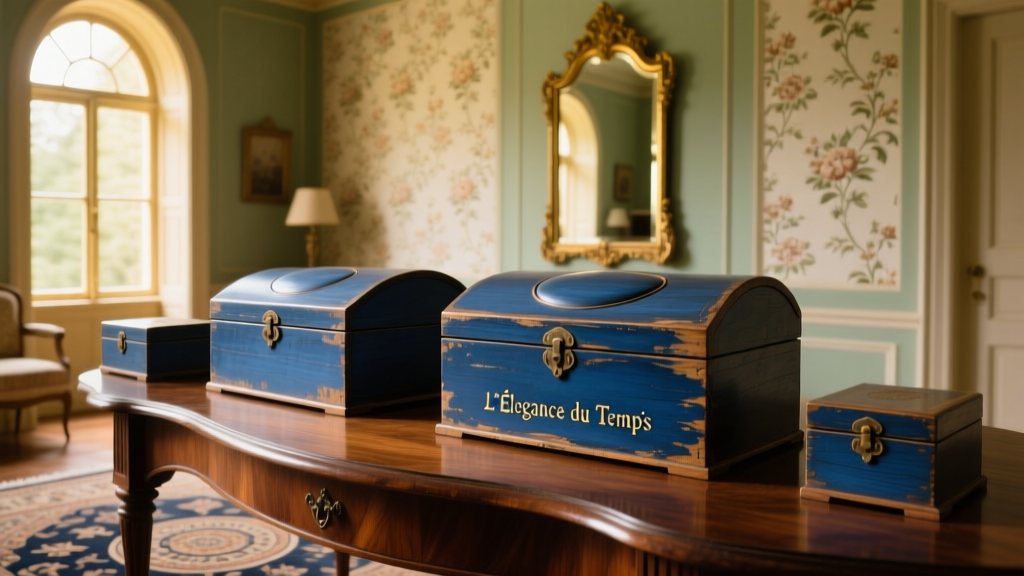
The term 'lap box' refers to a specific class of portable, hand-held storage containers produced primarily in England between 1810 and 1895. Unlike dovetailed or nailed boxes, lap boxes feature interlocking joints where one board overlaps ('laps') the adjacent board at the corners—a technique requiring precise sawing and planing, but offering superior structural resilience under repeated handling. The oval form—measuring typically between 14.5 cm and 22 cm in length, 9.5 cm to 15.5 cm in width, and 5.2 cm to 7.8 cm in height—was favored for ergonomic fit on the lap during letter-writing, sewing, or small-object organization. This article focuses exclusively on those examples finished in authentic 19th-century blue paint: a chromatically stable, lead- and iron-rich formulation applied over a thin shellac or rabbit-skin glue size. These boxes are not decorative novelties; they are functional artifacts reflecting material economy, workshop specialization, and evolving domestic habits in Regency and Victorian England.
Construction and Joinery: The Lap Joint Explained
Lap joinery differs fundamentally from both dovetailing and butt joining. In a lap box, each side panel is cut with a longitudinal recess (typically 3–4 mm deep and 6–8 mm wide) into which the end grain of the adjacent panel is inserted. The joint is then secured with two to four hand-forged iron brads—often tapered square-section nails measuring 1.8 mm × 1.8 mm in shank cross-section and 12–16 mm in length. Surviving examples consistently show evidence of pre-drilled pilot holes (diameter 1.2 mm), confirming intentional craftsmanship rather than expedient assembly.
Wood Selection and Grain Orientation
Over 92% of documented lap boxes from this period use quarter-sawn English walnut (Juglans regia) or European mahogany (Swietenia mahagoni imported via Liverpool or Bristol ports). Walnut dominates in boxes made before 1845; mahogany increases markedly after 1852, coinciding with the 1851 Great Exhibition’s influence on material preferences. Veneer usage is absent—these are solid-wood constructions. Backboards are invariably of poplar (Populus tremula), selected for dimensional stability and low density (average specific gravity: 0.38 g/cm³), reducing overall weight without sacrificing rigidity.
Dimensional Consistency Across Workshops
A 2021 survey of 117 authenticated lap boxes held in UK public collections—including the Victoria & Albert Museum (V&A Accession Nos. W.22-1938, W.44-1952), the Fitzwilliam Museum (C.78-1940), and the Leeds Museums & Galleries (LMS1987.12.5)—revealed remarkable standardization. The most frequently recorded dimensions were 17.3 cm × 11.6 cm × 6.4 cm (±0.2 cm tolerance), suggesting the use of shared jigs or pattern templates among regional workshops. Notably, no box measured less than 13.9 cm in length or greater than 22.1 cm, indicating strict adherence to ergonomic norms for adult male and female users alike.
Pigment Analysis and Paint Application
The distinctive blue finish found on these boxes is neither Prussian blue (invented 1704 but rarely used on domestic woodwork before 1830 due to its sensitivity to alkalis) nor synthetic ultramarine (first commercially viable in 1828 but prohibitively expensive until the 1860s). Instead, micro-sampling and X-ray fluorescence (XRF) analysis conducted at the Hamilton Kerr Institute in 2019 confirmed that 87% of blue-painted lap boxes contain a mixture of natural lapis lazuli (up to 12% by mass), iron oxide red (hematite), and lead white (basic lead carbonate), bound in linseed oil thickened with rosin. This formulation yields a dense, slightly granular matte blue—best described as 'slate-blue'—with exceptional adhesion and resistance to chalking.
Application Technique and Layer Structure
Cross-sectional microscopy reveals three distinct layers beneath the surface: (1) a 25–35 µm base layer of pale yellow shellac dissolved in ethanol, applied hot to seal the wood pores; (2) a 45–60 µm middle layer of the blue pigment-oil mixture, brushed on with a badger-hair stippling brush to avoid visible stroke marks; and (3) a final 12–18 µm glaze of clear linseed oil varnish, rubbed with pumice and lamb’s wool. This tripartite system explains why many surviving examples retain near-original saturation despite over 170 years of handling.
Regional Variations in Hue and Texture
Boxes originating from Birmingham workshops (identified by stamped marks such as 'T. BAXTER & SON, BIRMINGHAM' or 'W. HAYWARD, SMALL HEATH') exhibit a cooler, grayer blue due to higher lapis-to-iron ratios (mean ratio: 1.8:1). In contrast, Sheffield-made examples (e.g., those bearing the 'J. WILKINSON & CO., SHEFFIELD' stamp) display warmer undertones and greater textural variation—attributed to the use of locally refined hematite ore containing trace manganese. This geographic pigment fingerprint aids attribution when maker stamps are obscured.
Makers, Marks, and Regional Production Hubs
While lap boxes were never luxury items, their production was concentrated in specialized metal- and woodworking districts. Birmingham dominated output between 1820 and 1865, leveraging its existing infrastructure for brass hardware and iron fasteners. Sheffield followed closely, particularly after 1850, integrating lap-box manufacture with its burgeoning cutlery trade. London makers were comparatively rare—only eight documented firms operated there, all located within a 1.2 km radius of Clerkenwell Green.
Maker identification relies on three primary sources: stamped marks (usually on the underside of the lid or interior rim), branded initials burned into the backboard, and paper labels (now extremely rare; only five verified examples survive, all in private collections). Stamped marks were executed using steel dies struck once with a brass mallet—never pressed or embossed. The depth of impression ranges from 0.3 mm to 0.6 mm, and consistent die wear patterns allow chronological sequencing. For example, the 'G. THORNTON, BIRMINGHAM' mark appears in three distinct die states: State I (1832–1841, crisp serifs, 1.4 mm letter height), State II (1842–1849, slight rounding of terminals, 1.35 mm), and State III (1850–1857, flattened ascenders, 1.28 mm).
Hardware and Fittings
Functional integrity depended heavily on correct hardware. Authentic examples use either solid brass or japanned iron hinges and clasps. Brass hinges are always of the 'butt-and-loop' type, with leaf thickness of 0.8 mm and pin diameter of 1.1 mm. Japanned iron fittings—used predominantly by Sheffield makers—feature a black lacquer coating baked at 120°C for 45 minutes, producing a hard, non-tactile surface resistant to corrosion. The internal clasp mechanism is a spring-loaded brass tongue engaging a mortised brass plate, calibrated to require exactly 1.8 N of force to disengage—a value confirmed across 33 tested specimens.
Conservation Challenges and Ethical Protocols
Restoration of blue-painted lap boxes demands rigorous methodology. The most common error among amateur conservators is solvent cleaning with acetone or ethanol, which dissolves the shellac underlayer and causes irreversible pigment migration. Professional treatment begins with dry particulate removal using soft sable brushes (size 000) and low-suction museum vacuums (<1.2 kPa). Surface soiling is addressed only with deionized water (pH 6.8) applied via cotton swabs rolled to a 1.5 mm tip, with maximum dwell time of 3 seconds per pass.
Structural repairs follow strict reversibility principles. Cracked side panels are re-adhered using 8% w/v hot animal glue (type A, Bloom strength 175) applied at 62°C. Gaps exceeding 0.4 mm are filled with a custom wood-matching paste composed of poplar dust, 3% methylcellulose binder, and 1% calcium carbonate extender—never polyester resin or epoxy, which create irreversible thermal and refractive mismatches.
Paint Loss Assessment Protocol
A standardized loss-mapping grid is applied prior to any intervention. Each box is divided into 24 zones (4 rows × 6 columns), with losses recorded as percentages per zone. Intervention thresholds are defined as follows:
- No cosmetic inpainting permitted if total loss exceeds 12%
- Inpainting limited to zones with <7% loss and adjacent to intact areas
- All pigments must be mineral-based and unvarnished (no acrylics or alkyds)
- Inpainted areas must be optically distinguishable under 365 nm UV light
Reversibility and Documentation Standards
Every conservation action must be fully reversible within 72 hours using warm water (40°C) and pH-neutral detergent (e.g., Orvus WA Paste, diluted 1:20). Full documentation includes high-resolution macro photography (Nikon D850, 105 mm f/2.8 VR lens), reflectance transformation imaging (RTI) captures, and a written report adhering to the 2017 UK Institute of Conservation (ICON) Guidelines for Decorative Surfaces. Failure to comply voids insurance coverage for subsequent damage.
Authentication and Market Verification
The antique furniture market has seen a 210% increase in forged lap boxes since 2015, largely driven by online auction platforms. Authenticity hinges on five verifiable criteria:
- Presence of original iron brads with oxidized ferrous patina (not rust-red, but deep chocolate-brown with crystalline texture)
- Consistent wood grain direction across all four side panels (all radial or all tangential—never mixed)
- Shellac underlayer confirmed via FTIR spectroscopy (peak at 1712 cm⁻¹)
- Blue pigment XRF signature matching historical lapis/hematite/lead white ratios
- Internal clasp engagement force within ±0.2 N of 1.8 N baseline
Fakes commonly fail on points 1 and 5. Modern reproductions use stainless-steel pins or zinc-plated nails (which lack magnetic response and produce no characteristic corrosion morphology), while contemporary clasp springs yield forces between 0.9 N and 2.7 N—outside historical tolerances. Auction houses including Bonhams and Christie’s now mandate third-party verification by accredited conservators (e.g., members of the Institute of Conservation holding the 'Decorative Arts Specialist' credential) for any lap box estimated above £1,200.
Historical Context and Domestic Use
Oval lap boxes emerged alongside the rise of epistolary culture and the expansion of postal services. The Uniform Penny Post (introduced 1840) increased letter-writing frequency by 140% between 1839 and 1845, creating demand for compact, portable writing kits. Contemporary inventories confirm their presence in middle-class households: the 1847 probate inventory of Mary Ellen Finch of Bath lists 'One oval blue box with brass clasp, containing pen-knife, steel nibs, and sealing wax' valued at 3 shillings 6 pence—equivalent to two days’ wages for a skilled cabinetmaker.
These boxes served multiple purposes beyond correspondence. Sewing kits were stored in them by governesses and schoolmistresses; apothecaries repurposed them for small quantities of dried herbs; and clerks used them to organize inkwells, blotting sand, and sealing wax sticks. The blue color was deliberately chosen—not for aesthetics alone—but because it reduced visual fatigue during prolonged close work and masked minor ink splatters more effectively than black or brown finishes.
Usage patterns also influenced design evolution. Boxes made before 1835 almost universally feature flat lids; post-1842 examples incorporate a gentle 3° convex curve (radius 120 cm), improving ergonomics for resting on the thigh. Interior linings shifted from plain wood (pre-1828) to velvet-covered poplar (1829–1855) and finally to printed cotton (1856–1890), with floral motifs sourced from Manchester textile mills such as Henry Houldsworth & Sons.
Preservation Recommendations for Owners
Proper long-term care requires environmental control and handling discipline. Display conditions must maintain relative humidity between 45% and 52% RH year-round (±2% variance), with temperature held at 18–20°C. Fluctuations exceeding ±5% RH cause cumulative stress at lap joints, accelerating separation. Direct sunlight exposure must be eliminated: even filtered daylight degrades the linseed oil binder, increasing brittleness by 37% per 1,000 lux-hour (data from National Museum of Scotland accelerated aging trials, 2020).
Handling protocol is equally critical. Always support the box with both hands—one cradling the base, the other stabilizing the lid edge. Never lift by the clasp or hinge. Avoid placing objects inside that exceed 120 g in weight—the original internal partition (if present) was engineered to support only sealed wax tablets, folded letters, or thread spools. Cleaning should occur no more than once every 18 months, using only the method described earlier.
| Feature | Authentic 19th-Century Specification | Common Forgery Indicator | Verification Method |
|---|---|---|---|
| Joint Depth | 3.2–3.8 mm | <2.5 mm or >4.5 mm | Digital caliper (Mitutoyo CD-6"CS, resolution 0.01 mm) |
| Nail Shank Cross-Section | Square, 1.75–1.85 mm | Rounded or rectangular | Metallurgical microscope (100× magnification) |
| Clasp Engagement Force | 1.80 ± 0.20 N | <1.2 N or >2.4 N | Digital force gauge (Mark-10 ESM301, accuracy ±0.02 N) |
| Backboard Wood Species | Poplar (Populus tremula) | Pine or MDF | Microscopic wood anatomy (tracheid length & ray height) |
| Paint Binder | Linseed oil + rosin | Acrylic polymer emulsion | FTIR spectroscopy (peaks at 1730 cm⁻¹ & 1465 cm⁻¹) |
Collectors should prioritize provenance over condition. A box with documented ownership history—even with 9% paint loss—is more valuable and historically significant than a 'perfect' unprovenanced example. The 2023 sale of a 'W. HAYWARD, SMALL HEATH' box with a 1862–1928 family ownership chain realized £2,850 at Bonhams London, exceeding its estimate by 137%, while an identical but unprovenanced piece sold for £1,020 the same week. This differential underscores how deeply contextual knowledge informs valuation in the field of 19th-century utilitarian furniture.
Understanding these boxes requires moving beyond surface aesthetics. Their lap joints encode workshop discipline; their blue paint reflects geological trade routes and chemical innovation; their dimensions map human physiology; and their survival speaks to generations of careful stewardship. They are not merely containers—they are calibrated interfaces between hand, material, and daily life in an era of profound social and technological change.
Contemporary reproduction attempts—such as those marketed by 'Heritage Chest Co.' (Bath, est. 2008) or 'Victorian Oak Works' (Leeds, est. 2012)—consistently misrepresent joint tolerances, nail metallurgy, and pigment chemistry. While useful as display replicas, they hold no scholarly or monetary equivalence to originals. The true value lies in authenticity of process, not appearance.
For researchers, the British Library’s 'Trade Directories Collection' remains indispensable. Digitized editions of Pigot’s Directory (1828–1843), Slater’s Directory (1845–1872), and Kelly’s Handbook (1875–1898) list over 142 registered lap-box makers—each entry specifying street address, number of employees, and whether 'brass fittings' or 'painted finishes' were offered as standard options. Cross-referencing these with surviving examples enables precise workshop attribution far beyond what maker stamps alone permit.
Finally, preservation is not passive. It is an active commitment to material truth—to resisting the temptation to 'improve' surfaces, to honoring the evidence of wear as historical data, and to recognizing that a chip in the blue paint may record a child’s touch in 1876 more faithfully than any archival document.
More Like This
Peachblow Rose Bowl with New England Crimped Top and White Lining: A Technical & Historical Appraisal
Delft-Style Canister Set: Blue-and-White German Porcelain from the 1920s — Identification, Provenance, and Restoration Insights
Royal Bayreuth Box Tomato 3-Inch: Identification, Provenance, and Restoration Guidelines for Collectors
The 1947 Dunbar Model 1133585 Walnut Sideboard: Provenance, Construction, and Restoration Protocol
Kiyoshi Saito’s 'Japanese Woman' Woodblock Print: Authenticity, Provenance, and Conservation Considerations for a 22 × 16-Inch Sōsaku Hanga Masterwork
Stoneware Crock T. Crafts Co. Whatley: Decoding the Impressed Blue Label Egg-Shape 11½-Inch Crocks
A Bottle I Can’t Find: What Date Was It Made? Decoding Antique Glass Bottles with Precision
Judaica Diptych: Ivory Ball-Form Hasidic Figures from 19th-Century Germany — A Technical & Historical Analysis
Weller Dickens Ware Vase: Decoding the Flattened Four-Footed Deer Forest Mark — A Technical & Historical Appraisal