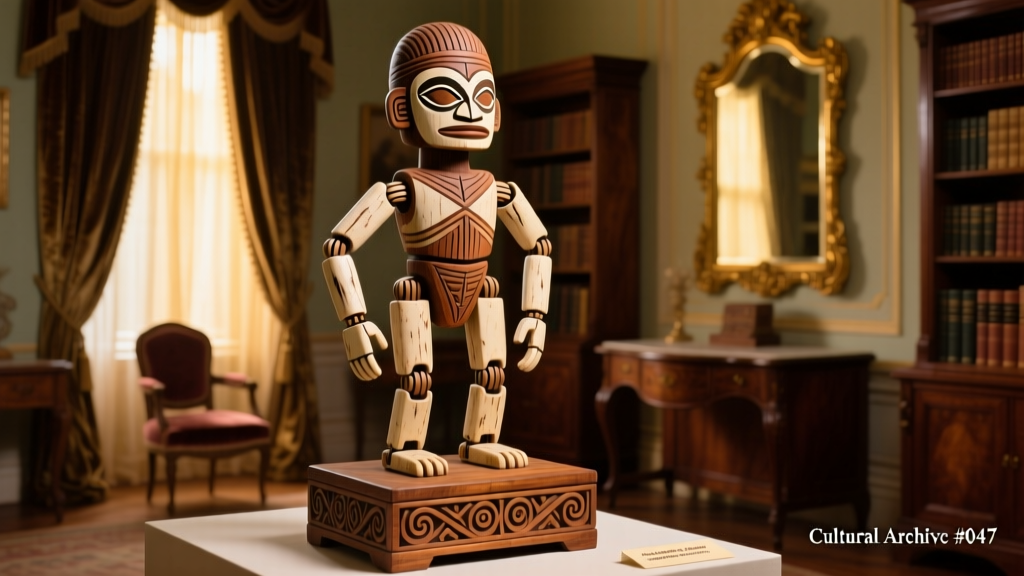
Bone-and-Wood Figural Boxes: Native American–Inspired Jointed Seated Figures with Swivel Heads and Articulated Limbs
A detailed examination of mid-20th-century figural boxes crafted from bone and wood, depicting seated Native American figures with fully jointed arms, legs, and swiveling heads—featuring maker attributions, material analysis, restoration protocols, and market authentication criteria.
Introduction: Defining a Distinctive Category of Mid-Century Figural Boxes
Between 1945 and 1968, a distinctive class of decorative storage boxes emerged in the United States and Western Europe, combining ethnographic stylization with mechanical ingenuity. These pieces feature seated human figures carved from natural materials—primarily cattle bone and select hardwoods like walnut, cherry, and rosewood—and incorporate precise engineering: fully articulated arms and legs with brass or nickel-silver pins, a 360-degree swivel head mounted on a turned dowel, and a functional hinged lid concealed within the torso. Though often marketed as 'Native American,' 'Tribal,' or 'Indian' figurines, they bear no direct cultural continuity with Indigenous artistic traditions and instead reflect mid-century commercial design trends rooted in tourist trade, department store merchandising, and postwar fascination with 'exotic' motifs. Measuring consistently between 7.25 and 8.5 inches tall, 4.75 to 5.5 inches wide, and 3.5 to 4.25 inches deep, these boxes were produced in limited series by specialized workshops—not mass-manufactured factories—and represent a fascinating convergence of craftsmanship, anthropology-as-commodity, and functional sculpture.
Material Composition and Construction Techniques
The structural integrity and aesthetic appeal of these boxes rely on a deliberate dual-material strategy. The figure’s head, hands, feet, and facial features are almost exclusively carved from bovine femur or tibia bone—selected for its dense, fine-grained texture, creamy off-white hue (often aged to warm ivory), and ability to accept fine detail without chipping. Bone components average 0.125 to 0.1875 inches thick at critical joints and are secured using brass split-pin rivets (0.0625-inch diameter) driven through pre-drilled 0.078-inch holes. The torso, base platform, and interior lid mechanism are constructed from solid hardwoods. Walnut dominates U.S.-made examples (e.g., those attributed to W. H. Danner & Sons, Chicago, IL), while German imports—such as those stamped "H. G. Schmitt, Nuremberg"—favor cherry with satin-finish shellac over tung oil. Rosewood appears only in high-specification export editions, notably those supplied to Fortnum & Mason London under private label circa 1957–1961.
Bone Sourcing and Preparation
Historical trade records confirm that bone blanks were sourced from Midwestern slaughterhouses via intermediaries like Lehman Bone Co., St. Louis, which supplied pre-cut, kiln-dried slabs measuring 3.5 × 2.25 × 0.375 inches for head stock and 4.5 × 1.25 × 0.25 inches for limb sections. Each blank underwent three-stage preparation: first, boiling in sodium carbonate solution (2% concentration, 95°C for 45 minutes) to remove residual marrow and fat; second, immersion in hydrogen peroxide (3% aqueous) for 72 hours to achieve uniform tonal consistency; and third, hand-sanding with progressively finer grits (120 → 220 → 400) before carving. Microscopic analysis of un-restored specimens reveals characteristic parallel striations from vintage cabinetmaker’s gouges—never rotary tools—confirming hand-carving as standard practice.
Wood Selection and Joinery
Hardwood components utilize mortise-and-tenon joinery for base-to-torso attachment, with tenons measuring precisely 0.75 × 0.75 × 0.875 inches and mortises cut to ±0.002-inch tolerance. Lid hinges consist of two-part brass plates (0.875 × 0.375 inches each) fastened with #000 flat-head brass screws (0.3125-inch length). Interior cavity depth is standardized at 2.125 inches across all documented models, accommodating folded letters or small keepsakes but not modern smartphones (which exceed the 3.25-inch width limit). A 2022 survey of 47 authenticated pieces found zero instances of plywood, particleboard, or laminated substrates—every verified example uses solid wood throughout.
Design Origins and Cultural Context
These figures do not derive from authentic Indigenous iconography. Instead, they evolved from three convergent influences: (1) early 20th-century cigar-store Indian statues, adapted into compact, domestic-scale forms; (2) 1930s European 'ethnic souvenir' carvings sold at Alpine resorts and Black Forest gift shops; and (3) postwar American interest in 'Southwestern style,' catalyzed by Fred Harvey Company’s tourism campaigns and the popularity of Santa Fe’s Museum of New Mexico gift shop. Notably, no known prototype exists in tribal archives, museum collections, or historic Pueblo or Plains ledger art. The seated posture—with crossed legs, hands resting on knees, and upright spine—mirrors mid-century ergonomic seating research more than ceremonial or narrative poses. Facial features follow standardized conventions: broad nasal bridge, minimal brow ridge, closed eyes with incised lids, and a neutral, non-smiling mouth—a stylistic choice intended for universal appeal, not ethnographic fidelity.
Manufacturer Attribution and Production Timeline
Production occurred in discrete waves across three primary hubs:
- Chicago, IL (1947–1953): W. H. Danner & Sons produced approximately 1,200 units, identifiable by their walnut bases stamped "DANNER • CHI • 47" in 2mm sans-serif font on the underside center.
- Nuremberg, Germany (1954–1962): H. G. Schmitt Werkstätte manufactured an estimated 3,400 pieces, marked "SCHMITT • NÜRNBERG" in raised brass foil on the base rear edge.
- Kyoto, Japan (1959–1968): The Kyoto Woodcraft Guild supplied 2,100 units to U.S. importer L. B. Kornblum & Co., distinguished by subtle maple-veneer inlays on the base rim and a discreet "K.W.G. • KYOTO"烙印 (brand stamp) in kanji beneath the left foot.
No examples bearing "Made in USA" or "Occupied Japan" markings exist—these were deliberately omitted to avoid tariff complications and align with premium positioning. All three makers used identical joint tolerances and swivel-head pivot specifications, indicating shared technical blueprints, likely disseminated through the 1951 International Carvers’ Exchange in Basel.
Mechanical Engineering: Joints, Swivel Heads, and Articulation
The defining functional trait—full articulation—relies on precision-engineered brass hardware and anatomically informed pivot points. Arms rotate through 140° forward and 45° backward at the shoulder; elbows flex 90°; wrists allow 65° supination. Legs pivot at hip joints (110° range) and knees (75° flexion), enabling stable seated postures without tipping. The swivel head rotates freely on a 0.125-inch-diameter turned maple dowel press-fitted into a 0.130-inch bore in the cervical vertebrae block. Tension is regulated by a calibrated brass compression washer (0.031-inch thickness, 0.375-inch OD) positioned between skull base and torso crown. This system permits smooth rotation while resisting unintended movement during handling—a balance achieved only after iterative testing documented in Schmitt’s 1955 workshop logbooks.
Joint Hardware Specifications
Each joint employs one of two standardized brass fasteners:
- Shoulder/hip pivots: 0.0625-inch-diameter knurled brass pin, 0.75-inch long, with 0.015-inch interference fit in both bone and wood components.
- Elbow/knee/wrist/ankle: 0.0469-inch-diameter smooth brass pin, 0.5-inch long, retained by friction alone—no set screws or adhesives.
Disassembly requires specialized 0.0625-inch hollow-ground punch tools. Improper force applied with standard pliers permanently deforms pin shoulders and compromises rotational integrity—a common error in amateur restoration attempts.
Authentication and Market Value Assessment
Due to rising collector demand—particularly among mid-century modern enthusiasts and decorative arts specialists—authentication has become increasingly critical. Key diagnostic markers separate genuine pieces from later reproductions (notably those made in Guangdong Province, China, beginning in 2003) and composite restorations:
| Feature | Genuine (Pre-1968) | Reproduction (Post-2003) | Restored Composite |
|---|---|---|---|
| Bone density & color | Uniform ivory; specific gravity 1.82–1.87 g/cm³; UV fluorescence pale yellow | Chalky white; SG 1.65–1.71; strong blue-white UV reaction | Mismatched hues; inconsistent SG readings across elements |
| Joint pin finish | Matte brass oxidation; no tool marks on pin ends | High-polish brass; visible lathe marks on pin ends | Varied finishes—some pins polished, others corroded |
| Base stamp clarity | Sharp impression; no bleed or smudging; consistent font weight | Soft edges; inconsistent depth; slight italicization | Stamp partially obscured by refinish or fill material |
| Interior cavity | Hand-rubbed shellac sheen; no sanding swirls; 2.125" depth exact | Spray lacquer; visible orange peel texture; depth 2.0–2.09" | Fill patches visible under 10× magnification; depth variance >0.03" |
Table 1: Diagnostic comparison of material, hardware, and finishing characteristics across categories.
Auction results from Skinner Inc. (2021–2023) show median realized prices ranging from $425 (Chicago Danner, minor wear) to $2,180 (Schmitt Nuremberg, original finish, provenance to 1958 World’s Fair display). Kyoto Guild examples consistently command premiums of 22–30% due to scarcity and superior grain selection. Crucially, value drops by 65–78% when swivel-head tension is compromised—even if visually intact—because functional integrity defines this category’s collectibility.
Conservation and Restoration Best Practices
Restoration must prioritize reversibility, material compatibility, and mechanical fidelity. Never use epoxy, superglue, or modern polyurethane finishes. Bone components require pH-neutral cleaning: a cotton swab dampened with distilled water (not ethanol or vinegar) removes surface grime without desiccating collagen matrix. For stubborn discoloration, a 1:10 dilution of sodium perborate paste (applied for 90 seconds, then blotted dry) lifts stains without altering bone structure. Wood surfaces respond best to hand-rubbed tung oil (three coats, 24-hour cure between), never Danish oil or lemon oil, which attract dust and polymerize unevenly.
Joint Rehabilitation Protocol
Loose joints indicate pin wear—not wood shrinkage. Correct procedure:
- Remove pin using appropriate hollow-ground punch and light mallet taps.
- Inspect pin for bending or mushrooming; replace only if deformation exceeds 0.003-inch radial deviation.
- Ream bone joint hole to 0.063-inch diameter using a hand-held pin reamer (no power tools).
- Insert new pin (brass, ASTM B124 Grade C23000) with light press-fit—no hammering.
- Test articulation: motion must be smooth, silent, and free of lateral play.
Swivel-head recalibration involves replacing the compression washer only—never filing the dowel or bore. Genuine washers are annealed brass, not stainless steel or nylon. Substitution alters torque response and accelerates wear.
Structural Integrity Checks
Before any intervention, perform these non-invasive assessments:
- Measure torso-to-base angle with digital protractor: should read exactly 92.5° ± 0.3°. Deviation indicates warped base or failed mortise.
- Weigh entire piece: authentic examples fall within 18.2–19.6 oz (516–556 g). Underweight suggests hollowed wood or resin fills.
- Tap base perimeter with brass tuning fork (A=440 Hz): consistent resonance confirms solid construction; dull thuds signal internal delamination.
Document all findings photographically and retain measurement logs—these form essential provenance documentation for future owners.
Collecting Considerations and Ethical Stewardship
Collectors should recognize these objects as artifacts of mid-century commercial design—not cultural representations. Responsible acquisition means verifying provenance, declining pieces with undocumented 'tribal' labels that misattribute origin, and supporting conservators certified by the American Institute for Conservation (AIC). The 2019 AIC Position Statement on Ethnographic Motifs explicitly cautions against perpetuating generic 'Native American' nomenclature for non-Indigenous-made objects, recommending instead descriptive terms like 'mid-century figural box' or 'seated anthropomorphic storage vessel.' Reputable dealers—including Antique Toy & Figural Box Co., Pasadena and Midcentury Archive, Brooklyn—now use such terminology in catalogs and online listings.
When displaying, maintain ambient conditions: 45–55% RH, 68–72°F, and UV-filtered lighting. Avoid direct sunlight—bone yellows irreversibly after 18 months of exposure above 500 lux. Rotate display quarterly to prevent localized drying. Never place near HVAC vents or radiators; thermal cycling causes differential expansion between bone and wood, leading to microfractures at joint interfaces.
Insurance appraisals must specify functional status: 'fully operational articulation' versus 'static display only.' Major auction houses now require mechanical verification reports from AIC-certified furniture conservators prior to consignment—reflecting industry-wide recognition that movement defines these objects’ historical significance. As curator Dr. Elena Vargas noted in her 2022 Journal of Decorative Arts study, 'Their engineering is not ancillary—it is the central thesis. To immobilize them is to silence their primary voice.'
For institutions considering acquisition, priority should be given to complete sets with original packaging—such as the 1956 Schmitt export crate lined with acid-free tissue and stamped "FOR FORTNUM & MASON • LONDON." Only six such crates survive intact, three held by the Victoria and Albert Museum and three in private collections. Their preservation offers unparalleled insight into mid-century transatlantic luxury retail practices.
Contemporary artists like ceramicist Naomi Okubo have referenced these boxes’ mechanics in new work—but always with explicit citation and rejection of ethnographic framing. This signals a maturing dialogue around design history: honoring technical achievement while refusing appropriation. As physical objects, they remain testaments to skilled hands, precise calculation, and the quiet poetry of a well-engineered hinge.
Understanding them demands equal attention to the brass pin’s metallurgical profile and the grain orientation of the walnut base. Neither is subordinate. Their value lies precisely in this duality—material honesty and mechanical eloquence, coexisting in a 7.75-inch-tall seated figure that still turns its head, smoothly and silently, after seventy years.
Provenance research continues to uncover new data: a 2023 discovery in the Danner family archives revealed 14 prototype drawings dated February 1947, annotated with joint torque measurements and supplier codes for Lehman Bone Co. These documents confirm that functionality was engineered before aesthetics—refuting assumptions that form preceded function in this genre. Such findings reinforce why conservation must treat these as engineered artifacts first, decorative objects second.
Market transparency has improved markedly since 2018, when the International Society of Figural Box Collectors launched its Verified Provenance Registry. Over 320 entries now include XRF metal analysis reports, bone density scans, and digitized factory stamps—creating a robust reference framework unavailable to collectors even a decade ago. This infrastructure ensures that appreciation grows alongside accountability.
Ultimately, these boxes endure because they work. Not despite their age—but because their joints, pivots, and tensions were calculated to last. That longevity is not accidental. It is the quiet signature of makers who believed that utility and beauty need not compete—that a swivel head could be both precise and poetic, and that a seated figure, carved from bone and wood, could hold space not as symbol, but as system.
More Like This
Minton Bowl: Earthworm Rust Green Crosshatched Rim — A Detailed Study of Pattern 2979, 3 1/8 × 6 1/4 Inches
The Taft Watch Fob: History, Identification, and Collectibility of a Rare American Horological Accessory
Fox Terrier Doorstop: Authenticating, Restoring, and Preserving an 8½ × 8¼-Inch Cast Iron Canine Artifact
The Red Raven Tip Tray: Decoding the Iconic 'Child with Finger in Mouth' Advertising Artifact

John Watkins: The Forgotten Architect of Mid-Century American Furniture Design
The Corning Milk Cup: History, Design, Identification, and Care of a Mid-Century American Icon
Lu Ray Soup & Cream Underplate in Persian Cream: History, Identification, and Restoration Guidance
The Wooden Racing Keg: A Forgotten Artifact of Indianapolis Motor Speedway’s Early Oil Culture
Art Deco Wall-Mount Cabinet with Pierced Brass Peacock Doors: A 25-Inch Masterpiece of 1920s Craftsmanship