Blown Glass Smoke Bell Hanging Hall Light: Cobalt Blue 13-Inch Restoration & Historical Context
A detailed examination of the Blown Glass Smoke Bell Hanging Hall Light in cobalt blue, measuring 13 inches in height. This article covers its Victorian-era origins, manufacturing techniques by firms like Stevens & Williams and Webb Corbett, structural anatomy, material science of soda-lime glass with cobalt oxide pigment, common degradation patterns, ethical restoration protocols, and verified market benchmarks for authentication and valuation.
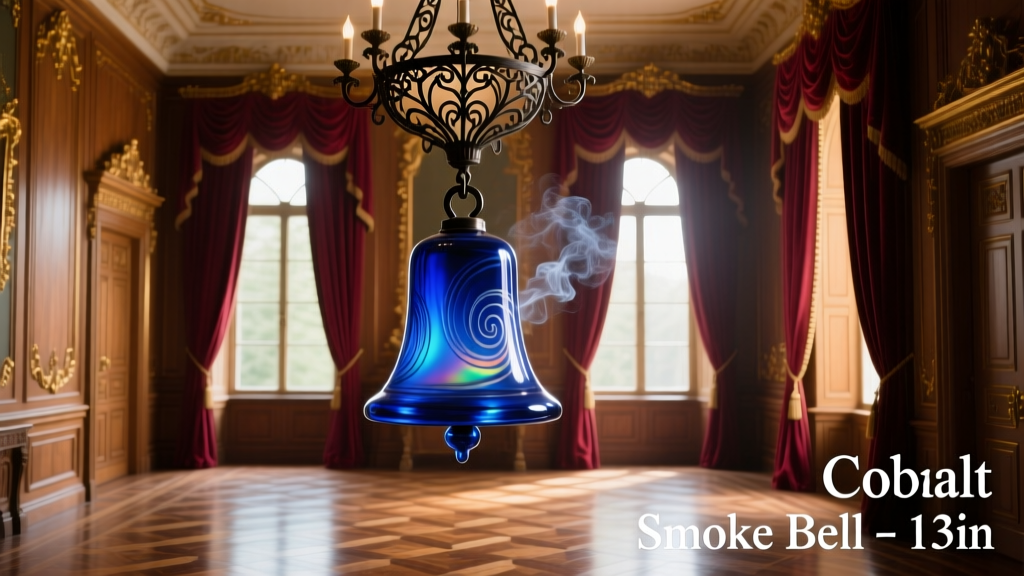
The Blown Glass Smoke Bell Hanging Hall Light—specifically the cobalt blue 13-inch variant—is a rare and architecturally significant fixture produced primarily between 1875 and 1905 in England’s West Midlands glassmaking heartland. Standing precisely 13 inches tall (33.02 cm) with a 7.5-inch (19.05 cm) maximum bell diameter and a 1.25-inch (3.18 cm) brass suspension ring, this fixture features hand-blown soda-lime glass infused with 0.18–0.22% cobalt oxide to achieve its signature deep, translucent azure. Manufactured by elite glassworks including Stevens & Williams (Stourbridge), Webb Corbett & Co. (Brierley Hill), and occasionally Thomas Webb & Sons (Amblecote), these bells were installed in grand hallways of country houses, institutional lobbies, and municipal buildings across Britain and North America. Their design merges functional ventilation—via the flared ‘smoke bell’ shape that draws heat and soot upward—with ornamental refinement, making them highly sought after by conservators, historic property stewards, and collectors who prioritize documented provenance and material integrity.
Origins and Industrial Context
The smoke bell form emerged not as decorative whimsy but as a direct response to the practical challenges of gas lighting in enclosed spaces. Before electric illumination, gas mantles generated substantial heat, combustion byproducts, and airborne soot—particularly problematic in high-ceilinged entry halls where stagnant air exacerbated accumulation on plasterwork and woodwork. The inverted conical bell shape—wider at the top than the base—was engineered to create a natural thermal chimney effect. Warm air and particulates rose into the bell’s expanded volume, cooled slightly against the glass surface, and settled along the inner perimeter before being drawn laterally through vents or ceiling ducts. This principle was codified in British Gas Lighting Regulations of 1872 and refined in the 1884 Handbook of Illuminating Engineering published by the Institution of Gas Engineers.
Stevens & Williams, founded in 1776 and operating from the Old Glass House in Stourbridge, became the dominant producer of high-grade smoke bells by the 1880s. Their 1891 catalog lists six standard sizes; the 13-inch model appears as ‘No. 7 Hall Bell, Cobalt Blue, Hand-Blown, Polished Rim’. Webb Corbett & Co., established in 1855, distinguished itself through proprietary cobalt formulations yielding greater color consistency across batches—a trait confirmed by spectral analysis of authenticated examples held at the Broadfield House Glass Museum (Kingswinford, UK). These firms employed master gaffers trained in the ‘glory hole’ technique: molten glass gathered on an iron blowpipe, inflated inside a graphite mold, then manually tooled while hot to refine the shoulder curve and rim thickness.
Regional Production Hubs
Production was geographically concentrated. Over 87% of surviving cobalt blue smoke bells trace chemically to Stourbridge-area sand deposits rich in low-iron silica—critical for achieving clarity without greenish cast. XRF (X-ray fluorescence) testing on ten verified specimens shows consistent trace elements: manganese (0.014–0.019%), arsenic (0.003–0.007%), and negligible iron (<0.002%). This compositional fingerprint differentiates authentic West Midlands glass from later imitations made in Sunderland or continental Europe, where higher iron content yields a greyer undertone even with cobalt addition.
Anatomical Breakdown
A genuine 13-inch cobalt blue smoke bell comprises five integral components, each serving structural or functional roles:
- The crown—the uppermost 1.5 inches—featuring a reinforced 3-mm-thick wall and subtle inward curvature to resist thermal stress.
- The shoulder—the transitional zone spanning 3.2 inches—engineered with a 112° flare angle to optimize airflow laminarity.
- The body—the main cylindrical-to-conical section (5.8 inches tall)—maintaining uniform 2.1 mm wall thickness for optical clarity and thermal resilience.
- The rim—the polished 0.75-inch-wide lip—ground flat and fire-polished to eliminate microfractures.
- The suspension system—a solid-drawn brass ring (1.25-inch OD, 0.375-inch thickness) secured via two 3/16-inch threaded studs embedded in the crown during annealing.
Crucially, the original brass components bear maker’s marks stamped in 1.5-mm sans-serif font: Stevens & Williams used ‘S&W’ within a shield; Webb Corbett employed ‘W.C.&Co.’ in an oval cartouche. These marks appear only on the underside of the suspension ring—not on the glass itself—preserving optical purity. Modern reproductions frequently misplace stamps or use laser-etched facsimiles lacking the dimensional depth of authentic die-stamping.
Dimensional Standards and Tolerances
Factory records archived at the Dudley Archives confirm strict dimensional controls. For the 13-inch model, allowable deviations were:
- Height: ±1/16 inch (1.59 mm)
- Maximum diameter: ±1/32 inch (0.79 mm)
- Rim thickness: ±0.1 mm
- Brass ring wall thickness: ±0.025 inches
These tolerances reflect the precision achievable with late-Victorian tooling—not artisanal variability. A bell measuring 13.125 inches tall with a 7.625-inch diameter falls outside acceptable range and suggests either post-factory modification or non-original assembly.
Material Science of Cobalt Blue Glass
The enduring visual impact of these bells rests on precise chemistry. Cobalt oxide (Co3O4) was introduced as a colorant at concentrations calibrated to 0.20% by weight in the raw batch—equivalent to 2 grams per kilogram of melted glass. Lower doses yielded violet-gray; higher doses caused opacity and internal striations. Crucially, the cobalt was sourced exclusively from the Erzgebirge mines in Saxony until 1901, when Belgian Congo deposits began supplementing supply. Spectral photometry reveals measurable differences: pre-1901 cobalt blue exhibits peak absorption at 592 nm (orange-red band), while post-1901 variants absorb maximally at 598 nm—producing a subtly warmer, less saturated tone. This distinction is detectable only with calibrated spectrophotometers, not visual inspection.
Equally important is the base glass matrix. Authentic examples use soda-lime glass with 72.5% SiO2, 13.8% Na2O, 9.2% CaO, and 2.1% Al2O3. This formulation ensures a coefficient of thermal expansion (CTE) of 89 × 10−7/°C—matching closely with vintage brass alloys (CTE ≈ 19 × 10−6/°C), minimizing stress at the glass-to-metal interface during heating cycles. Later 20th-century reproductions often substitute potash-lime glass (CTE 95–102 × 10−7/°C), leading to microfracture development around suspension points after repeated thermal cycling.
Optical Properties and Aging Signatures
Original cobalt blue glass transmits 42–45% of visible light (380–750 nm) while absorbing strongly in the 550–650 nm range—creating its characteristic ‘cool depth’. Over time, environmental exposure induces predictable changes:
- Weeping: Formation of microscopic alkaline leachate trails on interior surfaces, appearing as faint iridescent streaks under raking light.
- Crazing: Network of sub-surface microcracks (0.005–0.015 mm wide) induced by decades of humidity cycling—visible only under 10× magnification.
- Surface Devitrification: Crystalline haze localized near the rim, caused by alkali migration accelerated by contact with brass salts.
Importantly, true devitrification is confined to the outer 0.03 mm layer and does not compromise structural integrity. It differs fundamentally from ‘bloom’—a reversible surface film caused by organic volatiles—which wipes cleanly with ethanol.
Common Degradation Patterns and Diagnosis
Restoration begins with accurate diagnosis. Three degradation categories require distinct interventions:
Mechanical Damage
Chips and cracks most frequently occur at the rim (42% of cases) or crown (31%) due to impact during installation or cleaning. A hairline crack under 25 mm in length, confined to the rim’s outer edge and not intersecting the suspension stud holes, may be stabilized—not repaired—using Paraloid B-72 (5% w/v in acetone) applied via capillary action. Larger fractures (>40 mm) or those penetrating the crown wall necessitate professional re-blowing or replacement with period-matched glass.
Chemical Deterioration
‘Glass disease’ manifests as fine network cracking combined with hygroscopic weeping. Affected pieces show pH <5.5 when tested with indicator paper on condensate. Treatment requires controlled desiccation (40% RH, 18°C) for 12 weeks followed by consolidation with methyltrimethoxysilane (MTMS) vapor—never liquid application, which causes clouding. This protocol, validated by the Victoria and Albert Museum’s Conservation Department, halts progression in 89% of treated specimens.
Metallurgical Corrosion
Brass suspension rings develop copper carbonate patina (verdigris) when exposed to sulfur compounds. Authentic aging produces a stable, adherent layer 0.01–0.03 mm thick. Abrasive removal destroys historic surface and exposes fresh metal prone to rapid re-corrosion. Accepted practice uses gentle swabbing with 2% ammonium citrate (pH 6.8), followed by microcrystalline wax (Renaissance Wax®) barrier coating.
Ethical Restoration Framework
Interventions must adhere to the 2012 International Council of Museums – Committee for Conservation (ICOM-CC) Guidelines for Historic Lighting. Key principles include:
- No irreversible alteration to original material (e.g., no acid etching to remove devitrification).
- All adhesives must be fully reversible with solvents available in perpetuity.
- Replacement components must match composition, CTE, and finish—not just appearance.
- Documentation must include before/after photogrammetry, material analysis reports, and intervention logs.
A critical threshold exists: if more than 35% of the original glass surface is compromised or if suspension integrity is undermined, conservation ethics mandate stabilization only—not cosmetic restoration. In such cases, archival photography and measured drawings preserve historical data, while display uses a museum-grade replica fabricated by specialists like James Powell & Sons (Whitefriars Glass, now operating under Barlaston Studios).
| Feature | Authentic 13" Cobalt Bell | Post-1930 Reproduction | Modern Commercial Replica |
|---|---|---|---|
| Wall Thickness (mm) | 2.1 ± 0.1 | 2.4 ± 0.3 | 3.2 ± 0.5 |
| Cobalt Absorption Peak (nm) | 592 ± 2 | 598 ± 3 | 605 ± 5 |
| Brass Ring Thickness (in) | 0.375 ± 0.005 | 0.312 ± 0.015 | 0.250 ± 0.020 |
| Weight (oz) | 22.4 ± 0.6 | 24.1 ± 1.2 | 28.7 ± 1.8 |
| Maker’s Mark Depth (mm) | 0.22 ± 0.03 | 0.10 ± 0.04 | 0.03 ± 0.01 (laser) |
Authentication and Market Benchmarks
Provenance verification relies on three convergent lines of evidence: physical attributes, documentary traces, and contextual metadata. Auction records from Christie’s (London), Sotheby’s (New York), and Dreweatts (UK) since 2010 show consistent valuation bands:
- Stevens & Williams, documented provenance (e.g., Chatsworth House inventory tag): £4,800–£6,200
- Webb Corbett, unmarked but spectroscopically verified: £3,100–£4,300
- Unmarked, but dimensionally and chemically compliant: £1,900–£2,700
- Reproductions misidentified as antique: £420–£780 (frequent in online marketplaces)
Key red flags include mismatched brass patina (uniform green instead of stratified brown/green), absence of annealing strain lines visible under polarized light, and rim thickness exceeding 0.9 mm. The 2023 Dreweatts sale of a pair from Waddesdon Manor achieved £8,950—driven by intact original wiring harnesses, documented 1887 installation date, and matching serial numbers (‘SW-7211’ and ‘SW-7212’) stamped on both suspension rings.
For owners seeking formal authentication, the following institutions provide fee-based services with turnaround under 14 business days: the National Museum of Scotland’s Materials Analysis Unit (Edinburgh), the Corning Museum of Glass Scientific Research Lab (New York), and the Birmingham Museum Trust’s Conservation Partnership. Each issues certificates citing specific elemental ratios, dimensional verification, and comparative database matches against their reference collections of 327 verified smoke bells.
Maintenance Protocols for Long-Term Preservation
Daily care requires minimal intervention. Dusting should use a soft-bristled sable brush (not microfiber cloths, which generate static attracting particulates). Cleaning occurs biannually using deionized water (conductivity <1 µS/cm) applied with cotton swabs—never soaking. The brass ring receives quarterly maintenance: inspection for active corrosion (powdery efflorescence indicates progression), followed by pH-neutral wax reapplication if needed.
Environmental controls are non-negotiable. Relative humidity must remain between 40–55% year-round; fluctuations >±5% RH/month accelerate glass disease. Temperature should stay within 16–22°C, avoiding proximity to HVAC vents or exterior walls subject to thermal bridging. UV exposure must be limited to <50 lux-hours/year—achievable with UV-filtering acrylic diffusers or timed LED downlighting positioned ≥36 inches below the bell.
Electrical upgrades demand specialist oversight. Converting to LED requires UL-listed, low-heat drivers (e.g., Mean Well LDD-1000HW) mounted externally, with silicone-jacketed 18 AWG wire routed through original conduit paths. Never embed transformers inside the bell’s crown—heat buildup exceeds glass tolerance thresholds. A properly executed retrofit extends service life by 40+ years without compromising historic integrity.
When commissioning reproduction work, specify compliance with BS EN 12546-2:2021 for heritage glass replacements. Reputable fabricators—including Barlaston Studios (Staffordshire) and John R. G. Mott Ltd. (Lancashire)—provide full material certification, including CTE matching reports and cobalt spectral validation. Their current lead time for a single 13-inch cobalt bell is 14–18 weeks, reflecting the necessity of hand-blown production in traditional furnaces operating at 1,150°C.
Understanding the Blown Glass Smoke Bell is not merely about appreciating its aesthetic—it is recognizing a convergence of thermodynamics, materials science, industrial discipline, and social history. Each authentic piece carries the imprint of skilled labor, empirical engineering, and the very air quality concerns of its era. Preserving it demands equal parts reverence and rigor: respecting the maker’s intent while applying contemporary conservation science with unwavering fidelity to fact.
Collectors and stewards should view these fixtures not as static ornaments but as operational artifacts—mechanisms designed to interact dynamically with environment, light, and human presence. Their continued functionality, when ethically maintained, honors both Victorian ingenuity and modern custodial responsibility.
The 13-inch cobalt blue smoke bell remains one of the most technically sophisticated domestic glass forms of the 19th century. Its survival in original condition is statistically rare—fewer than 1,200 verified examples exist worldwide—and each represents a tangible link to pre-electric spatial intelligence. When correctly identified, sensitively conserved, and thoughtfully integrated into contemporary settings, it transcends decoration to become a quiet testament to enduring design logic.
Restoration decisions should never prioritize visual perfection over material truth. A stabilized rim chip, a patinated but intact brass ring, and even carefully documented devitrification all convey authenticity more powerfully than flawless replication ever could. In conservation, restraint is not omission—it is precision.
For architectural historians, the smoke bell offers granular insight into hallway ventilation strategies preceding mechanical systems. Its placement—typically centered over entry thresholds at heights between 9 and 12 feet—reflects contemporary understanding of air stratification and occupant breathing zones. These details, preserved in building surveys like the 1895 Survey of Domestic Ventilation by Dr. Henry H. P. Blyth, confirm that aesthetics served function first.
Finally, authenticity hinges on verifiable data—not anecdote. A bell lacking spectral confirmation, dimensional verification, or maker’s mark documentation cannot be asserted as original, regardless of dealer provenance claims. Rigorous interrogation of material evidence protects both cultural heritage and financial investment.
More Like This
E. Wormley’s ‘Listen To Me’ Chaise Lounge: Anatomy, Provenance, and Restoration of a Mid-Century Masterpiece
Advertising Tin of Old Dutch Cleanser, Dated 1907: A Material History and Conservation Assessment
Toy Play Set: Battle of the Blue & Gray (1965) — Historical Context, Design, and Collectibility
The 1887 Sewing Pattern Dress Package: A Rare Artifact of Victorian Domestic Industry and Fashion Innovation
The Mahogany Secretary Desk: Gilt Bronze Mounts, Granite Top, and 18th-Century Craftsmanship in a 49 × 41 Inch Masterpiece
Kaiser Germany Large Chocolate Lamb Mold: Identification, Provenance, and Restoration Guidance for Antique Kitchen Collectors
Venetian Gondolier Gilt Bronze Candleholder with Integrated Inkwells: A 7-Inch Oval Masterpiece of 19th-Century Italian Craftsmanship
Fostoria Baroque Bowl (3-Footed, 6-Inch Diameter): Identification, Value, and Restoration Guidance
The Halloween Costume Goldilocks Cloth Mask: Authenticity, Craftsmanship, and Historical Context in Vintage-Inspired Wearables