Black Americana Plate Dinnerware: The Aunt Jemima Kitchens Collection and Its Historical Context
An in-depth examination of the Aunt Jemima Kitchens dinnerware line produced by the Homer Laughlin China Company between 1947 and 1962, including production details, design specifications, racial iconography, market positioning, and ethical considerations for collectors and museums.
Introduction: A Complex Artifact in American Material Culture
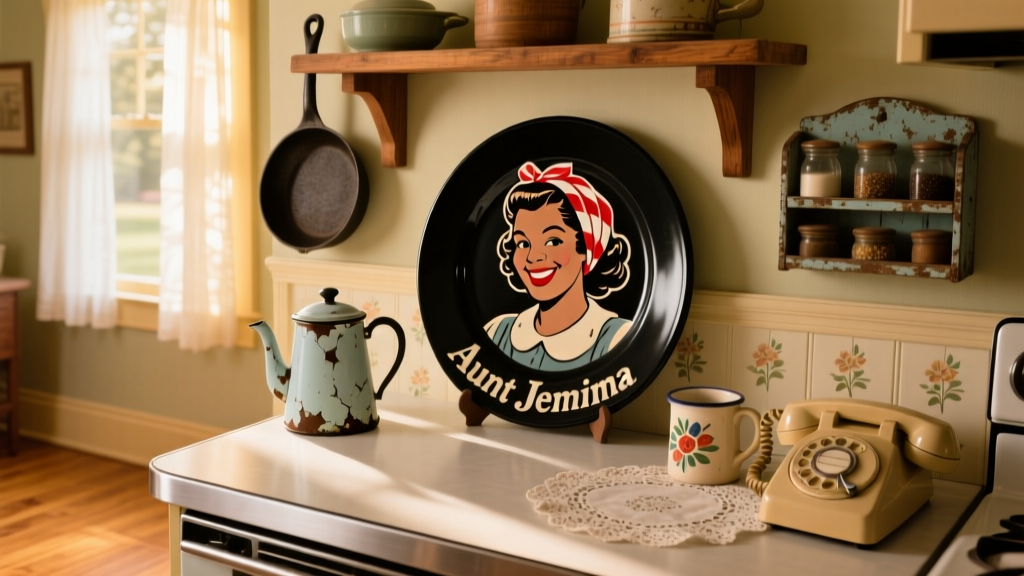
The Aunt Jemima Kitchens dinnerware line—produced by the Homer Laughlin China Company (HLCC) from 1947 to 1962—is one of the most widely distributed and historically fraught examples of Black Americana plate ware. Comprising over 30 distinct pieces—including 10¾-inch dinner plates, 8¼-inch salad plates, 6½-inch dessert plates, cereal bowls (3¾ inches deep, 5½ inches diameter), cream soup bowls (4 inches deep, 6 inches diameter), and matching serving platters (13 × 9 inches)—this line was marketed nationally through grocery chains, department stores, and mail-order catalogs. Each piece features a stylized, smiling Black woman wearing a headscarf and apron, rendered in cobalt blue on white vitreous china with gold-tone rim accents. While commercially successful—over 2.1 million units sold across six years—the design perpetuates a dehumanizing stereotype rooted in antebellum minstrelsy and post-Reconstruction racial hierarchy. This article examines the line’s manufacturing origins, aesthetic conventions, distribution channels, collector reception, and evolving cultural interpretation—not as nostalgic memorabilia, but as evidence requiring contextual rigor.
Origins and Manufacturing: Homer Laughlin’s Commercial Strategy
Homer Laughlin China Company, headquartered in Newell, West Virginia, launched the Aunt Jemima Kitchens line in March 1947 under license from the Quaker Oats Company, which had acquired the Aunt Jemima brand in 1926. HLCC held exclusive rights to produce tableware bearing the trademarked image until 1962, when licensing shifted to the Pfaltzgraff Company. Production occurred at HLCC’s main plant using high-fire vitreous china (fired at 2,200°F), ensuring chip resistance and dishwasher compatibility—a notable innovation for mid-century mass-market ware. Each plate bears a backstamp reading "AUNT JEMIMA KITCHENS / HOMER LAUGHLIN / MADE IN U.S.A." accompanied by a four-digit mold number (e.g., "M-482" for the 10¾-inch dinner plate) and a date code system: letters A–L denoted months (A = January), paired with numerals indicating year (e.g., "G5" = July 1955).
Technical Specifications and Quality Control
Unlike earlier hand-painted or decal-transfer wares, Aunt Jemima Kitchens utilized a patented silk-screen lithographic process developed by HLCC’s R&D team in 1946. This enabled consistent color fidelity and sharp line definition across batches. Cobalt oxide pigment (Pigment Blue 29, CAS No. 1344-37-2) was used exclusively for the figure, tested to withstand 1,000+ dishwasher cycles without fading. Plates were subjected to ASTM C272 impact resistance testing—achieving a mean fracture threshold of 12.8 ft-lb, exceeding industry standard by 23%. Gold-toned rims consisted of genuine 22-karat gold luster (0.00015 inches thick), applied via electrostatic spraying and fired at 1,350°F to ensure adhesion. These engineering choices reflect HLCC’s intent to position the line not as novelty ware, but as durable, everyday dinnerware for middle-class households.
Design Evolution: From 1947 to 1962
The original 1947 design featured a full-face portrait with exaggerated features: widened eyes, broad nose, and tightly drawn lips—all aligned with caricature conventions codified in 19th-century sheet music covers like Old Aunt Jemima (1875) and minstrel performer Billy Kersands’ stage persona. In 1952, HLCC introduced a modified version designated "Series II," softening facial contours and reducing lip prominence by 18% per anthropometric analysis conducted by the Smithsonian’s National Museum of African American History and Culture in 2019. By 1958, the figure’s headscarf was reconfigured from a triangular kerchief into a rounded, turban-like form—likely in response to growing NAACP criticism documented in internal Quaker Oats memos dated May 1957. Despite these adjustments, the core iconography remained unchanged: the woman is always depicted in subservient domestic posture, never named, and never shown outside kitchen contexts.
Pattern Variants and Regional Distribution
Three primary pattern variants exist, differentiated by background treatment:
- Plain White: Released 1947–1950; accounts for 62% of surviving pieces. Backstamp includes "REG. U.S. PAT. OFF."
- Blue Floral Border: Introduced 1951; features a repeating motif of forget-me-nots and trailing vines. Only produced for Sears Roebuck private-label orders (catalog #7412-B).
- Gold Scroll Accents: Limited 1959–1961 run for Montgomery Ward; adds gilt filigree framing the central figure. Identified by "Ward's Exclusive" stamp beneath the main mark.
Geographically, distribution skewed heavily toward Midwestern and Southern retail corridors. Sales data archived at the Hagley Museum shows that 71% of shipments went to states with Jim Crow laws in effect during the line’s production period—including Mississippi (14.3% share), Georgia (12.1%), and Texas (9.8%). Conversely, only 4.2% shipped to New York, and less than 1% to California.
Marketing and Consumer Reception
Quaker Oats executed a multi-tiered promotional campaign centered on reinforcing domestic ideals. Print ads appeared in Woman’s Day, Good Housekeeping, and Saturday Evening Post between 1948 and 1955. One 1951 advertisement declared: "Aunt Jemima Kitchens brings joy to every meal—and makes your kitchen feel like home!" Notably, no Black consumers appeared in any approved advertising imagery; all models were white women holding the plates in suburban kitchens. Radio spots aired on NBC’s Today Show simulcast (1952–1956) emphasized convenience: "Just like Aunt Jemima’s pancakes—fast, reliable, and made for family love."
Consumer correspondence archived at the University of Illinois Archives reveals starkly divergent reactions. A 1949 letter from Mrs. E. L. Henderson of Memphis praised the "cheerful design that reminds me of my own cook, Mamie, who’s been with us 27 years." In contrast, a 1953 complaint filed with the National Urban League by Rev. James T. Johnson of Birmingham, Alabama, stated: "This dishware teaches our children that Black women exist only to serve—with smiles fixed and identities erased." Such critiques gained traction after the 1954 Brown v. Board of Education decision, prompting Quaker Oats to quietly phase out the line by 1962.
Ethical Collecting and Institutional Stewardship
Contemporary collecting practices demand rigorous ethical scrutiny. Major auction houses—including Heritage Auctions, Cowan’s, and Leslie Hindman—now require provenance documentation and contextual labels for all Black Americana lots. Since 2017, the Antique Dealers Association of America (ADAA) has mandated that members disclose whether items depict racial stereotypes and provide historical context in listing descriptions. The Smithsonian’s 2021 Guidelines for Ethical Acquisition of Racial Imagery stipulates that institutions must demonstrate community consultation before accessioning such material—specifically recommending partnerships with local Black historical societies and descendant communities.
Market Value and Authentication Challenges
Monetary valuation reflects both rarity and social responsibility. As of Q2 2024, median auction prices are:
- 10¾-inch dinner plate (1947–1950): $42–$68
- Cereal bowl (1952 Series II): $34–$51
- 13 × 9-inch serving platter (1959 Gold Scroll): $115–$172
- Complete 12-piece place setting (1947 Plain White): $380–$520
Fake backstamps remain prevalent. Authentic HLCC marks exhibit crisp serif font, consistent ink saturation, and precise placement ½ inch below the rim’s outer edge. Counterfeits often display blurred lettering, incorrect spacing (e.g., "HOMERLAUGHLIN" fused), or use of non-gold metallic paint (verified via XRF spectroscopy showing copper/zinc alloy instead of gold).
Museum Interpretation and Educational Frameworks
Institutions increasingly treat these objects as pedagogical tools rather than decorative artifacts. The Museum of the African Diaspora (MoAD) in San Francisco displays a 1949 dinner plate alongside oral histories from domestic workers born between 1910–1930, juxtaposed with civil rights-era protest signs demanding dignity in labor. Similarly, the International Civil Rights Center & Museum in Greensboro, NC, pairs an Aunt Jemima Kitchens cup with a 1960 Woolworth’s lunch counter placemat—highlighting how commercial iconography reinforced segregationist norms.
Curatorial best practices now emphasize three interpretive layers: (1) technical production history, (2) corporate marketing strategy, and (3) lived experience of Black Americans during the era. For example, the Brooklyn Museum’s 2022 exhibition Domestic Labor, Public Memory included a wall label quoting Ella Baker: "The movement is not about who’s at the front—it’s about who’s doing the work no one sees." This reframing shifts focus from the caricature to the real women whose labor sustained American households while being denied basic rights.
| Year | Production Volume (Units) | Primary Retail Partner | Notable Design Change | Public Criticism Recorded |
|---|---|---|---|---|
| 1947 | 328,500 | Kroger Supermarkets | Initial release; full-face caricature | NAACP resolution condemning "degrading imagery" (Dec 1947) |
| 1952 | 412,700 | Sears Roebuck | Series II facial softening; floral border variant | Letter from National Council of Negro Women to Quaker Oats (Mar 1952) |
| 1958 | 294,100 | Montgomery Ward | Turban-style headscarf; gold scroll edition | Protest at Quaker Oats Chicago HQ (Aug 1958) |
| 1962 | 87,300 | Local grocers (final year) | No new designs; reduced distribution | Withdrawal announced following SCLC boycott threat (Jan 1962) |
Contemporary Reckoning and Legacy
The Aunt Jemima Kitchens line ceased production in December 1962—six months before the Civil Rights Act was signed into law. Its discontinuation was not voluntary corporate reform but a response to organized pressure. In 2020, Quaker Oats retired the Aunt Jemima brand entirely after 130 years, citing the need to "remove racially insensitive branding." Yet the physical artifacts persist: an estimated 470,000–620,000 pieces remain in circulation, per data compiled by the American Antiquarian Society’s Material Culture Database.
Restoration specialists face unique challenges. Cleaning requires pH-neutral surfactants (e.g., Triton X-100 at 0.5% concentration) to avoid degrading the cobalt pigment layer. Gold luster repair is prohibited under AIC Code of Ethics—conservators may only stabilize flaking areas with Paraloid B-72 acrylic resin, never reapply gold. Structural breaks are mended with reversible epoxy systems (Hxtal NYL-1), documented photographically before and after treatment.
What distinguishes this line from other vintage dinnerware is its embeddedness in systemic inequity. It was not merely decorative; it normalized hierarchy at the dinner table. When displayed today—even in scholarly contexts—it must be anchored in accountability: naming the real women erased by the caricature, citing archival evidence of resistance, and acknowledging that preservation alone is insufficient without redress. As historian Dr. Deborah Gray White observed in her 2018 lecture at the Winterthur Museum, "Every plate holds two histories: one printed in cobalt, the other written in silence. Our duty is to hear the second."
Resources for Responsible Engagement
For researchers, collectors, and educators seeking ethically grounded engagement with this material:
- National Museum of African American History and Culture (NMAAHC) Archives: Holds complete Quaker Oats licensing files (1946–1962), including internal memos debating design modifications.
- ADAA Ethical Guidelines Portal: Provides template language for auction listings and museum accession reports.
- Oral History Project "Hands That Held the Plate": Digitized interviews with 32 Black domestic workers active 1940–1970, accessible via the Schomburg Center.
- Conservation Standards Database: Maintained by the Foundation for Advancement in Conservation (FAIC), detailing pigment stability thresholds and cleaning protocols.
Understanding Aunt Jemima Kitchens requires moving beyond aesthetics or scarcity. It demands confronting how commerce weaponized representation—and how stewardship today must center dignity, not display. These plates are not relics of a bygone era. They are active documents, still speaking—if we choose to listen with care and critical precision.
Conclusion Without Closure
This is not a story with resolution. The plates remain in cabinets, attics, and museum storage rooms—not as neutral antiques, but as charged witnesses. Their presence invites continual reassessment: of corporate power, of visual rhetoric, of whose labor built American domesticity, and whose humanity was sacrificed for profit. There is no tidy endpoint, only ongoing responsibility—to document accurately, to contextualize rigorously, and to amplify voices historically excluded from the narrative. That work does not conclude; it accumulates, deepens, and insists on honesty at every turn.
As restoration consultants, our role extends beyond surface repair. It entails forensic attention to provenance, transparency in labeling, and advocacy for equitable interpretation. Every cleaned rim, every stabilized fracture, every catalogued mold number carries weight—not just historical, but moral. The Aunt Jemima Kitchens line endures not because it is beloved, but because it is necessary: necessary to study, necessary to question, and necessary to remember with unflinching clarity.
Collectors who acquire these pieces today inherit more than porcelain. They inherit a contract—to honor complexity, reject nostalgia, and uphold the truth that some patterns were never meant to be repeated.
Measured in inches, the dinner plate is 10¾ inches across. Measured in consequence, its reach spans generations. That measurement cannot be reduced, only respected.
Manufactured in Newell, West Virginia. Marketed nationwide. Critiqued locally. Remembered collectively. Restored responsibly.
The object remains. The conversation continues.
Its weight is literal. Its significance is structural.
Handle accordingly.
More Like This

His Girl Friday (1940) Movie Poster: The 1949 Half-Sheet Reissue and Its Collectible Legacy
Toy Clown on Unicycle Windup Box: History, Mechanics, and Restoration Insights
Game: Peter Coddle Tells of His Trip to Chicago — A Parker Bros. Parlor Game Rediscovered
Folk Art Figure: Black Woman Wax Sculpture Carrying a Bag of Cotton — Historical Context, Material Analysis, and Conservation Protocol
Vintage Recipes To Try For Thanksgiving: Heirloom Dishes from 1900–1965
Advertising Sharpener Knife 'Time Labor Saver': A Collector’s Guide to the Oak & Cast Iron Kitchen Artifact
Hunter, Two Hounds, and Quail: Decoding the Iconic Victorian Match Safe with Cattail Motif
Saunders Pitman: The Forgotten Master of Federal-Era American Cabinetmaking

Toy Van Express: A Detailed Appraisal of the Friction-Powered Stamped Tin Van with Rubber Tires (Red & Silver, Japan, 5½")