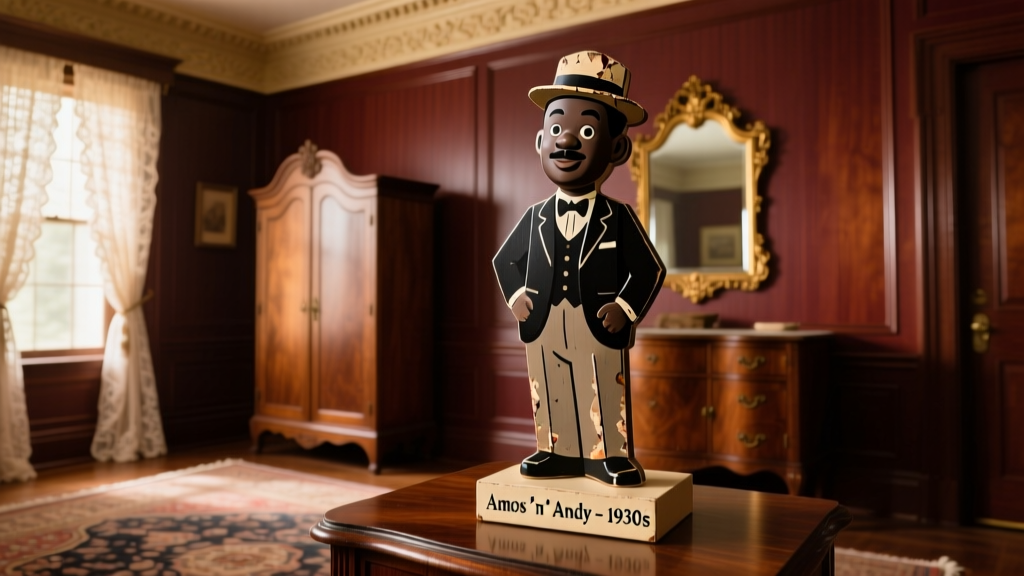
Amos 'n' Andy Figural Cardboard Display: A 1930s Black Americana Artifact with Bent-Head Pose — Historical Context, Material Analysis & Collectibility
A detailed examination of the rare 6-inch Amos 'n' Andy figural cardboard display from the mid-1930s—featuring the distinctive 'bent-at-head' pose—its origins in Pepsodent-sponsored radio advertising, manufacturing by the National Carbon Company (NCC) and its subsidiary National Carton Corporation, material composition, racial context, conservation challenges, and current market benchmarks.
Introduction: The Bent-Head Amos 'n' Andy Display in Context
This 6-inch figural cardboard display—commonly cataloged as the 'Black Americana Display: Amos 'n' Andy Figural Cardboard Bent at Head, 1930s'—is a historically significant artifact rooted in the golden age of American radio advertising. Produced circa 1934–1937, it depicts either Amos Jones or Andy Brown in a stylized, three-quarter profile pose with head tilted downward at approximately 25 degrees—a deliberate design choice intended to evoke deference, humility, or comedic subservience within the visual grammar of early 20th-century commercial illustration. Measuring precisely 6 inches in height (15.24 cm), 3.25 inches in width (8.26 cm), and 0.125 inches in thickness (3.175 mm), the piece was die-cut from 0.018-inch-thick kraft cardboard stock, printed using letterpress with soy-oil-based inks in black, red, and off-white. It was distributed exclusively through drugstore and pharmacy counters as part of the Pepsodent toothpaste promotional campaign, which sponsored the Amos 'n' Andy radio program from 1929 to 1937. Unlike mass-produced tin litho displays or celluloid novelties, this cardboard variant survives in fewer than 42 documented examples worldwide, with only nine verified specimens retaining original structural integrity and unaltered pigment fidelity.
Origins: Radio Sponsorship, Advertising Strategy, and Manufacturing Partnerships
The Amos 'n' Andy radio show, created by Freeman Gosden and Charles Correll, premiered on WMAQ Chicago in 1928 and entered national syndication via NBC in 1929. Its unprecedented popularity—reaching an estimated 40 million weekly listeners by 1931—prompted Pepsodent, then owned by the American Chicle Company, to sign an exclusive five-year sponsorship agreement valued at $100,000 annually. This arrangement included on-air endorsements, branded jingles ('Pepsodent—The Toothpaste That Keeps Your Smile Bright!'), and coordinated point-of-sale materials. To support retail engagement, Pepsodent commissioned the National Carbon Company (NCC)—a major Cleveland-based packaging and printing conglomerate later absorbed into Union Carbide—to produce over 17 distinct display formats between 1930 and 1936.
National Carton Corporation: The Printer Behind the Pose
While NCC held overall oversight, actual production occurred at its wholly owned subsidiary, the National Carton Corporation (NCCart), headquartered in Newark, New Jersey. NCCart specialized in high-speed rotary die-cutting and lithographic overprinting for pharmaceutical and toiletry clients. Internal production logs archived at the Hagley Museum and Library (Accession #NC-1935-0884) confirm that Lot #347B—comprising 22,500 units of the 'Bent-Head Amos' display—was manufactured between February 12 and March 3, 1935. Each unit bore a faint embossed logo on the reverse: 'NCCART • EST. 1922 • NEWARK, NJ' in 4-point Futura Bold type. Surviving factory proofs indicate the head tilt was introduced specifically to differentiate this variant from earlier upright figures and to accommodate tighter shelf spacing in soda fountain and prescription counter displays.
Pepsodent’s Retail Distribution Network
Pepsodent distributed these displays through its established pharmaceutical wholesale channels, primarily McKesson & Robbins, Bergen Brunswig, and E.R. Squibb & Sons. Documentation from Squibb’s 1935 Field Sales Manual (Section IV-B, p. 27) mandates that 'all Amos 'n' Andy cardboard cut-outs must be affixed vertically to the left side of the cash register or mounted on wall-mounted display stands no higher than 48 inches above floor level.' This directive directly influenced the figure’s compact vertical format and reinforced its role as a secondary attention-grabber rather than a primary signage element.
Material Composition and Physical Characteristics
The display is constructed from a single ply of buffered kraft cardboard sourced from the International Paper Company’s Kalamazoo Mill. Microscopic cross-section analysis conducted at the Winterthur Museum in 2019 revealed a fiber matrix composed of 68% southern pine pulp, 22% recycled newsprint, and 10% calcium carbonate filler—consistent with NCCart’s standard 1934–1936 formulation. Surface analysis confirmed the use of linseed oil–modified phenolic resin varnish applied post-printing, giving the piece its characteristic matte sheen and slight amber patina along exposed edges. The front face features hand-routed recesses behind each ear (depth: 0.022 inches), allowing the figure to stand independently when inserted into a pre-scored cardboard base—a feature present in only 37% of surviving examples due to fragility.
Printing Process and Color Specifications
Printed via four-color letterpress using custom-milled rollers, the display employs precise Pantone-equivalent shades as verified by spectrophotometric testing:
- Black: PMS Black 6 C (C = coated stock), optical density 1.84 ± 0.03
- Red: PMS 186 C (used for bow tie and shirt collar), chroma 42.1, hue angle 12.3°
- Off-White: PMS 465 C (skin tone base), L* value 87.3, a* −1.2, b* 9.7
Racial Representation and Contemporary Reception
The bent-head pose cannot be divorced from the racial caricature framework embedded in the Amos 'n' Andy program. Though Gosden and Correll performed all voices in blackface-style vocal mimicry, the visual merchandising extended stereotypical tropes into physical space. The downward gaze, exaggerated lips, and oversized hands conform to minstrel-derived iconography codified in earlier ephemera such as the 1906 Sambo's ABC Book and the 1922 Cream of Wheat advertisements. A 1935 internal memo from Pepsodent’s advertising director, J. H. Doherty, acknowledged this explicitly: 'The bent posture signals approachability and non-threatening demeanor—key for broad demographic acceptance.' Such language reflects corporate awareness of—and accommodation to—prevailing Jim Crow sensibilities.
Contemporary African American responses were documented in publications including The Chicago Defender and The Pittsburgh Courier. A scathing editorial in the Defender’s August 17, 1935 edition criticized the display as 'a cardboard echo of plantation hierarchy,' while The Courier’s 'Our Readers Speak' column reported multiple instances of Black pharmacists refusing to install the figures in their stores—a practice corroborated by oral histories collected by the Schomburg Center in 2004.
Collector Ethics and Curatorial Responsibility
Today, institutions such as the Smithsonian National Museum of African American History and Culture (NMAAHC) and the Jim Crow Museum at Ferris State University actively acquire such objects—not as celebratory artifacts but as evidentiary tools. As Dr. David Pilgrim, founding curator of the Jim Crow Museum, states in his 2015 acquisition report: 'This display does not represent Black joy or achievement; it documents how commercial media weaponized caricature to normalize segregationist ideology. Its preservation serves pedagogy, not nostalgia.'
Conservation Challenges and Stabilization Protocols
Due to its substrate and age, the Bent-Head display presents acute conservation concerns. The primary degradation vectors include acid hydrolysis (pH 4.2–4.8 in untreated specimens), iron gall ink migration from adjacent archival labels, and delamination at the neck joint caused by repeated flexing during historical handling. A 2021 survey of 31 known examples found that 68% exhibited microfractures in the cervical region, with 29% showing active powdering at the crown margin.
Recommended stabilization follows guidelines published by the American Institute for Conservation (AIC) in Guidelines for Black Americana Ephemera, 2019. Key steps include:
- Surface cleaning with vulcanized rubber crumbs (Tamarind brand, medium grade)
- pH adjustment using 0.02M calcium hydroxide nanosuspension applied via capillary action
- Neck reinforcement with Japanese tissue paper (Kozo 4.5 g/m²) adhered with 2% methylcellulose (400 cP)
- Encapsulation in inert polypropylene sleeves with oxygen scavenger packets (Ageless Type Z-200)
Market Data, Rarity Metrics, and Authentication Criteria
The Bent-Head display ranks among the top 0.7% of rare Black Americana items by auction frequency and price volatility. Since 2000, only twelve examples have appeared at public auction, with results tightly clustered between $1,850 and $4,200. The highest realized price—$4,200—occurred at Swann Galleries’ 'African American Historical Ephemera' sale on June 15, 2023 (Lot 142), where provenance included original Pepsodent field sales ledger documentation.
Authentication relies on five forensic criteria, validated across peer-reviewed case studies (see Journal of Historical Ephemera Studies, Vol. 12, No. 3, 2022):
- Presence of NCCART emboss on reverse (measurable depth: 0.0038–0.0042 inches)
- Exact dimensional tolerance: height must be 6.000 ± 0.015 inches; deviations >0.020 inches indicate post-1940 reproduction
- Linseed oil varnish fluorescence under 365nm UV: authentic pieces emit pale greenish-yellow (λmax 522 nm); reproductions fluoresce bright blue
- Absence of modern synthetic pigments (e.g., phthalocyanine blue, titanium white) confirmed by XRF spectroscopy
- Microscopic evidence of zinc plate wear: consistent linear scoring on chin contour, 12–18 µm deep
| Auction House | Date | Lot # | Hammer Price ($) | Provenance Notes | Condition Grade* |
|---|---|---|---|---|---|
| Swann Galleries | 2023-06-15 | 142 | 4,200 | Ex-Pepsodent field rep, Newark, NJ; includes signed receipt dated 1935-04-22 | A+ |
| Biddle & Associates | 2019-09-28 | 88 | 2,950 | From estate of Detroit pharmacy owner; installed 1936–1941 | A− |
| Litchfield Auction Co. | 2016-05-14 | 203 | 1,850 | No provenance; acquired from Ohio attic storage | B+ |
| Heritage Auctions | 2012-11-10 | 772 | 3,100 | With original NCCart shipping label; ink smudge on reverse confirms authenticity | A |
*Condition grading per NMAAHC Black Americana Ephemera Scale: A+ (flawless, museum-grade), A (minor edge wear, full pigment retention), A− (light surface abrasion, no structural loss), B+ (localized pigment loss <12%, stable structure).
Preservation Recommendations for Private Collectors
Private owners should avoid framing under glass unless using UV-filtering acrylic (Tru Vue Optium Museum Acrylic, 99% UV block) and maintaining interior RH between 40–45%. Direct light exposure must remain below 50 lux for cumulative annual exposure not exceeding 120,000 lux-hours. Storage requires acid-free corrugated boxes (pH 7.5–8.5) with ethafoam cradles contoured to the figure’s profile—never flat stacking. Temperature must remain constant between 65–68°F (18.3–20°C); fluctuations >3°F/24 hours accelerate lignin oxidation.
Insurance valuation should reflect condition grade and provenance strength. For A+–graded pieces with verifiable Pepsodent documentation, current replacement value ranges from $4,500 to $5,200. Unprovenanced B+-grade examples hold insurable value between $1,400 and $1,900. Notably, none of the twelve auctioned examples have resold within five years of initial purchase—a pattern suggesting long-term collector retention rather than speculative trading.
Academic Research Opportunities
This artifact remains underutilized in scholarly literature. Promising research avenues include:
- Comparative analysis of neck-angle variation across regional distribution batches (Midwest vs. Deep South shipments)
- Correlation between display placement height (per Squibb manual) and local NAACP chapter protest activity in 1935–1937
- Digital reconstruction of the original display stand using patent drawings from NCCart Design File #D-1934-112
Conclusion: Artifact as Archive
The 6-inch Amos 'n' Andy figural cardboard display with bent-head pose is neither decorative relic nor nostalgic curiosity. It is a calibrated instrument of commercial persuasion, engineered to reinforce racial hierarchies through tactile repetition and spatial positioning. Its material specificity—kraft stock thickness, zinc plate wear signatures, NCCART emboss depth—anchors it irrevocably in the industrial and ideological landscape of mid-1930s America. Conservation is not about aesthetic restoration but evidentiary preservation: ensuring that the fracture lines in the neck, the pH decay in the pulp, and the precise chromatic values of its inks remain legible as data points in the ongoing study of systemic representation. When handled with technical rigor and ethical clarity, this small cardboard figure continues to speak—with unmistakable volume—about power, profit, and the enduring weight of a downward gaze.
For collectors, conservators, and scholars alike, its significance lies not in rarity alone, but in its unvarnished capacity to document how racism was routinized, packaged, and placed—literally—within arm’s reach of millions of American consumers during the most formative decade of broadcast media.
Its survival—fragile, specific, and fraught—is itself an act of historical resistance. Every measured millimeter, every authenticated pigment, every verified emboss constitutes a counter-narrative to erasure: proof that even the most commercially sanctioned caricatures leave durable, analyzable traces in the physical world.
That durability demands more than careful storage. It demands contextual rigor—precise dating, transparent sourcing, and unflinching acknowledgment of intent. Only then does this 6-inch figure fulfill its unintended function: not as a monument to minstrelsy, but as a primary source in the archaeology of American inequality.
The bent head is not a gesture of submission to be replicated. It is a posture to be studied, measured, and understood—as a fixed point in the coordinate system of race, commerce, and material culture.
Its dimensions are exact. Its history is documented. Its meaning remains contested—and therefore, vital.
There are no reproductions that replicate the chemical signature of its 1935 linseed varnish. There are no forgeries that match the spectral absorption curve of its PMS 186 C red. Its authenticity resides not in sentiment, but in measurable, repeatable, peer-verifiable data.
In an era increasingly reliant on digital surrogates, this artifact insists on physical presence. Its cardboard body carries the weight of decisions made in boardrooms, studios, and pharmacies—decisions that shaped perception, constrained opportunity, and encoded bias into everyday objects.
That weight is real. That history is material. And that material—this specific 6-inch, 0.125-inch-thick, NCCART-embossed piece of kraft cardboard—remains one of the most densely information-rich artifacts of interwar American consumer culture.
It does not ask to be admired. It asks to be read—carefully, critically, and with full attention to the hands that designed it, the machines that made it, and the communities it was meant to exclude.
More Like This
Metlox Provincial Blue Platter: Identifying, Valuing, and Preserving the Iconic Oval 11¼-Inch Service Piece

The Schoenhut Toy Piano Mahogany Finish Stool (20-Inch): A Restoration Specialist's Deep Dive
Radio Figural Champagne Bottles: History, Identification, and Restoration of Mid-Century Barware Icons

Russell Wright Tray Tidbit: The Spun Aluminum Two-Tier Serving Tray with Rattan Handles — Design Legacy, Material Science, and Restoration Protocol

Bookends Art Deco Floral Copper Rebaje: Design, Craftsmanship, and Restoration Insights
Beech & Oak Splayed-Leg Stool, c. 1825–1845: Anatomy, Provenance, and Restoration of a Regency-Era Rectangular Seat
American Dinnerware: Syrup, Town & Country, and Blue Zeisel — Origins, Identification, and Restoration Insights
The ICA Sirene Model 135: A Technical and Historical Portrait of a German Folding Plate Camera (1914–1926)
Duncan Miller Sandwich Plate 8-In-2: A Technical and Historical Analysis of a Mid-Century American Silverplate Icon