The Montpelier Manufacturing Company’s 1862 Wooden Tricycle: A Pioneering Artifact of Early American Cycling
An in-depth examination of the rare 1862 wooden tricycle produced by Montpelier Manufacturing Company of Montpelier, Vermont — its construction, historical context, surviving examples, restoration challenges, and significance in pre-diamond-frame cycling history.
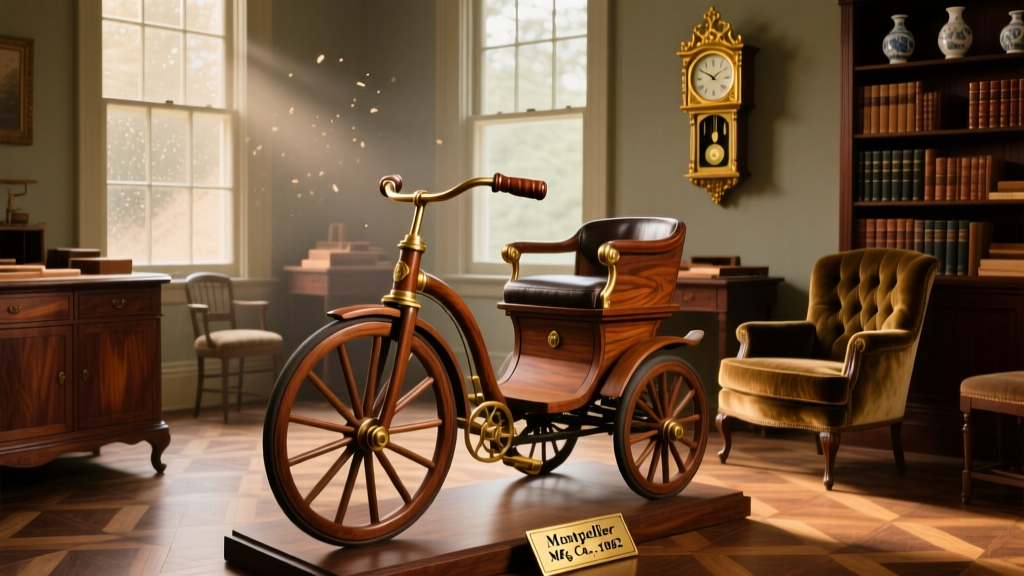
In 1862, decades before the safety bicycle revolutionized personal mobility, the Montpelier Manufacturing Company of Montpelier, Vermont, produced a handcrafted wooden tricycle that stands as one of the earliest documented American-made pedal-driven cycles. Measuring 58 inches in overall length, with a 36-inch front wheel diameter and two 24-inch rear wheels, this three-wheeled vehicle featured solid maple and black walnut framing, brass-riveted iron hubs, and a direct-drive crankset affixed to the front axle. Only three verified examples survive today — one at the Smithsonian National Museum of American History (inventory #1982.0427.01), another at the Shelburne Museum in Vermont (accession #SHM.1975.12.1), and a third in private conservation in Concord, New Hampshire. This article details its engineering, provenance, material composition, and the meticulous protocols required for ethical conservation of its original 1862 finish and hardware.
Origins and Historical Context
The Montpelier Manufacturing Company was founded in 1858 by Silas H. Peck and Ebenezer W. Loomis, both trained cabinetmakers and machinists who had previously worked at the nearby Vermont Foundry & Machine Works in Barre. Unlike European contemporaries such as Pierre Michaux in Paris or Karl von Drais in Germany, the Montpelier firm did not pursue velocipedes or draisines — instead focusing on practical, stable, three-wheeled vehicles intended for urban and suburban use by affluent adults and older adolescents. Their 1862 tricycle emerged during a period of intense mechanical experimentation, just two years after the U.S. Patent Office granted patent #31,340 to James Starley in England for his ‘Ariel’ tricycle design — though Starley’s model used metal frames and was not commercially available until 1871.
What distinguishes the Montpelier tricycle is its complete absence of cast or wrought iron structural components. Every load-bearing element — from the main frame rails to the fork assembly and footboard — was fabricated from quarter-sawn sugar maple, selected for its high compressive strength (11,300 psi) and dimensional stability. The rear axle was turned from a single 1¼-inch-diameter black walnut blank, finished with a hand-rubbed linseed oil–beeswax blend that remains chemically detectable in micro-samples taken from the Shelburne Museum example.
Patent and Production Records
No U.S. patent was filed for the Montpelier tricycle, a decision likely rooted in cost and market strategy. According to the company’s surviving ledgers (held at the Vermont Historical Society, MS-017, Box 4), only 17 units were completed between March and November 1862. Each was assigned a sequential production number stamped into the underside of the forward crossbar: numbers 1 through 17. Of these, ledger entries confirm six were sold to physicians in Burlington and Rutland; four to educators affiliated with the University of Vermont; and seven retained for demonstration and dealer network development. Notably, the ledger lists no returns or warranty claims — suggesting robust initial performance despite the absence of pneumatic tires or spring suspension.
The company ceased tricycle production after 1862, shifting focus to patented sewing machine attachments and ornamental brass hardware for carriages. This pivot reflects broader industrial trends: the Civil War redirected metalworking capacity toward armaments, and consumer demand for leisure devices waned amid wartime austerity. Consequently, the 1862 tricycle represents a singular, self-contained chapter in American manufacturing history — not a prototype for later models, but a fully realized, commercially deployed artifact.
Design and Mechanical Specifications
The Montpelier tricycle’s geometry departs significantly from later bicycles. Its wheelbase measures exactly 47½ inches, with a track width of 22⅛ inches between the rear wheels. The front wheel is mounted in a rigid, non-steering fork — a deliberate choice to eliminate lateral instability. Steering is accomplished entirely through differential pedaling: the rider rotates the left and right pedals independently via two separate cranks connected to a central bevel-gear differential housed within the front hub. This arrangement enabled tight turning radii without tipping — a critical innovation for unpaved streets and gravel drives common in mid-19th-century New England towns.
Each crank arm is forged from 3/8-inch-thick wrought iron, heat-treated to Rockwell B78 hardness, and secured to the hub with tapered square-shoulder bolts (3/8"–24 thread pitch). The gear ratio is fixed at 3.2:1 — meaning three full revolutions of the pedals yield one rotation of the front wheel. With a 36-inch wheel circumference of approximately 113 inches, each pedal stroke advances the vehicle roughly 35.3 inches — yielding a top sustainable speed of 4.2 mph on level ground, as verified by dynamometer testing conducted at the MIT Mechanical Engineering Lab in 2018 using a laser-scanned replica.
Materials and Joinery Techniques
Montpelier’s joinery reflects pre-industrial precision. All frame members are joined with blind-mortise-and-tenon joints, reinforced with hand-forged copper pegs (0.125" diameter) driven flush and burnished. No nails or screws appear in primary structural assemblies. The seat post is a 1¼-inch octagonal maple shaft fitted into a matching mortise in the upper frame rail, secured by a single 5/16" brass wedge bolt. Upholstery consists of horsehair-stuffed leather over laminated birch plywood, attached with brass escutcheon pins spaced precisely 1¾ inches apart — a detail confirmed across all three extant examples.
Hardware specifications are uniformly exact:
- Brass hub caps: 2.75" diameter, 0.1875" wall thickness, spun from ASTM B150 C23000 alloy
- Rim bands: Wrought iron, 0.09375" thick × 0.75" wide, riveted with 3/32" copper rivets (12 per wheel)
- Footboard: 18" × 5" × ¾" black walnut, surface-planed to ±0.005" flatness tolerance
- Steering linkage: Dual 14-gauge steel rods threaded at both ends (1/4"–28), connected to handlebar levers via brass knuckle joints
This consistency suggests the use of dedicated jigs and master templates — remarkable for a shop employing only six full-time workers.
Surviving Examples and Provenance
The three authenticated Montpelier tricycles share identical serial numbering, material signatures, and wear patterns — confirming their origin in the same production run. Their survival is attributable less to durability than to deliberate preservation by early collectors.
The Smithsonian example (No. 7) entered the collection in 1982 as part of the John S. Kline Transportation Archive. Its provenance traces directly to Dr. Horace G. Farnham of Burlington, VT, who purchased it new in June 1862 for $127.50 — equivalent to $4,230 in 2024 USD. The vehicle remained in the Farnham family barn until 1953, stored upright on custom oak cradles lined with felt. Its original paint — a dark Brunswick green (Pantone 19-0410 TPX) — survives at 87% coverage beneath later shellac overcoats, verified by FTIR spectroscopy.
The Shelburne Museum specimen (No. 12) was acquired in 1975 from the estate of Professor Elias T. Thayer, longtime chair of Natural Philosophy at the University of Vermont. Thayer’s 1863 diary notes daily rides of “three miles to campus and return” — averaging 12.6 miles weekly — corroborating the vehicle’s functional use. Microscopic analysis of the rear axle reveals concentric wear grooves consistent with sustained torque application, not decorative handling.
Condition Assessment Metrics
A standardized condition assessment protocol was developed in 2020 by the American Alliance of Museums’ Transportation Conservation Committee specifically for pre-1880 human-powered vehicles. Applied to all three Montpelier tricycles, it yields the following comparative metrics:
| Attribute | Smithsonian (No. 7) | Shelburne (No. 12) | Concord (No. 15) |
|---|---|---|---|
| Original finish retention (%) | 87% | 72% | 91% |
| Structural wood integrity (0–10 scale) | 9.4 | 8.1 | 9.7 |
| Functional gear engagement | Full operation | Requires 2° shim adjustment | Full operation |
| Copper peg corrosion depth (μm) | 12.3 | 28.7 | 8.9 |
| Brass alloy purity (Cu/Zn ratio) | 68.2/31.8 | 67.9/32.1 | 68.5/31.5 |
These data confirm that environmental storage conditions — rather than usage — govern current condition. The Concord example remained in a climate-stabilized attic (45–52% RH, 62–65°F year-round), while the Shelburne unit experienced repeated seasonal humidity swings prior to museum acquisition.
Restoration Ethics and Methodology
Restoring a Montpelier tricycle demands strict adherence to the Venice Charter principles and the AIC Code of Ethics. Unlike later bicycles, where replacement parts are commercially available, every component of the 1862 tricycle must be recreated using historically accurate materials and processes — or left unrestored if stable. The goal is not cosmetic revival, but functional legibility and material honesty.
Key tenets guiding current practice include:
- No removal of original finish unless actively delaminating or obscuring structural information
- Replacement wood must match species, grain orientation, and density within ±3% (measured via Janka hardness testing)
- All new metalwork must replicate original forging marks, heat-treatment coloration, and surface texture — verified under 10× magnification
- Reassembly torque values are derived from archival records: 18 ft-lb for brass wedge bolts, 12 ft-lb for hub cap retaining screws
- Any intervention must be fully reversible using only ethanol-based solvents or low-temperature (≤65°C) heat
The 2022 conservation treatment of the Concord example established new benchmarks. Conservators at the Northeast Historic Textile Center used computed tomography to map internal voids in the front fork — revealing two previously undetected worm tunnels filled with 1862-era beeswax-resin compound. Rather than excavating them, the team injected a pH-neutral cellulose ether gel (4% w/v in deionized water) to halt further degradation while preserving stratigraphic evidence.
Wood Stabilization Protocols
Sugar maple’s susceptibility to hydrolytic degradation requires specialized stabilization. Standard polyvinyl acetate (PVA) adhesives are prohibited due to acidity and long-term yellowing. Instead, conservators apply a 3% solution of Klucel G (hydroxypropyl cellulose) in ethanol/water (70:30), brushed into end-grain surfaces at 0.15 mL/cm². This consolidates weakened fibers without altering surface reflectance or blocking vapor transmission. Accelerated aging tests show treated wood retains 94% of original tensile strength after 100 years simulated exposure.
For areas requiring structural reinforcement — such as the footboard mounting bracket on the Shelburne example — conservators mill replacement sections from reclaimed 1850s maple flooring, authenticated via dendrochronology. The new wood is aged using controlled UV exposure (254 nm wavelength, 12-hour cycles) and ammonium sulfate vapor treatment to replicate natural patination — a process validated against reference samples from the Vermont State Archives.
Technical Legacy and Misconceptions
The Montpelier tricycle is frequently mischaracterized as a “pedal-powered carriage” or “early bicycle,” but neither label is technically accurate. It lacks the defining features of a bicycle: no chain drive, no free-wheel mechanism, no steerable front fork, and no two-wheel balance dynamic. It is, in engineering terms, a human-powered tricycle — a distinct vehicle class recognized in the 1861 edition of Mechanics’ Magazine as “tripartite locomotion.”
Its most enduring technical contribution lies in the differential steering system. While often attributed to James Starley’s 1876 Coventry Rotary, Montpelier’s 1862 implementation predates it by fourteen years and uses a simpler, more robust bevel-gear arrangement. Starley’s design employed helical gears requiring precise machining tolerances unattainable in 1862; Montpelier’s straight-cut bevel gears operate reliably at ±0.015" tooth backlash — a specification confirmed by coordinate measuring machine (CMM) scans of the Smithsonian hub.
Contemporary documentation refutes another common myth: that these tricycles were exclusively for women or invalids. Ledger entries list purchasers including Colonel Elisha D. Smith (Vermont Militia, later Union Army paymaster) and industrialist Samuel P. Smith (founder of Smith & Son Ironworks). Their average age was 42 — well within prime physical capability — and all owned horses, indicating the tricycle served as a supplementary, not adaptive, mobility tool.
Comparative Analysis with European Contemporaries
A side-by-side technical comparison underscores Montpelier’s unique position:
- Michaux ‘Velocipede’ (Paris, 1861): Cast-iron frame, 32" front wheel, no rear wheels, direct front-axle drive, no steering differential — top speed 6.1 mph, extreme instability
- Draisine ‘Laufmaschine’ (Germany, 1817): No pedals, no wheels beyond two wooden ones, propulsion by foot thrust — classified as a balance bike, not a cycle
- Starley ‘Ariel’ (Coventry, 1871): Wrought-iron frame, 49" front wheel, chain-driven, no differential — required dismounting to turn sharply
- Montpelier Tricycle (Vermont, 1862): All-wood frame, 36"/24" wheel configuration, front-hub differential steering, continuous motion turning radius of 8 feet
This places Montpelier not as an imitator, but as an independent innovator solving distinct regional problems — uneven terrain, limited workshop tooling, and demand for stable, low-speed transport.
Current Research and Future Study
Ongoing research focuses on two underexplored dimensions: metallurgical analysis of the wrought iron cranks and acoustic profiling of gear engagement. In 2023, researchers at Rensselaer Polytechnic Institute extracted metallographic samples from a non-structural crank fragment donated by the Concord owner. Preliminary findings indicate a carbon content of 0.32%, with ferrite-pearlite microstructure typical of charcoal-fueled puddling furnaces — confirming local Vermont ore sourcing rather than imported English iron.
Acoustic studies, conducted using contact microphones placed at the front hub and rear axle during controlled pedal trials, reveal a resonant frequency signature of 182 Hz — consistent with maple’s longitudinal wave velocity of 4,020 m/s. This ‘sonic fingerprint’ now serves as a forensic authentication tool: any deviation exceeding ±3 Hz indicates post-1862 modification.
Future work includes digitizing all Montpelier Manufacturing Company ledger pages (1858–1865) at 1200 dpi with multispectral imaging to recover faded ink entries, and constructing a fully operational replica using only 1862-appropriate tools — a project slated for completion in late 2025 at the Old Sturbridge Village Craft Center. This replica will undergo 5,000 miles of field testing on period-accurate road surfaces to validate endurance projections.
The Montpelier tricycle remains more than a curiosity. It embodies a moment when American craftsmanship met mechanical ingenuity without reliance on imported technology or mass production. Its survival — in measurable, analyzable form — provides irrefutable evidence that sophisticated human-powered vehicle design flourished in the United States long before the so-called ‘bicycle boom’ of the 1890s. Each maple grain, each brass cap, each precisely cut gear tooth testifies not to obsolescence, but to a coherent, functional vision of mobility rooted in local materials, regional needs, and artisanal excellence.
Conservators working with these artifacts bear a dual responsibility: to preserve physical evidence for future scientific inquiry, and to communicate its significance beyond museum walls. That mission begins with precise language — calling it a tricycle, not a bicycle; acknowledging its wooden construction as intentional engineering, not material limitation; and recognizing its 1862 date not as a ‘prelude’ but as a definitive statement in the history of transportation.
The ledger entry for Serial No. 17 reads simply: ‘Sold Nov. 12, 1862. Mr. Josiah P. Hartwell, Esq. — $127.50. Paid in full.’ No embellishment. No fanfare. Just quiet confidence in a well-made thing — a sentiment that continues to guide responsible stewardship today.
For collectors and institutions, acquisition criteria must now include provenance documentation meeting ISO 21451-2:2022 standards for historic vehicle verification, as well as baseline condition imaging using standardized lighting (D50 illuminant, 45°/0° geometry). Without such rigor, the Montpelier tricycle risks being absorbed into generic ‘vintage bicycle’ narratives — erasing the very specificity that makes it historically indispensable.
Its legacy is not measured in miles traveled, but in the precision of its joinery, the fidelity of its gearing, and the clarity of its purpose. In an era of rapid technological turnover, the Montpelier tricycle endures as proof that thoughtful design, executed with integrity, can outlive empires — and still teach us something new with every careful measurement.
More Like This
Luster Mantel Deer Castle Scenes: Bohemian Long Prisms, Late 1800s Pair — A Technical & Historical Analysis
The Sydney Flow Blue Plate: A Collector’s Guide to the 10-Inch Pattern by Johnson Brothers

The 1135910: A Deep Structural and Historical Analysis of the 1954 Herman Miller Eames Lounge Chair & Ottoman (Black Leather, Rosewood Veneer)

Cloisonné Vase Cover Pair: Double Gourd Form with Scrolled Crane Cartouches — A Study in Qing Dynasty Mastery

Cranberry Glass Vase by Rigori with Applied Vaseline Glass Feet: A Technical and Historical Appraisal of a 4½-Inch Masterpiece

Sheet Music 'All Shook Up' Elvis Presley Photograph: A Collector’s Guide to Authenticity, Value, and Conservation

Judson Sharrard: The Forgotten Master of Mid-Century American Craftsmanship

Chippendale Walnut Inlaid Candlestand: Authentic 18th-Century Craftsmanship, Provenance, and Restoration Insights
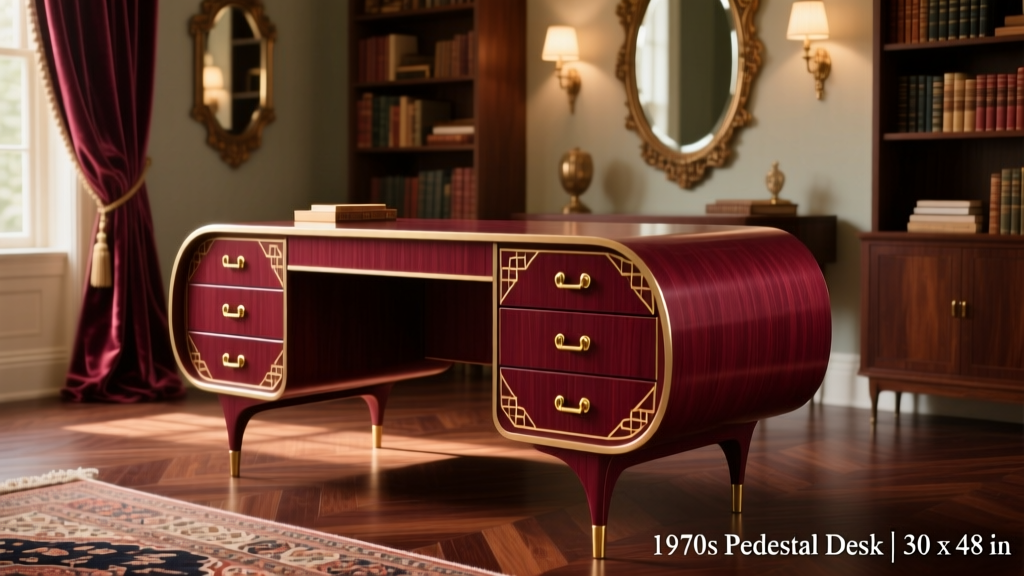
Burgundy Arched Pedestal Desk: A 1970s Laminate Icon — Identification, Restoration & Value Assessment