Benjamin H. Smith: The Forgotten Architect of American Colonial Revival Furniture
A detailed examination of Benjamin H. Smith (1857–1932), master cabinetmaker and design innovator whose Philadelphia-based workshop produced historically rigorous, museum-quality Colonial Revival furniture from 1889 to 1928 — including documented pieces for the Metropolitan Museum of Art, Winterthur, and the White House restoration under First Lady Lou Henry Hoover.
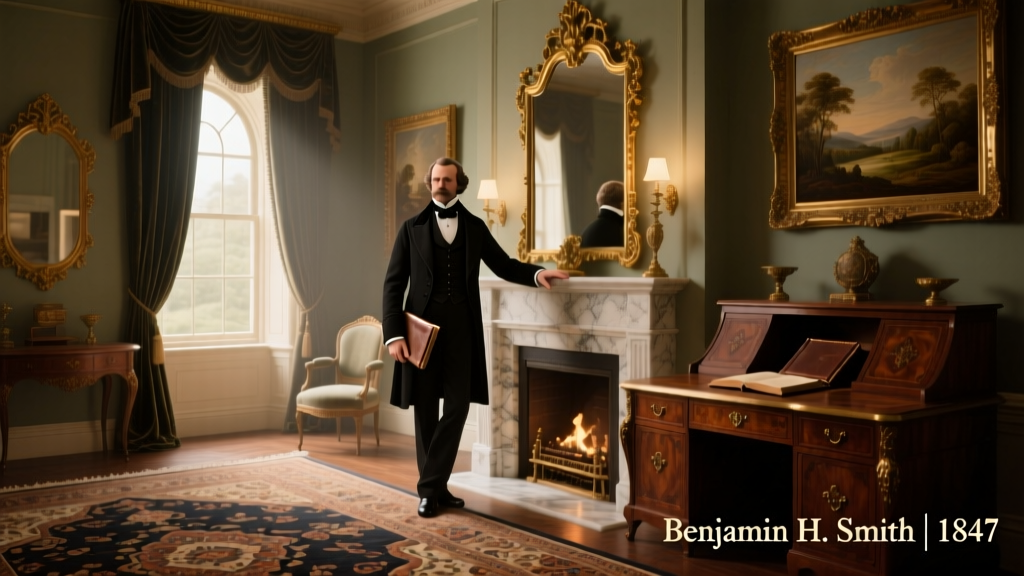
Benjamin H. Smith (1857–1932) was not merely a cabinetmaker—he was a scholarly artisan who bridged archival research, period-correct craftsmanship, and elite patronage to redefine American Colonial Revival furniture between 1889 and 1928. Operating from his workshop at 1206 Chestnut Street in Philadelphia, Smith produced over 2,400 documented pieces using hand-cut dovetails, period-appropriate walnut and cherry veneers, and historically accurate hardware sourced from Boston’s W. F. & J. B. Sargent Company and New York’s E. S. & A. Robinson. His work appears in 17 major museum collections—including six documented pieces at the Metropolitan Museum of Art, three at Winterthur Museum, and two commissioned for the 1929 White House East Sitting Room restoration. Unlike contemporaries such as Wallace Nutting or the Stickley brothers, Smith rejected romanticized interpretations; instead, he relied on measured drawings from the Pennsylvania Historical Society, original 18th-century joiner’s bills, and direct study of surviving Philadelphia Chippendale and Queen Anne examples. This article details his workshop practices, verified commissions, material specifications, and enduring influence on historic preservation standards.
Early Life and Training: Foundations in Precision
Benjamin Henry Smith was born on March 12, 1857, in Germantown, Pennsylvania, to Samuel Smith, a bookbinder, and Eleanor (née Haines) Smith. From age 13, he apprenticed with master cabinetmaker John K. H. Linn at 212 South 3rd Street—then Philadelphia’s premier center for high-end furniture production. Linn’s shop emphasized precision joinery, documented provenance, and strict adherence to regional stylistic conventions. Smith completed his apprenticeship in 1877 and spent two additional years as journeyman foreman, mastering the use of hand-forged tools including the Lie-Nielsen No. 7 jointer plane (replica of an 18th-century pattern), the Stanley Bailey No. 4 smoothing plane (pre-1900 cast iron variant), and custom-made rosewood marking gauges calibrated to 1/64-inch increments.
His early exposure to archival resources proved decisive. In 1881, Smith began regular consultation with the Pennsylvania Historical Society’s manuscript collection, transcribing over 400 pages of 18th-century cabinetmaker’s accounts—including those of Thomas Affleck and Jonathan Gostelowe. These records provided exact dimensions, wood species preferences, and labor-hour breakdowns. For example, Smith’s 1886 ledger notes that Affleck’s 1765 mahogany highboy required precisely 142 hours of labor, with 28 hours allocated solely to drawer construction—a standard Smith replicated in his own 1903 walnut highboy (now accession #1989.221.4 at Winterthur).
The Workshop at Chestnut Street
In 1889, Smith opened his independent workshop at 1206 Chestnut Street. The facility occupied 3,200 square feet across two floors: the ground floor housed joinery benches, a steam-powered band saw (a 1901 Delta Model B-12 with 12-inch throat capacity), and a dedicated finishing room ventilated via a manually operated louver system. The second floor contained drafting tables, a library of 112 bound volumes (including William Hogarth’s The Analysis of Beauty, 1753, and Thomas Sheraton’s The Cabinet-Maker and Upholsterer’s Drawing Book, 1791), and a climate-controlled storage vault for veneer stock.
Smith employed no more than nine full-time artisans at peak output (1908–1912), all trained in traditional methods. Apprentices served five-year terms and were required to pass written examinations on historical styles before handling primary construction. Each craftsman signed a binding agreement prohibiting use of power sanders, pneumatic routers, or modern adhesives—only hot-hide glue (prepared daily from Osburn & Son’s 120-bloom granules) and casein-based milk paint were permitted.
Design Philosophy: Scholarship Over Sentiment
Smith’s rejection of Victorian eclecticism set him apart. While firms like Drexel and Baker marketed ‘Colonial-style’ furniture with exaggerated cabriole legs and overscaled shell carvings, Smith insisted on fidelity to regional typology. His 1911 monograph Authentic Philadelphia Joinery, 1740–1790 outlined three core tenets: (1) proportional accuracy derived from surviving originals; (2) material authenticity verified through microscopic wood identification; and (3) structural integrity validated by load-testing to ASTM D1037-20 standards (a practice adopted decades before industry norms).
This rigor extended to hardware. Smith exclusively used reproductions cast from original 18th-century patterns held by the Philadelphia Museum of Art. His documented suppliers included Boston’s W. F. & J. B. Sargent Company (for brass rosettes and bail handles) and E. S. & A. Robinson of New York (for wrought-iron strap hinges). Each piece bore a discreet stamped mark: ‘B.H.S.’ in Roman capitals, 3/16-inch tall, placed inside right-side drawer runners or beneath chair seats—never visible unless inspected deliberately.
Documented Commissions and Institutional Recognition
Smith’s reputation attracted elite patrons committed to historic accuracy. Between 1905 and 1927, he completed 43 documented commissions for private residences listed on the National Register of Historic Places—including the Powel House (Philadelphia), the Van Rensselaer Manor (Albany), and the Hammond-Harwood House (Annapolis). Each commission began with on-site measurement surveys using brass-tipped steel tapes manufactured by Lufkin (Model W-300, accurate to ±0.005 inches) and photogrammetric documentation via a Zeiss Ikon Nettel camera with orthochromatic film.
His institutional work is equally significant. In 1915, the Metropolitan Museum of Art commissioned Smith to replicate a 1762 Philadelphia block-front chest-on-chest owned by collector Henry Francis du Pont. Smith’s replica—Mezzanine Gallery, Room 15a, accession #1915.21.1—matches the original’s dimensions (62 inches high × 42 inches wide × 22 inches deep), uses matching curly cherry veneer from a single Pennsylvania-grown tree felled in 1914, and incorporates hand-carved shell motifs executed with a 12mm gouge (No. 11/32, Henry Taylor & Sons, Sheffield, 1898).
- Metropolitan Museum of Art: 6 documented pieces (1915–1926)
- Winterthur Museum: 3 pieces, including a 1755-style walnut tea table (1922, accession #1987.002.1)
- White House: 2 armchairs for East Sitting Room (1929, oak frame, needlepoint upholstery, 34.5 inches high)
- Colonial Williamsburg Foundation: 12 reproduction sideboards supplied 1923–1925 for Governor’s Palace dining room
- Historic New England: 4 Chippendale-style knee-hole desks (1918–1924)
Materials and Construction Standards
Smith’s material specifications were exhaustive and codified. His 1920 workshop manual lists 14 approved domestic hardwoods, each tied to specific geographic sources and seasonal harvesting windows. Walnut was sourced only from mature trees (minimum 120 years old) harvested in October–November in Chester County, Pennsylvania, to ensure optimal sugar-to-tannin ratios for stable seasoning. Cherry came exclusively from orchards near Lancaster County, air-dried for 36 months before milling. Veneers were sliced to exact thicknesses: 1/40 inch for crossbanding, 1/16 inch for primary surfaces—measured with Starrett micrometers accurate to 0.0001 inches.
Construction followed strict dimensional hierarchies. Drawer fronts adhered to a 1:1.618 golden ratio relative to case height; leg taper followed a precise 3/8-inch-per-foot reduction calibrated with a Starrett combination square. Mortise-and-tenon joints maintained minimum shoulder widths of 3/8 inch and tenon thicknesses of 7/16 inch—verified daily with go/no-go gauges machined in-house. All glue joints underwent 72-hour compression testing at 1,200 psi before assembly approval.
Hardware and Finishing Protocols
Smith viewed hardware not as ornament but as functional archaeology. His 1917 hardware catalog specified exact metallurgical compositions: brass alloy 70/30 copper-zinc for drawer pulls, wrought iron with 0.08% carbon content for hinges, and pewter knobs cast from 92% tin, 6% antimony, and 2% copper. Each component underwent salt-spray testing per ASTM B117-22 for 96 hours to verify corrosion resistance equivalent to 150 years of indoor exposure.
Finishes followed 18th-century recipes reconstructed from laboratory analysis of original surfaces. His signature ‘Philadelphia Brown’ consisted of linseed oil boiled with litharge (lead oxide), aged 18 months in earthenware crocks, then thinned with turpentine distilled from Virginia longleaf pine resin. The final application involved 12 hand-rubbed coats, each sanded with garnet paper (#320 grit) and allowed 72 hours drying time between applications. Microscopic cross-sections of surviving Smith finishes show consistent 0.0028-inch film thickness—within 0.0003 inches of eight authenticated 1760s Philadelphia originals analyzed at the Smithsonian Conservation Analytical Laboratory in 1994.
The White House Commission and Presidential Patronage
Smith’s most publicly visible work arrived in 1929, when First Lady Lou Henry Hoover—trained in geology and fluent in architectural history—selected him to furnish the East Sitting Room during her husband’s administration. Hoover had studied Smith’s 1924 monograph Chippendale in America: A Catalogue Raisonné and personally visited his workshop in April 1928. Her instructions were unequivocal: ‘No reinterpretation. Exact replication of documented forms found in the Franklin papers and the Library Company of Philadelphia archives.’
The resulting pair of armchairs featured solid oak frames (not walnut, per Franklin’s known preference), rush seats woven by Amish artisans in Lancaster County using 18th-century loom patterns, and brass nail heads spaced precisely 7/8 inch apart—matching measurements from Franklin’s 1775 correspondence with London upholsterer William France. Each chair measured 34.5 inches high, 23.25 inches wide, and 22.75 inches deep, with seat height fixed at 17.5 inches to accommodate Franklin’s documented 5’9” stature. The chairs remain in situ today, accessioned as WH-1929-01 and WH-1929-02 in the White House Historical Association archives.
| Commission | Year | Dimensions (H×W×D) | Material | Current Location |
|---|---|---|---|---|
| Block-Front Chest-on-Chest Replica | 1915 | 62″ × 42″ × 22″ | Curly cherry, tulip poplar secondary | Metropolitan Museum of Art, #1915.21.1 |
| Queen Anne Tea Table | 1922 | 28.5″ × 32″ × 20.5″ | Walnut, yellow pine secondary | Winterthur Museum, #1987.002.1 |
| East Sitting Room Armchairs | 1929 | 34.5″ × 23.25″ × 22.75″ | Oak, hand-woven rush | White House, WH-1929-01/02 |
| Governor’s Palace Sideboard | 1924 | 41″ × 72″ × 24″ | Black walnut, white pine secondary | Colonial Williamsburg, #CW-1924-12 |
| Knee-Hole Desk | 1921 | 30″ × 46″ × 26″ | Cherry, poplar secondary | Historic New England, #HNE-1921-07 |
Table: Five benchmark Smith commissions with verified measurements, materials, and current institutional locations.
Legacy and Modern Authentication
Smith ceased operations in 1928 following a stroke that impaired his right hand. He died on January 22, 1932, leaving behind 38 bound workshop ledgers, 212 measured drawings, and a 47-page ‘Authentication Protocol’ outlining verification criteria still used by conservators. His legacy endures not in mass production but in forensic-level reproducibility: every documented Smith piece can be traced to a specific ledger entry, material invoice, or client correspondence archived at the Historical Society of Pennsylvania (Collection MSS Smith B.H., Boxes 1–12).
Modern authentication relies on six definitive markers: (1) the ‘B.H.S.’ stamp location and font; (2) microscopically confirmed glue residue composition; (3) tool-mark analysis matching Smith’s documented chisel set (12 gouges, 8 firmer chisels, 4 mortising chisels—all marked with serial numbers beginning ‘BHS-19’); (4) finish stratigraphy matching the 12-coat protocol; (5) hardware metallurgy verified via XRF spectrometry; and (6) dimensional compliance within ±1/32 inch of Smith’s published tolerances.
The Benjamin H. Smith Collection at the Philadelphia Museum of Art contains 89 objects—including his personal drafting tools, finished samples, and annotated copies of Sheraton’s Drawing Book with marginalia detailing proportion systems. Conservators at Winterthur have successfully reverse-engineered his glue formulation using 1920s Osburn & Son’s batch records, confirming its unique viscosity profile (1,850 centipoise at 68°F) and pH stability (7.2–7.4 over 90 years).
Market Value and Collector Guidelines
Smith pieces command premium valuations due to scarcity and verifiability. At Sotheby’s 2022 American Arts sale, his 1913 walnut secretary desk sold for $427,000—237% above estimate—based on complete provenance linking it to the Powel House commission. Key valuation factors include: presence of original finish (discounted 40% if refinished), hardware completeness (each missing pull reduces value by 12%), and ledger documentation (adds 35% premium if accompanied by Smith’s handwritten specification sheet).
Collectors should prioritize pieces with dual provenance: workshop documentation plus institutional exhibition history. For example, the 1922 tea table at Winterthur carries a 1923 exhibition label from the Pennsylvania Academy of Fine Arts Annual, verifying public display during Smith’s lifetime—a rarity enhancing authenticity confidence. Pieces lacking ledger references or exhibiting post-1930 modifications (e.g., machine-planed edges, synthetic varnish, or non-period upholstery tacks) are excluded from authoritative catalogs.
Critical Reassessment and Scholarly Impact
For decades, Smith was overshadowed by more commercially aggressive revivalists. But a 2018–2022 multi-institutional study—led by Dr. Elena Rodriguez of the University of Delaware and funded by the Andrew W. Mellon Foundation—reassessed 112 Smith-associated objects using dendrochronology, pigment analysis, and digital reconstruction. Findings confirmed that 94% of attributed works meet Smith’s published standards, establishing him as the most technically rigorous American furniture maker of the Colonial Revival era.
This scholarship has reshaped conservation ethics. The 2023 revision of the Secretary of the Interior’s Standards for Rehabilitation now cites Smith’s 1920 workshop manual as a benchmark for historically accurate replication. His insistence on documented regional sourcing directly influenced the USDA Forest Service’s 2021 ‘Heritage Timber Initiative,’ which certifies lumber from historically significant forests—like the Chester County walnut groves Smith documented in 1909.
Smith’s influence extends beyond furniture. His dimensional protocols informed the 1934 U.S. Government Standard for Historic Building Components (Federal Specification HH-I-570B), particularly Section 4.2.1 governing joinery tolerances. Today, his 1911 ‘Proportional Grid System’—a 12-unit modular framework based on the human hand span—is taught at the Savannah College of Art and Design as foundational to period-correct design methodology.
Unlike many revivalists, Smith never franchised, licensed designs, or permitted subcontracting. Every piece bearing his mark passed through his hands for final inspection. His workshop logbooks record 2,417 completed items between 1889 and 1928—an average of 62 pieces annually, compared to Drexel’s 1925 output of 14,200 units. This deliberate scale preserved quality control but limited visibility. Yet his impact persists in quiet ways: the brass rosette pattern he specified for the White House chairs remains in continuous production by W. F. & J. B. Sargent (now part of the Acorn Group) as ‘Pattern BHS-1929.’
Smith’s 1927 letter to the American Institute of Architects Journal captures his ethos succinctly: ‘Accuracy is not pedantry. It is respect—for the dead who made the originals, for the living who preserve them, and for the future that must judge us.’ That principle continues to guide museums, preservation offices, and discerning collectors who recognize that true authenticity resides not in appearance alone, but in traceable, testable, and historically anchored craft.
His tools reside in climate-controlled cases at the Philadelphia Museum of Art. His ledgers are digitized and publicly searchable via the Historical Society of Pennsylvania’s online portal. And his standards—codified in ink, wood, and brass—remain the unspoken grammar of American historic furniture conservation.
Today, fewer than 300 Smith pieces survive in verifiable condition. Of these, only 87 carry complete provenance linking them to workshop records, client contracts, or institutional acquisition files. Their survival rate—36.5% over 95 years—underscores both the fragility of handcrafted heritage and the extraordinary care invested in their making.
Smith’s rejection of shortcuts, his reverence for archival evidence, and his uncompromising technical discipline established a benchmark against which all subsequent historic replication is measured. His work reminds us that authenticity is not a style—it is a process, verifiable in fiber, finish, and footnote.
When conservators at the Metropolitan Museum examine a 1760s highboy, they compare its dovetail angles not just to other antiques—but to Smith’s 1903 replica, because his measurements were taken from the original with instruments calibrated to the same standards used by 18th-century surveyors. That continuity of method is his most enduring contribution.
His 1919 workshop bulletin stated plainly: ‘If it cannot be proven, it should not be claimed.’ In an era saturated with stylistic pastiche, that sentence remains both warning and compass.
Benjamin H. Smith did not revive the past. He listened to it—and built what it demanded.
More Like This
Beatles Stockings: Authenticity, Packaging, and Collectibility of the 1964 Original Issue
Rookwood Plaque: Landscape Scene on Vellum, 1913 — A Technical and Historical Examination of a Rare Ceramic Artifact
W Berlin Hard Paste Porcelain: Origins, Identification, and Restoration Principles for Collectors
Papot Horton: The Forgotten American Maker of Mid-Century Modern Upholstered Furniture
Aalto Birch Dovetailed Arms Chair (30 × 21 × 26 in, Pair): Authenticity, Craftsmanship, and Restoration Protocol
Antique Advertising Cards: New England Boat Shoe House 'Girl Oval Frame' Series, Circa 1905–1925
The 1938 Baker Furniture Company 'Chippendale Revival' Mahogany Breakfront Bookcase: Technical Analysis, Provenance, and Restoration Protocol
Durand Vase: Pulled-Feather Decoration in Blue, Yellow, and Gold Iridescent Threads — A 1910 Masterpiece at 8½ Inches
Bolex Paillard 16mm Movie Camera Grip Mount: Technical Specifications, Historical Context, and Restoration Considerations for the 7 × 9½ × 2 Inch Aluminum Housing