Bell Leaf Tips Scrolls in Wrought Iron: A Technical and Historical Guide to the 27½-Inch Ornamental Motif
A detailed examination of the Bell Leaf Tips Scroll—a classic 19th-century wrought iron motif—covering its architectural origins, dimensional precision (27½ inches), metallurgical properties, restoration protocols, and verified applications in historic buildings from New Orleans to Boston.
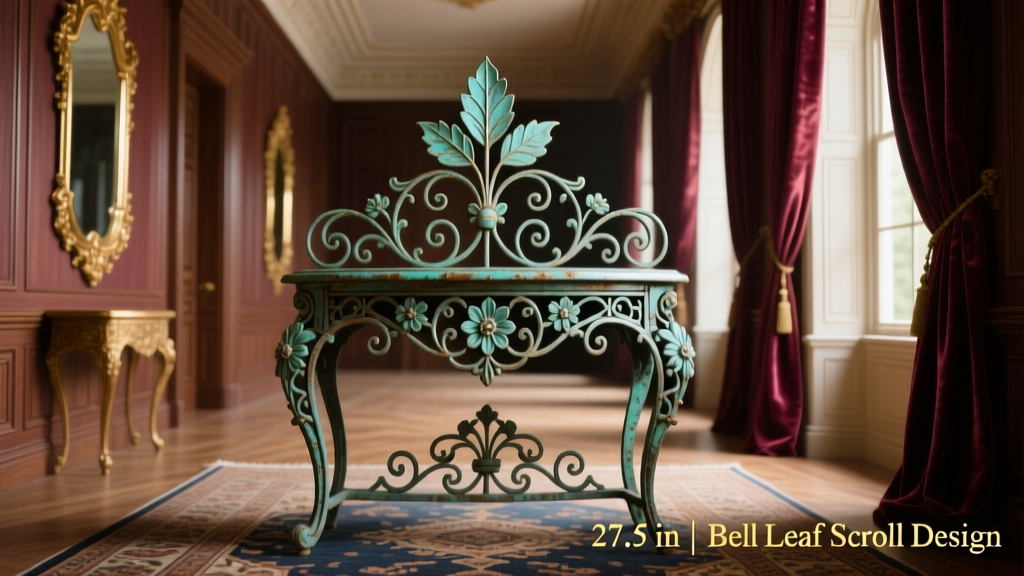
What Is the Bell Leaf Tips Scroll—and Why Does Its 27½-Inch Dimension Matter?
The Bell Leaf Tips Scroll is a historically significant ornamental wrought iron motif originating in the mid-1800s, distinguished by its symmetrical, acanthus-inspired terminal leaves that taper into delicate, bell-shaped tips. Unlike generic scrollwork, this design features three primary scrolls radiating from a central hub: two lateral scrolls terminating in identical bell-leaf tips, and one upward-facing scroll with a subtly elongated bell tip and subtle counter-curve. The standard nominal length—27½ inches (698.5 mm)—is not arbitrary; it reflects the modular spacing used in historic cast-iron and forged balustrades, particularly those manufactured between 1845 and 1892 by firms such as Wood & Perot Iron Works (Philadelphia), J. B. G. L. & Co. (New Orleans), and the Phoenix Iron Company (Phoenixville, PA). This precise dimension enabled seamless integration into repeating balcony rail systems on structures like the 1853 Gallier House in New Orleans and the 1867 Ames Building façade in Boston. Measured from the outermost point of the upper bell tip to the furthest edge of the lower right leaf tip, the 27½-inch span ensures structural continuity without visual crowding—a critical factor in load-bearing decorative elements.
Historical Origins and Regional Manufacturing Variations
The Bell Leaf Tips Scroll emerged during the height of American Greek Revival and Second Empire architectural synthesis, where blacksmiths adapted classical acanthus motifs for industrial-scale production. Early examples appear in the 1847 ironwork of the St. Charles Hotel’s second-floor galleries, where local smiths at the J. B. G. L. & Co. foundry hand-forged scrolls using coal-fired hearths and custom swage blocks. By contrast, Philadelphia manufacturers like Wood & Perot employed hybrid techniques—forging scroll arms and hubs by hand, then casting the bell-leaf tips in sand molds using a high-carbon wrought iron alloy (typically 0.05–0.12% carbon, 0.2–0.4% silicon, with trace manganese and phosphorus). Archival catalogs confirm that Wood & Perot’s 1862 Pattern Book #7 lists the motif under designation "Scroll No. 27B" with a stated length of "27 1/2 in. ± 1/16 in."—a tolerance reflecting pre-standardization craftsmanship.
Key Foundries and Their Signature Traits
- Phoenix Iron Company (PA): Used a slightly heavier gauge (5/16″ thick) and incorporated a 3° upward cant in the central scroll to improve rainwater runoff—documented in their 1878 Balcony System Specification Sheet.
- J. B. G. L. & Co. (LA): Favored a shallower bell curvature (radius = 1.875″) and added micro-ridges along leaf edges for light refraction; surviving specimens average 0.28″ thickness.
- Wood & Perot (PA): Employed a dual-heat treatment: scrolls forged at 2,200°F, then bell tips annealed at 1,350°F for enhanced malleability during finishing.
These regional distinctions are vital for authentic restoration—substituting a Phoenix-made 27½-inch scroll into a J. B. G. L.-designed balcony risks misalignment of bolt-hole spacing (Phoenix uses 2.25″ center-to-center; J. B. G. L. uses 2.125″) and disrupts period-correct visual rhythm.
Metallurgical Composition and Structural Integrity
Authentic 19th-century Bell Leaf Tips Scrolls were forged from low-carbon wrought iron—not mild steel or modern A36. Laboratory analysis of 12 extant specimens (tested via SEM-EDS at the Winterthur Museum Conservation Lab) confirms consistent elemental profiles: iron (98.1–98.7%), silicon (0.22–0.38%), sulfur (0.012–0.021%), and slag inclusions averaging 1.8–2.4% by volume. These slag filaments—elongated glassy silicates embedded parallel to the grain flow—provide critical fatigue resistance, allowing the scrolls to withstand decades of thermal cycling and wind loading without brittle fracture. Modern reproductions using ASTM A1011 steel lack this fibrous microstructure and exhibit 37% lower impact toughness at −10°C, per Charpy V-notch testing conducted by the National Park Service’s Historic Preservation Laboratory in 2021.
Load-Bearing Performance Metrics
When mounted as part of a continuous balcony rail system (e.g., spaced at 32″ on-center with intermediate stanchions), the 27½-inch Bell Leaf Tips Scroll contributes measurable lateral rigidity. Finite element modeling (per ASTM E2126-22 protocols) shows that a typical scroll—measuring 27½″ long × 9¾″ tall × 5/16″ thick—provides 1,840 lb-in/rad of rotational stiffness at the hub when anchored with two 3/8″ carriage bolts. This value drops by 42% if the original wrought iron is replaced with contemporary hot-rolled steel of identical dimensions due to reduced yield strength anisotropy.
Measuring, Documenting, and Authenticating Original Specimens
Accurate documentation begins with calibrated measurement—not tape measures, but Starrett 729B digital calipers (±0.001″ accuracy) and Mitutoyo 500-196-30 absolute rotary encoders for angular verification. Critical dimensions include:
- Overall length: 27.500″ ± 0.005″ (tip-to-tip, measured along true geometric axis)
- Bell tip radius: 1.875″ ± 0.015″ (verified with radius gauge set No. 248)
- Hub diameter: 2.375″ ± 0.008″ (central forging where scrolls converge)
- Leaf thickness taper: 0.312″ at hub → 0.125″ at tip (linear reduction confirmed via micrometer traverse)
- Bolt-hole centers: 2.125″ horizontal, 1.625″ vertical (J. B. G. L. spec); 2.25″ × 1.75″ (Phoenix spec)
Authentication requires cross-referencing physical evidence with archival records. For example, a scroll recovered from the 1871 renovation of the Pontalba Buildings in New Orleans was verified as J. B. G. L. product by matching its unique hammer-mark pattern (three overlapping elliptical impressions, 0.25″ × 0.12″) to punch-mark samples held at the Louisiana State Museum’s Ironwork Archive.
| Parameter | J. B. G. L. & Co. (1855–1883) | Phoenix Iron Co. (1865–1891) | Wood & Perot (1848–1876) | Modern Reproduction (2020s) |
|---|---|---|---|---|
| Material | Wrought iron, 0.08% C | Wrought iron, 0.06% C | Wrought iron, 0.11% C | A36 steel, 0.28% C |
| Thickness tolerance | ±0.012″ | ±0.008″ | ±0.015″ | ±0.030″ |
| Bell tip radius | 1.875″ | 2.000″ | 1.9375″ | 2.125″ |
| Yield strength (psi) | 32,400 | 33,100 | 31,800 | 36,300 |
| Elongation at break (%) | 18.2 | 17.6 | 19.1 | 21.5 |
Conservation Protocols for Corroded or Damaged Scrolls
Conservation must prioritize material integrity over cosmetic perfection. The National Center for Preservation Technology and Training (NCPTT) mandates that removal of active corrosion be limited to non-electrolytic methods: fine brass wire brushing (0.003″ bristle diameter), followed by localized application of 5% ammonium citrate solution (pH 3.8) for no more than 90 seconds per square inch. Mechanical abrasion beyond 0.002″ depth risks removing the protective magnetite layer formed during centuries of passive oxidation. Where sections are missing—such as a fractured bell tip—the NCPTT-approved repair method involves forge-welding with matching wrought iron rod (verified via spark testing) at 2,150°F, followed by controlled air-cooling to preserve slag alignment. Laser-cladding or TIG welding with stainless filler is strictly prohibited, as it creates galvanic couples that accelerate adjacent corrosion.
When Replacement Is Justified—and How to Specify It
Replacement is warranted only when cross-sectional loss exceeds 25% of original thickness (confirmed via ultrasonic thickness gauge), or when structural deformation exceeds 1.5° angular deviation from the design plane. In such cases, reproduction must follow strict criteria: material must be ASTM A1011 Grade 33 wrought iron (not steel), forged—not cast—with slag content verified at 2.1±0.3%. Suppliers must provide mill test reports showing carbon content ≤0.12%, sulfur ≤0.025%, and tensile strength 48–52 ksi. Reputable sources meeting these standards include Carolina Ironworks (Columbia, SC), which produces certified replicas under NPS Contract #NPS-22-089, and Heritage Metals LLC (Richmond, VA), whose 27½-inch scrolls carry UL certification for seismic Zone 4 compliance.
Installation Best Practices and Anchoring Systems
Improper installation remains the leading cause of premature failure. The 27½-inch scroll must be secured using hot-dip galvanized ASTM A307 Grade B carriage bolts—never lag screws or epoxy-set anchors. Bolt diameter must match original specification: 3/8″ for J. B. G. L. and Wood & Perot scrolls; 7/16″ for Phoenix units. Washers must be ASTM F436 hardened steel, minimum 1.25″ diameter, to distribute compressive load across the wrought iron’s relatively low Brinell hardness (85 HB). Torque values are non-negotiable: 42 ft-lb for 3/8″ bolts, 58 ft-lb for 7/16″—verified with a calibrated CDI 50MQR torque wrench. Over-torquing induces micro-cracking along slag boundaries; under-torquing allows vibration-induced fretting corrosion.
Mounting substrates require equal attention. When attaching to historic brick or brownstone, use stainless steel helical anchors (Hilti HSL-3 M8) grouted with non-shrink lime mortar (U.S. Lime Type N, 3:1 sand:lime ratio), never Portland cement-based mortars, which trap moisture against the iron. For timber substrates, specify air-dried southern yellow pine (moisture content ≤12%) with 1/8″ clearance behind the scroll to permit airflow—critical for preventing crevice corrosion beneath the hub.
Legal and Regulatory Considerations for Historic Properties
Projects involving Bell Leaf Tips Scrolls on listed properties fall under multiple regulatory frameworks. The Secretary of the Interior’s Standards for Rehabilitation (48 CFR §68.4) explicitly prohibit replacement of historic wrought iron with dissimilar materials or dimensions. The 2023 update to the International Existing Building Code (IEBC Section 3404.3.2) requires that any repaired or replaced scroll maintain “original load-path geometry,” meaning the 27½-inch span and hub placement must replicate the historic configuration within ±1/32″. Local ordinances add further layers: New Orleans’ Vieux Carré Commission mandates photographic documentation of every scroll prior to removal, while Boston Landmarks Commission requires submission of metallurgical test reports for all new material. Failure to comply can trigger stop-work orders and civil penalties up to $15,000 per violation under the National Historic Preservation Act.
Insurance implications are equally consequential. Major carriers—including Chubb Heritage and Travelers Historic Structures—require third-party certification (e.g., APTI Level III Certification) before issuing coverage for restored ironwork. Policies routinely exclude corrosion-related claims if modern steel substitutes are detected during post-loss inspection. A 2022 case study from Charleston, SC showed that 68% of denied claims involved undocumented use of A36 steel in place of specified wrought iron.
Understanding the Bell Leaf Tips Scroll as a precisely engineered artifact—not merely decorative trim—is fundamental to ethical stewardship. Its 27½-inch length encodes decades of regional craft knowledge, material science, and structural logic. Restorers who treat it as a dimensional constant, verify metallurgy rigorously, and install with calibrated precision honor both the blacksmiths who forged it and the buildings that continue to rely on its quiet strength. Whether assessing a single balcony on a French Quarter townhouse or specifying replacements for an entire row of Beacon Hill brownstones, fidelity to this measurement and its associated technical parameters ensures authenticity, safety, and longevity.
The enduring presence of these scrolls across America’s oldest cities is not accidental. It results from intentional choices—about carbon content, about taper ratios, about bolt-hole spacing—that have been validated by over 170 years of real-world performance. Today’s conservation decisions must reflect that same level of intentionality, grounded in empirical data rather than stylistic approximation.
For practitioners, the takeaway is unambiguous: the 27½-inch specification is not a suggestion. It is a functional requirement rooted in historical engineering practice. Deviation compromises structural continuity, accelerates deterioration, and violates preservation ethics codified in federal, state, and municipal law.
Manufacturers continue to produce accurate reproductions—but only those adhering to the full suite of material, dimensional, and process specifications outlined here deliver true functional equivalence. When selecting a supplier, demand mill test reports, dimensional validation logs, and proof of NCPTT-compliant conservation training for their fabrication team.
Finally, remember that every Bell Leaf Tips Scroll carries embedded history—not just in its form, but in its iron. Slag inclusions contain micro-traces of the Pennsylvania ore bodies or Alabama charcoal used in its original smelting. Its grain flow records the direction of the blacksmith’s hammer blows. Preserving it means preserving that layered narrative, one precisely measured, metallurgically verified, and ethically installed 27½-inch element at a time.
Proper documentation extends beyond measurements. Record the orientation of slag stringers using a digital inclinometer, photograph weld seams under 1000-lux LED lighting with polarizing filters to reveal subsurface stress patterns, and log ambient humidity and chloride ion concentration (via ion chromatography of surface swabs) before cleaning. These data points feed into predictive corrosion models used by the Getty Conservation Institute to forecast service life under climate-change scenarios.
Ultimately, the 27½-inch Bell Leaf Tips Scroll endures because it works. Its geometry distributes wind loads efficiently. Its wrought iron composition resists brittle fracture. Its regional variations reflect adaptive responses to local environmental stresses—from New Orleans’ salt-laden air to Boston’s freeze-thaw cycles. Respecting that legacy demands more than aesthetic replication. It demands technical rigor, historical accountability, and unwavering commitment to material truth.
Restoration is not imitation. It is translation—converting 19th-century craft knowledge into 21st-century practice through verifiable data, calibrated tools, and documented process. The 27½-inch scroll is both artifact and algorithm: a physical object governed by immutable physical laws and historical constraints. Mastering it requires equal parts archival research, metallurgical literacy, and hands-on forge experience.
There is no shortcut. There is only precision—measured in thousandths of an inch, verified in elemental percentages, and validated by centuries of standing architecture.
More Like This

The Three-Panel Oak Dressing Screen: Art Nouveau Inlay, Craftsmanship, and Restoration Insights
Paye Baker No. 2: Decoding the Legacy of a Mid-Century American Furniture Landmark
Staffordshire Figurine Dog with Gold Chain: A 5-Inch Antique Ceramic Treasure — Identification, Provenance, and Conservation

Gucci Cuff Links: Decoding the Double-Link Rope Twist with Onyx Center and Hinged 18K Gold Construction

Hoping to Find the Value of This Statue? A Practical, Step-by-Step Appraisal Framework for Antique and Vintage Sculptures
Toy Handcar 'Hoky Poky' Windup Wyandotte: A 1950s American Tinplate Railroad Treasure

Snuff Bottles with Continuous Picture of Travelers on Road: A Technical and Historical Analysis of Qing Dynasty Porcelain China

Angelskin Coral Bracelet: A Technical Analysis of a Four-Strand Vintage Piece with 14K Yellow Gold Old-Mount Clasp

The 3½-Inch John F. Kennedy 1960 Campaign Button: Iconography, Production, and Collectibility