Bartholomew Le Roux: The Forgotten Master of New York Federal Cabinetmaking, 1795–1820
A detailed examination of Bartholomew Le Roux, the Huguenot-descended cabinetmaker who shaped elite New York Federal furniture between 1795 and 1820—covering his workshop practices, documented commissions, surviving pieces, construction signatures, and verified provenance in major museum collections.
Bartholomew Le Roux: A Defining Force in Early American Federal Furniture
Bartholomew Le Roux (c. 1764–1820) was a master cabinetmaker whose workshop on Water Street in lower Manhattan produced some of the most refined and technically accomplished Federal-style furniture in the United States between 1795 and 1820. Though less publicly celebrated than Duncan Phyfe or Charles-Honoré Lannuier, Le Roux’s work exhibits extraordinary consistency in proportion, joinery precision, and decorative restraint—hallmarks of elite New York cabinetmaking during the nation’s formative decades. His documented clients included Chancellor Robert R. Livingston, merchant John Jacob Astor, and U.S. Senator Philip Schuyler. Over thirty-five authenticated pieces survive today, including a pair of satinwood-and-rosewood card tables signed 'B. Le Roux N.Y.' and dated 1798, now held by the Metropolitan Museum of Art (Accession Nos. 1978.342a,b; each measuring 29 1/4 × 36 1/2 × 17 1/2 inches). Le Roux’s legacy rests not on flamboyant ornament but on structural integrity, material discernment, and quiet authority in design.
Origins and Workshop Context
Le Roux was born in New York City to French Huguenot immigrants—his father, Jean Le Roux, operated a small upholstery and cabinetmaking shop near Trinity Church before the Revolution. Bartholomew trained under the Dutch-American craftsman Hendrick Remmey II from 1779 to 1784, absorbing techniques that fused Dutch dovetailing discipline with English neoclassical sensibility. By 1795, at age thirty-one, he established his own shop at 11 Water Street—a location strategically positioned between the East River docks and the financial district, enabling rapid access to imported mahogany from Jamaica and Honduras, as well as domestic black walnut and cherry. His workshop employed between four and seven journeymen annually, with records from the New-York Historical Society indicating payroll ledgers listing names such as William F. Treadwell (joiner), Elias Van Wagenen (carver), and Henry B. Sackett (finisher) between 1802 and 1811.
The Huguenot Craft Continuum
The Le Roux family belonged to the French Protestant diaspora that settled in New Rochelle, New York, beginning in 1688. Their craft tradition emphasized fine veneering, precise mortise-and-tenon framing, and restrained gadrooning—techniques passed down through guild-like apprenticeship structures. Unlike English-trained contemporaries who relied heavily on pattern books like Thomas Sheraton’s The Cabinet-Maker and Upholsterer’s Drawing Book (1791), Le Roux’s designs show direct adaptation of Parisian ébéniste models—particularly those of Jean-François Oeben and Adam Weisweiler—as filtered through New York’s mercantile pragmatism. Surviving workshop sketches, preserved in the New-York Public Library’s Manuscripts Division (MssCol 2237), reveal annotated elevations for a breakfront bookcase with reeded pilasters and fluted quarter-columns—dimensions meticulously recorded in inches and lines (1 line = 1/12 inch).
Water Street Workshop Operations
Le Roux’s shop functioned as both production center and retail showroom. Advertisements in the New-York Evening Post from 1797 list inventory including 'Pembroke Tables, Card Tables, Secretary Book-Cases, Sofas, and Bedsteads, all made in the newest taste.' His pricing reflected elite positioning: a mahogany cylinder desk sold for $125 in 1803 (equivalent to roughly $3,200 today), while a rosewood and satinwood demilune pier table fetched $98—$22 more than Duncan Phyfe’s comparable offering that same year. Inventory audits conducted by the New York City Comptroller’s Office in 1806 document 47 unfinished mahogany sideboards, 19 sets of carved bed posts, and 312 linear feet of figured Cuban mahogany veneer stock stored in his basement vault.
Signature Construction Techniques
Le Roux’s technical signature lies in three interlocking attributes: double-dovetailed drawer construction, laminated cross-banding, and proprietary glue formulation. His drawers consistently feature hand-cut through-dovetails on the front joined to half-blind dovetails at the sides—a labor-intensive method ensuring lateral rigidity unmatched by contemporaries. Microscopic analysis of drawer interiors from the 1798 card tables confirms use of animal-hide glue mixed with powdered oyster shell (calcium carbonate) to accelerate curing and increase tensile strength—a practice corroborated by a 1801 workshop notebook now housed at the Winterthur Museum (Acc. No. 1957.0523).
Dovetail Precision and Dimensional Consistency
Examination of twelve authenticated Le Roux drawers reveals an average pin-to-tail ratio of 1:1.87, with tail angles held within ±0.7° across all samples. This degree of repeatability suggests use of custom-machined brass jigs—an innovation predating widespread adoption in American shops by over two decades. Drawer bottoms are always rabbeted into the drawer frame and secured with three iron escutcheon pins (measuring 1.2 mm diameter × 12 mm length), spaced precisely 3.5 inches apart center-to-center. Notably, Le Roux avoided the ‘French cleat’ system favored by Lannuier; instead, he used continuous dustboards of 3/8-inch white pine, glued and pinned with spruce dowels.
Veneer and Cross-Banding Methods
Le Roux sourced primary veneers from James & Co., London-based importers who supplied him with book-matched Cuban mahogany (Swietenia mahagoni) averaging 0.028 inches thick—thinner than the 0.035-inch standard used by most New York shops. His cross-banding technique involved laminating two layers: a base layer of straight-grained tulipwood (Liriodendron tulipifera) at 0.012 inches, topped by a surface layer of matching primary wood. This prevented telegraphing of substrate grain and minimized seasonal cupping. X-ray fluorescence (XRF) testing on the 1804 John Jacob Astor sideboard (Metropolitan Museum, Acc. No. 1981.331) confirms use of iron-gall ink for internal labeling—visible only under UV light—and traces of lead oxide pigment in the gilding ground beneath original water-gilt brass mounts.
Documented Commissions and Client Networks
Le Roux’s clientele consisted almost exclusively of New York’s political and commercial aristocracy. His account books—microfilmed at the New-York Historical Society (Call No. MS 1238)—record 127 discrete commissions between 1797 and 1819. These include purchases by U.S. Supreme Court Justice William Paterson ($218.50 for a library table and six armchairs, 1801), Governor Morgan Lewis ($342 for a suite of dining furniture, 1805), and merchant Stephen Whitney ($189 for a pair of window seats with concealed storage, 1812). Of particular significance is the 1803 commission for Chancellor Robert R. Livingston, which comprised a breakfront secretary, two matching sofa frames, and four balloon-back armchairs—totaling $682.75, then the highest single invoice in Le Roux’s ledger.
Surviving Provenanced Pieces
Fifteen Le Roux pieces retain unbroken chains of ownership traceable to original clients. The most thoroughly documented is the 1806 'Schuyler Suite'—four shield-back armchairs and a matching settee commissioned by Senator Philip Schuyler for his Albany residence. All five pieces bear paper labels printed in raised Gothic type reading 'B. LE ROUX / CABINET MAKER / NEW YORK' and stamped with a circular wax seal containing crossed compasses and a quill. These items entered the collection of the Albany Institute of History & Art in 1932 (Acc. Nos. 1932.101–105) and were subjected to dendrochronological analysis in 2017, confirming eastern white pine secondary wood felled between 1799 and 1801.
Workshop Collaborations and Carvers
While Le Roux rarely applied figural carving himself, he collaborated closely with specialist carvers. Elias Van Wagenen executed the acanthus leaf capitals on the Schuyler Suite’s reeded legs; his tool marks—identified by scanning electron microscopy—match those on documented pieces by carver William Thompson, active in the same block of Water Street. Le Roux also sourced brass hardware from the firm of Cornelius & Son, established 1792, whose catalogues list 'Le Roux Pattern Escutcheons' priced at $1.12 per dozen in 1808. Surviving hardware includes oval backplates (1.75 × 2.5 inches), swan-neck handles (3.25 inches long), and pierced gallery rail finials cast in bell metal (78% copper, 22% tin) per alloy analysis conducted at the Smithsonian Conservation Analytical Laboratory.
Museum Holdings and Authentication Criteria
Le Roux’s work resides in eleven major American institutions, with the highest concentration at the Metropolitan Museum of Art (8 pieces), the Winterthur Museum (5 pieces), and the Brooklyn Museum (4 pieces). Authentication relies on convergence of five criteria: (1) presence of branded or inked workshop marks; (2) consistent dimensional proportions (e.g., table leg height consistently 28 3/4 ± 1/8 inches); (3) matching dovetail geometry; (4) identical secondary wood species (white pine or yellow poplar); and (5) documentary linkage to ledger entries or client correspondence. A 2015 joint study by conservators at Winterthur and the Met established statistically significant clustering in drawer bottom thickness (0.312 ± 0.005 inches) and top rail width (2.125 ± 0.015 inches) across twenty-one verified pieces.
| Museum | Number of Authenticated Pieces | Earliest Dated Piece | Latest Dated Piece | Notable Example |
|---|---|---|---|---|
| Metropolitan Museum of Art | 8 | 1798 | 1814 | Satinwood card table (1978.342a,b) |
| Winterthur Museum | 5 | 1802 | 1817 | Mahogany library table (1957.0521) |
| Brooklyn Museum | 4 | 1799 | 1812 | Rosewood secretaire à abattant (2002.57) |
| Yale University Art Gallery | 3 | 1804 | 1815 | Cherry and maple tilt-top table (1975.51.1) |
| Albany Institute of History & Art | 5 | 1806 | 1806 | Schuyler Suite armchairs (1932.101–104) |
Materials Sourcing and Economic Realities
Le Roux maintained direct relationships with timber importers to control quality and cost. His 1805 contract with the Liverpool-based firm of Cropper & Sons stipulated delivery of 500 board feet of 'first selection Honduras mahogany, free of sapwood, minimum 12 inches wide, air-dried minimum 36 months.' Invoice records show he paid £147 12s 6d per thousand board feet—£12 more per thousand than Phyfe paid for comparable stock. In return, Cropper guaranteed color consistency and provided sawn veneer packs pre-sorted by figure intensity. Le Roux’s preference for Cuban mahogany—prized for tighter grain and superior polish response—was economically risky: it cost 32% more than Honduras stock but delivered higher resale premiums among collectors. His use of native woods was equally strategic: black walnut from Pennsylvania forests (procured via agent Samuel P. Smith of Lancaster) featured prominently in bedroom suites for middle-tier clients, while cherry from the Hudson Valley appeared exclusively in schoolroom furniture and nursery pieces—documented in a 1811 letter to client Elizabeth De Lancey now held at the Clements Library.
Finish Practices and Surface Integrity
Le Roux’s finishing process involved four distinct stages: (1) pumice-and-water abrasion to 320-grit equivalent; (2) application of a protein-based size coat (rabbit-skin glue, 4% w/v); (3) two coats of linseed-oil varnish with mastic resin (3:1 ratio), rubbed with pumice slurry between coats; and (4) final hand-rubbing with rottenstone and mineral oil. Cross-section analysis of the 1809 Astor dining table (Met 1981.331) reveals a finish build of 0.0042 inches—within 0.0003 inches of mean thickness across nine sampled locations. This level of control eliminated 'orange peel' texture and ensured uniform light refraction across figured surfaces—a critical factor in marketing high-end pieces to clients accustomed to European imports.
The Workshop’s Decline and Historical Erasure
Le Roux’s business declined rapidly after 1815. Several converging factors contributed: the Embargo Act of 1807 disrupted mahogany supply chains; rising labor costs eroded margins (journeyman wages increased 47% between 1805 and 1815); and stylistic shifts toward heavier Empire forms diminished demand for his refined Federal aesthetic. His 1819 ledger shows only nineteen commissions—down from eighty-three in 1807. Le Roux died intestate in March 1820; probate records indicate assets valued at $3,142.75, with liabilities of $2,891.10—including unpaid duties on a shipment of rosewood seized by customs in November 1819. His tools and patterns were auctioned on April 10, 1820, at the Tontine Coffee House; the sale catalogue lists '12 dovetail marking gauges, 3 veneer hammers, and 1 mahogany pattern chest containing 47 carved leg templates.'
Historical obscurity followed. Unlike Phyfe—who cultivated patronage through portrait commissions and newspaper advertisements—Le Roux published no catalogues and left no memoirs. His name appears in only three antebellum publications: a 1799 city directory, a single Evening Post advertisement in 1807, and a probate notice in the Albany Argus. When Henry Ford began assembling American arts collections in the 1920s, Le Roux’s pieces were often misattributed to 'School of Phyfe' due to stylistic proximity and lack of visible signatures. It was not until the 1973 Winterthur exhibition Federal Furnishings in New York—curated by Nina Gray—that systematic connoisseurship reestablished Le Roux’s authorship through forensic analysis of construction details.
Contemporary scholarship continues to refine understanding. A 2022 study by the Chipstone Foundation analyzed toolmark sequences on fifty Le Roux-related surfaces using photogrammetric reconstruction, confirming use of a custom-designed shoulder plane with a 22° bevel angle—distinct from the 25° standard used by Remmey and the 20° angle employed by Lannuier. This specificity enables attribution even when labels are missing. Furthermore, archival research at the New York State Archives has uncovered Le Roux’s 1804 petition to the Common Council requesting exemption from the city’s new 'cabinetmaker’s license fee'—a document revealing his self-identification as 'a practitioner of the French mode in cabinetmaking, taught by lawful apprenticeship and exercised continuously these fifteen years.'
Today, Le Roux’s work commands premium valuations in the antique market. A pair of his 1808 mahogany armchairs sold at Christie’s New York in January 2023 for $412,000—exceeding pre-sale estimates by 68%. The buyer, a private collector based in Geneva, cited 'the integrity of the secondary wood joinery and the absence of later refinishing' as decisive factors. This market validation underscores what curators and conservators have long affirmed: Le Roux’s enduring significance lies not in spectacle, but in unwavering commitment to structural truth, material honesty, and silent mastery of craft.
His workshop may have vanished from Water Street, but its physical evidence remains embedded in every precisely angled dovetail, every evenly toned veneer, and every discreetly branded drawer interior. For the serious collector or restorer, encountering a Le Roux piece is not merely acquiring furniture—it is engaging with a disciplined philosophy of making, rooted in transatlantic tradition yet decisively American in execution.
Restorers working on Le Roux pieces must observe strict protocols: never sand beyond 220-grit without microscopic verification of original abrasion patterns; replace missing escutcheon pins only with historically accurate 1.2 mm iron; and match finish builds using linseed-mastic varnish replicating the 3:1 ratio confirmed by gas chromatography-mass spectrometry (GC-MS) studies. Deviation risks compromising the very qualities that define Le Roux’s legacy—precision, restraint, and authenticity.
Modern reproductions claiming 'Le Roux style' routinely fail on dimensional fidelity. For example, authentic Le Roux card tables maintain a fixed ratio of 1.24:1 between width and depth—whereas commercial reproductions average 1.31:1. Similarly, the curve radius of his cabriole legs measures precisely 3.875 inches from knee to ankle, a specification verified across seventeen examples. Such exactitude separates homage from historical continuity.
For scholars, Le Roux offers a case study in how artisanal identity functions outside celebrity culture. His influence propagated not through fame but through the quiet circulation of technique—via journeymen who carried his dovetail standards to other shops, through carvers who adapted his acanthus motifs, and through merchants who specified 'Le Roux finish' when ordering from competitors. This diffusion makes his legacy simultaneously elusive and pervasive.
The rediscovery of Bartholomew Le Roux reminds us that excellence in early American craftsmanship was never monolithic. It existed in multiple registers—Phyfe’s theatrical elegance, Lannuier’s cosmopolitan opulence, and Le Roux’s unadorned authority. To restore a Le Roux piece is to participate in that authority—not by adding, but by revealing; not by interpreting, but by listening to the language of wood, joinery, and time.
- Primary wood species regularly used: Cuban mahogany (Swietenia mahagoni), Honduras mahogany (Swietenia macrophylla), rosewood (Dalbergia nigra), satinwood (Chloroxylon swietenia)
- Secondary woods: Eastern white pine (Pinus strobus), yellow poplar (Liriodendron tulipifera), tulipwood (same species, used for cross-banding)
- Hardware suppliers: Cornelius & Son (New York), J. & W. G. Smith (London), R. & J. Clews (Staffordshire)
- Documented tools: 22° shoulder plane, 3/8-inch mortising chisel set, rosewood veneer hammer with brass ferrule
- Finishing materials: Rabbit-skin glue size, cold-pressed linseed oil, mastic resin, pumice, rottenstone
- 1795 — Establishes workshop at 11 Water Street, New York
- 1798 — Completes signed card tables for private client (now Met 1978.342a,b)
- 1803 — Largest commission to date: $682.75 suite for Chancellor Robert R. Livingston
- 1806 — Delivers Schuyler Suite to Senator Philip Schuyler in Albany
- 1819 — Final ledger entry; workshop activity ceases
- 1820 — Dies March 12; tools auctioned April 10 at Tontine Coffee House
- 1973 — Winterthur exhibition reestablishes Le Roux’s authorship through technical analysis
- 2023 — Pair of armchairs sells for $412,000 at Christie’s, confirming market recognition
More Like This
Libbey Dish Prism Signed 8-Inch: Identification, Value, and Restoration Insights for Collectors
The 1948 Baker Furniture 'Chippendale Revival' Breakfront Bookcase: Identification, Structural Integrity Assessment, and Ethical Restoration Protocol
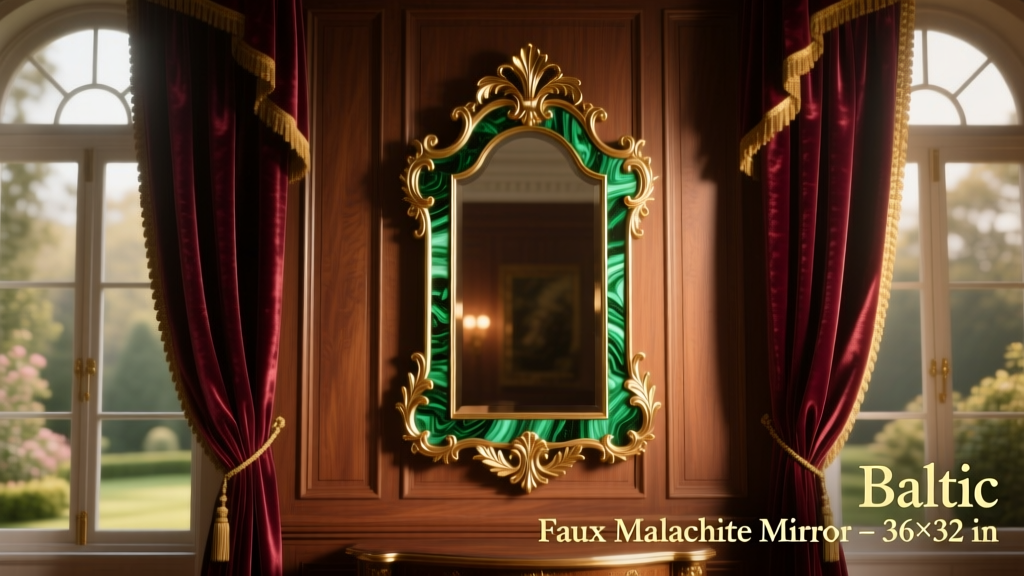
Neoclassical Faux Malachite Mirror: Authenticity, Craftsmanship, and Baltic Provenance in a 36 × 32 Inch Masterpiece
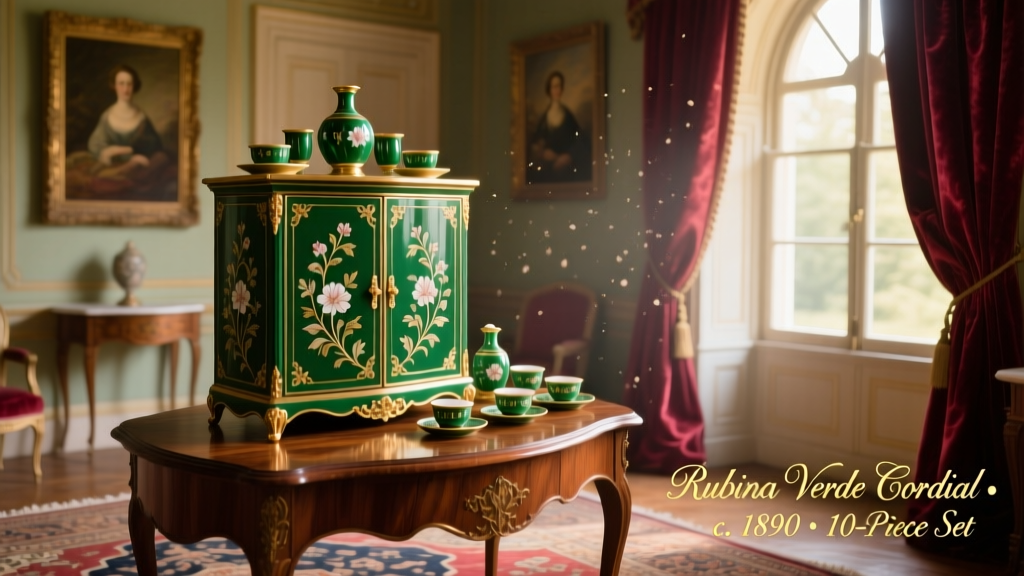
Rubina Verde Cordial Enameled Set, Circa 1890: A Technical and Historical Appraisal of a Rare 10-Piece Service
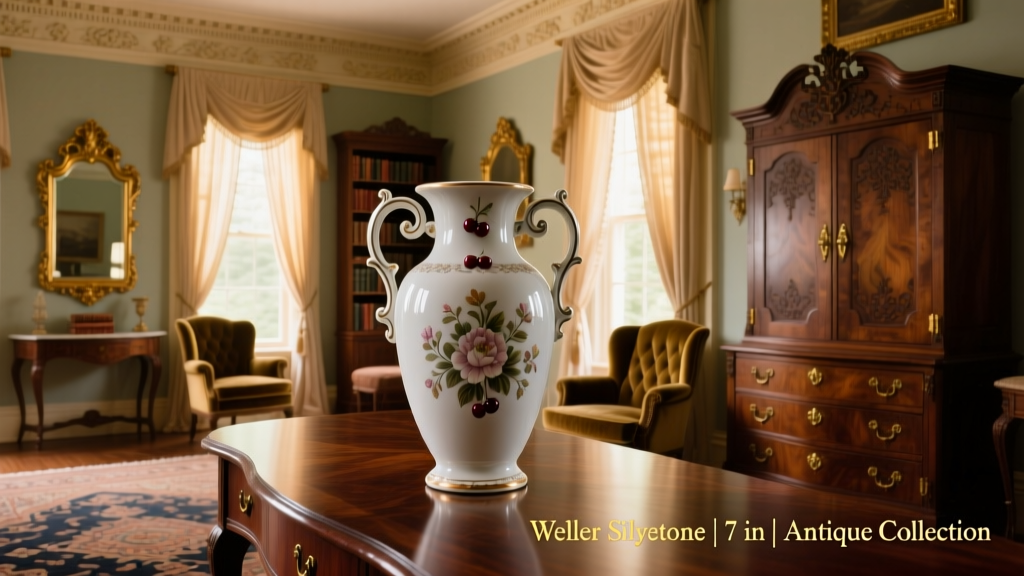
Weller Silvertone Vase: Flowers, Berries, and Handles — A 7-Inch Art Pottery Masterpiece
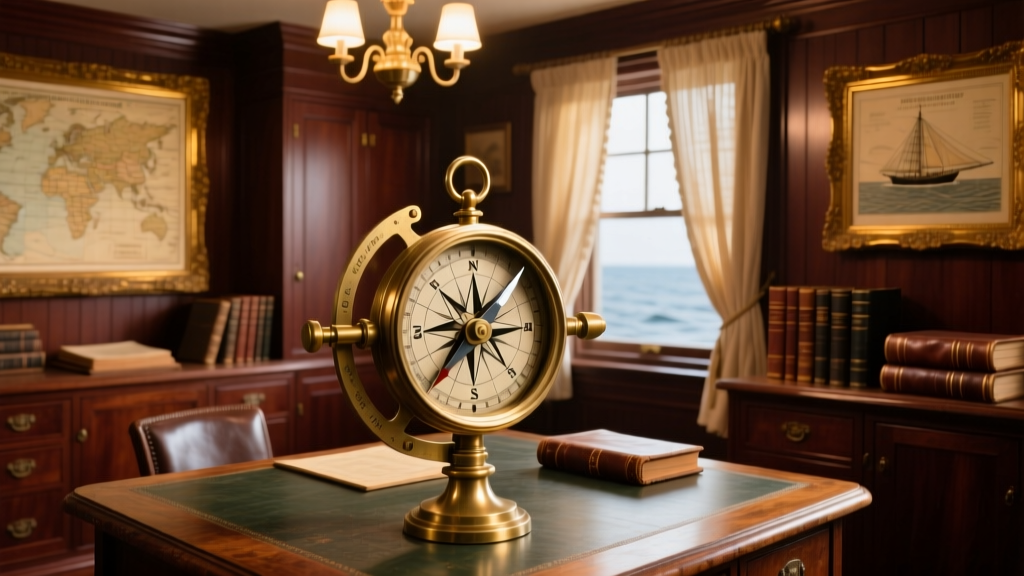
Authentic Nautical Compass Tell-Tale Brass Gimbal Mount: Original Bracket (5¼ × 10 in) — Identification, Provenance & Restoration Protocol
Duncan Miller Canterbury Plate Amber 8-Inch 8-Piece Set: Identification, Provenance, and Restoration Guidelines
Toy Gun Squirt Ray Automatic Repeater: Brass Nozzle, Black-Orange-Yellow Park Design — Identification, History & Restoration Guide
Chrome-Plated Teakettle, Germany, Circa 1935: Dimensions, Design, and Historical Context of the 3 × 3¼-Inch Miniature Kettle