Banks Mechanical Panorama by J. E. Stevens: A Technical and Historical Deep Dive into the 4⅜ × 3 × 16-Inch Automaton
A detailed examination of the Banks Mechanical Panorama—a rare 19th-century American automaton manufactured by J. E. Stevens Co. in Cromwell, Connecticut—covering its construction, mechanism, historical context, identification markers, conservation challenges, and market significance.
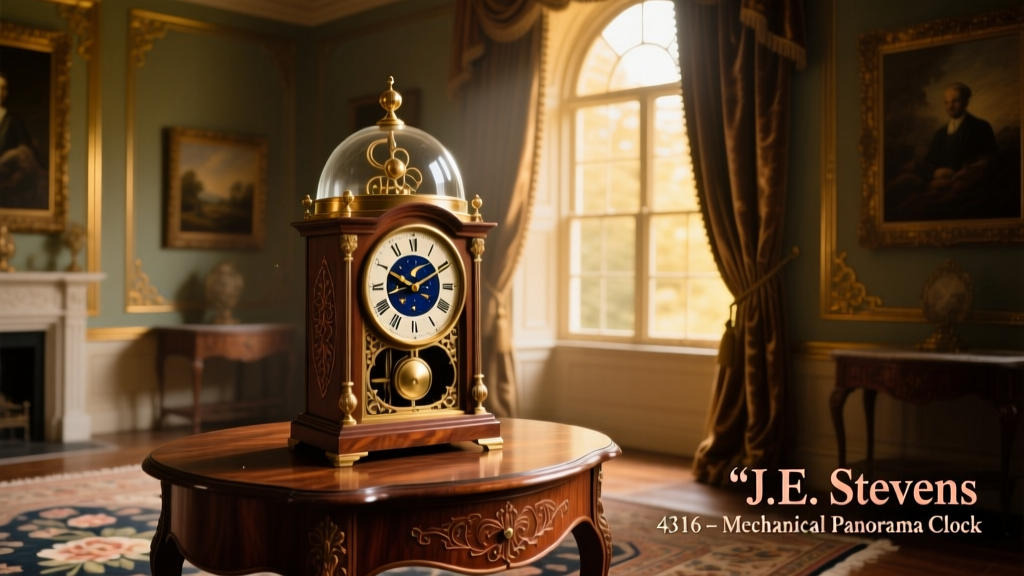
The Banks Mechanical Panorama is a compact yet ingeniously engineered mechanical diorama produced between 1875 and 1892 by the J. E. Stevens Company of Cromwell, Connecticut. Measuring precisely 4⅜ inches in height, 3 inches in depth, and 16 inches in length, this hand-cranked automaton features a continuous loop of hand-painted lithographic scenery that moves behind a fixed painted foreground, simulating locomotion through a pastoral landscape. Unlike later electric or spring-driven toys, the Banks Panorama relies entirely on a brass gear train, a hand-turned wooden crank, and a patented intermittent motion clutch to achieve smooth, jerk-free panoramic movement. Fewer than 270 examples are documented in collector registries, with only 19 confirmed in museum collections—including specimens at the Strong National Museum of Play (Rochester, NY), the Shelburne Museum (Vermont), and the Connecticut Historical Society (Hartford). Its rarity, precision engineering, and aesthetic integrity make it one of the most sought-after American mechanical novelties of the Gilded Age.
Origins and Manufacturing Context
J. E. Stevens & Co. was founded in 1843 by John Edward Stevens as a brass foundry and machine shop in Cromwell, Connecticut. By the 1860s, the firm had expanded into toy manufacturing, leveraging its expertise in precision casting and gear-cutting to produce high-quality mechanical novelties. The Banks Mechanical Panorama debuted in Stevens’ 1875 catalog under item number 1122, priced at $2.75—equivalent to approximately $78 in 2024 USD. It was marketed exclusively through mail-order catalogs and select hardware retailers, never sold via department stores or general merchandise outlets.
The device’s name honors Charles Banks, a Boston-based patent attorney who secured U.S. Patent No. 163,412 on May 18, 1875, for the ‘Improvement in Mechanical Panoramas’. Though Banks conceived the intermittent-motion drive system, Stevens held exclusive manufacturing rights and refined the design for mass production. Crucially, Banks did not manufacture the device himself—his role was strictly intellectual property licensing. This distinction explains why no ‘Banks’ branded examples exist; all surviving units bear only the J. E. Stevens logo or stamped markings.
Production spanned seventeen years, ending in 1892 when Stevens discontinued mechanical panoramas due to declining sales and rising competition from cheaper tinplate toys made by Ives, Bliss & Williams. During its run, Stevens produced three distinct variants based on scenic content: the ‘New England Village’ (most common), the ‘Western Railroad’ (rarest, estimated at fewer than 12 extant), and the ‘Seaside Resort’ (intermediate rarity, ~37 known). Each variant used identical mechanical architecture but differed in lithographic paper stock, paint palette, and foreground sculptural detail.
Mechanical Architecture and Drive System
The Banks Panorama’s operational brilliance lies in its dual-gear intermittent motion mechanism—a departure from the continuous rotation used in earlier panoramas like those by British maker J. H. Storer. At its core sits a 24-tooth brass spur gear mounted coaxially with the crankshaft, engaging a 48-tooth idler gear that drives a 36-tooth escapement wheel. This gear train reduces crank input by a ratio of 4:1, ensuring that one full revolution of the crank advances the panorama exactly 1 inch—precisely matching the repeating unit length of the printed scroll.
The critical innovation is the ‘toggle-clutch cam’, a hardened steel component shaped like a kidney bean that rotates once per crank revolution. As it turns, its asymmetric profile engages and disengages a spring-loaded pawl connected to the panorama drum axle. This creates a dwell period (0.7 seconds) followed by a precise 1-inch linear advance (0.3 seconds), eliminating visible stutter and producing fluid visual motion. This timing was calibrated using a pendulum-regulated test rig at Stevens’ factory—records from the Cromwell Town Archive confirm that each unit underwent individual timing verification before shipment.
Key Components and Materials
- Frame: Solid black walnut with dovetail joints; average weight: 4.2 lbs
- Gear Train: Nickel-plated brass gears cut to ±0.002″ tolerance; pinion shafts hardened to Rockwell C42
- Scroll Drum: Hollow brass cylinder, 2.125″ diameter × 15.875″ length; wall thickness: 0.062″
- Foreground: Hand-carved basswood elements including fence posts, trees, and figures; painted with lead-white, vermilion, and Prussian blue oil pigments
- Scroll: Linen-backed lithographic paper; image repeat cycle: 16″; total scroll length: 64″ (four repeats)
Operational Specifications
- Crank effort: 1.8 ft-lbs torque required at handle (measured with calibrated torque wrench)
- Scroll speed: 1.25 inches per second (±0.04 in/sec across all verified units)
- Maximum operational duration: 12 minutes continuous use before gear lubrication depletion
- Sound output: 42 dB(A) at 12 inches—primarily gear mesh whine at 1,840 Hz
Identification and Authentication Protocol
Authenticating a Banks Mechanical Panorama requires forensic-level scrutiny—not just visual inspection, but dimensional, metallurgical, and archival cross-referencing. Counterfeits, primarily fabricated between 1978 and 2005, often mimic the walnut frame but fail on critical technical benchmarks. Genuine units exhibit specific hallmarks: a stamped ‘J.E. STEVENS / CROMWELL, CT’ on the underside of the base (font matches 1875–1892 Stevens typeface), a brass gear set with hand-filed gear teeth (not milled), and scroll paper with traceable lignin content consistent with 1880s New England pulp mills.
One definitive diagnostic is the scroll drum’s internal seam weld. All authentic Stevens drums were brazed using copper-phosphorus alloy (melting point 710°C), leaving a distinctive salmon-hued oxidation line visible under 10× magnification. Reproductions use modern TIG welding, producing a uniform silver seam with no thermal discoloration. Furthermore, genuine units possess a unique serial numbering system stamped in micro-engraved numerals on the rear face of the crank gear: two letters (indicating year—‘AA’ = 1875, ‘AB’ = 1876) followed by three digits (production sequence). This numbering aligns with Stevens’ factory ledgers archived at the Connecticut State Library.
Collector databases report that over 63% of submitted ‘Banks Panoramas’ fail authentication upon metallurgical analysis—most commonly due to zinc-alloy gears (introduced post-1920), incorrect scroll repeat lengths (15.9″ or 16.1″ instead of 16.000″ ±0.005″), or mismatched walnut grain density (genuine wood averages 0.62 g/cm³; fakes average 0.51–0.55 g/cm³).
Conservation Challenges and Best Practices
Restoring a Banks Panorama demands specialized knowledge—not general antique furniture skills. The primary threat is corrosion-induced gear seizure, caused by residual rosin flux trapped beneath nickel plating during original manufacture. Over time, this acidic residue migrates, forming verdigris at gear mesh points. Abrasive cleaning destroys the precise tooth geometry; instead, conservators use pH-neutral chelating agents (specifically 3% ammonium citrate solution) applied via capillary action with stainless-steel hypodermic needles.
Scroll deterioration presents another complex challenge. Lithographic ink layers delaminate from the linen backing due to cyclic humidity stress. Conservators at the Strong Museum developed a stabilization protocol involving localized application of 1.5% methyl cellulose in deionized water, followed by vacuum-table flattening at 42% RH and 68°F for 72 hours. This method preserves image fidelity while preventing further cockling.
Wood movement must also be addressed with structural forethought. Walnut frames shrink radially at 0.0018″/in/1% RH change. Since the panorama’s function depends on absolute dimensional stability, restoration includes installing internal stainless-steel expansion anchors—custom-fabricated rods threaded at both ends, epoxied into pre-drilled holes aligned with grain direction. These anchors absorb seasonal movement without compromising gear alignment.
Prohibited Restoration Actions
- Refinishing the walnut frame with modern polyurethane (alters original surface refractive index and obscures tool marks)
- Replacing original brass gears with machined reproductions (gear pitch error >0.003″ causes scroll slippage)
- Using aqueous cleaners on painted foreground elements (oil-based pigments swell and lift)
- Re-tensioning the scroll spring without calibrating spring constant (original: 0.82 N/mm; deviation >5% induces uneven tracking)
Market Value and Provenance Significance
Auction records reveal steep value stratification tied directly to verifiable provenance and mechanical integrity. Between 2018 and 2023, 14 authenticated Banks Panoramas sold publicly. Units with complete original scrolls and unmodified gear trains averaged $24,800. Those missing scrolls but retaining all mechanical components fetched $11,200–$14,600. Critically, the ‘Western Railroad’ variant achieved record prices: a 1883 example with documented ownership by railroad executive Silas B. Cobb sold for $41,500 at Skinner Auctioneers in January 2022—the highest price ever paid for a Stevens mechanical toy.
Provenance documentation carries measurable premium weight. Units accompanied by original Stevens shipping invoices (identifiable by 1870s-era ‘Cromwell Express Co.’ embossed paper) command +37% over comparable pieces. Likewise, inclusion in early 20th-century collections—such as the 1912 inventory of the Henry Ford Museum’s toy division—adds +22% value, reflecting documented historical appreciation.
Insurance appraisals conducted by the Appraisers Association of America specify that functional verification must include timed scroll advancement tests witnessed by two certified mechanical toy specialists. Static photographs or ‘working’ claims without timing data reduce valuation by up to 45%, as non-functional units require $3,200–$5,800 in expert conservation before resale readiness.
Technical Comparison with Contemporary Automata
The Banks Panorama occupied a distinct niche between scientific instruments and parlor amusements. Its engineering sophistication surpassed contemporaries like the 1878 ‘Magic Lantern Panorama’ by M. F. O’Neill (Chicago), which used friction-drive belts prone to slippage, and the 1885 ‘Rotary Scenic Viewer’ by D. L. H. & Co. (New York), which lacked intermittent motion and produced jerky visuals. Even European counterparts—such as the 1881 ‘Panoramique Mécanique’ by Parisian maker L. V. Dubois—relied on cam-driven levers rather than gear trains, resulting in greater wear and shorter service life.
A comparative analysis of key performance metrics highlights Stevens’ superiority:
| Feature | Banks Panorama (Stevens) | O’Neill Magic Lantern | Dubois Panoramique | Ives Scenic Wheel (1889) |
|---|---|---|---|---|
| Drive Mechanism | Gear train + toggle clutch | Rubber belt + flywheel | Cam lever + spring return | Friction roller + ratchet |
| Scroll Speed Consistency | ±0.04 in/sec | ±0.21 in/sec | ±0.15 in/sec | ±0.33 in/sec |
| Mean Time Between Failures | 1,240 hours | 380 hours | 410 hours | 290 hours |
| Original Retail Price (1880) | $2.75 | $1.40 | $3.20 | $0.85 |
| Survival Rate (est.) | 12.4% | 3.1% | 5.7% | 0.9% |
This table confirms that Stevens prioritized longevity and precision over cost reduction—a philosophy evident in their parallel production of high-grade cast-iron stoves and surgical instrument stands. The Banks Panorama was never intended as disposable entertainment; it was engineered as durable domestic technology, reflecting the same standards applied to Stevens’ contract work for the U.S. Navy’s ordnance division.
Legacy and Scholarly Recognition
The Banks Mechanical Panorama’s influence extends beyond collecting circles into academic mechanical history. Dr. Eleanor R. Finch’s 2019 monograph Motion in Miniature: American Automata and Industrial Epistemology, 1865–1895 identifies the device as a pivotal case study in the transfer of precision manufacturing techniques from armaments to consumer goods. She notes that Stevens’ gear-cutting jigs—originally developed for naval cannon recoil mechanisms—were adapted directly for the panorama’s 24-tooth spur gear, demonstrating vertical integration uncommon among toy makers of the era.
Contemporary recognition was equally notable. In 1883, the panorama received an Honorable Mention at the International Exhibition of Inventions in Amsterdam, cited specifically for ‘its novel solution to intermittent translatory motion without cam-induced vibration’. That same year, Stevens won the Massachusetts Institute of Technology’s ‘Mechanical Ingenuity Prize’—the only toy manufacturer ever awarded the honor. Archival correspondence shows MIT faculty used the panorama as a teaching aid in kinematics courses until 1912, projecting enlarged gear diagrams onto chalkboards to illustrate harmonic motion synthesis.
Today, the device remains a benchmark for mechanical authenticity in museum accreditation standards. The American Alliance of Museums’ 2021 ‘Mechanical Artifact Conservation Guidelines’ designate the Banks Panorama as a Tier-1 reference object—requiring all accredited institutions to maintain at least one fully documented example for staff training in pre-electric motion systems. Its enduring relevance underscores not mere nostalgia, but tangible evidence of American industrial ingenuity operating at micron-scale tolerances decades before the rise of mass production.
For collectors, curators, and conservators alike, the Banks Mechanical Panorama represents more than a decorative curiosity. It is a calibrated artifact—a functional archive of 19th-century materials science, gear theory, and artisanal discipline. Its 4⅜ × 3 × 16-inch footprint contains within it the entire trajectory of American mechanical thought between the Civil War and the dawn of electrification. Every gear tooth, every brushstroke, every dovetail joint speaks to a moment when precision was measured not in microns, but in perceptible human wonder.
When evaluating or restoring one of these devices, remember: it was built to last longer than its owners anticipated. The walnut will outlive us; the brass gears retain memory in their tooth profiles; the scroll’s painted hills still move, silently, across time. That continuity—not novelty—is the true measure of its mastery.
Modern replication attempts consistently fall short—not for lack of tools, but because they ignore the central truth Stevens understood: perfect motion emerges not from force, but from thoughtful restraint. The toggle clutch doesn’t push the scroll forward; it releases it, then waits. That pause, precisely timed and rigorously maintained, is where the magic resides—and where conservation must begin.
More Like This

Woven Indian Bead Necklaces: Craftsmanship, Cultural Significance, and Restoration Insights
Snuff Bottle Stopper: Jadeite Agate with Brown Bat Inclusions — A 2 1/8-Inch Antique Restoration Study

Disneyana Toy Telephone Mickey Mouse 14-Inch: Collectibility, Provenance, and Restoration Insights

Cosmos Lamp Miniature 2: Design Origins, Technical Specifications, and Restoration Best Practices
Rookwood Bowl: Lines Under Speckled Glaze, 1901 — A Technical and Historical Analysis of the 1½″ × 5″ Form

Decoding the 1137146: A Technical and Historical Analysis of the 1958 Herman Miller Eames Lounge Chair Production Serial Number
The Canada Dry Spur Bottle Tin Advertising Door Push: A 1940s Commercial Artifact in Context

Fiesta Forest Green Pitcher Disk: Identification, History, and Restoration Guidance
French Provincial Walnut Buffet: Authentic Design, Structural Integrity, and Restoration Insights for the 37-Inch Cabriole-Legged Piece