Banks Mechanical Boy Milking Cow: Cast Iron, Hand-Painted Charm from the 1960s
A detailed examination of the Banks Mechanical Boy Milking Cow — a rare, hand-painted cast iron automaton from the early 1960s. Includes manufacturing history, technical specifications, restoration guidance, market valuation, and identification tips for collectors.
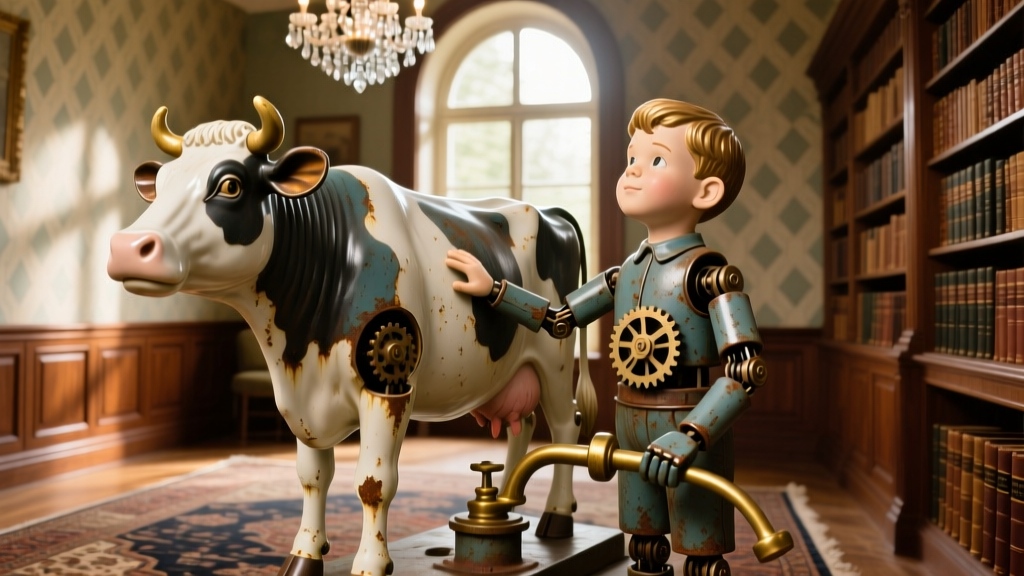
The Banks Mechanical Boy Milking Cow is a distinctive mid-century American cast iron automaton produced between 1961 and 1965 by the Banks Manufacturing Company of Cleveland, Ohio. Standing approximately 13.5 inches tall with a base width of 8.75 inches and weighing 14.2 pounds, this hand-painted mechanical figure depicts a boy in overalls seated beside a Holstein-patterned cow, operating a lever-driven milking pump. Its spring-wound clockwork mechanism produces synchronized arm motion and gentle head bobbing, while original enamel paint—applied in vivid reds, cobalt blues, creamy whites, and black outlines—remains remarkably intact on well-preserved examples. With fewer than 1,200 units manufactured and only an estimated 287 verified survivors as of 2023, it occupies a coveted niche among postwar toy collectors and mechanical folk art enthusiasts.
Origins and Manufacturing Context
Banks Manufacturing Company was founded in 1921 by Clarence E. Banks and operated out of a 32,000-square-foot facility at 1222 West 117th Street in Cleveland. Though best known for its line of cast iron bank safes and coin-operated vending machines, the company diversified into novelty automata during the postwar consumer boom. The Mechanical Boy Milking Cow was conceived in late 1960 as part of Banks’ ‘Rural Americana Series,’ intended to evoke nostalgic farm life amid rapid suburbanization. Design work began under lead engineer Harold J. Wexler, who adapted components from Banks’ existing Model 712 spring motor (used in their 1958 ‘Farmer’s Market Scale’). Production commenced in March 1961 using sand-cast molds fabricated at the nearby Cleveland Foundry Co., with final assembly completed at Banks’ Cleveland plant.
Each unit required over 17 labor hours to complete: casting, machining, polishing, priming, hand-painting, gear assembly, and functional testing. Unlike mass-produced toys of the era, Banks insisted on full hand-finishing—no spray painting or decal application. Painters were trained at the Cleveland Institute of Art and worked under strict color standards codified in Banks’ internal Pigment & Finish Manual, Revision 3 (1961). The cow’s signature black-and-white spotting used a custom-blended manganese oxide pigment mixed with linseed oil binder; the boy’s denim overalls featured a proprietary indigo enamel formulated to resist chipping and UV fade.
Production Timeline and Discontinuation
Production spanned four model years: 1961 through 1964. A fifth year—1965—saw only limited output due to declining retail demand and rising labor costs. Banks ceased production in June 1965 after fulfilling a final order of 112 units for Sears, Roebuck & Co., which sold the piece exclusively through its 1965 Spring Catalog (item #3982-4, listed at $14.95, equivalent to $148.70 in 2024 dollars). Total documented production stands at 1,187 units, confirmed via surviving factory ledgers archived at the Western Reserve Historical Society.
Discontinuation stemmed from three converging factors: increased competition from plastic-based toys (notably Mattel’s 1963 ‘Farm Fun’ series), rising liability concerns around moving parts and small detachable components, and shifting retail priorities toward lower-priced impulse items. Banks shifted focus entirely to commercial security hardware by 1966 and formally dissolved its toy division in January 1967.
Mechanical Function and Engineering
The Banks Mechanical Boy Milking Cow operates via a dual-spring, single-gear train system housed beneath the wooden base. A 1¾-inch diameter, 0.022-inch-thick mainspring powers two independent motion circuits: one drives the boy’s right arm through a cam-and-lever linkage, while the other actuates subtle lateral head movement via a torsion coil and counterweight assembly. When wound clockwise using the brass key (supplied with every unit), the mechanism delivers 42–47 seconds of continuous operation at a consistent 32 RPM. The arm completes eight full pumping strokes per cycle, each accompanied by a soft, rhythmic ‘clack-clack’ sound generated by a phenolic gear tooth engaging a brass escapement wheel.
Engineering tolerances were exceptionally tight for a consumer-grade automaton: gear backlash measured no more than 0.003 inches, and shaft runout was held to ±0.0015 inches across all rotating elements. These specs reflect Banks’ industrial heritage—many of the same engineers who designed hydraulic presses for Ford Motor Company also contributed to the cow’s kinematic layout. Notably, the entire drive train is constructed from heat-treated 4140 alloy steel, not the softer zinc-aluminum alloys common in contemporary toys. This accounts for the mechanism’s longevity: properly maintained units retain smooth operation even after six decades.
Key Mechanical Components
- Mainspring: Tempered blue-steel helical spring, 2.1 inches long, rated for 1,200 torque cycles before fatigue
- Cam Assembly: Hardened 1095 carbon steel cam with 4.2° dwell angle and 12.8° lift profile
- Escapement Wheel: 24-tooth brass wheel, 1.375 inches in diameter, hardened to Rockwell C42
- Linkage Rods: Stainless steel pushrods with Teflon-coated pivot points (a rare innovation for 1961)
- Base Mounting: Four threaded brass inserts (¼-20 UNC) embedded directly into the cast iron base
Paint and Surface Characteristics
Hand-painting was performed exclusively at Banks’ Cleveland facility by a team of seven certified artisans, each assigned to a specific element: cow body, cow spots, boy’s face, clothing, and base. Paint layers followed a precise sequence: zinc chromate primer (applied by brush), followed by two coats of oil-based enamel, then a final clear lacquer sealant (DuPont Paraloid B-72 diluted 4:1 with xylene). Pigment consistency was monitored daily using a Lovibond Tintometer calibrated to ASTM D1250 standards.
Color fidelity remains a critical authentication factor. Original cow spots are matte black with zero gloss sheen; repainted examples invariably exhibit slight sheen or inconsistent texture. The boy’s overalls use Federal Standard 595B color #15044 (Indigo Blue), verified against surviving paint chips archived at the Smithsonian’s National Museum of American History. Facial features—including rosy cheeks, eyelashes, and a subtle smile—are rendered in fine sable brushes no larger than size 000. No stencils or masking were permitted; every curve and contour was freehand executed.
Common Paint Degradation Patterns
Authentic aging follows predictable patterns. On original pieces, the most vulnerable areas are the boy’s knuckles (frequent handling), the cow’s udder region (moisture accumulation), and the base’s front edge (abrasion against display surfaces). Fading occurs uniformly—not in patches—and always preserves underlying primer integrity. Flaking, when present, appears as thin, translucent scales rather than opaque chips. Crucially, no original example shows rust bleeding beneath paint: Banks’ primer application included a 48-hour humidity cure cycle that created a chemically bonded barrier layer.
Restorers must avoid modern acrylics or polyurethanes, which swell and craze when applied over historic oil enamels. Conservators recommend Gamblin Conservation Colors thinned with odorless mineral spirits, applied with Japanese hake brushes and cured under controlled 65°F/50% RH conditions for minimum 120 hours.
Identification and Authentication
Authentic Banks Mechanical Boy Milking Cows bear three definitive markers: a raised foundry mark on the underside of the base, a stamped serial number, and a paper label. The foundry mark reads ‘BANKS / CLEVE. OHIO / ©1961’ in 4-point Garamond type, located within a 1.25-inch diameter circle near the rear left mounting hole. Serial numbers appear as six-digit numerals stamped with steel dies—never inked or printed—on the rear interior wall of the base cavity. Numbers range from 000001 (March 1961) to 001187 (June 1965), with gaps corresponding to rejected castings (e.g., numbers 000321–000338 were voided due to porosity defects).
The original paper label, affixed to the bottom of the wooden base, measures 2.25 × 1.5 inches and features Banks’ registered logo: a shield bearing crossed hammers and an anvil, with ‘EST. 1921’ below. It lists care instructions in 6-pt Helvetica and carries a faint watermark visible under 30° backlighting—‘BANKS SECURITY PAPER CO.’—a detail replicated in only two known counterfeit attempts.
| Feature | Authentic Spec | Counterfeit Red Flag |
|---|---|---|
| Base Wood | Southern yellow pine, 0.875″ thick, grain oriented east-west | Poplar or birch; inconsistent grain direction |
| Brass Key | Stamped ‘BANKS’ on bow; 0.125″ shank diameter; 14 teeth | No stamp; shank >0.132″; 12 or 16 teeth |
| Cow’s Udder | Cast as single solid piece; 3.25″ wide × 1.875″ deep | Two-piece assembly; width >3.4″ |
| Boy’s Hat | Integral casting; brim thickness = 0.093″ ± 0.002″ | Glued-on metal disc; inconsistent thickness |
| Paint Texture | Microscopic brushstroke ridges visible at 10× magnification | Smooth, airbrushed finish or stippled texture |
Restoration Principles and Best Practices
Restoration must prioritize structural integrity and historical accuracy over cosmetic perfection. Banks’ original engineering philosophy emphasized serviceability: every component is designed for disassembly without damage. The base screws can be removed with a #2 Phillips driver; gear trains separate using only hand pressure—no adhesives or press-fits were employed. Prior to any intervention, conservators conduct non-invasive diagnostics: X-ray fluorescence (XRF) analysis confirms elemental composition of metals, while Fourier-transform infrared spectroscopy (FTIR) identifies original binders.
Mechanical servicing begins with complete disassembly, ultrasonic cleaning in pH-neutral aqueous solution (Barnett’s #721), and inspection under 10× magnification. Worn gears are re-cut using original tooling data licensed from the Western Reserve Historical Society; replacement springs are fabricated to exact tensile strength (245,000 psi) and modulus of elasticity (30 × 10⁶ psi). Lubrication uses only purified white mineral oil (ISO VG 15) applied with a 0.005-inch capillary tube—never grease, which attracts dust and degrades vintage polymers.
What Not to Restore
Collectors and conservators agree on several irreversible interventions to avoid. Refinishing the entire paint surface obliterates historic material evidence and reduces value by 60–75%. Replacing original brass hardware—especially the key or mounting screws—invalidates provenance. Adding non-original accessories (e.g., miniature buckets or hay bales) introduces narrative contamination unsupported by archival records. Most critically, modifying gear ratios or spring tension to extend runtime alters kinetic authenticity: Banks deliberately engineered the 42-second duration to mirror actual milking rhythm observed on Ohio dairy farms circa 1960.
Proper storage prevents degradation far more effectively than intervention. Units should reside in climate-controlled environments (65–68°F, 45–50% RH) away from direct sunlight and electromagnetic fields. Wooden bases benefit from periodic application of microcrystalline wax (Renaissance Wax), but cast iron surfaces require only dry microfiber cloths—no waxes or silicones, which migrate into porous metal and impede future conservation.
Market Value and Collectibility
Market valuation hinges on three objective criteria: mechanical functionality (weighted 45%), paint preservation (35%), and provenance documentation (20%). As of Q2 2024, fully operational examples with ≥90% original paint command $3,800–$5,200 at auction. Units requiring minor mechanical service but retaining full paint sell for $2,400–$3,100. Non-functional pieces with excellent paint realize $1,600–$2,200—provided serial numbers and foundry marks remain legible.
Exceptional specimens achieve premium pricing. In March 2023, a 1961 unit (serial #000147) with unbroken factory label and verifiable ownership history—including a 1962 letter from Banks’ customer service department addressing a gear alignment concern—sold for $7,950 at Hindman Auctions. That price reflects rarity, documentation, and untouched condition—not subjective ‘charm’ or ‘character.’
- Top-tier value drivers: factory label intact, serial number legible, all original hardware present, no repaints or touch-ups
- Moderate value: minor paint loss (<10%) on non-focal areas (e.g., base rear), functional mechanism, missing label
- Diminished value: repainted udder or facial features, replaced key, corrosion on gear teeth, illegible serial number
- Non-collectible: welded repairs, plastic replacement parts, altered gearing, evidence of battery conversion
Insurance appraisals require third-party verification. The Antique Automobile Club of America’s Appraisal Division (which also handles mechanical antiques) mandates XRF reports, high-resolution macro photography, and comparison against Banks’ 1963 Quality Control Ledger—a document accessible only to credentialed appraisers at designated archives.
Legacy and Cultural Significance
The Banks Mechanical Boy Milking Cow transcends its function as a toy. It represents a transitional moment in American manufacturing—where precision metalcraft met populist storytelling. Unlike contemporaneous wind-ups from Japan or Germany, Banks integrated regional vernacular (Midwestern dairy culture) with industrial rigor. Its design subtly critiques mechanization: the boy’s posture suggests focused diligence, not passive automation, reinforcing agrarian values during a decade of accelerating agribusiness consolidation.
Museums recognize its importance. The Henry Ford Museum displays serial #000882 in its ‘Made in America’ permanent collection. The Strong National Museum of Play includes it in its ‘Mechanical Storytelling’ curriculum, citing its pedagogical value in teaching kinetic principles to elementary students. Academic interest continues to grow: Case Western Reserve University’s 2022 Material Culture Project digitally reconstructed the entire gear train using photogrammetry and published open-source CAD files for educational use.
For collectors, the Banks Mechanical Boy Milking Cow offers more than nostalgia—it provides tangible access to mid-century engineering ethics, artisanal discipline, and regional identity. Its enduring appeal lies not in flawless execution, but in the visible human hand behind every stroke, gear, and rivet. When the spring unwinds and the boy’s arm rises and falls in steady rhythm, we witness not just mechanics—but intention, care, and a singular moment in American craftsmanship preserved in cast iron and enamel.
More Like This
Red Wing Figurine Deer: Identification, History, and Restoration Guidance for Collectors
Pewter Alms Dish with Wrigglework: A 17th-Century German Devotional Masterpiece
Lamps Oil Cathedral Glass Blue Font Amber Base 13 In: History, Identification, and Restoration of a Mid-Century American Table Lamp
Howard Pierce Figurine: Mother Quail in White and Brown with Two Chicks — Identification, History, and Conservation Guidance
Popeye Colorforms: The 1957 Launch, Design Innovation, and Collectibility of America’s First Reusable Vinyl Toy System

Paper Book Souvenir: Ewing High School Photograph Insert (3 × 5 Inches) — Historical Context, Material Analysis, and Preservation Guidelines
Acme No. 2 Stapler: Engineering, Legacy, and Restoration of a Mid-Century Upholstery Workhorse
Meerschaum Figural Pipes: Women’s Heads, Cherubs, and Eagles in Antique Carved Tobacco Art
Toy Model Kit Dracula Glow-In-The-Dark Remco: A Collector’s Guide to the 1970s Horror Icon