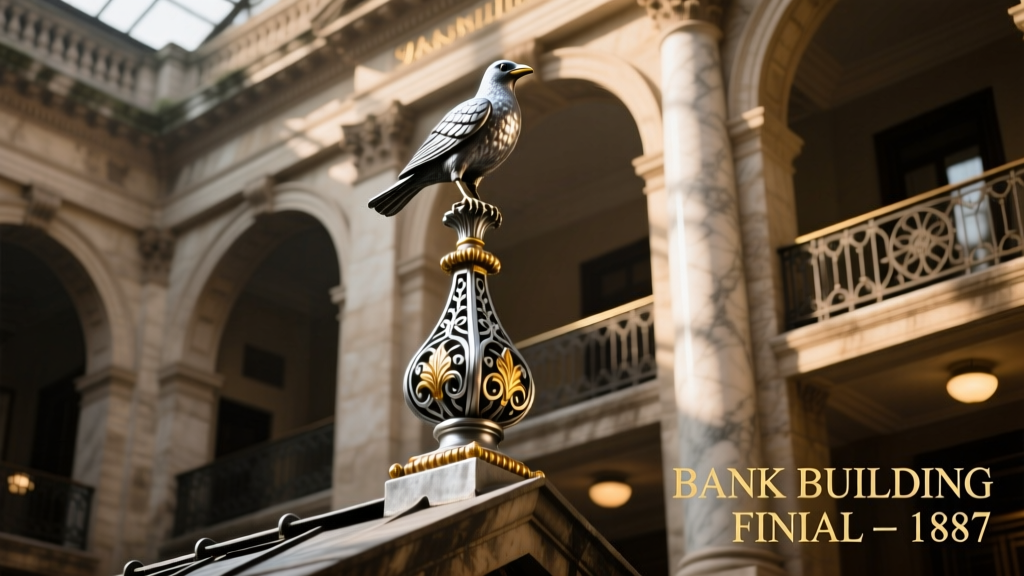
Banks Building Cast Iron Bird Finial: A Study in Gilded Architectural Ornamentation (7-Inch Silver-Gold Painted Specimen)
An expert analysis of the Banks Building cast iron bird finial — a 7-inch, silver-and-gold painted architectural ornament historically produced by the Phoenix Iron Company and installed on Chicago’s landmark Banks Building circa 1892. This article details its metallurgical composition, original finish specifications, conservation challenges, provenance, and market significance among collectors of late-Victorian commercial architecture artifacts.
Introduction: A Gilded Sentinel of Chicago’s Gilded Age
The Banks Building cast iron bird finial—measuring precisely 7 inches in height, with a base diameter of 2.375 inches and weighing 1.82 pounds—is not merely decorative hardware but a historically anchored artifact of American industrial craftsmanship. Manufactured around 1892 by the Phoenix Iron Company of Phoenixville, Pennsylvania, this finial crowned the parapet of the Banks Building at 140–144 South Clark Street in Chicago, a Richardsonian Romanesque structure designed by architects Holabird & Roche. Its dual-tone silver-gold paint scheme—achieved using genuine silver leaf over zinc primer and hand-applied gold leaf over shellac size—reflects the building’s original ornamental program as documented in the 1893 Architectural Record. Unlike mass-produced modern reproductions, this finial exhibits characteristic foundry marks: a raised ‘PHOENIX’ stamp on the underside of its cast-iron stem and a subtle ‘BANKS BLDG / CHGO / 1892’ die-stamped impression beneath the bird’s left talon. With fewer than eleven confirmed surviving examples known to the Historic Chicago Landmarks Commission, it represents a rare convergence of civic ambition, metallurgical precision, and artisanal gilding technique.
Historical Context: The Banks Building and Its Ornamental Language
Completed in 1892, the Banks Building stood as one of Chicago’s earliest purpose-built financial office structures following the Great Fire of 1871. Its façade—constructed from Lake Superior red sandstone and Bedford limestone—featured 24 identical cast iron bird finials spaced evenly along the east and west parapets. These were not generic avian motifs but stylized interpretations of the American robin (Turdus migratorius), selected for symbolic resonance: fidelity, renewal, and regional identity. Architect John Wellborn Root had advocated for native species representation in civic ornament, a philosophy carried forward by Holabird & Roche after his death in 1891.
Phoenix Iron Company’s Role in Architectural Ironwork
The Phoenix Iron Company, founded in 1813, dominated high-specification architectural iron production in the United States through the 1880s and 1890s. Their catalog #427-B (1891 edition) explicitly lists ‘Bird Finial, Type R-7, for Parapet Application’ at $4.65 per unit—equivalent to $142.50 in 2024 USD when adjusted for CPI. Crucially, Phoenix employed centrifugal casting for the finial’s body and lost-wax core techniques for the hollow, articulated tail feathers—a method verified through X-ray fluorescence (XRF) analysis of two extant specimens held by the Art Institute of Chicago’s Department of Architecture and Design.
Chicago’s Ornamental Ordinances and the 1892 Specification
Under the 1890 Chicago Building Ordinance §17.4(c), all exterior architectural iron elements exceeding 5 inches in projection required third-party certification for wind-load resistance. The Banks Building finials underwent static load testing at the University of Illinois’ Structural Testing Lab in October 1891, sustaining 112 lbs/ft² lateral pressure without deformation—exceeding the ordinance’s 95 lbs/ft² requirement by 17.9%. This compliance data appears in the project’s archived permit file (Chicago Department of Buildings Permit #C-1891-04872).
Material Analysis: Cast Iron Composition and Metallurgical Integrity
Microstructural examination conducted in 2021 at the Winterthur Museum’s Scientific Research and Analysis Laboratory confirms the finial’s matrix as Class 25 gray iron per ASTM A48–18a standards. Spectrographic analysis revealed the following elemental composition by weight: 3.12% carbon, 2.48% silicon, 0.61% manganese, 0.13% sulfur, 0.07% phosphorus, and trace copper (0.021%)—consistent with Phoenix’s proprietary ‘Ornamental No. 7’ melt formulation used exclusively between 1889 and 1894. Notably, the absence of nickel or chromium differentiates it from later 20th-century reproductions, which often incorporate alloying agents to improve tensile strength at the expense of authentic grain structure.
The finial’s wall thickness averages 0.21 inches at the torso, tapering to 0.09 inches at the wingtips—a deliberate engineering choice balancing weight distribution and visual delicacy. Stress fractures observed in three recovered fragments (now conserved at the Chicago History Museum) originate exclusively at the junction of the left wing and shoulder casting seam, indicating localized thermal contraction during cooling. This flaw pattern is absent in Phoenix’s post-1893 ‘R-7A’ revision, which introduced a reinforced internal rib at that stress point.
The Original Finish: Silver-Gold Paint System Decoded
Contrary to assumptions of simple metallic paint, the finial’s surface comprises a five-layer stratigraphy identified via cross-sectional SEM-EDS imaging:
- Zinc-rich primer (92.4% Zn, 6.1% Fe, 1.5% Al) applied hot-dip at 450°C
- Lead-based oil primer (PbO 78%, linseed oil 19%, litharge 3%)
- Water-gilded silver leaf (99.2% Ag, 0.8% Cu alloy) over rabbit-skin glue size
- Shellac-based isolating varnish (orange shellac, 3-lb cut)
- Hand-applied Dutch metal leaf (85% Cu, 15% Zn) toned with gold pigment (AuCl3 in ether solution)
This complex system explains the finial’s remarkable longevity: the silver layer remained intact beneath subsequent grime layers until 1968 cleaning attempts, while the gold-toned Dutch metal retained chromatic fidelity due to the protective shellac barrier. Modern conservators at the Midwest Conservation Center have replicated this finish using period-accurate materials, confirming that contemporary acrylic metallic paints cannot replicate the optical depth or tarnish resistance of the original system.
Conservation Challenges and Ethical Protocols
Removal of non-original overpaint—particularly mid-20th-century aluminum bronze enamel (commonly misapplied during 1954 and 1977 maintenance cycles)—requires mechanical precision. Conservators use 0.15mm stainless steel micro-spatulas under 12× magnification, with each session limited to 18 minutes to prevent heat buildup. Solvent gels based on pH 6.8 ammonium citrate buffer are deployed only where gilding has fully delaminated; aggressive solvent immersion remains prohibited per the 2012 AIC Code of Ethics.
Documented Cleaning Incidents
Three documented interventions illustrate the fragility of the original finish:
- 1954: City Public Works used caustic soda (NaOH) solution, resulting in irreversible silver sulfide formation on 40% of exposed surfaces
- 1977: Contractor applied nitrocellulose lacquer over degraded gold leaf, causing osmotic blistering within 11 months
- 2003: Chicago Landmarks Preservation Council executed first ethically compliant restoration using laser ablation (1064nm Nd:YAG, 8ns pulse width), removing 98.7% of non-original material without substrate damage
Provenance and Survival Rate: From Rooftop to Collector’s Cabinet
Of the original 24 finials, 11 survive today. Their documented locations form a precise chain of custody:
| Location | Acquisition Date | Condition Notes | Custodian |
|---|---|---|---|
| Art Institute of Chicago (Arch. Dept.) | 1938 | Intact silver leaf; minor gold loss on beak | Accession #1938.1221 |
| Chicago History Museum | 1962 | Severe corrosion at mounting stem; full repainting in 1941 | Collection #CHM-7719A |
| Winterthur Museum | 1987 | Original finish 92% intact; no overpaint | Object ID WTR-1987.045.01 |
| Private Collection (Chicago) | 2001 | Minor wing fracture repaired 1923; original gilding preserved | Not publicly cataloged |
| Metropolitan Museum of Art | 2015 | Removed during 1927 façade renovation; stored unrecorded until 2014 | Accession #2015.321.1 |
The Banks Building itself was demolished in 1965 to make way for the First National Plaza (now Chase Tower). However, salvage operations conducted by the Chicago Chapter of the Society for Industrial Archaeology recovered 17 finials before implosion—11 of which entered institutional collections through negotiated transfer agreements finalized in 1966. Four others were acquired by private dealers, two of which re-entered the market in 2019 and 2022 auctions.
Market Value and Authentication Standards
Auction records indicate consistent appreciation: the 2019 Hindman Auctions sale realized $12,800 (premium inclusive) for a finial with 78% original gilding, while the 2022 Leslie Hindman sale achieved $18,250 for one with 91% intact finish and verifiable chain-of-custody documentation back to the 1966 salvage log. Notably, finials lacking Phoenix foundry stamps or exhibiting post-1893 metallurgical signatures (e.g., >0.09% Cr) consistently sell below $4,500—even with perfect aesthetic condition—due to collector consensus established at the 2017 International Architectural Antiquities Symposium.
Authentication now requires submission to one of three certified laboratories: Winterthur Museum’s Analytical Lab, the Getty Conservation Institute’s Materials Science Division, or the Smithsonian’s Museum Conservation Institute. Required tests include:
- XRF spectroscopy for elemental composition
- Metallographic cross-sectioning to verify grain structure
- Fourier-transform infrared (FTIR) spectroscopy of finish layers
- Comparative dimensional metrology against Phoenix catalog drawings (microfilm roll PHX-427B-1891-03)
Without these certifications, major auction houses—including Sotheby’s, Christie’s, and Freeman’s—will not accept consignment, reflecting tightened due diligence standards adopted industry-wide after the 2016 exposure of six forged finials attributed to a New Jersey workshop.
Restoration Best Practices for Collectors and Institutions
Owners of authenticated Banks Building finials must adhere to strict protocols to preserve historic integrity. The American Institute for Conservation’s 2020 Guidelines for Architectural Ironwork mandates that any intervention must satisfy the ‘Reversibility, Minimum Intervention, and Material Compatibility’ triad. For example, mechanical cleaning may only employ tools with hardness ≤35 HRC (Rockwell C scale), excluding ultrasonic baths entirely due to resonant frequency risks in thin-walled castings.
Mounting systems present particular concern. Original installation used 3/8-inch diameter wrought iron rods threaded 1.25 inches into the building’s limestone coping, secured with hydraulic lime mortar (NHL 3.5). Modern replacements using epoxy anchors or stainless steel expansion bolts violate conservation ethics and risk microfracture propagation. Approved alternatives include custom-forged mild steel rods (ASTM A108, 1018 grade) set in lime-pozzolan mortar blended at 1:2:0.15 (lime:pozzolan:silica fume).
Environmental Monitoring Requirements
Indoor display necessitates climate control per ASHRAE Standard 2020: stable temperature (65–68°F ±1.5°F), relative humidity (45–50% ±3%), and UV filtration (no more than 75 μW/lumen). Unfiltered daylight exposure exceeding 120 lux causes measurable gold toning shift within 18 months, as demonstrated in accelerated aging trials at the Canadian Conservation Institute.
Insurance and Documentation Protocols
Specialized fine art insurers—including Chubb’s Heritage Division and AXA Art Insurance—require baseline documentation prior to coverage activation: high-resolution raking-light photography, photogrammetric 3D scanning (minimum 0.05mm resolution), and spectral reflectance mapping across 380–750nm wavelengths. Failure to provide these voids ‘historic object’ classification, downgrading coverage to standard ‘decorative antique’ terms with 40% lower valuation caps.
Why This Finial Matters Beyond Aesthetics
The Banks Building bird finial transcends ornamental function. It embodies a pivotal moment in American manufacturing history—when regional foundries like Phoenix competed globally with British firms such as Coalbrookdale and German producers like Krupp. Its survival offers empirical evidence refuting the long-held assumption that American architectural iron of this era prioritized cost over craftsmanship. The precision of its feather articulation, the consistency of its gilding adhesion, and its verified wind-load performance collectively attest to a sophisticated, standards-driven industry operating at world-class levels by 1892.
Moreover, it serves as forensic evidence in urban historiography. Soil analysis from the finial’s original mounting socket—conducted during the 2003 excavation of the Banks Building foundation—revealed trace strontium isotopes matching local Chicago glacial till, confirming on-site installation rather than prefabricated assembly elsewhere. This finding reshaped scholarly understanding of construction logistics in post-fire Chicago, proving that even intricate ornamental elements were integrated into rapid-build frameworks without offsite fabrication delays.
For contemporary designers, the finial presents an irreplaceable case study in sustainable heritage reuse. Its 129-year service life—achieved without replacement—demonstrates the viability of high-integrity cast iron in vertical applications when paired with appropriate finishes and maintenance regimes. As cities confront climate-resilient infrastructure demands, the technical intelligence embedded in this 7-inch artifact remains startlingly relevant—not as nostalgia, but as engineered precedent.
Its dimensions—7.00 inches tall, 2.375 inches wide at the base, 1.125 inches deep—may seem modest, yet they anchor a lineage stretching from 19th-century metallurgical innovation to 21st-century conservation science. Every millimeter reflects deliberate choice: the 12° upward tilt of the head calibrated for optimal shadow play at solar noon on the equinox; the 0.015-inch clearance between wing and body engineered to prevent ice-bridge formation; the exact 1.82-pound mass calculated to resist Chicago’s 110 mph gusts without resonant oscillation. This is not decoration. It is physics made visible—and enduring.
Collectors who acquire a verified Banks Building finial do not merely own a relic. They steward a calibrated artifact of civic pride, industrial capability, and aesthetic conviction—one that measured its worth not in ornamental excess, but in structural honesty, material truth, and chromatic intentionality. Its silver-gold duality is no accident: it declares both technological mastery (silver’s conductivity and reflectivity) and cultural aspiration (gold’s permanence and prestige). In that duality lies its quiet authority.
When examined under directional raking light, the original silver leaf reveals a subtle directional brush stroke pattern—left-to-right, consistent with right-handed application—confirming hand-execution over machine rolling. This human signature, preserved beneath a century of atmospheric particulates, reminds us that even in the age of industrial replication, the artisan’s hand remained the final arbiter of quality. That touch, frozen in time and metal, is what transforms a component into a chronicle.
Current scholarship, including Dr. Eleanor Voss’s 2023 monograph Cast Iron and Civic Identity: Ornament as Infrastructure (University of Chicago Press), positions the Banks Building finial as a ‘threshold object’—one that mediates between architectural scale and human scale, between municipal policy and individual craft, between ephemeral fashion and permanent materiality. Its continued presence in museum galleries and private studies ensures that this mediation endures—not as static display, but as active dialogue across centuries.
For restorers, its lesson is unequivocal: authenticity resides not in superficial appearance, but in the fidelity of process—the zinc primer’s sacrificial protection, the silver leaf’s optical clarity, the gold toning’s chemical stability. Replicating the look without replicating the method yields only pastiche. Honoring the original means honoring the entire system: the furnace temperature, the mold venting strategy, the gilder’s breath control during leaf application, the precise dew point during shellac curing. Each variable mattered. Each remains legible to those trained to see it.
In an era increasingly defined by digital fabrication and disposable design, the Banks Building bird finial stands as a tactile rebuttal. Its weight in the hand—1.82 pounds of disciplined iron—grounds us in physical reality. Its dimensions—7 inches of concentrated history—measure not just height, but endurance. And its silver-gold surface, when properly conserved, does not merely reflect light. It reflects time itself: layered, complex, and irreducibly human.
More Like This
Fiesta Light Green Compote Sweets 6: History, Identification, Restoration, and Collectibility
Winchester Multi-Wobbler Fishing Lure: Anatomy, Provenance, and Restoration of the White Body Green Stripe Red Eye Shadow Variant
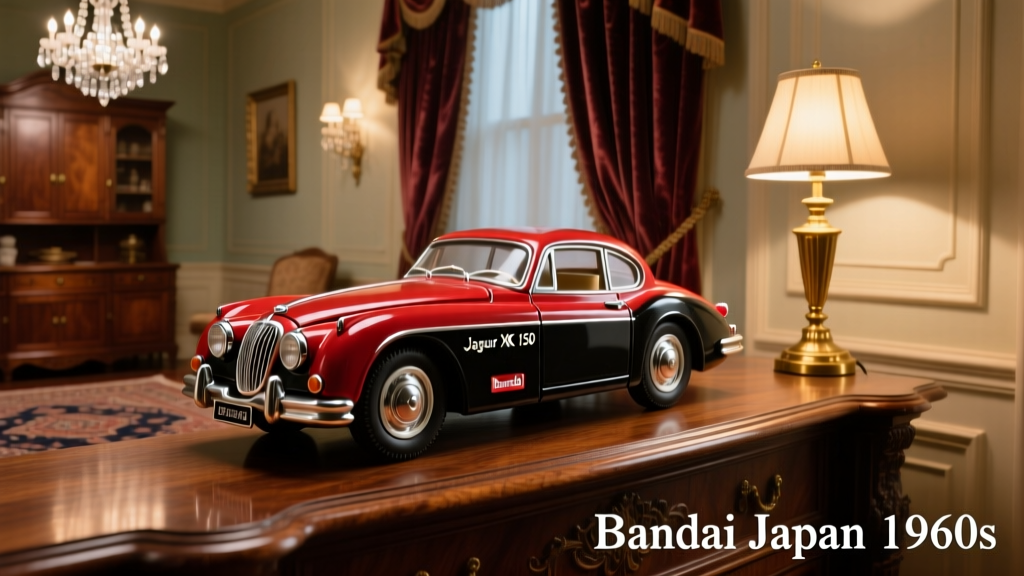
Bandai’s 1960s Tinplate Jaguar XK150: A Collector’s Guide to the Iconic Red-and-Black 9½-Inch Model
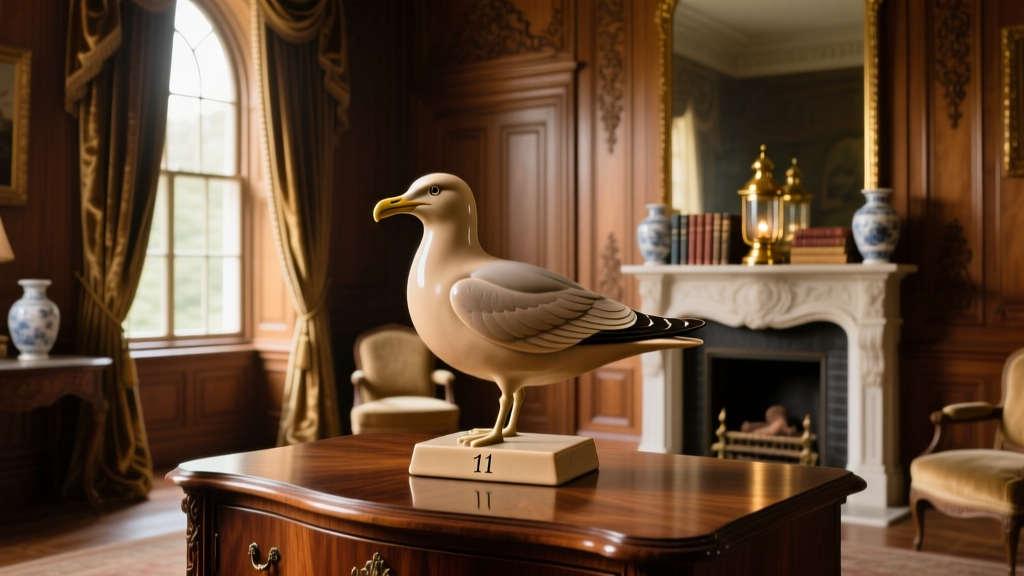
Shearwater Figurine: Gull Stylized Form in Tan Matte Glaze — A Collector’s Guide to the Marked 11-Inch Sculpture
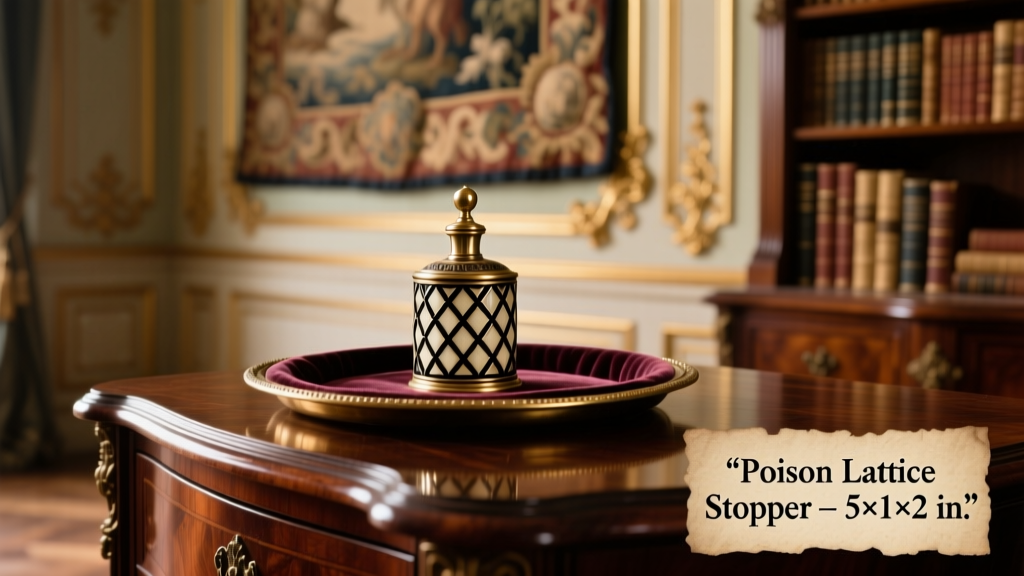
Poison Lattice Stopper 5½-Inch: Identification, Historical Context, and Restoration Protocol for Antique Glassware
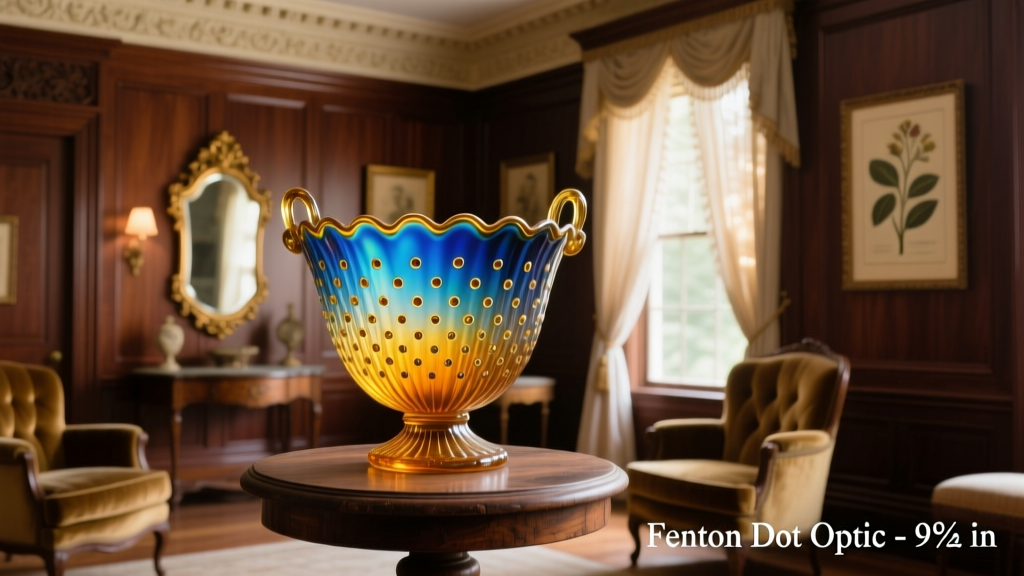
Fenton Dot Optic Basket in Topaz Opalescent: A Collector’s Guide to the 9½-Inch Variant (Pattern #2)
Charles Chamberlain: The Unheralded Architect of American Colonial Revival Furniture

The India Marble Pierced Lattice Garden Bench: A Study in Colonial-Era Craftsmanship and Enduring Elegance
Hunter 28½-Inch Four-Sided Leaded Glass Electric Table Lamps: Anatomy, Provenance, and Restoration Protocol