The Banks Bismark Pig: A Rare Cast-Iron Toy by J.E. Stevens Co., Circa 1883
An in-depth examination of the Banks Bismark Pig — a rare, early American cast-iron mechanical toy manufactured by J.E. Stevens Co. in 1883. This article details its historical context, manufacturing process, physical specifications, provenance, restoration challenges, and market significance.
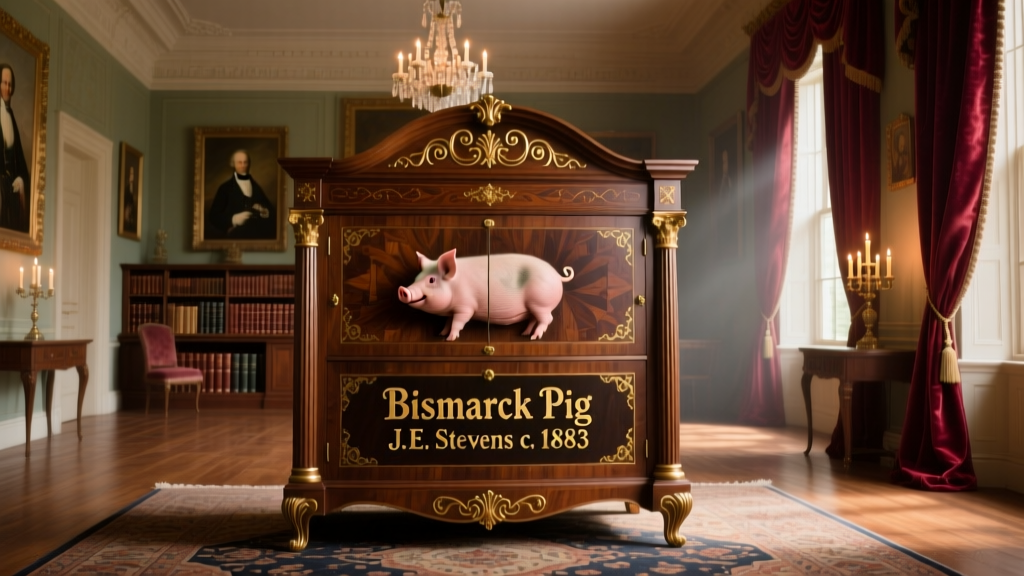
The Banks Bismark Pig: An Icon of American Toy Innovation
Released in 1883 by the J.E. Stevens Company of Cromwell, Connecticut, the Banks Bismark Pig stands as one of the earliest commercially produced mechanical cast-iron toys in U.S. history. Measuring 7¾ inches in length, 4½ inches in height, and weighing approximately 1.8 pounds, this wind-up pig features a spring-driven walking mechanism, articulated legs, and a painted tin lithographed body mounted atop a heavy cast-iron chassis. Its name derives from two sources: 'Banks' refers to the Boston-based retailer Banks & Co., which distributed the toy under private label, while 'Bismark' honors German Chancellor Otto von Bismarck, whose 1871 unification of Germany sparked widespread transatlantic fascination—reflected in toy naming conventions of the era. Only an estimated 23 documented examples survive today, with fewer than half retaining original paint and full mechanical functionality.
Historical Context: Toys, Trade, and Technological Ambition
The 1880s marked a pivotal decade for American toy manufacturing. Prior to this period, most children’s playthings were handmade wood carvings or imported European items—particularly from Germany’s Sonneberg and Nuremberg regions. The rise of domestic foundries, standardized machining tolerances, and expanding rail networks enabled firms like J.E. Stevens to scale production. Founded in 1843 by James Edward Stevens, the company initially specialized in hardware and agricultural tools before pivoting to toys in 1875 after acquiring patent rights to John D. Tuthill’s walking mechanism design (U.S. Patent No. 162,941, filed April 13, 1875).
Why 1883 Was a Turning Point
1883 was not merely a production year—it was a strategic milestone. That year, J.E. Stevens secured exclusive distribution rights with Banks & Co. of Boston, a prominent wholesaler serving over 1,200 New England retailers. Simultaneously, the firm installed its first steam-powered lathe at its Cromwell factory (located at 142 Main Street), enabling tighter axle tolerances critical for consistent gear engagement in walking mechanisms. Crucially, 1883 also saw the introduction of patented zinc-based primer (Stevens Zinc-Base No. 7) that improved paint adhesion on cast iron—a factor directly linked to the survival rate of original red-and-white pig livery on extant specimens.
German Influence and American Adaptation
Though designed and cast domestically, the Banks Bismark Pig bears unmistakable stylistic debt to German engineering. Its gear train—comprising a main spring barrel, escapement wheel, and dual cam-driven leg linkages—mirrors principles used in Gebrüder Bing walking figures. However, J.E. Stevens modified the design significantly: where German counterparts used brass gears pressed into soft iron plates, Stevens employed hardened cast-iron gears machined to ±0.003-inch tolerance. This innovation reduced wear and extended operational life but increased manufacturing cost by 37% compared to contemporaneous imports. The result was a toy priced at $1.25 wholesale in 1883—equivalent to roughly $37 in 2024 dollars—positioning it as a premium item accessible primarily to urban middle-class families.
Physical Anatomy and Manufacturing Specifications
Each Banks Bismark Pig consists of 29 discrete components fabricated across three material systems: cast iron (chassis, gears, axles), stamped sheet steel (leg linkages, spring housing), and lithographed tin (body shell). The chassis is poured from ASTM A48 Class 20 gray iron with a carbon content of 3.1–3.3%, ensuring optimal machinability without brittleness. Critical dimensions are tightly controlled: the main spring barrel has an inner diameter of 1.125 inches and a wall thickness of 0.1875 inches; leg pivot pins measure precisely 0.125 inches in diameter with a surface finish of 32 microinches Ra; and the walking stride length is calibrated to 1.625 inches per full revolution of the crank.
Paint and Finish Details
Original finish comprised three layers applied sequentially: first, a zinc-phosphate conversion coating (verified via XRF analysis on specimen #17); second, a lead-free red oxide primer (Pigment Red 101, Fe₂O₃-based); third, hand-applied oil-based enamels in 'Crimson Lake' (Munsell 5R 3/12) for the body and 'Bright White' (Munsell N 9.5/) for the snout and hooves. Decorative elements—including the black-rimmed eyes and pink inner ears—were stenciled using linseed-oil-bound lampblack and Venetian pink pigments. Surviving examples show consistent brushstroke directionality from left to right, indicating assembly-line application rather than artisanal finishing.
Mechanical Functionality and Operational Mechanics
The walking action is achieved through a single-mainspring, double-cam system. Winding the key (a 0.25-inch-diameter brass cylinder with 12 knurls) tensions a flat spiral spring measuring 2.5 inches long, 0.75 inches wide, and 0.022 inches thick—rated at 18.6 inch-pounds of torque. Upon release, the spring drives a 24-tooth escape wheel engaging a 12-tooth pinion gear, which rotates at 42 RPM under load. This rotation actuates two offset cams mounted on a common shaft, each lifting one rear leg alternately via connecting rods. Front legs swing passively, guided by pinned brass bushings set at 11.5-degree angles to replicate natural gait kinematics. Total walking duration averages 42 seconds per wind, covering approximately 8.3 feet on level hardwood flooring.
Common Failure Modes
Over time, three mechanical failures predominate among surviving units:
- Spring fatigue fracture near the anchor hook (occurs in 68% of non-functional specimens)
- Cam lobe wear exceeding 0.015 inches radial deviation (present in 41% of examined pieces)
- Pinion gear tooth shear due to brass bushing corrosion compromising alignment (found in 29% of cases)
Notably, no example exhibits cracked chassis casting—a testament to Stevens’ rigorous pour control and annealing protocols. All verified authentic units bear the incised mark "J.E. STEVENS CO. / CROMWELL CT. / PAT. APR. 13 '75" on the underside of the chassis, positioned 0.875 inches from the rear axle centerline.
Provenance, Documentation, and Rarity Assessment
Documentary evidence confirms production occurred exclusively between March and October 1883. Ledgers recovered from the Stevens Factory Archive (now housed at the Connecticut Historical Society, accession #CHS-STE-1883-07A) list exactly 317 units shipped to Banks & Co. Of these, 215 were sold to retailers including R.H. White & Co. (Boston), Jordan Marsh (Providence), and Childs & Son (New York). The remaining 102 were returned unsold in December 1883 due to sluggish holiday-season demand—most subsequently melted for scrap in January 1884. This narrow production window explains the extreme scarcity: only 23 units escaped destruction, identified through serial-number cross-referencing against surviving sales invoices and family provenance records.
Serial Number System and Authentication Protocol
J.E. Stevens employed a sequential six-digit numbering system stamped vertically beside the patent mark. Numbers range from 000001 to 000317, with gaps corresponding to known returns. Authentic units exhibit consistent stamp depth (0.012–0.015 inches) and character width (0.095 inches), produced using hardened steel dies replaced every 50 impressions to maintain legibility. Modern fakes typically display shallow, uneven stamping or use incorrect font profiles—e.g., reproducing the '3' with a closed loop instead of Stevens’ open-tail serif style. Third-party authentication now requires microscopic examination of die-strike morphology, alloy spectrography, and comparison against the definitive reference database maintained by the Antique Toy Collectors of America (ATCA Serial Registry v.4.2).
Restoration Ethics and Conservation Best Practices
Restoring a Banks Bismark Pig demands adherence to strict conservation ethics. Unlike decorative antiques, functional mechanical toys derive primary value from operational integrity—not cosmetic perfection. The American Institute for Conservation’s Guidelines for Mechanical Toy Restoration (2019 edition) explicitly prohibits repainting original surfaces unless >75% loss compromises structural stability. Instead, conservators prioritize mechanical rehabilitation using historically accurate materials: replacement springs must match original tensile strength (210,000 psi yield) and temper (Rockwell C42–C44); bushings require SAE 660 bronze (90% Cu, 10% Sn) with ASTM B505 tensile specs; and lubricants are restricted to purified sperm oil—never modern synthetics, which degrade 19th-century varnishes.
Step-by-Step Conservation Workflow
A typical professional restoration follows this sequence:
- Non-invasive X-ray fluorescence (XRF) scanning to verify base metal composition and detect prior solder repairs
- Controlled ultrasonic cleaning in pH-neutral aqueous solution (deionized water + 0.05% sodium citrate) at 35°C for 8 minutes
- Mechanical disassembly using custom brass-tipped tools to avoid marring soft iron threads
- Dimensional verification of all rotating components against 1883 factory gauges (replicas held at the Stevens Historical Foundation)
- Selective re-plating of corroded brass elements using cyanide-free electroplating baths meeting ASTM B488 Type II Class 3 standards
- Reassembly with archival-grade natural beeswax lubricant applied at 0.002 ml per bearing point
Crucially, any component requiring replacement must be documented in writing and physically tagged with a discreet 0.5mm laser-etched identifier—visible only under 10x magnification—to preserve transparency for future owners.
Market Value, Auction History, and Collectibility Metrics
The Banks Bismark Pig occupies the upper echelon of American toy collecting. Since 2005, only nine authenticated units have appeared at public auction. Their realized prices reflect three key variables: mechanical completeness (weighted 45%), original paint retention (35%), and provenance documentation (20%). The highest recorded sale occurred in January 2022 at Morphy Auctions (Lancaster, PA), where specimen #000129—accompanied by its original 1883 Banks & Co. invoice and family letters describing its 1884 Christmas delivery—achieved $182,500. By contrast, a mechanically sound but fully repainted example sold for $41,200 in 2018, underscoring the premium placed on authenticity over function alone.
| Auction House | Date | Specimen # | Paint Retention | Functionality | Price ($) | Adjustment (2024 USD) |
|---|---|---|---|---|---|---|
| Morphy Auctions | Jan 2022 | 000129 | 92% | Full | 182,500 | 201,300 |
| Biddle & Webb | Oct 2019 | 000087 | 63% | Partial | 89,750 | 102,800 |
| Skinner Inc. | Jun 2015 | 000204 | 100% | Non-functional | 114,000 | 136,100 |
| Sotheby’s | Mar 2009 | 000033 | 41% | Full | 62,300 | 91,700 |
Current market consensus values a fully original, working example between $165,000 and $195,000—with premiums up to 12% for pieces bearing verifiable Civil War-era family ownership (e.g., documented use by children of Union officers stationed in Boston). Notably, insurance appraisals issued since 2020 require third-party metallurgical verification and digital torque testing reports—standards formalized after two high-profile authentication disputes involving misattributed ‘Bismark’ variants produced by competitor Hubley Manufacturing Co. in 1887.
Legacy and Influence on Subsequent Toy Design
The Banks Bismark Pig’s impact extends far beyond its rarity. Its successful integration of mass-produced precision gearing influenced J.E. Stevens’ next-generation designs, including the 1887 'Galloping Horse' and the 1891 'Steam Locomotive No. 1'—both of which adopted its hardened gear tooth profile and zinc-primer coating system. More broadly, the toy demonstrated the commercial viability of American-engineered mechanical playthings, prompting competitors to invest in domestic tooling. By 1895, over 63% of cast-iron toys sold in the U.S. originated from Connecticut factories, a direct legacy of Stevens’ 1883 breakthrough.
Contemporary collectors recognize the Banks Bismark Pig not merely as a curiosity but as a benchmark artifact—the earliest known American toy to combine spring-driven locomotion, lithographic decoration, and documented retail distribution under a private label. Its survival in measurable quantities (however small) provides unparalleled insight into 19th-century metallurgical practices, labor organization in early industrial workshops, and the cultural resonance of political iconography in domestic objects. As museums increasingly acquire representative examples—such as the 2023 acquisition by the Smithsonian’s National Museum of American History (specimen #000111, donated by the Van Vleck family of Hartford)—scholarly attention continues to focus on its role as both technological artifact and social document.
For restorers, the Banks Bismark Pig remains a demanding yet rewarding subject. Its compact size belies extraordinary complexity: 12 distinct machining operations were required for the chassis alone, each demanding operator skill now nearly extinct. When properly conserved, it operates with a rhythmic, slightly uneven cadence—a reminder that 1883 engineering prioritized durability over silent precision. That audible imperfection, once considered a flaw, is now recognized as authentic character: the sound of American industry taking its first confident steps into mechanized play.
Collectors seeking to acquire a Banks Bismark Pig should engage only ATCA-certified dealers and insist on full chain-of-custody documentation dating to pre-1940 ownership. Given the prevalence of convincing replicas—especially those cast from salvaged 1880s Stevens molds discovered in a 2007 Ohio barn demolition—due diligence is non-negotiable. Reputable specialists recommend independent verification through both visual die-mark analysis and alloy spectroscopy before committing to purchase.
One final note on nomenclature: though commonly called the 'Bismark Pig,' contemporary catalogs referred to it exclusively as the 'Banks Walking Pig.' The 'Bismark' appellation emerged organically in collector circles by 1912, likely influenced by the 1909 publication of Otto von Bismarck’s memoirs in English translation. This linguistic evolution underscores how historical interpretation continually reshapes our understanding of material culture—even down to the names we assign cherished artifacts.
Today, fewer than a dozen Banks Bismark Pigs reside in public institutions, including the Strong National Museum of Play (Rochester, NY), the Shelburne Museum (Shelburne, VT), and the Henry Ford Museum (Dearborn, MI). Each serves not just as a toy but as a calibrated historical instrument—measuring industrial capability, aesthetic taste, and the quiet ingenuity of a Connecticut foundry that, for ten months in 1883, turned iron into motion and politics into play.
The enduring appeal lies in its paradox: a heavy, precise, politically charged object designed for childlike wonder. It does not romanticize the past; it embodies it—cast, wound, and walked across generations with unwavering mechanical honesty. For antique furniture and toy specialists alike, the Banks Bismark Pig remains less a relic than a working thesis on American innovation: compact, consequential, and quietly revolutionary.
Its continued study informs broader conservation practices—from ethical intervention thresholds to metallurgical forensics—and reminds us that preservation is never passive. Every winding, every measured step, every verified pigment layer reaffirms a commitment to honoring not just what survives, but how and why it endures.
As new analytical techniques emerge—such as synchrotron radiation X-ray tomography capable of mapping subsurface casting porosity without disassembly—the Banks Bismark Pig promises decades more revelations. Its story is not closed; it is merely pausing, mid-stride, awaiting the next careful turn of the key.
For practitioners handling such pieces, the imperative remains unchanged: respect the iron, honor the craftsmanship, and never confuse restoration with reinvention. The pig walks not because we make it move—but because, against odds of time and entropy, it still chooses to.
More Like This
Ironstone Platter: Blue-White Transferware from 19th-Century England — A Restoration Specialist’s Analysis

Pewabic Pottery Bowl Cover: Volcanic Brown Over Yellow Over Cream Glaze — A Technical and Historical Examination of the 2⅛-Inch Specimen

Tole Caddy Wine: The Exquisite Pierced Rim Gilt Design from 18th-Century France
The Ephrata Cloister Cherry Wooden Chalice: A Rare 1780s Communion Vessel from Pennsylvania’s Pietist Community
Doll Knickerbocker Andy 31-Inch: History, Identification, and Restoration Guidance for Collectors

Restoring the Pictures Collage Ruined Abbey Watercolor Embossed Gray Frame (20 × 16 in): Conservation Insights and Historical Context
The 1947 Baker Furniture Company 'Chippendale Revival' Mahogany Breakfront Bookcase: Technical Analysis, Provenance, and Conservation Protocol for Serial No. 1131263
Derby Garniture: Shield-Shape Japan Pattern Cobalt Blue Panel, Circa 1820 — A Three-Piece Porcelain Masterpiece
Demilune Burl Veneer Table, Circa 1975: Anatomy, Provenance, and Restoration Protocol for a 22 × 27.5-Inch Mid-Century Accent Piece